Singular, idiosyncratic and a little mysterious, Black Clock is one of America's leading literary journals.

Blog—

James Franco options Steve Erickson’s “Zeroville”

Variety‘s Jeff Sneider reports:

James Franco has optioned feature film rights to Steve Erickson’s 2007 novel Zeroville and will develop the project under his Rabbit Bandini Prods. banner with an eye to direct the pic.

Franco will produce with Miles Levy and Vince Jolivette, though there are currently no plans for the thesp to star. The trio are eyeing an early 2012 start date.

The darkly comic story follows Ike “Vikar” Jerome, a 24-year-old student who arrives in Hollywood in 1969 with dreams of breaking into the movie business, which is in the midst of a seismic shift as the decline of studios gives way to the rise of independent directors. Jerome, who has tattoos of “A Place in the Sun” stars Montgomery Clift and Elizabeth Taylor on his head, becomes a successful film editor and embarks on a Hollywood journey that ends in both tragedy and discovery.

Characters in the book include Robert De Niro, Brian De Palma, Ryan O’Neal, John Milius, Margot Kidder, Ali McGraw, Paul Schrader and the ghost of Clift.

Zeroville was named one of the best novels of 2007 by Newsweek, the Washington Post BookWorld and the Los Angeles Times Book Review, among others.

Franco is set to play the title role in Disney’s Oz: The Great and Powerful, which starts filming this summer. He next stars in David Gordon Green’s comedy Your Highness, which Universal releases April 8, and also toplines 20th Century Fox’s Rise of the Apes.

Erickson’s next novel, These Dreams of You, will be published by Europa in February.

Franco is repped by CAA and James/Levy Management.

Contact Jeff Sneider at [email protected]

POTENTIAL *EMERGENCY* MINECRAFT (Part 2 of 2)

This, the fourth entry in “Playing Between The Lines” (a series of expeditions into the evolving space of interactive storytelling, its praxes and practical benefits), concludes the investigation of the narratological implications of Minecraft begun here.

In Part 1, I expressed some of why I find the experience of watching other people play Minecraft rewarding.  It speaks to my views on what makes all interactive storytelling rewarding.  I’ve described the symptom in enough detail, at this point, that it’s probably time to look at the cause, to begin to unpack the three narrative types I mentioned earlier and to figure out how exactly they’ve come up with this digital distillation of the private soul that we’re calling Minecraft.

LORE

I’ll begin with the most familiar, the one most people refer to simply as “narrative.”  When Karen/Ebert besmirches the video game “story,” this is what they’re referring to.  Even those who share my enthusiasm about the interactive form have a tendency to place the “story” in its own bracket, to block it off from the aspects of the experience with which they pretend to concern themselves.  In reality, because the lines of distinction between these three narrative forms become nebulous in good interactive design, their distinct characteristics and interplay are often rendered invisible: it’s often difficult to tell where “story,” as the Karen/Ebert is using it, ends and where the rest of the experience begins.

To avoid implications that any one of these three forms is subordinate to the others, I’m going to swap the term “narrative” here for a slightly more fraught, but less problematical, one: “lore.”  When interactive aficionados discuss lore, they refer to the largely unspoken but internally consistent rules and backstory that govern the behavior of the secondary characters and the setting they inhabit.  The recent Bioware title Dragon Age: Origins, for example, includes a rich vein of lore in its virtual codex, a hypertextual compendium of terms, figures, history and beliefs concerning the high fantasy realm in which it is situated.  This is a very different approach to how From Software’s Demon’s Souls characterizes its high fantasy setting: the latter employs minimal but effective dialogue, focusing instead on evocative architectural structures and the telling placement of characters, objects, and creatures within them.  This, too, is lore.

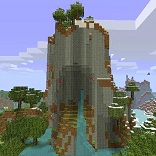
Minecraft’s lore is diverse and plentiful, though more deeply buried than in the previous examples.  Lore can be something as simple as where friendly or hostile creatures (known as “mobs”) are likely to appear, how they behave, and what sorts of materials they drop when killed, especially when the results are particularly esoteric or unexpected.  It’s important to note that the actual mechanics of the AI and whatnot aren’t lore — that’s just coding — but the player’s understanding of those mechanics can be.  If the player finds a saddle, for example, it can be used to ride a pig, for whatever small pleasures that conveys.  The green moss covering the walls of all Minecraft dungeons (small randomly-appearing chambers containing treasure chests and mob-spawning mechanism) is lore.  Recipes for refining and crafting items from raw materials are part of the lore.  Alternately, lore can be as complex as The Nether: an underworld added in October 2010, accessible only via portals generated when the player constructs a 4X5 archway of pure obsidian blocks.  The Nether comes attached with all sorts of delicious and evocative rules or exceptions: any distance traveled in The Nether is multiplied by eight when the player transports back to the world above, clocks and compasses fail to work, and it contains its own unique set of creatures and materials.

Lore, in the specific sense suggested by these examples, can be understood as an effort to suggest a much larger framing narrative fueling and lending interpretation to the player-character’s passage through the interactive world.  World-building would be an acceptable alternative term, as might paratextuality.

I think it would be useful, though, to consider lore more broadly: not simply as the hidden details or worked surface surrounding the narrative, but as every aspect of the narrative that is fixed in place.  Lore is the only degree of control the author of an interactive story has over the way the story will shape up, even in the most linear of interactive stories.  This would make the blocky visual appearance of everything in Minecraft part of its lore.  It makes any prologue or supplement found in an instruction manual, or on the back of a game case, lore.  Lore now includes the actions mapped to individual buttons or commands, the player-character’s library of verbs.

It also includes things like the non-interactive cinematic reel that introduces virtually every video game.  It includes the ending, or multiple endings.  It includes every line of dialogue, every scripted gesture.  By this broader definition, “The princess is in another castle” is part of the lore of Super Mario Bros.

This is more than just a taxonomic whim.  Lore, as I said before, suggests and interprets the actions of the player-character.  Because the protagonists acts outside the direct control of the interactive story’s author, we have to take into account where the authorial hand does show itself.  Doing so, we find it to be equally present, and operating in much the same way, in the environmental minutiae of the story-world (lore specific) and in the forty-five-minute movie that precedes the climactic battle (lore general): both feed, emotionally and narratively, into how the player approaches and experiences that fated clash.  Even previous experiences of failure or success can be lore, as they alter the interactor’s attitude toward and understanding of the task at hand.  People who build a wall between “story” and “gameplay,” or anything else, forget that without story, gameplay would be a purely technical exercise.

POTENTIAL

Let’s not forget, though, that the opposite is equally true.  Just as a game’s interactive elements cannibalize from its lore for their emotive and narrative impact, so a game’s story must include every interaction the player provides, regardless of their apparent lack of importance.  This is the key to understanding the concept of potential narrative.

The term “potential narrative” is fairly self-explanatory.  In traditional narratives of the kind Great-Aunt Ebert champions, the author writes us from A to B to C, from the exposition all the way up until the denouement.  To utilize a Minecraft-appropriate analogy, writing traditional narrative is like building a rollercoaster: it might be full of surprises, twists and turns, it might speed up and slow down, it might lull you into a comfortable rhythm only to pull the ground out from under you, and it might be intricately constructed and beautiful as hell.  But the tracks don’t change.  It’s the same plot from reading to reading, though our understanding of it may vary (see: emergence).

In a potential narrative, the plot is built from the interplay between information the author has provided, or lore, and input the interactor provides, and thus varies from reader to reader and from reading to reading.  The author simply lays a groundwork from which conflict and resolution may naturally develop.  In Minecraft terms, reading a potential narrative is like traversing a dungeon: you know there will be skeletons, and you know there will be treasure, but it’s up to you how and in what order you choose to encounter and resolve these plot points.

Minecraft, which keeps its scripted elements as invisible as possible(there’s no introductory reel, no set goal, and no way to win, in fact no end to the story except in death) isn’t the best model for clarifying potential narrative.  For a more concrete example, we need look no further than Andrew Plotkin’s Hunter, in Darkness, mentioned in this series’ previous entry.  Hunter, in Darkness begins with the lines “Nearly — nearly. The animal stink is rank and close. You raise your crossbow, try to peer beyond dark, wet stone.”  This is an immutable element of the story; every potential narrative will begin the same way.  From there, the player-character may venture forward into the darkness … to be immediately devoured by the lurking beast.  Thus ends one potential narrative.  In another potential narrative, the player-character investigates a side chamber to the left, where a swarm of bats necessitate a blind dive into a pit.  There’s another pit to the right of the starting point: most attempts to descend this will result in protracted but inevitable death (capping their respective potential narratives).  The option to fire blindly at the beast, wounding it but allowing it to escape, also exists, but all paths lead eventually to death, or to the bottom of a pit with a wounded hand and blood-hungry bats on your trail.  If we rule out death and failure (which are, rightly, potential narratives of their own), this and the opening, along with several other milestones leading to the conclusion, are fixed narrative elements. They anchor all the potential stories together, allowing for the illusion of a unified narrative.  These fixed milestones are what most people refer to when they talk about the “story” of a video game or other interactive work, but in reality each experience with an interactive story is its own potential narrative.  Actions such as shooting the beast, which have repercussions on the written narrative, or making closer investigations of the pit and other elements of the cave system, which emotionally flavor the overall text, are far from trivial additions to be judged separately from the fixed “plot.”

It’s important enough to repeat: everything that unfolds within the interactive story, regardless of its apparent significance, is a part of the potential narrative.  That means that, in Minecraft, placing a block in the middle of the field, then immediately reducing it to rubble, must still be counted in the potential narrative, even though it will have no repercussions on the ending (if Minecraft had an ending).  Taking a step forward then back, or standing in one place, likewise contribute. After all, in the absence of other signifiers of character, how are we to tell if Minecraft Guy is decisive or vacillatory, adventurous or lazy?

To provide some literary context: in 1960, author Raymond Queneau and mathematician François Le Lionnais joined forces to create the Ouvroir de Littérature Potentielle, or Oulipo, with the goal not of creating works of literature themselves, but of discovering new metaphorical machines for generating works of potential literature.  Noted authors as different in aesthetic orientation as George Perec and Italo Calvino have employed Oulipian constraints and algorithmic processes to produce literary works that they regard less as books than as models of potential literary processes.  What many people fail to consider, however, is that every interactive story, from the most linear shooting game to open-ended playgrounds for self-expression like Minecraft, is its own machine for generating potential narratives.  As with the Oulipian texts, the literary quality of the narratives produced, like the content of the narratives themselves, cannot be accurately predicted.

I’m not interested in Minecraft as a game.  If I were, I would have played it by now.  No, in my addiction I see it not as a game at all, but as a generator of potential narratives.

EMERGENCE

Which, it turns out, has only a little bit to do with narrative as we would normally conceive it, as even the Oulipo conceived it.  It has everything, on the other hand, to do with emergence.

Emergence arises when interaction governed by a simple set of rules transforms into something significantly more complex.  While you could view it as a question of degrees — emergent narrative is one notch up from potential narrative — they’re actually complementary concepts.  The easiest distinction to make is that potential narratives are, at least conceptually, measurable and recordable.  Emergent narratives, on the other hand, can’t be found in the screen or on the page.  They are entirely psychic phenomena, and can afflict, without warning, any person tuned in to receive them.

Generally, emergent narratives emerge when the input from the audience and the feedback from the interactive story approaches a 1:1 relation.  In most potential narratives, the player-character’s actions are built from the lore provided by the author.  In emergent narratives, the player-character’s actions are built from the actions of the player-character.  It’s the same process by which we make narratives out of dreams and fevers.  Noby Noby Boy, Keita Takahashi’s interactive art game thing, is emergent to the point of abstraction due to its literally elastic controls and high level of unpredictability.

If potential narrative is like a dungeon full of monsters and treasure, emergent narrative is like Survival mode itself.  A dungeon can be carefully crafted out of lore to lead adventurers to discover certain paths.  Trick floor panels and pitfalls can be installed.  Ancient scrolls detailing the terrible, primordial, and prophesied evils that dwell in the deepest locked room can be scattered about, usually next to the key to that very room.  Not to put too fine a point on it, a dungeon can be constructed.  Minecraft’s Survival mode, on the other hand, procedurally generates entire worlds, complete with forests, oceans, islands, mountains, and cave systems.  Procedural generation, to oversimplify things, means that the content is, for all intents and purposes, random.  Algorithms are put into use to ensure that bits of lava aren’t floating around in midair above an ice floe, but that’s as far as the authorial hand extends.

Which means that caves in Minecraft aren’t guaranteed to contain treasure, or skeletons, although the chances of the latter are fairly high.  They certainly won’t contain ancient scrolls and mysterious keys.  They don’t contain, in short, anything remotely resembling a plot.  What they do contain is the unknown in its purest form.  Every block you uncover in Minecraft is another cubic meter of uncharted wilderness, a frontier virgin to the eyes of man.

Emergence is why the minutiae and tedium of potential narratives — that 1000th skeleton vanquished, those hours spent mining wood from trees — remain vital.  Emergent narratives are unpredictable, and can therefore reliably be expected to adhere to the least expected moments.  In an emergent system, subtle changes, such as those introduced in Survival mode, can engender profound effects.

Advertising for video games, which are by and large fairly linear potential narratives, often make a big fuss about the choices presented to the player, all of which tend to fall into uninteresting binary categories.  “Will you be a hero?  Or a villain?  Will you save the world?  Or destroy it?”  An emergent narrative, on the other hand, doesn’t ask such questions.  It doesn’t offer choices.  It simply offers a space in which the player is free to act as they see fit.  Most potential narratives are multiple choice tests.  Emergent narratives are Rorschach tests.

The previously cited Minecraft videos illustrate one of the most exciting benefits of creating emergent or potential narratives: they come to reveal at least as much, if not more, about the interactor as they do about the author.  Of course, this comes with fairly steep trade-off: the more emergent the narrative is, the more tongue-tied it leaves the author, an issue closely related to the interactive author’s dilemma in Alexander Ocias’s very different independent work Loved.  Notch isn’t making a statement with Minecraft.  He is building an increasingly rich and varied environment in which his players can express themselves, or in which they find themselves expressed, for the emergent narrative is often as much of a surprise to the interactor as it is to the original author.

Simply put, if you have more answers than questions, you’d be a fool to try to express them emergently.  It’s no place for political commentary.  But when the goal becomes unlocking things neither the author nor the audience knows are there….

Even with that in mind, there’s another hurdle.  It’s 600 meters tall and made of flaming cubes of magma.  Even in something as unpredictable and open-ended as Minecraft, there’s no guarantee a narrative will emerge, and if it does, its form will be entirely unpredictable.  There’s only a small chance that anything meaningful will arise at all; it will depend entirely on the audience.  In short, one does not write an emergent narrative; to do so would go against the very nature of the thing.

Which isn’t the same thing as saying there’s no such thing as an emergent text.  “But I know nothing of interactive storytelling!” you quaver, in your best staunchest luddite impersonation.  Bosh, I say.  As much as they take advantage of the interactive form, emergent or potential narratives can exist, and even thrive, outside of electronic media.  Interactivity is an element of the way a work is conceived and received; it isn’t tied to medium.  Go read a poem: symbolism, slippage, sensorially supercharged abstraction … these are all fertile grounds for emergent meaning.  Sure, you aren’t likely to read the novelization of Minecraft any time soon.  Any book emergent on the same level of Minecraft would look like a crossword puzzle, or a collection of abstract ASCII art.  Both the author and the reader would have to relinquish control.  If potential narratives are about choice, then there must exist a choice to view the page as something more than a self-contained box of text, as a mere staging ground  for an as-yet-unwritten drama.  I’m thinking of collaboration, of revision, of adaptation and appropriation.

I don’t know if such a book yet exists.  I don’t even know if it would be worth writing.  A good narrative can be very reassuring.  There’s an existential anguish in casting about in a wilderness, finding nothing but random patterns and a meaningless wash of your own inputs.  It takes a great deal of dedication to press on into that world of darkness and of your own reflections, in the hope that you will discover something of meaning, something beyond solipsism.  If the Minecraft novel existed, I don’t know if I could read it.  But it would still excite the hell out of me.

As I said above, unpredictable narratives emerge when a simple set of rules yields something more complex.  What could be more simple, and more complex, than written language?

A box of Legos, perhaps.  A starship made out of toy blocks.

by Byron Alexander Campbell
a Black Clock Editorial Assistant preoccupied by dreams and theories of interactivity

SEE + HEAR + DO (3/30-4/05)

The arts collide in this week’s See + Hear + Do.

JOEL SELVIN (3/31 @ 7PM, LA)
Book Soup, 8818 Sunset Blvd, West Hollywood, CA 90069
For his latest book, Smartass: The Music Journalism of Joel Selvin: California Rock and Roll, famed San Francisco Chronicle pop music critic, Joel Selvin has collected his finest reporting on California rock and roll. Free.

ELLYN MAYBE’S POETRY RODEO (3/31@7:30PM, LA)
Beyond Baroque, 681 Venice Bl. Venice, CA 90291
Ellyn Maybe and her band will be perfoming songs from Rodeo for the Sheepish, her poetry/music CD, as well as other works. Attendees can participate! Bring up to five minutes of poetry and the band will improvise behind you. General admission $8, students/seniors/children $5, Beyond Baroque members free.

AN AFTERNOON OF FAILURE (4/02@3PM, NYC)
MoMA PS1, 22-25 Jackson Avenue, Long Island City, NY 11101
Triple Canopy and Dalkey Archive Press present an afternoon of failure, celebrating the release of the Review of Contemporary Fiction‘s “Failure” issue. Selected readings from the issue will be attempted by Eileen Myles, Helen DeWitt, Sam Frank, Travis Jeppesen, and Keith Gessen. There will also be a botched tribute to the classics of American literature by John Collins and Scott Shepherd of the theater group Elevator Repair Service, a mangled covers of pop songs by US Girls, and an effort to resurrect William Gaddis.  Free with museum admission.  Museum admission: $10 for adults, $5 for students and seniors, free for MoMA members.

SHAKESPEARE AND FRIENDS, IBSEN AND ENEMIES WITH FIONA SHAW (4/03@4PM, LA)
Hammer Museum, 10899 Wilshire Blvd, Los Angeles, CA 90024
Through reading and commentary on how language works in plays, Fiona Shaw, a regular on the London stage, will take us through Western theater. Free. Parking under museum, $3 for 3 hours.

JON GLASER MY DEAD DAD WAS IN ZZ TOP (4/05@7PM, NYC)
Strand Books, 828 Broadway, New York, NY 10003-4805
Comedian Jon Glaser delves into the highly secretive histories of rock and roll’s greatest bands in his book, My Dead Dad Was in ZZ Top: 100% Real,* Never Before Seen Documents from the World of Rock and Roll (*100% Fake). Bordering on blasphemous, Glaser’s book often spectacular, sometimes heartbreaking, and meant for those who love absurd, made-up stories about their favorite real bands. Strand says, “It’s also for everyone who doesn’t love absurd, made-up stories about their favorite real bands; they just might not enjoy it as much.” Free.


$10
for adults, $5.0for students and senior citizens, free for MoMA members.

SEE + HEAR + DO (03/23-03/29)

This week, See + Hear + Do focuses on the act of performance, from stage plays to dramatic readings by renowned actors to poetry slams.

ROOM (3/12-3/27, times vary, NY)
Women’s Project, 55 W End Ave # 2, New York, NY 10023
Director Anne Bogart’s revival of Jocelyn Clarke’s one-woman-play, starring Ellen Lauren, is in its last week. Produced by SITI Company at Women’s Project’s Julia Miles Theater, the play has been adapted from the writings of Virginia Woolf to explore themes of memory, reality, truth, and a brilliant creative mind in crisis. Tickets required. $60.

GRACE KRILANOVICH, J.R.D. MIDDLETON, JAMES GREER (3/26@6PM, LA)
Stories, 1716 W Sunset Blvd, Los Angeles, CA 90026
Black Clock contributor and “5 Under 35” author of The Orange Eats Creeps Grace Krilanovich kicks off a night of readings, Q&A, and cocktails at Stories in Echo Park. Also reading are J.R.D. Middleton, author of the surreal, lyrical An Dantomine Eerly, and musician, critic, screenwriter and novelist James Greer, author of Artificial Light and The Failure. Free.

SELECTED SHORTS 2011: DELICIOUS FICTIONS (3/26@3PM, 3/26@7PM, & 3/27@3PM, LA)
The Getty Center, 1200 Getty Center Drive, Los Angeles, CA 90049
This two-day event takes place at the Getty Center’s Harold M. Williams Auditorium. Performers as commanding and varied as Leonard Nimoy, Rene Auberjouois, Denis O’Hare, and Christina Pickles will read short fiction by Raymond Carver, T.C. Boyle, Dorothy Parker, Juan Martinez, and more. The fabulous Tim Curry will be reading “Ziggurat” by Stephen O’Connor, a Black Clock contributor. Tickets required. $30 (students/seniors $25).

MARC SMITH, DERRICK BROWN, PAM WARD, DERRICK WESTON BROWN, DOUGLAS KEARNEY (3/27@2PM, LA)
Beyond Baroque, 681 Venice Blvd, Los Angeles, CA 90291
Marc Smith, performance poet, Godfather of Slam, and author of the sourcebook Take the Mic and Stage a Slam as well as the stage plays Flea Market and A House Party For Henry, leads an arresting group of performance poets including former paratrooper, weatherman, gondolier and magician Derrick Brown (founder, Write Bloody Publishing), Pam Ward (Want Some Get Some, Bad Girls Burn Slow), as well as Cave Canem fellows Derrick Weston Brown and Douglas Kearney (Fear, Some, The Black Automaton). Free.

SEXY SUNDAYS: PROFESSIONALLY SEXY (3/27@5:30PM, CHI)
Sono Wood Fired, 1582 N Clybourn Ave, Chicago, IL 60642
This is a tie-in event to the Steppenwolf Theatre Company‘s production of Sex With Strangers, which runs from Jan 20-May 15. Laura Eason’s play, directed by Jessica Thebus and featuring Sally Murphy and Stephen Louis Grush, is a shrewd look at the digital divide in writing, following the love affair between a struggling novelist in her 30s and a successful sex blogger in his 20s at a Michigan writer’s retreat. Professionally Sexy, between showtimes at the nearby Sono Wood Fired, is a panel of actual sex bloggers, including Jenina Nunez (The Relationship Diva), Clarisse Thorn (Time Out Chicago), and Ana Fernatt (Accidentally Sexy). $5.

POTENTIAL *EMERGENCY* MINECRAFT (Part 1 Of 2)

This is the third entry in “Playing Between The Lines,” a series of expeditions into the evolving space of interactive storytelling, its praxes and practical benefits.

Video games have terrible stories.  You know it.  Your Great-Aunt Karen knows it.  Roger Ebert, famously and repeatedly, knows it.

Yet people invest hundreds of hours of their lives, long after any apparent narrative satisfaction has been achieved, on what amounts to an endless epilogue of monster-slaying and skill-point distribution.  There is an emergent narrative, in double-jumps and headshots (the kind that involve eruptions of viscera), that gamers find so thrilling they ignore the inadequacies of the scripted tale.  The stauncher of the anti-gaming luddites express bafflement when grown men, not to mention teenage boys, confess to shedding tears over these ridiculous melodramas with nary a trace of three-act structure.  Goodness!

But maybe you, Roger Ebert, Great-Aunt Karen, and the rest of the stauncher luddites are looking at it the wrong way.  Judged against classic film theory or narratological structures, many interactive stories do indeed fall far short.  Yet, if they produce as strong or stronger an emotional or intellectual reaction in their audience, can we really call them inferior?  Interactive stories, video games included, should be judged not by their scripted content, which is often limited.  They should be judged by the potential stories they make possible, which are infinite.  These potential stories don’t exist anywhere in a trailer or script; they can only be experienced by means of true, invested, 1:1 personal interaction.

To illustrate this concept, I’m going to talk about a game I’ve never played.

A CLASSIC IN THE MAKING

I’ve never played Minecraft.

I just wanted to let you know that, if you haven’t played Minecraft either, you’re not alone.  There’s you, me, and probably at least one other person out there somewhere.  Great-Aunt Karen, maybe.  Possibly somebody who has spent the past two years researching flightless birds at a remote base in Antarctica.  It’s also possible they were dwelling at the bottom of the ocean.  Or pinned under rubble.  Not perfect cubes of rubble, though, because if they had, they would have been playing Minecraft.

Minecraft, developed by Markus Persson, a.k.a. “Notch,” is a freeform saga of creation and destruction built in Java.  It began in May 2009 as what is now known as Minecraft “Classic,” or “Creative mode.”  Classic resembles nothing more than a horizonless shoebox filled to the brim with digital legos.  Providing players with a randomly generated terrain and graphically simple cubes of various design, Notch tasked them with building, collectively or alone, anything they could imagine.  The players, experiencing this virtual architectural Toyland from the first-person perspective of a nameless fellow about three cubes tall, could stack limitless quantities of the block of their choice vertically or horizontally, as well as destroy any blocks currently in existence, with the click of a mouse button.

If there’s anything to be learned from Minecraft Classic, it’s that human beings can imagine a great many things, and, like chimpanzees with a typewriter, they will build them given enough time and resources.

This primitive version of Minecraft was an unmitigated success, and within a month Notch was accepting pre-orders for the final version of the game, which is still off there somewhere beyond the edges of the shoebox.  By January 10, 2011, over 1,000,000 copies had been sold.  Lest we forget, this is something that was developed by one person over the span of two years, and it’s still very much a work in progress—in fact, its conceptual framework relies on this state of incompletion.  It can be taken as a given, at this point, that Minecraft will join the ranks of Second Life and World of Warcraft as an honest-to-goodness phenomenon of interactive design.

While the range and complexity of objects produced in Classic is a true testament to humanity’s unswerving drive to — especially keeping in mind that these full-scale reproductions or cloud-capped monuments to whimsy were put together block by pixellated block — the original Minecraft was too blatantly and open-endedly an electronic toy-set to be considered a storytelling platform.  There was no goal, except to build, and no conflict, except for the internal conflicts all creators face.  The most exciting narrative that could arise went something like: build a beautiful structure, make it public, have it destroyed or vandalized by somebody with malicious intent (figures known among collaborative gamers as griefers).  Some might call this the quintessential structure of a tragedy, but it was too repetitive, and too vague, to carry any emotional oomph.

All that changed when Notch introduced “Survival mode.”  In Survival mode — available only to those who have pre-ordered the game — things function in largely the same manner…but for two all-important distinctions.  One, building blocks are no longer free or limitless: the player must now collect and craft every resource by hand.  Two, the procedurally generated worlds are no longer uninhabited: they now contain sheep, cows and chicken, which yield resources as important as leather and feathers.  With this population boom, as well, came mobs of predators, inhabiting dark spaces only to emerge at night and home in on the player with eerie precision.

Suddenly, Minecraft isn’t about devoting weeks to building a scale model of the Tower of Babel.  It’s about scrambling to fashion some form of shelter, just to last through the night.  It’s about venturing into caves infested with hostile creatures in the hopes of discovering some of the more valuable resources.  It’s about survival in a way that camping in the woods doesn’t begin to approximate.  And it’s about making something out of that inkblot of a cubist world, something revelatory and meaningful.

Suddenly, it’s a wellspring of potential narratives.  Which is precisely why I haven’t played Minecraft.

“LET’S PLAY”

I’ve let other people play it for me.  And it’s become an addiction.

Luckily, people seem more than happy to make their struggles and victories public.  Series of “Let’s Play” videos on video sharing sites such as Youtube provide narratives at least as engaging as the highest budget television serials.  If you don’t believe me, check here.  Or here.  Or any of dozens of others.

It can be difficult to explain the draw of these videos to somebody uninitiated in the infinite drama Notch has incepted.  Watching other people play video games seems a counter-intuitive practice, particularly after my declamation about invested personal interaction in the introduction.  The pivot-point here is that there are actually three co-planar levels of narrative at work in any interactive story: “lore” (a term I’m using broadly to encompass all elements of linear storytelling present in an interactive work), potential narrative, and emergent narrative.

I’m going to touch on all three in greater detail in the follow-up post, so you can keep your wig on.  For now, let me just say that Minecraft Survival is deeply emergent.  So emergent, in fact, that I couldn’t hope to navigate the subterranean sprawl that houses its various narratives if I merely played it by myself.  Narratives emerge from the back-and-forth between the simple, flexible, but elegant process that drive the game and the distinct subconscious signatures of the players.  Playing it myself, I would soon fall into a rhythm in the way I react to the way Minecraft reacts to my reactions.  My narratives would begin to homogenize, and the narratives of others would soon become a part of that homogenization, victims of narrative projection.  It’s therefore more rewarding for me, more fascinating, to watch others try to cope with survival.  I witness narratives sprouting up out of the darkness that I would never have seen on my own.

Minecraft has become a door via which the inner minds of its players are made visible.  With each step into the unexplored caves, they are venturing deeper toward the basal planes of their own psyches.  It’s like watching them build a toy block window into their most intimate recesses.  It’s like people-watching with x-ray goggles.  It’s like a number of other analogies with perverted connotations.

It’s what makes Minecraft so appealing to not play.

Watch out for part 2, in which I delve deeper into the narratological trinity from which interactive stories are composed.

by Byron Alexander Campbell
a Black Clock Editorial Assistant preoccupied by dreams and theories of interactivity

SEE + HEAR + DO (3/16-3/22)

This week, See + Hear + Do travels into the future… or various versions of it.

MICHIO KAKU, PHYSICS OF THE FUTURE (3/16@7PM, NYC)
The Strand, 828 Broadway, New York, NY 10003
Theoretical physicist Michio Kaku—author of Physics of the Impossible and Hyperspace—materializes at The Strand bookstore to provide his forecast on where science is headed in the coming century. Highlights include elevators into space, driverless floating cars, robotic surgeons, and every boy’s dream, x-ray vision. Free.

ANDREW FOSTER ALTSCHUL (3/17@7:30PM, LA)
Skylight Books, 1818 N Vermont Avenue, Los Angeles, CA 90027
Andrew Foster Altschul, author of Lady Lazarus, reads from and signs his new novel Deus Ex Machina, about a reality TV show gone terribly awry, at Los Angeles’ Skylight Books. Free.

DEVO (3/19@8PM, LA)
Club Nokia, 800 West Olympic Blvd, Los Angeles, CA 90015
Performance artists cum rock band DEVO serve up their signature blend of essential vitamins, sci-fi kitsch, surrealist humor, and mordant discordant satirical synthetic pop. The Octopus Project opens. $35-$100.

LISA TEASLEY, PETER MEHLMAN, MEGAN BROWN (3/20@7:30PM, LA)
Wordspace, 3191 Casitas Ave #156, Los Angeles, CA 90039
Wordspace in Los Angeles continues its Featherless reading series with an unlikely trio: Lisa Teasley (Heat Signature, Dive), Peter Mehlman (Seinfeld writer/producer), and playwright Meghan Brown. Free.

DEB OLIN UNFERTH & BEN MARCUS (03/22@7PM, NYC)
The Center for Fiction, 17 East 47th St, New York, NY 10017
Novelist Ben Marcus (Notable American Women, The Age of Wire and String) and memoirist/fiction writer Deb Olin Unferth (Revolution: The Year I Fell in Love…, Vacation) will read and discuss their work at an event presented in partnership with Creative Capital. Free.

Jonathan Lethem Experiences “They Live”

They LiveI didn’t watch John Carpenter’s They Live. I’m not a buff by any standard. Intentionally, even as I anticipated the book’s arrival, I declined the free opportunity to see  this film. But I have read Jonathan Lethem’s They Live. My interest stemmed from my Lethem fandom and a single description printed in size 18 serif font atop the front cover of this book: it reads, “A Novel Approach to Cinema.” My curiosity was snagged wondering at the narrative innovations Lethem could offer in a book of criticism. Other descriptions are similar, if not quite as stimulating. About their new Deep Focus series, of which this work is the first of two so far, Soft Skull Press promises it will present, “…long form criticism that’s relentlessly provocative and entertaining.” And in “Note to Approach I,” set as a preface, Lethem himself describes the piece matter-of-factly, writing “This is the first monograph on They Live.”

Above all, this book represents Lethem’s repeated viewings of They Live articulated through stream-of-consciousness probes on anything from the implied homosexuality of the characters, Los Angeles as its-unnamed-self, RayBan Wayfarers (or, as Lethem points out as the likely case in this movie, their drugstore rip-offs), to diving into racial, Marxist, and generic motifs. The quick introduction, a poetic and prophetic day-after reaction—entitled “What You’ll Recall of the Dream in the Morning”—renders the experience of this book as it does the movie more aptly than any review ever could.

A street preacher’s warning and a pirate television broadcast.
The demolition by riot policemen, helicopters, and bulldozers of an open-air homeless-persons’ compound in a vast vacant lot.
A brazen assault on a ghetto church.
A hero, a wrestler garbed as a construction worker.
A pair of sunglasses that reveals yuppies as alien ghouls.
A chilly, enigmatic beauty, her intentions toward our hero unknown.
The black guy and the white guy. They begin in distrust, but soon learn they’ve got enemies in common. From that point they’ll cover each other’s backs.
Machine-gun fire in a television studio.
A surprise with tits.

But, above all, two sequences…

That is to say, this is Lethem’s experience and this will be your experience too.

Lethem’s writing is, as usual, amazingly pleasurable. Free-associative though rarely tangential, it constantly compels forward movement by refreshing readers on what feels most like every peculiarity of the movie. “RayBan Waferers … had been established as a specifically eighties movie icon…” Or: “At the height of the colorization crisis, a rumor spread that Ted Turner intended to colorize the Kansas sequences in The Wizard of Oz…” Yet all these observations are tightly situated  in the narrative of They Live itself.  That is, the book literally follows the movie’s established discourse. Once the premises are settled, we start at “0:00” and move toward the movie’s conclusion at “1:30:21,” and to help check the two mediums when need be, run time is often cued—“(2:18)” or “(1:02:05).” Also, though this is a work of criticism, Lethem often presents the movie’s shots and sequences as fictional scenes. “Garbed in default blue-collar duds and wearing a back-pack, Nada picks his way out of the distance, across the tracks, toward us … our hero strolls into the story’s frame through the civilization’s back doors, unnoticed, an entrance simultaneously suggesting modesty of means, self-reliant competency, wraithlike anonymity, and (at least to begin) neutrality…” The overall effect is that of a novel stealing the film’s diegetic. That is to say, a novel whose narrator is embedded within the movie itself. (Not many other books give background music).

This was my reason for picking up the book: I’d imagined a work truly adapted from film, appropriating not only the plot but any trope of action and science-fiction movies or even film code.  I’d imagined a perspective not unlike that in Robbe-Grillet’s Jealousy, an ultimately distant view that treats the characters with seemingly complete objectivity, but made “fun” by the popcorn content. Why not, at a minimum, leave open the narrative hooks or even help produce rather than squelch them even before they come up? Here’s an example: in the section titled “Villainous Vehicles (22:40),” Lethem writes of helicopters, “Nada will later be killed by a sniper shot from one.” Is this your friend ruining the end of the story or is this Lethem purposely deflating the narrative so as to direct your full attention to his own “reading” of the film? Ultimately, as B-movies go, They Live is, in the best Roger Corman tradition, a film of ideas. Had I watched it, I would have understood this in my anticipation. Thus arises the need to expand, explain, and explicate. Another note that Lethem provides on helicopters is this: “So, in They Live’s ironclad us-versus-them scheme, the director’s affiliation with his persecuting machines points to a subliminal ambivalence, or even complicity.” Ultimately, this book becomes one of ideas that exist on so many slippery levels that… it, in many ways, re-enacts its own version of these events and becomes the movie as hoped for, as previewed or advertised, as promised.

For this reader the total effect is that of an awed (odd) epic of an 1980s America that could only be retold precisely this way. It drew me in entirely—I set the book down only once to wrap myself in more blankets as my heater recently died—so by the end, I was completely rewarded, just as any reader is upon discovering an new manner in which fiction momentarily demystifies our world.  “Put on the @*#!ing glasses.”

by Justus Caudell
an Editorial Assistant for Black Clock and an MFA Writing candidate at CalArts

SEE + HEAR + DO (3/09-3/15)

ANN BEATTIE & MARGARET WAPPLER (3/09@7PM, LA)
Hammer Museum, 10899 Wilshire Blvd, Los Angeles, CA 90024
Margaret Wappler, CalArts alum, and Ann Beattie–new book Ann Beattie: The New Yorker Stories–will be featured in the Hammer’s New American Writing series this week. Parking $3 after 6PM. Free.

NOW PLAYING (3/09@8:30PM, NYC)
Astor Center, 399 Lafayette Street, New York, NY
Actor Jesse Eisenberg and actress Lili Taylor will be reading at Now Showing, a series by the Alliance for Young Artists & Writers‘s fundraiser for creative scholarships. The night of lit, music, and art also includes a silent auction and the sounds of Rasputina, Max Vernon, and DJ Gilles Wasserman. $30-125.

SHERMAN ALEXIE (3/11@7PM, SEATTLE)
Barnes & Noble, 2675 NE University Village St, Seattle, WA 98105
Sherman Alexie, Native American poet, screenwriter, and author, will be reading in an event with hopes that benefit Thurgood Marshall School. Free.

SUSAN MEISELAS & WILLIAM T. VOLLMANN (3/15@7PM, LA)
Hammer Museum, Billy Wilder Theater, 10899 Wilshire Blvd, Los Angeles, CA 90024
Susan Meiselas, a documentary photographer best known for her coverage of the insurrection in Nicaragua and her documentation of human rights issues in Latin America and William T. Vollmann, winner of the 2005 National Book Award for Fiction will be in discussion. Free.

Etsy for the Erudite

If your ethic carries even a hint of DIY, it’s likely you’ve already heard about Etsy, the notoriously indie online marketplace for all that’s holy in the world of handmade. Etsy pushes the idea that we can all make things and a living at the same time, and that annihilating middlemen is the path to a sustainable and visionary economy. Whether it’s crocheted head adornments, Dia de los Muertos cufflinks, or taxidermy-themed housewares you seek, it’s unlikely that Etsy will disappoint. But what happens if you’re looking for more than miniature red velvet cupcakes? What happens if your heart’s desire looks more like magnetic poetry or a fountain pen whose quill dares never to run dry?

Enter the search term “literature” on Etsy, and your results will number in the many-thousands. Refine your search so that you’re only culling from that which is handmade, (because you should be buying your vintage lit from book and mortar bookshops, right?), and you’ll generally knock your results down to a couple thousand. Take a moment, now, to bask in the unequivocal variety that cascades down your screen. Here lies one of the bounties and banes of all community websites: self-attribution. Sellers on Etsy dictate their own tags for the items they list, and undeniably, members of our species don’t always agree about what certain words mean. Within the world of Etsy, this means that you’re bound to run face first into both the agreeably expected as well as the exultantly unforeseen.

Let me warn you–you’re going to see a lot of maimed and cut-up books. They will have found rebirth as secret boxes, canvases, and things heart-shaped. Pages torn will be ensconced in one-inch pins, in pendants, and in frames. Tiny glass vials will hold, in pieces, your favorite lines of Poe. Find grace in the fact that, for the most part, you will be spared the gore of inky spills and shredded remnants of the canon. This is what we call upcycling.

Next, you’re going to read a lot of quotes. They’ll be on t-shirts, magnets, stickers, and even more pins. You’ll find many authors unaccredited, because one of the favored pastimes of literati is taking note of all the moments that prove its members are of a secret society that knows more good lines than any other. Or, get quippy. Need people to know you’re serious about your syntax? Get a “Grammar Police” pin to identify thyself. Want your offspring to demonstrate how very in-the-know you are? Acquire a shirt proclaiming him or her “Mr. Darcy’s Love Child.” Stud your leather with “fat books are so damn sexy!” or “i am a cautionary tale.” Press, savagely, upon thy bosom, the burning visage of Bukowski.

What you might love more than anything else here, though, is what follows interpretation. Have you ever wondered what “Curiouser and curiouser” smells like? Will your highest hopes be manifest after you’ve burned through an Oscar Wilde prayer candle? If you bathe yourself with One Hundred Year of Solitude, will you find it your fate? And I have to know–would you ornament your pulse points with the oil of the Torture Garden?

When Etsy says “literature,” it does so in either the most literal sense (not to torment you again with the image of books torn limb from limb), or in the most ideological (oh, how we love our Ophelias, our fleurs du mal, and our bell jars). Dig deeper in what’s bookish here, and you can traverse a captivatingly motley landscape of zines, handmade blank journals, and ostrich feather pens. But linger too long, and you might find it advisable, nay, crucial to get thee a hollowed book outfitted with a flask. At once.

by Patricia Cram
an Editorial Assistant for Black Clock and an MFA Writing candidate at CalArts

SEE + HEAR + DO (3/02-3/08)

MARK DANIELEWSKI (3/02@7:30PM, LA)
Bootleg Theatre, 2220 Beverly Boulevard, Los Angeles, CA 90057
Acclaimed author Mark Z. Danielewski and breakthrough U.K. rock band Biffy Clyro will co-headline Liner Notes, a one-of-a-kind event that explores the cross-pollination of music and literature while raising money for Homeboy Industries, a Los Angeles-based non-profit that helps at-risk and former gang-involved youth. Presented by SPIN, Skylight Books, and Bootleg Theater, the event will feature performances by Biffy Clyro, readings by Danielewski, and an audience Q&A session to examine how Danielewski’s 2006 novel Only Revolutions inspired the band’s 2009 album of the same name. If you haven’t experienced  Danielewski work in performance, here’s a great opportunity. Dig him or not, he is always unique and inspiring. Admission $25.00.

2011 CHAPBOOK FESTIVAL (3/02-3/05, NYC)
various locations throughout NYC
The Third Annual Chapbook Festival will take place at locations throughout New York City. The Festival celebrates the chapbook as a work of art and as a medium for alternative and emerging writers and publishers. Included will be panels, a book fair, readings, and workshops. A full schedule is available here. Free.

HEIDI W. DURROW (3/02@6PM, LA)
Santa Monica Public Library, 601 Santa Monica Boulevard, Santa Monica, CA
Durrow will be reading from her debut novel The Girl Who Fell From The Sky, winner of the 2010 Bellwether Prize for fiction and national best seller. Free.

KEVIN YOUNG (3/04@7:30PM, NYC)
Greenlight Books, 686 Fulton St., Brooklyn, NY
The poet will read from his latest book, Ardency: A Chronicle of The Amistad Rebels, which is based on the 1840 slave-ship mutiny. Listen to a short interview with Young, including readings of a couple poems, on Public Radio’s Studio 360 here and check out his recent essay on The Anthology of Rap on Book Forum here. Free.

SLAKE PRESENTS LUNDI GRAS AT THE BOOTLEG (3/07@7PM, LA)
Bootleg Theater, 2220 Beverly Blvd., Los Angeles, CA 90057
Slake celebrates New Orleans on Fat Monday with short films by the late New Orleans filmmaker Helen Hill and Robert Sobul, erformances by the New Orleans Traditional Jazz & Funeral Band, Venice torch-and-twang duo honeyhoney, and musician Paul Gailiunas, readings by Slake writers, including former New Orleans resident Hank Cherry, art by Matjames — Hank’s running mate in the Ninth Ward — photographers Anne Fishbein and Michelle Pullman, and painter Ingrid Allen, food from the Crazy Creole Cafe truck on the back patio, and beer and wine at the bar. $10 donation.