

Singular, idiosyncratic and a little mysterious, Black Clock is one of America's leading literary journals.

Author Archive for Jessica Marie Felleman—

Music and the Chaos That Binds Us: A Look at Music and Reading with Henry Bean

IMG_0070Back in November, Black Clock Associate Editor Patrick Benjamin started a train of thought on the union of music and reading. I found his insight into this experience quite astounding, as I had never given it even a bit of thought before. This is because when I read I block out the rest of reality, so listening to music isn’t important to me as a reader. I’m sure if I could remember them, there have been times when the feeling of the music in the room mingled with the reading world I was in, but it’s not something I seek out, and I especially avoid listening to anything I know the lyrics to because I’ll just end up singing – leaving the book unceremoniously abandoned on my lap. More often then not, the world of the book is all I can hear, and all I care to hear.

But, maybe the truth is that I’m just not listening to the right music. So, I turned to one of our Black Clock 16 contributors, Henry Bean, to see what his thoughts were on this matter. Mr. Bean’s story in the newest issue of Black Clock, “A Hole in the Sky,” follows Tyrell, a man with strong ties to music, as he struggles through the special chaos of a certain moment in his life. Without giving anything away, I think between my associate and Mr. Bean I’ve been inspired to give the combination of music and reading an actual chance.

***

Henry Bean: “In Ingmar Bergman’s final film, Saraband, there’s a scene in which a angry old man, played by Erland Josephson, sits in his study, leaning forward in concentration, eyes closed, brow furrowed, listening with all his might to a recording of a Bruckner symphony.  His son enters the room; the man stops the music, begins to tell his son (who is 60) what, in fact, he thinks of him, a bitter, scathing denunciation that is one of the most terrible encounters between a parent and child ever depicted in film or literature, after which the son leaves, shattered, and the man picks up the symphony where he left off, burying himself in it with the same intensity as before.

This, I imagine, is how music ought to be listened to, as if it contained the secrets of the universe, and not a note is to be missed.  Unfortunately, I can’t do that, except on drugs, which I don’t take anymore.  To listen now, I need something else (driving, cooking, cleaning the house) to siphon off nervous energy so the rest of me can focus on the music.  Reading is not a good something else; it’s too complicated and demanding.  Usually, when I try to read and listen, I end up either turning off the music so I can follow the words, or getting so absorbed in the writing I don’t hear the music. 

But every now and then, for five minutes or half an hour, it works perfectly; the music and reading abet each other, each somehow clearing the way for the other kind of perception.  When this happens, it’s almost invariably one of two kinds of music that does the trick. 

The first is Bach, particularly Glenn Gould’s two recordings of The Goldberg Variations (1955 & 1980) which are both such mysterious blends of mathematics and “feeling” that either they don’t interfere with the decoding of printed words and the understanding of sentences, or they even facilitate that process.  It is as if the Bach expresses a truth, a universal constant, in the presence of which everything becomes logical.  The world makes sense.  This calms the mind and lets it focus on the words and their meaning because a deeper, foundational meaning is being attended to.

 The other kind of music that sometimes has this effect is a larger category, 20th Century classical. Not all of it works.  Stravinsky doesn’t; it’s too dramatic, it fights the words.  But Schoenberg, Stockhausen, Shostakovitch and especially Charles Ives sometimes do, though they are, in a way, as chaotic as the Bach is orderly.  I’m not sure how this happens, but the modern music’s abstraction, the scarcity of melody or conventional harmony, the atonality, the wavering between structure and chaos, somehow “support” or enable reading just as the Bach does, but from the opposite direction. 

 Ives is the 20th Century composer I know best, particularly his 2nd Symphony, in two different recordings by Bernstein, and maybe one of the reasons it works is that I know it so well.  Reading “to it’ is like sitting with a book in a familiar landscape; there are “events” in this landscape (especially the grave restatement of the main theme late in the symphony) that inevitably distract me, but they do so in a way that is predictable, and thus comforting.  And, when they’re past, I go back to the reading refreshed, restored.  Even if I’ve only ‘been away’ for half a second, it lets me see the text with new eyes. 

 Of course, Gould’s Bach is also very familiar, so maybe that’s the key as much as the music itself.  Music we know well does what we expect; that reassures us and leaves us free to fall through the hole of our reading into another reality, confident that the one we left behind is being attended to by the music.”


Following this wonderful continuation of our thoughts about the intertwining of music and reading, I wanted to dig further into the possible implications of music in “A Hole in The Sky.” So, I asked a few prying questions, to which Mr. Bean graciously replied with an honesty I’m sure Tyrell would appreciate.

Black Clock: I would venture a guess that the main character in your story shares a similar opinion about music. Would you say that?

Henry Bean: I imagine that Tyrell’s opinions about music are very different from mine. For one thing, he knows music much better than I do. As he observes in the story, he would “live inside it” if he could. The problem is, he can’t. I have no idea what kind of music he likes or listens to, but I suspect that a lot of it would be people I’ve never heard of. He might find the composers I mentioned (Ives, Stockhausen, Schoenberg, etc) formally interesting, but my guess is they’re too cerebral for him (though I could be wrong about that). He wants an expression of feeling that’s more direct, raw, deep, shattering; as I say in the story, he’s a romantic, and we share that. But, unlike me, he would have no trouble listening to music while he reads or writes (if he wrote) because music to him is the deepest reality. I agree with that, but I can’t feel it the way he does.

Black Clock: Does your character’s affinity for music play a role in the way he sees the world, and inevitably, in his fate?

Henry Bean: Music is the purist of the arts, and Tyrell is nothing if not a purist. It’s purism (an insistence on what should be in the face of what is) that gets him into trouble and that won’t let go even as it threatens to destroy him. It’s not so much that his affinity for music leads him to this fate as that it reveals the purist impulse that also produces the fate. They’re parallel not causative.

Black Clock: I’ve started incorporating certain music into the background while I write, though it only works about fifty-percent of the time. Did you listen to music while writing “A Hole in the Sky”? If yes, what?

Henry Bean: No. I can sometimes listen a little while writing a screenplay, but never with prose. It’s too hard; there’s no concentration left over for anything else.

Black Clock: As a fun question, any suggestions for what you might listen to while reading “A Hole in the Sky”?

Henry Bean: Frankly, I want the reader’s full attention on my story, not divided and shared with someone else’s music. However, if I had to pick one piece it would be Ives’s The Holidays Symphony. All the little musical fragments in that work, the patriotic tunes, traditional ditties, Stephen Foster, etc, help set the very American landscape where the story occurs. (The importance of which I never thought of until you asked this question.) And Ives is always working on the boundary between order and chaos; this is very much where Tyrell wants to be and must be and who he is; and I guess we share that, too.

 ***

I think being on this boundary is something we can all sympathize with, even if the experience is different – especially if the experience is different – because in that space which only one person can truly know, lies a very good story.

Inspired? Intrigued? Perhaps you, like me, are staring at your record collection with a heavy tome in one hand, ready to bite into a new musically charged reading experience. I hope so, and I hope that if you’re interested, you’ll check out Henry Bean’s story “A Hole in the Sky” in the newly released Black Clock 16, and join us for the issue’s launch on Sunday February 17th (4pm at The Last Bookstore, Downtown LA).


By Jessica Marie Felleman
an Associate Editor for Black Clock and an MFA Writing candidate at CalArts.


Pop-Hop: The evolution of the bookstore at its finest

As a writer and a reader there’s something I can’t/won’t/refuse to shake, and that’s a good bookstore. With the threat of e-books taking over as the popular form of publication, I tremble with rage at the thought that we might lose my favorite kind of business.

When I first moved to Los Angeles in 2008 I found it incredibly difficult to locate a good bookstore. I went so far as to follow half complete directions to a used bookstore somewhere between Malibu and some hills only to find it had been dissolved years before. Do you know that disappointment? Does it permeate your city too? I blame the Internet, I think it goes out of its way to forget bookstores still exist. I’m sure it’s intentional, and I hope someone more versed in conspiracy theory is already on this, because I don’t really have the time.

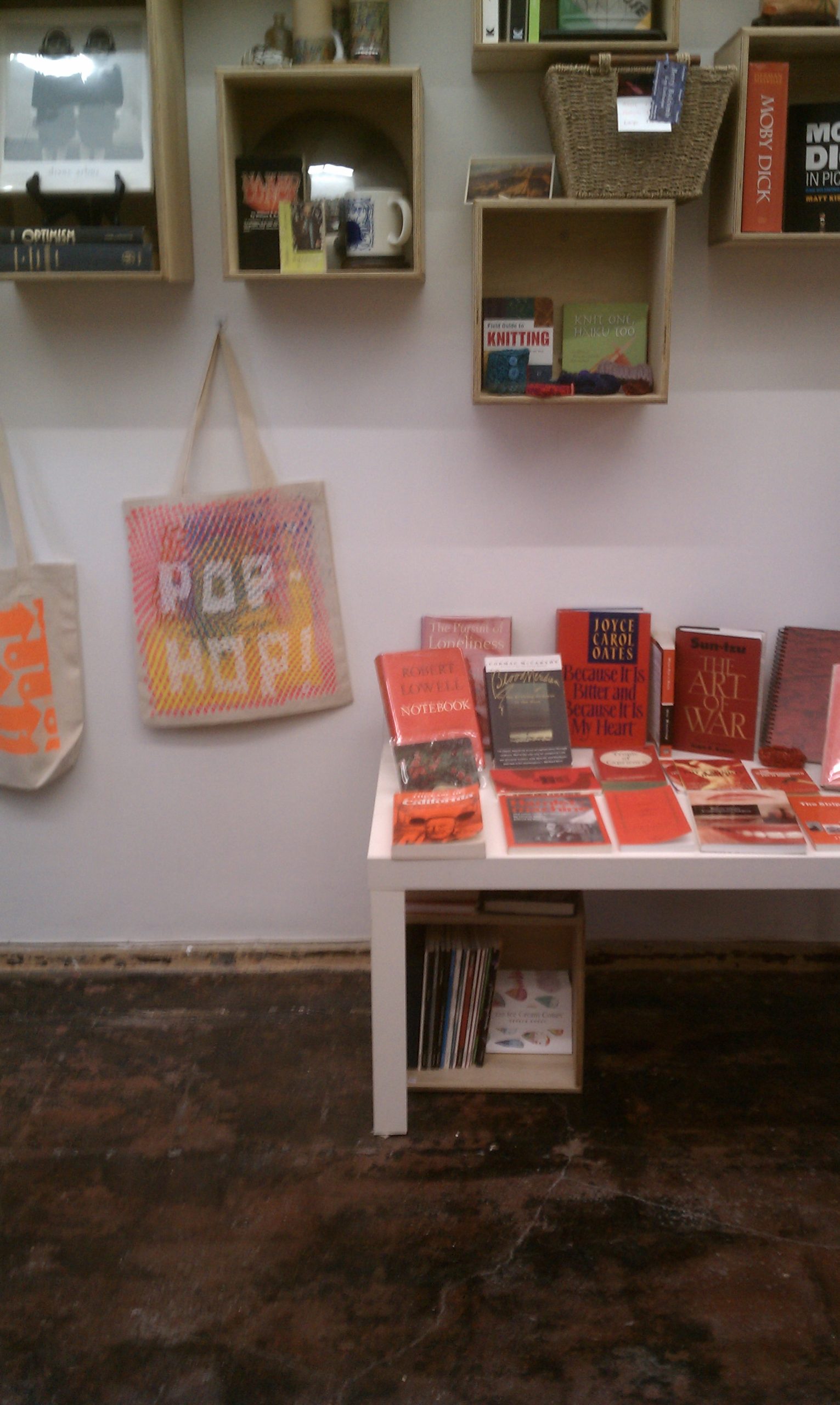
However, in spite of the Internet’s selective memory, I’ve managed to locate bookstores here and there throughout the last four years. From The Last Bookstore downtown to Iliad Bookshop in North Hollywood, the book business is hanging in there. Then there are the special places that are doing more than hanging in there, that are making their own distinct presence known by building a community, and one of those places is Pop-Hop Books & Print, “[a] bookshop, print studio & salon in the Highland Park neighborhood of Los Angeles”.

If you haven’t been to Pop-Hop yet, well shame on you, but really, you should make the trip. Recently opened in May 2012 by friends Robey Clark and Sarah Balcomb, Pop-Hop is what I dream my home library will look like someday. Sturdy shelves installed by friends line the right side of this narrow, long, and high ceilinged space. The shop gives off an air of clean and clear purpose. The white walls contrast with what might look like items from your grandmother’s attic. At first glance, to the non-bookish eye, the books and items gracing these shelves don’t seem all that special – mostly used, with a handful of newer books, and scattered lost objects. But these shelves are weighed down by something very specific. Love. Sarah loves books, you can see it in the way she has carefully chosen, organized, and alphabetized her shop, and in the little color coordinated display that lingers by the register. First editions pop up every other grab. Lovingly read books creak open to show you their unique stories and odd photos. You’ll find cookbooks, children’s stories both old and new, psychology and social science books, fiction, non-fiction, local handmade books, and maybe even something as unusual as an instruction book on the best ways to kiss a woman: titled The Art of Kissing (copyright 1936, reprinted in 1988).

This last example is why I have a particular affinity for Pop-Hop. I’m a person who will pick up old communist manifestos and books from the 1900s on how to learn Esperanto, and at Pop-Hop, Sarah displays this same affinity for the odd and rare little book. If you’re looking for a surprising read, or a gift for the book loving person in your life, Pop-Hop is the place to go.

You should also swing by if you’re looking for that yard sale item that’s escaped you, or fun handmade art by local artists. Scattered around the shelves, bits of scrap art mingle with very precious French mugs, and it’s not at all unusual to see very small screen-printing screens acting as bookends. Another aspect to the Pop-Hop shop is its screen-printing studio run by Robey. The walls are hung with bags, t-shirts, and baby clothes that were all screen-printed in house. They run weekend workshops where you can learn to screen print, or make a handmade book. Also on weekends they host story times for kids as well as readings and music performances open to the public, and participate in the NELA bi-weekly art walk. Basically their feet aren’t just wet, they’re soaked from all the activities they’ve both started and become involved with in only the first year of their existence. They’ve created an inviting open space where everyone is welcome, and they’re flourishing.

I appreciate what Pop-Hop does, that they’re helping to keep the printed book circulating and doing it with verve. Their unique and constant interaction with their neighborhood is creating a community, and a community with an appreciation for books and art. A community with this kind of appreciation isn’t going to let a place like Pop-Hop slip away in the oncoming storm of electronic books. Pop-Hop is a lesson in the adaptability of the bookstore, and it’s a lesson I hope other aspiring bookstore owners can pick up, make their own, and run with.


By Jessica Marie Felleman
an Associate Editor for Black Clock and an MFA Writing candidate at CalArts.
The Stages of Falling for the Deliberate Love of Humans: A review of Aimee Bender’s “Willful Creatures”

Reading Aimee Bender’s Willful Creatures is uniquely emboldening. The ride is all magic and turmoil in open air, and you finish smiling, face taut from being smacked with the full range of human capabilities. Bender shows us how we all have the potential to be willful, to act unreasonably or deliberately to a fault, and how doing so can be just as heartbreaking as it is inspiring. In this collection, Bender locates and exposes the multiple layers of what it means to truly act with willful intent. Her characters open up and move the reader to understanding his/her own desires. From a man who cannot see theperfect woman, to a pumpkinhead mother who cannot help her ironhead son sleep, to a woman weighed down by grief equaling exactly the same as seven potatoes, Bender’s characters bring you into their world and expel you just as quickly with a slight whiplash that is well worth it.

Separated into three parts, Willful Creatures acts as a coming-of-age tutor. A more apt title for “Part One” might be Childhood, as the characters in this section all share an immaturity. They are mean as they torture; they are stubborn as they defy themselves; and they underestimate their emotions as they act rashly. Watch the doomed men in “Death Watch” cry, run away, beat the ground, and then completely miss out on their own lessons. Detest the big man in “End of the Line” when, after he has committed many unthinkable deeds, he stops not through an understanding of his crimes, but from a renewed selfish feeling of entitlement. Scream at the driven girl in “Off” as she drowns all of her opportunity for greatness in stubborn games. Feel the pain of “Debbieland”–the pain that we bring to others in order to get rid of our own. Savor the familiar tingling in your hands from the urge to shake these characters, caress them, or push them down a flight of stairs.

Enter the lives of Bender’s characters in “Part Two” who feel older, but are yet still incompetent in their limbo-ridden world of indecision–who show us the weakness of being weak. An investigation of intimacy and emotion,“Motherfucker” leaves you wandering your own house of desire and all the memories of times you left it too widely open, thus missing out on something true. Captivated by the magic of a few moments of change, the characters in both “Fruits and Words” and “I Will Pick Out Your Ribs (from My Teeth)” suffer in all-too-familiar suspended weightless fields of danger and uncertainty, and make you wish they would break like poorly made plates, not out of malice, but as a way to redemption.

As in the Kübler-Ross model of the five stages of grief, the last section of Willful Creatures takes us through acceptance. Hold your breath while reading “Job’s Jobs” in which our hero has everything taken from him but still oozes that soul-crushing ability to love what he can do. Here, Bender finally lets you shout “TAKE THAT!” at God and shove his face in the human ability to continue striving for happiness in spite of any obstacles. In “The Case of the Salt and Pepper Shakers” Bender examines the equality that can be found in discord, and in “The Leading Man” she explores the process of self-discovery with the acceptance of every subsequent reveal. The characters in Part Three feel ancient, wise and self-assured compared to the volatile creatures in the first two sections. “Hymn,” a story of acceptance of perfection in a seemingly chaotic town where everyone can find a true purpose, finishes the book off like a perfectly sculpted tower of whipped cream. It is as unifying as a comfortable close hug between warring sisters.

To read Willful Creatures is to submerge oneself into the thick fiction of Aimee Bender’s creation, to swallow every story whole, to feel her characters tap at you from the inside as you digest them, and to glow in their aftereffects. It is an experience made for lovers and dedicated students of the human condition, and a revelation into what it means to be able to act with intent. Read it, feel yourself judged not worthy of the will you have, and then go out and be as unreasonably stubborn as you can possibly be.

By Jessica Marie Felleman
an Editorial Assistant for Black Clock and an MFA Writing candidate at CalArts
