
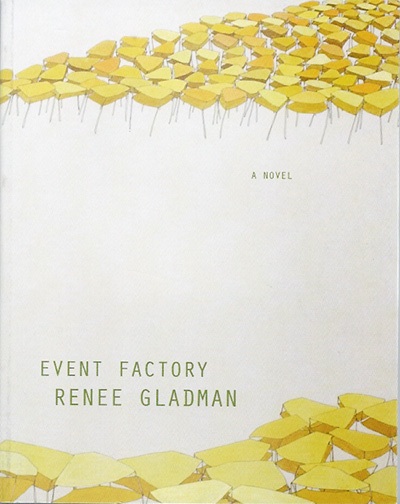
 October 22. 7pm-9pm. CalArts, Butler Building 4: Renee Gladman will read from and discuss her ongoing series about the invented city-state of Ravicka. Her visit is part of a public lecture series connected to the MA Aesthetics and Politics and MFA Creative Writing course, Interventions: A Wor(l)ding Project. Free to the public. Reception to follow.
Event Factory, the first novel in Gladman’s series, concerns a linguist tourist bent on exploring the landscape and customs of Ravicka. She arrives to find the inhabitants fleeing from a mysterious yellow fog. Events happen. But how should one digest the “happening” if meaning continually eludes?
Does the city reflect the consciousness of its maker?
In an interview with Volta, Gladman says, “At no time in the three centuries of western thought I studied did I ever feel my subjectivity was being considered. A black, queer woman was not a problem in philosophy; rather it was a zero.”
In another with Bomb: “The sentence is at once a map of where we have gone and where we wish to go.”
Has a city ever held you tender?
Critics puzzle: how to name Gladman’s Event Factory. Is this the world of science or speculative fiction? In the Acknowledgements section Gladman gives thanks “most especially to Samuel R. Delany, for Dhalgren”. Surely that must be a sign! How else to read the yellowed air, the “emptying out”, the seen/unseen bulbous growths in the streets? But the narrator disrupts the attempt to name. She warns: “Do not misunderstand me. I am not insinuating there is anything extraterrestrial about this place. How could there be?” The reader wanders through Gladman’s world, unmoored by the twinned opacity and spectrality of experiences. Is this a planet? A dream? A misunderstanding?
If language performs chaos does that mean language can stand outside of chaos?
Critics puzzle once more. In that case we are in the world of the social sciences, yes? Seen in this light, Event Factory would appear to cast linguistics as the science of interest. The narrator, unnamed and unknown, comes to Ravicka as an eager linguist-traveler well-versed in various languages. Despite her fluency in Ravic she remains unable to deeply place herself within the city. Meaning, “in high Ravickian form”, continually hides itself in gesture and obfuscation. Our linguist stumbles upon a language that refuses to be known. Rather the signifying leads to spaces dizzyingly further from the signified. Spaces that crumble, multiply, roam. She encounters the Esaleyons, a group of people who speak “in gaps and air.” She ponders: can the written capture the speechless? If not, what of the spaces, those gaps of air?
What (who) structures consciousness?
Gladman maps her ontological questions right onto the architecture of Ravicka. We begin to wonder: if our city vanishes, do we? Gladman resists digestible interpretation. Like the citizens of Ravicka she “hides the story in a dance.” Her prose envelops you in a lucid trance daring you to question its supposed unreality or fiction. You come to wonder if it matters in the end. I think of the scene where the narrator has stumbled upon an underground camp of resistance members. Gladman deflates the importance of the whats, the whys, the how comes. These are just dances that hide the meanings. Our narrator misses the cues of their revolution. Instead she focuses on their slippery talk of the shape and nature of things. Soon the experience eclipses the questions: ”Water gathered around my feet. I tried to capture it with my mind…[b]ut it was water. Water you cannot hold. I look around: everything filling that space shone magnificently, shining with this or that iconic power⎯old and extraordinary and arranged complete out of sync with time.”
Event Factory slows the deafening, chaotic blur of existence.
Within we will attempt to seek, understand and gather meaning.
But water you cannot hold.
By Allison Conner
an Editorial Assistant for Black Clock and an MFA Writing candidate at CalArts
