Singular, idiosyncratic and a little mysterious, Black Clock is one of America's leading literary journals.

Archive for the ‘Interviews’ Category—

Crawling Down Cahuenga: An Interview with author David Smay

David Smay, co-editor of Bubblegum Music Is the Naked Truth, and Lost In the Grooves (both in collaboration with Kim Cooper), and author of Swordfishtrombones (Bloomsbury, 33 1/3 series), discusses Tom Waits and the changing nature of Los Angeles with Sr. Associate Editor Emma Kemp. David is a regular contributor to the website HiLobrow, and has published in such magazines as Oxford American.  He lives in San Francisco with his wife and two children. Read his work at: http://hilobrow.com/author/dsmay/.


EMMA E. KEMP: Hi David. We recently met on Esotouric’s Crawling Down Cahuenga: Tom Waits’ L.A – an alternative bus tour revealing the hidden secrets of Los Angeles through the lore of Tom Waits. I’d like to start at the beginning and work our way back to the bus…

Can you talk about your relationship to Tom Waits? Do you remember your introduction to Tom’s music?

DAVID SMAY: I became an obsessed Tom Waits fan when Frank’s Wild Years came out. I remember standing in my friend’s bedroom as he played “Hang On St. Christopher” and I could tell something very different and distinctive was happening.  It didn’t exactly appeal to me at first, so much as it challenged me.  There was something there to explore and discover.

I went back and completely immersed myself in the previous two albums in the Frank Trilogy (Swordfistrombones and Rain Dogs) and then desperately looked for anything that sounded remotely like that. (There wasn’t much at the time.)  I had heard some earlier albums through a friend who was a big fan of Blue Valentine, and, in fact, I remembered seeing Tom on the Mike Douglas Show back in the 70s when I was just a kid.  But I wasn’t converted until I heard his albums on Island Records.

EEK: You’re the author of Swordfishtrombones published by Bloomsbury as part of their 33 1/3 series, can you talk a little about the experience of writing this book? How did you become involved with the series, and how did you approach long-form criticism?

DS: My friend and co-editor, Kim Cooper, had written a book for the 33⅓ series on Neutral Milk Hotel and encouraged me when Continuum Press had their open call for proposal. It’s an opportunity to work in long-form criticism, which is increasingly rare.  This series provides a platform to dig deeper into a work than market driven reviews can allow.

EEK: Did you have a clear agenda when you set out? Did this change as the book progressed?

DS: I knew I wasn’t planning on doing a standard critical book. I’d done plenty of record reviews in my day, and I wanted to use the longer form of a full book to explore Swordfishtrombones in a different way. As I noted in my introduction, it would have been exceedingly perverse to “explain” an album like Swordfishtrombones, an album which works best because of its provocations and mysteries. I had to find a structure which would allow entrance into the work without spelling everything out.

EEK: How did you go about researching and writing this project?

DS: There’s a huge amount of Tom Waits material available online. I spent two years researching everything about his career, reading literally hundreds of interviews. Spending time and taking lots of notes on all of his albums – not just Swordfishtrombones. Since it’s such a fulcrum in his career I really needed to understand what lead up to it, and what followed. With Swordfishtrombones, Tom Waits began to transition from a culture figure to an icon. Somebody whose work influenced so many artists who came after, often in subtle ways.  So many younger artists tap into that sonic palette that he developed, the exotic instruments, the distorted vocals, the bang-on-a-can aesthetic.  And his lyrics changed too, though they’ve proven harder to imitate without parody. The lyrics became very concrete, specific and detailed but at the same time he left space between them, a very controlled ambiguity.  It’s a very masterful way to approach songwriting but it allows him to build depth and mystery into his songs.

EEK: How did the book impact your relationship to Waits? I’m interested in how this relationship may have evolved, moving from fan, to aficionado, to scholar…? Has the book influenced how you listen to the music now?

DS: When you spend so much time and research on one artist it’s easy to become burned out on them. That never happened with Tom Waits – he’s created such a rich and varied musical legacy that I still love it. However, the process of writing the book did exhaust my questions about him. I understood his personal history, his creative methods, his favorite themes and sonic palette.  In a way, when you answer so many questions about an artist you lose some of the magnetic draw towards them.  In comparison, I’m a huge Kinks fan but because I haven’t studied Ray Davies so exhaustively I still have things to discover about him and his work. 

EEK: Were there difficulties in writing about an infamous figure in such an intimate way? Is the “cult of celebrity” difficult to transcend in a project like this?

DS: All of my critical writing tends to burrow under the perceived notion or narrative of an artist or their work. There is a tendency for critical assessments to become calcified and rigid over time and they can distort more than they reveal.  So getting past Tom’s persona and into his work was my standard strategy.  I did have a couple of pangs when I found buried little biographical details which he had obviously wanted kept hidden, or were painful to him.  But they were relevant to discussing his work so I wrote about them anyway.

EEK: During our first meeting, you were at the helm of a passenger coach pointing out choice spots in the underbelly of L.A significant to the Tom Waits chronology; how important is this particular city to the story of Tom Waits? What is it about L.A that lends itself to this kind of figure? Or did the figure create the city? How significant is geography in the construction of artistic identity? You’re obviously extremely familiar with Los Angeles, but you live in San Francisco, which has its own unique counter-cultural/literary history… how does this shape your own thinking/writing?

DS: Los Angeles is by far the most important city in Tom’s work and his relationship with L.A. is intimate and profound.  While the rest of the music industry was tucked away in Laurel Canyon in the Seventies, Tom Waits was the first musician to write about the Los Angeles of the streets.   He’s so specific about neighborhoods and intersections and bars and hotels and that kind of creative attention lends them a kind of myth.  He created a certain idea of Los Angeles which still has currency.  You have to look at movies like Cassavetes The Killing of a Chinese Bookie, or Barfly or Altman’s The Long Goodbye to see that Los Angeles. 

I lived in L.A. before I moved to San Francisco, so I’m familiar with both cities and their cultures.  There were times during the Beat era, and also during the punk era when LA/SF were more united than at odds with each other.  All those bands bombing up and down I-5 in their beat up vans to play at the Mab or the Whiskey.  Rebecca Solnit’s book The Secret Exhibition gave me a lot of insight into Wallace Berman’s circle and the artists associated with the Beat era and that’s a lens I bring to seeing Tom’s work.  More even than the actual writers like Kerouac and Bukowski who directly influenced Tom Waits.

EEK: You lead the Tom Waits bus tour once a year, how does this reenergise your relationship to Tom, and to your book? Did you spend a lot of time exploring these places during your research, or did the relationship between the music and the city come after, when you had the opportunity to do the tour?

DS: Every year I go back and revisit my book and my research before I do the tour. I try to change around the AV portion of the tour from year to year so that gives me something different to extemporize from.  Obviously we used his Letterman appearance before this year’s tour.  And, yes, I do learn something new from the passengers every tour.  Tom’s had such a long career and I’ve met more than a few people who saw his legendary Steppenwolf production of Frank’s Wild Years in Chicago in the 80s, or locals who saw him perform in a play called Demon Wine.  I’ve met people who did lighting and sound on the Big Time movie. It all adds to the picture. 

When we first did the tour, I gave Kim and Richard a list of specific places I’d like to visit and they figure out how that could work as a tour, but it’s really over time that I’ve come to really grasp what you might call the psychogeography of his work.  There’s always more historical context to fill out, more layers of history, more interesting stories to discuss.  Kim and Richard do an incredible job of explicating what was going on in Los Angeles politically, culturally, scandalously in any era so you can see how it all fits together.

EEK: I love that the tour connects you to such a diverse range of Tom Waits fans, how has this experience enhanced your relationship with Tom and the city?

DS: I love it! My favorite part is talking to the people on the tour when we stop at Canter’s.  Get to find out their discovery of Tom, what they’ve seen and heard.  Oftentimes people travel a long way just to do the tour, and that’s always an honor.  By the very nature of his work, Tom Waits attracts intelligent, interesting, creative people.

EEK: Can you talk a little about the changes sweeping DTLA? What’s your prognosis for the types of artists that can/will inhabit this new L.A?

DS: Downtown has changed so much in just 8 years (or so) we’ve been doing this tour.  It really had been frozen in amber since the Freeways went in, and when we started you still had many skid row bars and amazing cultural institutions like Clifton’s Cafeteria (where we used to end the tour).  But finally the desire for urban density has landed in Los Angeles, that most spread out and car-defined of cities, and it’s remaking downtown.  Certainly there are things I love about the changes – the Last Bookstore is exactly the kind of thing which can sustain and create its own cultural energy.  But if it just follows the standard gentrification of upper middle class and wealthy white people razing and developing indiscriminately, displacing long running locally owned business (as is happening at the Grand Central Market), we’re going to lose so much.  Los Angeles has not generally done a great job of preserving its incredible legacy (despite the heroic efforts of people like Kim and Richard, and many other preservationists).  The people of Los Angeles need to wake up to the fact that they are on the cusp of losing so much of their cultural history.  It’s in the balance right now.

EEK: What are you working on right now?

DS: I write for the website HiLobrow most recently doing a piece on the great fantasy and horror writer, Fritz Leiber (another creator with strong ties to both LA and SF).  I did a critical/analytical series for them on Early Sixties Horror movies which fascinated me (The Haunting, The Innocents, Blood and Roses, Eyes Without a Face, et al).  It’s a great outlet for the range of my interests which allows me to write about everything from Jack Kirby’s comics to Anna Ahkmatova’s poetry.

EEK: Do you have any advice for folks who may be putting together a 33 1/3 proposal for this year’s open call?

DS: Every correspondence is an advertisement for your writing, so sweat your emails and be cognizant of every word you’re putting down. The proposal is intended to present your depth of interest and give a hint of how the book is going work. I think giving substantial insight of what book will look like, while showcasing your technical ability, makes for a successful proposal across the board. For this series, you have to pitch a work you’re not going to get bored of. I was able to write about the breadth of Tom’s career, what went into it and what came out of it, so be creative in how you approach the topic, because there are many ways to do it. Take a chance, and don’t fuck it up!

Catch David in Pasadena on July 23rd at the Pasadena Central Library as he and co-presenters Kim Cooper, Gene Sculatti and Becky Ebenkamp discuss the history of Bubblegum Music. For more details visit http://www.lavatransforms.org/bubblegum.
Emerson Whitney’s Ghost Box: An Interview

Ghost Box is based on the true story of Emily, who, in the fall of 2012, arrived in the parking lot of a vacant big-box store, or “ghost box,” near downtown Los Angeles with 45-pound bags of cat food. She converted the otherwise vacant property into an impromptu bird sanctuary, and evaded arrest by the LAPD for months. Emerson Whitney adventures into the weirdness of Emily’s story and the strangeness of vacant urban space, writing wildness and ferocity into the strip mall. Ghost Box is gross and wry, gorgeous and feral, a hoarse cry from abandoned city space: “we want to be beautiful too.”

Sr. Associate Editor Emma Kemp interviews Emerson Whitney on his new book, Ghost Box (Timeless, Infinite Light, 2014)


EMMA E. KEMP: How did you arrive at the ghost box?


EMERSON WHITNEY: I was often stuck at this light on the corner of San Fernando and Fletcher. Nearly every time I was stuck at the light, a towering cloud of birds seemed to rise from this giant empty lot adjacent to the intersection. The scene just started to seem strange, every time I passed, there were more birds and more birds. I was curious. Just before I started the project, I looked it up and found YouTube videos and Instagram photos of the lot and its birds. We were all marvelling, I guess.


EEK: Can you talk about your first visit to the lot?


EW: Well, I realised my intention was really just to work out why the birds were there. And I figured part of my reason for wanting to do so was because I was also having a lot of strong feelings about living in a space that was so dry. We just made it through a really uncomfortable hot season and I was feeling really distressed by the landscape, partially because I had grown up in a similar environment in Dallas, hot and concretized and full of strip malls with blowing trash. I grew up on the access road to a highway. There’s always been some part of me that wanted to investigate the potential beauty of man-made detritus. I wanted to know there was something I could wrestle out of the mess, something that I could love.


EEK: So you saw the birds as a guiding force, directing you to this new perspective?


EW: Yes! That’s a great way of putting it. I saw the birds as a way in. It also raises questions for me about “natural,” which is something I think about all the time. Ideas of ‘nature’ and ‘natural’ in relation to queerness and gender identity, trans-ness, is often hissed at as “unnatural.” I’m curious about the implications of “nature” as a tool used to exclude, exterminate, etc…

In other words, the lot would not have been interesting if it weren’t for the birds. They were a way for me to understand that this place was alive, and really, who am I to question its beauty? Who am I to say that’s not natural or nature? Maybe it’s even perfect.


EEK: Do you feel like you arrived at some kind of resolution in terms of your relation to space? If not, then what new questions did the inquiry propose?


EW: It did actually shift the lens a little bit, writing this made me realize that have been asking these same questions constantly and forever. Now, I feel a different level of serenity around that space and spaces like it.


EEK: I’m curious about your relationship with the ‘man with rake’? I wonder if you could talk a little about how you initially encountered him as an individual, and how over the course of time you spent with him your relationship changed.


EW: I met him one Sunday when I was sitting in my car at the lot, planning on spending some time writing, making some audio recordings.


I watched the man with rake pull up in front of me from far away. I forget the acreage, but it’s a pretty sizeable space. He got out of his car with the rake and started going at the concrete with the rake like he was trying to kill it. I knew I needed to talk to this guy, but I very much recall feeling squeamish about walking up to him because the ground was covered in fresh, wet poop–it was literally multi-colored poop because (I later found out) Emily was feeding them all this multi-colored cat food.


I think I told him I was a reporter at first, rather than a poet because I figured he’d actually talk to me if I said I was a reporter. But he ignored me and asked if I was a producer for a reality TV show, that’s when I said, no, I’m a poet. And he really wanted to talk to me about everything. He seemed so excited to have a witness.


EEK: Who was paying him to rake all day?


EW: Home Depot. Because Home Depot had purchased the lot but the actual building of a new Home Depot was thwarted by community activists, this is the thing with “ghost box” stores (I learned this term from the ‘man with the rake’) that there’s a whole network within the big box store community (is it a community?) of empty, foreclosed big boxes. Remember when all the RadioShack’s and all the K-Marts were closing? Because the floor plans are gigantic, the sale of a big box store doesn’t generally happen quickly. There’s a whole industry of folks who are paid to upkeep the “ghost boxes.”


EEK: Have you been back there since releasing the book?


EW: Yes. It’s now a fancy new Goodwill, and my partner and I have shopped there a handful of times.


EEK: Is Emily still there?


EW: I doubt it. I would be very surprised. There are no birds now either.


EEK: What birds were they?


EW: Actually, I called an ornithologist at the Natural History Museum to try and find out, the people I spoke with said the birds were a mix of seagulls, pigeons, some wild parrots, yellow finches, occasional hawks. The ornithologist said they thought it was beach. That they read the concrete as sand. And it was disgusting, wall-to-wall with poop.


EEK: It’s interesting hearing you talk about Emily in this way. At a certain point in the book, I felt protective of her, even though I never see her except as an absence, an absent space of poetics, and I feel frustrated with the man-with-rake at certain points over his relentless pursuing of Emily. Though in a way, Emily thrives from this chase because it reinforces her presence in a world where no one else but the birds even acknowledges that she exists. Its a really interesting relationship that these two solitary figures have, they have no one else to talk to but are communicating with each other in a game of cat and mouse; they each have a purpose – hers to avoid being caught and his to catch the criminal. You, as the writer, do not interfere or judge either position in any way, and I wonder if you experienced any frustration yourself?


EW: I think it reads more quickly in the book than how it felt in real life, but for some reason, the lot was vacant for 10 years and then I put my attention to it, and within three months it was over. There was a flash of activity. Even the man with the rake described it as that. He was taken by surprise by the changing circumstances that accompanied my arrival. The moment that I felt truly dedicated to this project was when I had been visiting it for like 2 or 3 weeks and then there was all of a sudden, in front of where I’d been parking, a sign that said NO TRESPASSING, NO LOITERING, FEEDING BIRDS OR WILDLIFE. I just stared at that sign for something like 30 minutes thinking about the term “wildlife,” and wondering about the power of the woman who caused someone to make this significant signage – it seemed so absurd.


Because my background is in journalism I’m much more comfortable staying out of a story and letting events unfold. I tried not to interfere in writing or in real life, aside from the impact of being a documenter, which undoubtedly has significant impact.


I have a whole bunch of projects that are similar, a kind of anti-journalism. I don’t feel like I’m doing the antithesis of journalism, but I’m taking some of the techniques of reportage and looking at the absence of story. I’m going to the cold place. I’m curious about showing up and seeing what happens and that being my work. I guess I’m interested in letting the words occupy the vacancy and animate it.


EEK: Do you own personal or moral reactions come into play?


EW: Oh absolutely, I think that’s why I wrote it. My partner’s brother was dying of cancer when I was working on the editing of this book, and I think there was part of me that felt the heft of that information that the man with the rake had, that he knew Emily had cancer but wasn’t moved by it at all. He just wanted her out of the lot.


I was also really curious about the density, the area around the lot is so dense with businesses and housing and traffic, that for there to be a vacancy seemed incredible. The building was in such disrepair. The man with the rake told me that people had gutted it numerous times, stolen the copper wiring from inside.


EEK: Can you talk about why you avoided using his name?


EW: It’s funny because when you said that thing about him seeming like this symbolic figure, when I was writing it, I saw him as this sort of weird, pastel, fuzzy figure.


EEK: Is this part of your synesthesia?


EW: Maybe, yes, but it was like watching through the camera on the first season of RuPaul’s drag race. Do you know what I mean? All the shots specifically reserved for Ru were filtered through this hazy sort-of ‘70s lense. You know? I wanted him to have that sort of haze. I wanted Emily to be in-focus and highly saturated. I wanted her to have the name.


EEK: Did you really never see Emily?


EW: Never! But she was always there. There would be cat food and bags around, I knew she had been there. I was concerned when things with the lot visibly started to change, when the birds were leaving. But by that point I was kind of disgusted with being there. It’s right next to McDonalds and so loud, so much traffic. When I noticed Emily’s departure, I felt a little relieved.


EEK: Reading the book, a part of me thought for a moment that Emily might be you. Not physically, but if Emily was a symbolic construction: performing those acts, the wildness of her doing what she needs to do in the confines of that space, against all the odds of her situation, speaks to me of the wildness in you, the wildness of self in other texts that I’ve read by you…


EW: Yes, I’m very curious about that space between a cultural reality and “difference.” So, our cultural reality would suggest that this person is mad, and that madness is wildness to some extent because she is not “domesticated,” is feral. I don’t know if that’s true, but I am always curious about the cultural ‘stepping out’ that people choose or are forced to do. I think about this a lot in my work, as someone who has moved from one gender to another, something that’s supposed to be fixed and undoable. I’ve allowed something to grow wild that was otherwise tightly controlled, this kind of move really does trip the wire a little bit, like now I constantly wonder, what else about my person (or our persons) is being domesticated without my consent?

EEK: That makes a lot of sense. The fact that Emily is in this raw, poetic, state, or, perhaps that Emily manifests in poetry, she is up against these terrible odds. And we have the man-with-rake who is designated only by a description of the utilitarian object he holds. He is frustrated, he just wants to find Emily, but he never does. In a larger sense this portrays what capitalism inspires, an endless desire for something we cannot hold, which I guess, essentially, is freedom distorted through the vessel of money. And then we have Emily who is living outside of that framework, and not that we can say that she’s happy or not, but from the way she’s written, we experience her with so much more vitality than we experience the man-with-rake even.


EW: Yes! These are the things that I hoped would be there in the text. That’s what I wanted to write.


EEK: Have you considered donating any of these books to Goodwill?


EW: Haha, yes. Someone did suggest that I take some over there. Wanna go with me?

Living Well: Alisa Stein and the Healing Power of Art

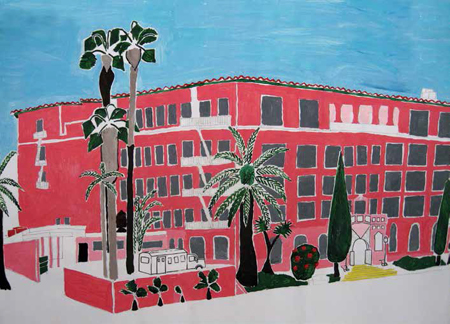
A portrait of Harbor View House by resident artist Ray Rodriguez

A portrait of Harbor View House by resident artist Ray Rodriguez

Among the first in the United States to champion the validity of outsider art were Janos Marton and Bolek Greczynki, two expat scholars out of Columbia University’s School of Visual Arts in the 1970s. Largely influenced by the idealistic, humanist approaches of artists and writers like Jean Dubuffet and André Breton, Marton and Greczynki later founded the first-ever art studio on the grounds of Creedmoor Psychiatric Hospital in Queens. This art studio, christened The Living Museum, sought to showcase the work of Creedmoor’s many untrained yet visionary patients, and was dedicated to the purposes of beauty and healing above all else.

 
Fifteen years ago, psychologist Dr. Israel Rubenstein flew out from Southern California to visit Creedmoor, and was so impressed by the hospital’s art studio that he decided to open a similar space at Harbor View House, an adult residential psychiatric facility in San Pedro. For the past four years, Alisa Stein has served as Art Director of The Living Museum Art Center at Harbor View House, a former racquetball court turned studio and gallery space for the Harbor View House residents—as well as anyone else who’d like to spend a morning chatting with the artists and viewing their work over a hot cup of fresh (free!) coffee, which is exactly how I first met Alisa Stein, as part of a class trip to the studio in one of Mady Schutzman’s graduate writing workshops at California Institute of the Arts. A few weeks later, I returned to the studio to talk one-on-one with Alisa about her work managing the atypical art space. The two of us discussed the psychological benefits of art-making, the realities of mental illness, and more.

ADRIANA WIDDOES: Who are the residents of Harbor View House and how do they get here?

ALISA STEIN: Everyone here has been diagnosed with a mental illness. In addition, they usually have drug and alcohol addictions, so prior to getting here most of them have lived on the streets—either on skid row or park benches. They usually have had some kind of altercation with the law or some other issue and end up at a psychiatric hospital in that way. Then from there they’re referred to living here at Harbor View House. But the number one reason for being here is mental illness. Most of our residents have schizophrenia or bipolar disorder.

AW: What do you think drives the residents of Harbor View House to create art?

AS: I think what drives them is that most of these people have never been accepted by society for whatever reason—whether that’s because of their mental illness or their addiction problems. Coming in here and being able to create gives them a sense of self worth that they can do something. They can make something that they can get recognized by. And that recognition is not just from a gallery or a museum. It’s also from me and other people who are working or living here. Because most of them have never been told that they were good at anything. They haven’t had a lot of success in their lives, so something as small as creating a tissue paper poinsettia can give them such a sense of self worth.

AW:
I agree that creating gives people a sense of purpose, and that’s not something special to people who suffer from mental illness either.

AS: It’s for everyone. We all want to feel creative. We all want to be able to do. People without a mental illness can get that feeling through many different avenues. But for people with mental illness it is so critical because they really lack so much support. Most of their families have just been tired by their illnesses and their addictions and the chaos that they cause, so they just sort of left them to be. So maybe creating tissue paper poinsettias doesn’t give them everything they need, but it’s still something. If they didn’t have that and had nothing instead, it would be even more traumatic.

AW: What are some of the obstacles for the artists that you work with here?

AS: One pretty common obstacle is that they are all on psychotropic drugs and some of them are heavily medicated. Just trying to function through a day when you’re taking 400mg of Lithium and 300mg of something else is difficult. It affects your sleeping and your eating. A lot of them are also trying to stay sober and unfortunately the neighborhood has a lot of drugs that are available. People have to fight off their demons just to not go outside and use. That is an obstacle. Some of the residents’ personalities here can be very volatile and sometimes the environment can be very unsafe, and they’ve got to deal with that. They might have a roommate who has stolen something or done something else bad. This is their home, but it can be a very difficult atmosphere.

AW: How do you experience the relationship between the Living Museum Art Center and the rest of the building, which is perhaps more clinically oriented?

AS: I think the art is such a blessing to this building. People come in and it’s like the oasis here. It has life, color and beauty. The building is otherwise pretty traditional in the sense that the walls are all white and it can feel very institutional. We try to hang art throughout the building and give it some life. The fact that the art wasn’t just done by some artist in downtown L.A. and is actually the art that has been created here gives it so much more meaning. When outsiders come to visit this place, they’re not expecting to see what they see in here, and it feels good to know that things are still going on here. Residents aren’t just milling around smoking cigarettes or lying in bed all day. They are actually producing something that gives the building life.

AW: Are you ever concerned that visitors might be coming to view the patients and not the art?

AS: I’ve never had that feeling. The artists actually really like it when they have visitors. They don’t feel that it’s an observation of them. I think they almost feel privileged that people are interested enough to come see what’s produced here and how this program works. It makes them feel good.

AW: Do you consider yourself an artist (trained or otherwise)?

AS: Not trained, not untrained. I am not an artist. I would say I’m a creative person, but the only F I got in school my whole entire life was when I got an F in art in 7th grade. My teacher at the time told me that I was the most uncreative person that she had ever met! I tell that story all the time. It really stuck with me, but lo and behold— I’m Art Director of a mental health facility creating projects. I think I’m artistic in the sense that I understand the elements of art, but I always tell my artists here that if they ask for help painting a portrait, I can’t.

AW: Do you think being untrained helps your dynamic with the artists working at LMAC?

AS: I do. I think their perception of me is as a leader and as someone who is able to explain and define things. I always tell them how talented they are—and they really are—and I think it’s a good balance. They have taught me a lot about art and drawing and painting. I feel they are not intimidated by me because 99% of the time I can’t out paint them and I can’t create something that looks lovelier than they can. It makes it a more comfortable atmosphere.

AW: How necessary do you feel art programs like LMAC are?

AS: Oh, they are so necessary. They are vital, and not just to provide an extracurricular activity; it has been proven that art-making enhances cognitive skills. There is just no downside to creating. It enhances people’s wellbeing tremendously. I see it first hand. I see the change in the artists’ expression. It just gives them a purpose to create something. That’s not something that anything else in their life offers them.

AW: Do you ever feel frustrated? Do you ever feel like what the art studio can provide the residents here is not enough?

AS: Of course. I feel frustrated when I’ve been working with an artist for 6 months and they’re really coming along and I can see some hope in their eyes and then I don’t see them for a month and I find out that they’ve started smoking crack again and are living on the streets. Then when they end up back at Harbor View they’re all beat up and we have to start from square one again. I get frustrated when I feel like all the work that an artist and I have been doing is lost in an instant. It’s hard to understand mental illness. It’s so different for everyone. Even the same diagnosis of schizophrenia can manifest so differently in each person— and it can be very frustrating. It’s frustrating when a 55-year-old woman doesn’t understand that she is making a poinsettia even though I’ve explained to her that a poinsettia’s leaves are red 15 times. That’s tough. But that woman did do something in the end. It’s all good—and she felt good about it.

AW: Is any of the art for sale?

AS: Yes, we do sell the art. 50% of the proceeds goes to the artist and 50% goes to buying supplies for the studio. Anyone who’s interested in purchasing something can view the art by contacting me and setting up an appointment. We don’t necessarily use the gallery for art sales or exhibits. It’s mostly just to showcase the larger pieces of art that artists have created here. We’ve tried in the past to open the gallery up to the outside, but because of its location on the third floor of the facility it’s difficult to get passersby up here. 95% of our sales happen in outside art galleries. We’ve exhibited in L.A. City Hall, Torrance Art Museum, Angels Gate Cultural Center—all various types of galleries.

The Living Museum Art Center is located at 921 S. Beacon Street in San Pedro, CA. To contact Alisa Stein, make a donation or become a volunteer, please visit the LMAC website.


By Adriana Widdoes

an Associate Editor for Black Clock and an MFA Writing candidate at CalArts

Music and the Chaos That Binds Us: A Look at Music and Reading with Henry Bean

IMG_0070Back in November, Black Clock Associate Editor Patrick Benjamin started a train of thought on the union of music and reading. I found his insight into this experience quite astounding, as I had never given it even a bit of thought before. This is because when I read I block out the rest of reality, so listening to music isn’t important to me as a reader. I’m sure if I could remember them, there have been times when the feeling of the music in the room mingled with the reading world I was in, but it’s not something I seek out, and I especially avoid listening to anything I know the lyrics to because I’ll just end up singing – leaving the book unceremoniously abandoned on my lap. More often then not, the world of the book is all I can hear, and all I care to hear.

But, maybe the truth is that I’m just not listening to the right music. So, I turned to one of our Black Clock 16 contributors, Henry Bean, to see what his thoughts were on this matter. Mr. Bean’s story in the newest issue of Black Clock, “A Hole in the Sky,” follows Tyrell, a man with strong ties to music, as he struggles through the special chaos of a certain moment in his life. Without giving anything away, I think between my associate and Mr. Bean I’ve been inspired to give the combination of music and reading an actual chance.

***

Henry Bean: “In Ingmar Bergman’s final film, Saraband, there’s a scene in which a angry old man, played by Erland Josephson, sits in his study, leaning forward in concentration, eyes closed, brow furrowed, listening with all his might to a recording of a Bruckner symphony.  His son enters the room; the man stops the music, begins to tell his son (who is 60) what, in fact, he thinks of him, a bitter, scathing denunciation that is one of the most terrible encounters between a parent and child ever depicted in film or literature, after which the son leaves, shattered, and the man picks up the symphony where he left off, burying himself in it with the same intensity as before.

This, I imagine, is how music ought to be listened to, as if it contained the secrets of the universe, and not a note is to be missed.  Unfortunately, I can’t do that, except on drugs, which I don’t take anymore.  To listen now, I need something else (driving, cooking, cleaning the house) to siphon off nervous energy so the rest of me can focus on the music.  Reading is not a good something else; it’s too complicated and demanding.  Usually, when I try to read and listen, I end up either turning off the music so I can follow the words, or getting so absorbed in the writing I don’t hear the music. 

But every now and then, for five minutes or half an hour, it works perfectly; the music and reading abet each other, each somehow clearing the way for the other kind of perception.  When this happens, it’s almost invariably one of two kinds of music that does the trick. 

The first is Bach, particularly Glenn Gould’s two recordings of The Goldberg Variations (1955 & 1980) which are both such mysterious blends of mathematics and “feeling” that either they don’t interfere with the decoding of printed words and the understanding of sentences, or they even facilitate that process.  It is as if the Bach expresses a truth, a universal constant, in the presence of which everything becomes logical.  The world makes sense.  This calms the mind and lets it focus on the words and their meaning because a deeper, foundational meaning is being attended to.

 The other kind of music that sometimes has this effect is a larger category, 20th Century classical. Not all of it works.  Stravinsky doesn’t; it’s too dramatic, it fights the words.  But Schoenberg, Stockhausen, Shostakovitch and especially Charles Ives sometimes do, though they are, in a way, as chaotic as the Bach is orderly.  I’m not sure how this happens, but the modern music’s abstraction, the scarcity of melody or conventional harmony, the atonality, the wavering between structure and chaos, somehow “support” or enable reading just as the Bach does, but from the opposite direction. 

 Ives is the 20th Century composer I know best, particularly his 2nd Symphony, in two different recordings by Bernstein, and maybe one of the reasons it works is that I know it so well.  Reading “to it’ is like sitting with a book in a familiar landscape; there are “events” in this landscape (especially the grave restatement of the main theme late in the symphony) that inevitably distract me, but they do so in a way that is predictable, and thus comforting.  And, when they’re past, I go back to the reading refreshed, restored.  Even if I’ve only ‘been away’ for half a second, it lets me see the text with new eyes. 

 Of course, Gould’s Bach is also very familiar, so maybe that’s the key as much as the music itself.  Music we know well does what we expect; that reassures us and leaves us free to fall through the hole of our reading into another reality, confident that the one we left behind is being attended to by the music.”


Following this wonderful continuation of our thoughts about the intertwining of music and reading, I wanted to dig further into the possible implications of music in “A Hole in The Sky.” So, I asked a few prying questions, to which Mr. Bean graciously replied with an honesty I’m sure Tyrell would appreciate.

Black Clock: I would venture a guess that the main character in your story shares a similar opinion about music. Would you say that?

Henry Bean: I imagine that Tyrell’s opinions about music are very different from mine. For one thing, he knows music much better than I do. As he observes in the story, he would “live inside it” if he could. The problem is, he can’t. I have no idea what kind of music he likes or listens to, but I suspect that a lot of it would be people I’ve never heard of. He might find the composers I mentioned (Ives, Stockhausen, Schoenberg, etc) formally interesting, but my guess is they’re too cerebral for him (though I could be wrong about that). He wants an expression of feeling that’s more direct, raw, deep, shattering; as I say in the story, he’s a romantic, and we share that. But, unlike me, he would have no trouble listening to music while he reads or writes (if he wrote) because music to him is the deepest reality. I agree with that, but I can’t feel it the way he does.

Black Clock: Does your character’s affinity for music play a role in the way he sees the world, and inevitably, in his fate?

Henry Bean: Music is the purist of the arts, and Tyrell is nothing if not a purist. It’s purism (an insistence on what should be in the face of what is) that gets him into trouble and that won’t let go even as it threatens to destroy him. It’s not so much that his affinity for music leads him to this fate as that it reveals the purist impulse that also produces the fate. They’re parallel not causative.

Black Clock: I’ve started incorporating certain music into the background while I write, though it only works about fifty-percent of the time. Did you listen to music while writing “A Hole in the Sky”? If yes, what?

Henry Bean: No. I can sometimes listen a little while writing a screenplay, but never with prose. It’s too hard; there’s no concentration left over for anything else.

Black Clock: As a fun question, any suggestions for what you might listen to while reading “A Hole in the Sky”?

Henry Bean: Frankly, I want the reader’s full attention on my story, not divided and shared with someone else’s music. However, if I had to pick one piece it would be Ives’s The Holidays Symphony. All the little musical fragments in that work, the patriotic tunes, traditional ditties, Stephen Foster, etc, help set the very American landscape where the story occurs. (The importance of which I never thought of until you asked this question.) And Ives is always working on the boundary between order and chaos; this is very much where Tyrell wants to be and must be and who he is; and I guess we share that, too.

 ***

I think being on this boundary is something we can all sympathize with, even if the experience is different – especially if the experience is different – because in that space which only one person can truly know, lies a very good story.

Inspired? Intrigued? Perhaps you, like me, are staring at your record collection with a heavy tome in one hand, ready to bite into a new musically charged reading experience. I hope so, and I hope that if you’re interested, you’ll check out Henry Bean’s story “A Hole in the Sky” in the newly released Black Clock 16, and join us for the issue’s launch on Sunday February 17th (4pm at The Last Bookstore, Downtown LA).


By Jessica Marie Felleman
an Associate Editor for Black Clock and an MFA Writing candidate at CalArts.


Black Clock’s Own “Drifting Clarifier”: The Anthony Miller Interview, Part Two

The first part of this interview with Anthony Miller, Black Clock’s Editor-at-Large, appeared on this blog way back in September 2012. The promised sequel to the interview was starting to look as apocryphal as one of the movies Miller wrote about in Black Clock 15. In the second part of the interview, we continued our conversation about his “Alternative Film History,” as well as his larger role in the shaping of Black Clock.

BLACK CLOCK: What does it mean to be Editor-at-Large of Black Clock?

ANTHONY MILLER: I’m still not entirely sure. After being a contributor who sat in on more than a few editorial meetings, Steve christened me “Editor-at-Large” starting with issue 7.  In that issue, I had the privilege of working with Samuel R. Delany on his story “In the Valley of the Nest of Spiders,” which eventually became his 600-plus-page novel Through the Valley of the Nest of Spiders. Since then, I’ve been a roving resource, soundboard, and consultant, engaged in some combination of brainstorming, contributing, and editing. My responsibilities have differed with every issue. Brian Eno once described himself as a “drifting clarifier.” That’s how I fancy myself as an editor-at-large. It’s also one of those masthead monikers that confer instant gravitas upon you.

BLACK CLOCK: What is your process for writing the essay-like capsules for Black Clock?

ANTHONY MILLER: The capsules are actually the easiest and most fun things to write. They’re so small; I try not to take them too seriously or to overwork them.  (I do not always succeed.)  I think of them as barroom riffs. It’s as if you’re drinking with your friends and discussing the most influential first novels or weirdest cult movies or your favorite music or restaurant critics, tossing out just the right arresting detail or amusing insight, trying to make your case in a very narrow conversational window.

BLACK CLOCK: What was the process like writing those capsules with Steve Erickson for the “Noir” issue (Black Clock 10)?

ANTHONY MILLER: Steve thought our Noir issue ought to have a kind of primer that would run throughout the issue. I was flattered when he asked me to collaborate with him in compiling a list and writing capsules. We began by exchanging a series of lists about books, movies, music, and images that were swirling in our heads as we grappled with the question “What is noir?” At first it was intimidating because Steve was one of the people who first got me reading writers like Charles Willeford, which led to my discovery of The Burnt Orange Heresy (#32 on our list). There are about a dozen entries where we combined forces so that we could both weigh in on a particular “noirtifact.” We disagreed about some entries but we found that we each ranked The Long Goodbye and Double Indemnity exactly the same (#2 and #1, respectively).

BLACK CLOCK: Reading your alternative film timeline from issue 15, I kept feeling like I was watching a time-travel movie, as if a slight alteration to Cary Grant’s career in 1940 somehow offset Val Kilmer’s life some fifty years later. Did you write the timeline chronologically?

ANTHONY MILLER: I love the idea that Cary Grant’s portrayal of Hamlet in Hitchcock’s film is the butterfly that flaps its wings and causes the storm of Val Kilmer’s demise. I’m overjoyed to hear it felt like time travel. I love time-travel movies and universe (or multiverse)-jumping narratives like those on Fringe and in Matt Fraction’s comic book Casanova. I also relish Alan Moore’s exquisitely researched historical distortions in his League of Extraordinary Gentlemen: Century trilogy. As I’m discussing comic books, I should add that the very first alternate histories I encountered were in the pages of a Marvel comic book called What If.

As I mentioned before, I did not proceed chronologically. I had a bunch of ideas already in my mind but I also sat around riffing with my friends and they came up with ideas I could never have imagined. Some of their ideas set my mind spinning in altogether different and fascinating directions. Two influences outside my circle of movie-going friends were Patton Oswalt’s program of imaginary double-bills in his 2007 tribute post to the late Sherman Torgan, the proprietor and double-feature programmer at the New Beverly Cinema, “I Will Program A Month In Heaven For You, Sherman Torgan” and Sean Hartter’s fantastic and fantastical movie posters. I was thrilled when Sean agreed to share his magnificently divergent visions of the movies with us. His cover for Black Clock 15 is an absolutely ideal representation of the issue.

BLACK CLOCK: Is there a single entry in the timeline that feels most important? One that had the biggest impact on the rest of the timeline?

ANTHONY MILLER:

For Establishing a Divergent World…:

Buckaroo Banzai Against the World Crime League, the second successful film in the Buckaroo Banzai series.

For Charting A New Direction Not Only In Movies But Also In Music…:

Nicolas Roeg’s A Clockwork Orange, starring Mick Jagger as Alex, with the rest of the Rolling Stones as his fellow “droogs.”

For Imagining What Would Never Be…:

Chris Farley’s Oscar-winning role as “Fatty” Arbuckle.

BLACK CLOCK: Which is the better adaptation of a postmodern novel and why: Cassavetes’ version of The Crying of Lot 49 or Wes Anderson’s Pale Fire?

ANTHONY MILLER: Of course, Frederic Jameson examines Cassavetes’ Lot 49 in his analysis of Pynchon in his totemic Postmodernism, or, The Cultural Logic of Late Capitalism. Ray Carney says when Cassavetes discovered Pynchon’s book—which he felt had some affinities with his Shadows—he thought of the young girl he had worked with on Paul Mazursky’s Tempest. That was how Molly Ringwald came to be cast as Oedipa. As for the film version of that diamantine Nabokov book Mary McCarthy called “a creature of perfect beauty, symmetry, strangeness, originality, and moral truth,” I recommend Wes Anderson’s essay in the Norton Critical Edition of Pale Fire and that magnificently erudite and weird collection Pale Fire ReasZembled.

I should probably say The Crying of Lot 49 because you Don’t Ever Antagonize The Horn.

BLACK CLOCK: Since your interests and taste plays such a big part in your work, I’d like to ask for just a list of the various things you like, but in lieu of that, What are your favorite books? What has affected or influenced your writing the most?

ANTHONY MILLER: Some books I love: Gravity’s Rainbow, The Marriage of Heaven & Hell, Labyrinths, Pale Fire, The Phantom Tollbooth.

A number of other things of which I am fond: Thelonious Sphere Monk, Charles Mingus, Anthony Braxton, Van Morrison, David Bowie, Robert Wyatt, the Mekons, Ken Nordine, Gil Scott-Heron, Robyn Hitchcock, PJ Harvey, The Handsome Family, The Firesign Theatre, Marc Maron, Joseph Cornell boxes, Rosamond Purcell photographs, poems by Yeats, Eliot, Berryman, and Paul Muldoon, Flann O’Brien and Italo Calvino on living inside stories, Alberto Manguel on readers and libraries, comic books by Grant Morrison, cultural musings by Luc Sante, bewildering and bewitching ephemera from Ben Schott and John Hodgman, plays by Wallace Shawn, films with Tilda Swinton, Bookworm, Dangerous Minds, HiLobrow, BLDGBLOG, The Venture Bros., Utopia (the Channel 4 series), arcane words, obscure museums, strong coffee, reading aloud to women, annotations, aphorisms, epigraphs, digressions, lists, trivia, the year 1973, the Reino de Redonda prize, a properly pulled pint of Guinness, well-aged whiskey, midnight movie screenings, Scrabble, cats, psychogeography, pogonotrophy, mythology (ancient and modern), curiosity, passion, originality, affection.

I love the maximalist novel, the concept album, the epic movie. I adore artists who attempt to encompass entire worlds in their work, who are unapologetically inclusive and ultra-referential, who work on everything-but-the-kitchen-sink canvases. Some of these artists—Pynchon, Bowie, Kubrick—have also affected me by being as emblematically enigmatic as any of their works of art.

BLACK CLOCK: What is the one “secret” book or movie that you think should get more attention?

ANTHONY MILLER: There are so many books that deserve more attention. Anything by Anna Kavan, Russell Hoban, Alasdair Gray, Alexander Theroux, Bruce Olds, Siri Hustvedt, and fellow Black Clock 15 contributor Geoffrey O’Brien. I have always believed J.G. Ballard’s writing tells us more about the time in which we live than Jonathan Franzen’s. Victoria Nelson’s The Secret Life of Puppets and Gothicka should both be read by anyone who is at all curious about the role of the supernatural in the 20th and 21st Centuries. Another recent book which impressed me with its scope and obsessiveness was Dave Tomkins’s absolutely alluring history of the vocoder, How to Wreck a Nice Beach. Not long ago, I recommended Wanderer by the actor Sterling Hayden to an adventuresome friend of mine, an autobiography of a flinty yet thoughtful Hollywood nomad that makes a bracing antidote to an age when people don’t seem to have to have accomplished very much before penning a memoir.

A truly secret film is David Blair’s Wax or the Discovery of Television Among the Bees, a bizarre amalgamation of apiology, military history, and conspiracy theory, which I read and heard about before I tracked it down on video. It can also be watched on the Internet. You’ll never get the bees out of your head again.

BLACK CLOCK: How does Los Angeles fit into your writing? How has it influenced your writing?

ANTHONY MILLER: I was born and raised in Chicago and lived for a few years in Dublin. Both of those cities have had as much impact on me and on my imagination as Los Angeles has. Some days, after more than a decade, I’m still not sure I live here. I think L.A. is simultaneously the most exhilarating and confounding place I’ve ever lived, but my writing isn’t rooted in any of its well-worn literary tropes: fame, noir, self-invention, oblivion, apocalypse, decay, the shimmer of fool’s gold. I have learned about this city from the work of Reyner Banham, Mike Davis, Thom Andersen, and Steve Erickson, among others, but I’ve learned just as much from driving around and getting incredibly lost.

BLACK CLOCK: If you were to write an entry for “Black Clock” in an encyclopedia of literary journals, what would that entry say?

ANTHONY MILLER: Established in 2004, this journal of the mercurial and the magnificent, of the evanescent and the intransigent, of the profound and the profane, remains known for its sinuous wordplay and scintillating design, its dedication to its stable of brilliant and wildly successful contributors, and its complete absence of page numbers in its Table of Contents.


By Sam Freilich
an Associate Editor for Black Clock and an MFA Writing candidate at CalArts

A Bumpkin’s Metropolis: Trop Founder Tom Dibblee on Why Fiction Matters

A few weeks back I met up with Tom Dibblee, editor for the relatively new online publication Trop. He was kind enough to sit down at a posh little place in Glendale, Capri Jimmie Maddin’s Lounge, have a few drinks, and answer some questions.  

Patrick: So you got this Trop thing. How did this come together?

Tom: (laughs) It’s funny. I’m hesitating here because I’ve told this story so many times that I have this easily accessible, streamlined, one paragraph answer. And that answer is: Roger Sollenberger, Stephan McCormick and I were all living in Milledgeville, Georgia, a small college town about a hundred miles southeast of Atlanta. There it is: We were living there and we became friends. (laughs) We were the only people in town who were older than twenty-two, not local, and especially who were writers.

Patrick: So who were the other people in Milledgeville?

Tom: College students, locals. But actually Milledgeville is a really vibrant little town.

Patrick: Why do you think that is?

Tom: I think that rural culture there is intact. Rural culture there doesn’t feel like it’s dying.

Patrick: Much like Southern California’s might…?

Tom: I’m actually thinking more of the rural Midwest and rural Northeast. Rural parts of those places feel beleaguered to me, but the rural South went through its beleaguered phase like a century and a half ago. They got it down and the place is still intact so it feels, even, on the up and up. It’s an optimistic rural place. Like the worst is over. So yeah, it’s vibrant. It’s 18,000 people and it is rural, but because of Georgia College it had a handful of bars and restaurants.

The Trop was Metropolis Café, a Greek restaurant owned by an Indian guy named Deepak. He was at the time twenty-six. But before I met Roger and Stephan I knew maybe a few baristas, a couple of farmers, and then I started going to Metropolis because it’d just opened and Deepak was around my age and not from Georgia. We were fish out of water together. So I spent about six months hanging out there every night, just shootin’ the breeze with Deepak and the rest of the staff.

Then, one day Roger showed up. I was sitting at the bar at Metropolis. This was during the World Cup and I’m drinking beer and it’s 1:30PM, it’s 110 degrees out and there’s this guy sitting next to me and we start talking and he goes, “Where’re you from?” and I say, “San Francisco,” and he says, “Aw, yeah, I know a few people out in San Francisco.” And I’m thinking, “What the fuck?!?” I was holding myself back from pounding my fist on the bar. I’m thinking, “No one here knows anyone from San Francisco! Who the hell are you!?” So we talk for a while and the game ends at, whatever, 3PM and we make a date to meet up later. And by later I mean, like, 5:30PM that same day. (laughs) So I walked home, took a shower and kinda sat on the couch for a little bit and then walked back and Roger came back a few minutes later. It turned out we were both working on novels, and both sort of feeling marooned. At this point it’s the dead of summer in Milledgeville. The college has cleared out, there’s no one around. You see the same six people every day at Metropolis. So I was extremely glad to meet Roger. And then, sometime after that Metropolis installed a stage and we decided to start putting on shows.

Patrick: So Trop started as a performance collective.

Tom: Yeah. Our first show was an awards show. This would have been February of 2011. It was right around the Academy Awards and we put on a show where we gave ourselves absurd awards, just as an excuse to deliver absurd acceptance speeches.

Patrick: That would be the writing aspect?

Tom: Yes. Roger won “Most Culturally Sensitive Man.” He came up with his entourage and delivered this long speech about being a culturally sensitive man. But Stephan McCormick won for “Most Haggard Bastard Alive” and wrote a twenty-minute speech about the origins of haggardness in the French Revolution. We all said to him that if he delivered this twenty-minute speech it might kill the entire show, so he tore through it as fast as he could and scattered pages around him dramatically, and it wound up being an epic performance. It went over very well.

Patrick: It’s interesting that that was the first of Trop, but Trop is still doing that in a way, where you have this, not a new kind of non-fiction but maybe a skewed kind of non-fiction. This sort of “It could happen but it hasn’t happened.”

Tom: Fake non-fiction is one way to put it. It’s funny, especially now that we’ve started to take submissions, looking at what a short story is and what the fiction in The Weather section is, there’s a sensibility to that fiction. I think that… (pauses) Y’know, I don’t know how to describe it.

Maybe it’s that, when we started scheming, we all were going to have columns, and that’s all the site was going to be. It was just going to be a bunch of columns and these were essentially our silos for creative writing. Some were going to be pure fiction and some pure non-fiction. Mine was classic in-between and a couple others were in-between too. So we, rather than trying to categorize these columns, decided not to worry about it and call it quasi-fiction. These columns are not planned out. You have to figure things out on the fly. It’s like you’re improvising a novel in front of people, on stage. So for me as a writer, I needed the versatility to go in and out of both fiction and non-fiction. And Roger definitely did this too. At first he’s writing about a grocery store, then he catches a plotline and sees it out. He’s talking about this guy who lived near the grocery store and it became a short story. But I think embracing quasi-fiction was about giving us the versatility to let our columns be what they were going to be.

Patrick: If you want content weekly that sounds like a much more comfortable place to be.

Tom: For me that’s exactly how it was. At first I was writing one column post every two weeks and my life wasn’t eventful enough to supply a column with real information, so I would use really minor events and just fly off the chain to make them worthwhile. It wound up being about driving to Nevada, and once I discovered the Nevada thing, I didn’t want that discovery to end, so I made it about driving towards an eternally receding Nevada.

Patrick: Is that a way of filling in the gaps of where life could have been exciting?

Tom: It’s just a lot easier if you’re trying to draw on your own life in a recurring way, and frequently, you then need to be able to turn a story about walking into a dude’s kitchen into something. If you are confined to non-fiction that’s going to be hard.

Patrick: And boring.

Tom: And boring. Writing like this has become the case I make for fiction. When I’m talking to people and they’re telling me “Oh, I’m working on this and that, I don’t know if it should be creative non-fiction or not.” Well, to me, it’s about giving yourself the wider range of possibility that fiction makes available, so that you can make a story about walking into a dude’s kitchen worthwhile.

Patrick: Allowing yourself to be tangential. Even if that tangent is one where the thing never happened.

Tom: Yeah.

Patrick: Trop has a number of serialized novels going now. You have your own most recent one, Nightmares of Hell.

Tom: I have a couple of fake books going. The first one is My Bad Man Memoir, which is an idea that came up when we were doing our Trop retreat.

Patrick: What was that about?

Tom: Evan Allgood, Roger Sollenberger, Will Torrey and I spent a couple weeks in a house in Chincoteague, Virginia and wrote a lot and worked on the website. Will is from San Antonio and he has what became known as a “bumpkin voice,” which is a voice he uses not all the time but a lot. So we’re spending two and a half weeks straight in a little house with the same people writing a lot. And drinking a lot. And not doing much of anything else but those two things. And we slipped into one of those funny vortexes you only get in when you spend a lot of time with the same people in a confined space. And the soundtrack to that vortex was Will’s “bumpkin voice.” (laughs)

The way I would describe it is Will being incredulous at the modern world. Not knowing, for example, what “mocha” is and trying to order a “mo-cha” at Starbucks. Being really intent upon getting his free drink at the mini-golf place. Being certain that every drink he ordered came size large. In any case, the bad man memoir that I started to write was originally his idea. It was his “bad boy meth memoir” that he would recite into his voice-recorder. And I was the number one fan. We all asked him if he would actually write it. He talked about making it a Twitter feed at one point. We all really wanted him to do something with the bad boy memoir. He didn’t want to, though, so finally asked him if I could do it myself. I changed it so it seemed like my idea though, the “bad man memoir” instead of the “bad boy memoir.”

So I’ve got two excerpts from My Bad Man Memoir and more coming. But then I started getting into the idea of writing fake books, which is just fun. It just adds to the absurdity of it. If you’re just writing a four-hundred-word short story, that’s one thing. But if it’s four-hundred words, and it’s about something way, way less than walking into a dude’s kitchen, and the presumption is that it’s part of a one-hundred-thousand-word book, you’re giving yourself a lot more ammo to play with. So I started creating other fake books. I have My Bad Man Memoir, Nightmares of Hell, The Head and Neck Consultation Suite: A Bad Health Memoir, and then I also have Deleted Sex Scenes, which is a compilation of sex scenes that didn’t make it into any of those other memoirs. Both Sex Scenes and Head and Neck are forthcoming.

Patrick: One of the things that I think is really interesting about these fake books that if you were to write them enough how would they not become books? Wouldn’t they stop being fake at a point?

Tom: That’s a good question. Nightmares of Hell I could see myself going on with for a while. I’m not sure I could hold the attention of the reader (laughs) much beyond six or seven four-hundred-word excerpts. Fake books might have a shorter shelf life than real books.

Patrick: Speaking of keeping readers’ attention, being an online publication now, has that been difficult? You guys didn’t start that long ago.

Tom: Well yeah I’d say the whole project has been a challenge. Right now the main challenge is, at first we were all writing everything ourselves. We identified as a collective. But then, to keep the site growing, and to enable ourselves to have lives outside Trop, we had to expand, and find other writers, and open up a bit. So what I’m doing is looking around. Evan Allgood tends to approach people he’s seen at readings in Atlanta, but I look on Twitter. When I find something I like by someone who seems like a good fit, I reach out.

Patrick: Has that been successful?

Tom: We just started doing this two weeks ago, and we’ve gotten a few new people that way, and I think we’ll find more. I think that’s my new strategy. To canvas the other online literary magazines out there in search of people who would be a good match. I like that better than submissions because we do have such a specific sensibility and aesthetic, the sort-of fake non-fiction thing and kind of a we-don’t-do-that-much-pure-humor-writing-but-there’s-a-lot-of-humor-anyway thing

Patrick: I’ve noticed there’s humor all over the site.

Tom: There’s a good amount of it. I think part of that is from being performative. Part of it is just being who we are and who we’ve chosen to be friends with.

Patrick: If someone wanted to submit to Trop how would they do that?

Tom: Just reach out. There’s a general email address on the page and we accept submissions for The Weather. That’s [email protected].

Patrick: Trop’s reviews and interviews include people like Jesse Ball, Ben Marcus, and there are a few others from that camp. Do you guys have a focus for your criticism?

Tom: We just brought on a new reviews editor, so this could change. But before, most people who were writing reviews for us were writing more than one or are were going to write more than one for Trop. We were generally doing everything in-house, so we wound up reviewing people that we were individually interested in reading and thinking about. Though we did at one time have a mission statement for our criticism that we would review younger American writers. People who we saw occupying the tier that we were all trying to get to.

Patrick: What’s that tier?

Tom: Many of us are working on first novels. So we wanted to review the people who had a novel or two out. People who were where we wanted to be. Speaking for myself with my criticism, I just wanted to know the terrain. But that actually wound up being complicated because reviewing debuts of literary fiction is a more sensitive task than reviewing, say, Jonathan Franzen. You can say whatever the hell you want about Jonathan Franzen.

Patrick: There’s already a body of criticism.

Tom: Right. But if you’re writing about someone who just got his first book out you have to be more tactful. And so, if you’re reviewing a lot of debuts and second efforts you wind up with too much positive criticism. It started to feel like we weren’t really flexing our critical muscles. I know for me, after a few debuts, I was like, “I’m not doing this again.” Because I want to be able to write within an expanded frame and not have to be delicate.

Patrick: Do you feel like you’ve been too sweet? Too precious to debut novelists?

Tom: I believe what I write in my reviews. But if I were reviewing someone’s third or fourth book they would be different reviews, more like talking to a friend than to an elder.

Patrick: Which is interesting coming from someone who is involved in a really new publication. This is a new publication talking about new literature from new writers. It sounds like infants grabbing at infants.

Tom: You’re waking up in the morning and working on what you hope will become your first novel and you’re struggling and you want to pull your hair out and then you sit down to write your review of a first novel. (laughs) If you have any kind of self-awareness, you’ve gotta–

Patrick: Because it’s not just about being kind to the other writer. It’s also about being kind to yourself.

Tom: It’s respecting the effort. With someone with their fifth or sixth book out you’re still respecting the effort but you know they’re all right. And for you, the would-be debut novelist, a fifth or sixth novel is distant enough that there’s no sense that you’re secretly talking about yourself. If you’re an aspiring first-time novelist writing about Jonathan Franzen, there are just too many leaps involved. But if you’re sitting there talking a debut (puts on voice) “In first novels this this and this,” you’re immediately talking about yourself.

Patrick: Speaking of which. You have all these fake novels and tons of reviews and all this other stuff up but you do have a book you’re working on.

Tom: All of us do. This is another reason I think for the fake non-fiction, for the humor, and for the performative aspect. The original group of us that started with our columns, we all had novels going or short story collections we were working on. We all wanted to do this but we didn’t want our columns, our writing for Trop, to replace our books. We wanted it to be what at the time we naively called “low-pressure, complementary” writing. And it became… (laughs) It’s not low-pressure. We’re trying to make it good but let it maintain a more playful feeling.

I think for me doing a playful “fake book” is a way of compartmentalizing. I have a very specific Trop style that keeps my writing separate from what I do in the novel. I think that part of that is making sure my Trop writing doesn’t take away from my novel. Another part of that is that my novel is happening in private while my Trop writing is happening in public. From the time I finish a Trop piece to the time it goes live is a matter of days. It’s immediately public. It feels like there’s an audience sitting right there. I’m conscious in my Trop writing that I’m writing to that audience and writing in such a way where with my novel I know I have as much time as I want to sit with it by myself and make it right.

Patrick: One of my favorite columns is “Charlatans of Pop.” Where’s this Hesiod James? Where does he come from?

Tom: Hesiod James comes from his own universe. He’s from Virginia. I think he’s twenty-nine or so and as far as I know he’s been a professional musician for coming up on a decade. But he’s a sideman. Meaning he’s a bassist who plays for country stars that you’ve heard of and he rotates around. He was playing for one guy this year then I saw him a year ago play for another guy out here in Lancaster. But Hesiod James is interesting because he’s an autodidact. Can you tell that from the column?

Patrick: Sure.

Tom: Yeah. He is an at-the-top-of-his-game country bassist. And he’s also a front man for his own band too. Hellens. Hopefully they do well. I’ve listened to their music. It’s really good. But think about the normal course of events for a literary twenty-something who’s writing a book. Think about the normal kind of trajectory, you know when you’re a teenager you read Catcher In The Rye and Hermann Hesse then when you’re in college you maybe discover, I dunno, like, Pynchon and maybe Roland Barthes or something like that. And then maybe you have a David Foster Wallace phase and then you maybe decide you need to read a lot of “the great books” and then you want to read the contemporary fiction so you know what’s going on. Hesiod James, being an autodidact, is not like that. He has his own trajectory. He’s really reading the classic texts. Like Plato’s Dialogues is just the beginning. He’s referring to stuff that I don’t think anyone else on Trop could possibly pick up on. He’s dropping names of minor characters from minor tragedies that are barely even referred to on Wikipedia. (laughs)

Patrick: But also sometimes comparing those characters to The Beatles or The Beatles’ manager.

Tom: That’s him. He reads that shit while waiting to do sound-checks.

Patrick: What should we be reading right now?

Tom: I like The Yellow Birds by Kevin Powers. It’s about Iraq. Powers is an Iraq vet. It’s such a good case for fiction. If you think of my case for fiction being that you can tell a story about walking through a guy’s door into his kitchen, and if you have fiction at your disposal you can possibly make that story good, Kevin Powers has a heightened case for fiction. He makes Iraq real through fiction. What happens is gruesome. It is extremely gruesome, heart wrenching, and sad. But the beauty of the book is that it makes the gruesomeness of the war, and what happens to the protagonist, through the way Powers sets up the plot so that you care so much about the character… he makes it real. What happens to the protagonist is something that you probably read about in the paper. But Powers makes all the shit about Iraq in the newspapers register. Just by tying it all to a plot. Having that gruesomeness happen to a character that you’re emotionally wrapped up in.

Patrick: And not to get too precious about this but that sounds like an argument for fiction is that you can take those things people would gloss over–

Tom: I think that’s exactly it. I think that’s exactly what Kevin Powers does. The Yellow Birds brought Iraq home for me. It’s what lodged the war in my consciousness as much as it could for someone who wasn’t there and has met a couple of people who have been but really is very much removed. That was a book that lodged Iraq in my consciousness.

Patrick: So fiction can matter.

Tom: I think Kevin Powers’s The Yellow Birds is a case in point for why fiction matters.

Patrick: As you know, Black Clock is a Los Angeles based publication, of course we have contributors from all over the place, but you’re here in Los Angeles. You have a number of Trop folk out in the world. Is there anything about Trop that is about Los Angeles?

Tom: The fact that we’re spread out is a reflection on Milledgeville more than anything. Milledgeville is the kind of place where if you’re in your mid- to late-twenties and you’re working on a novel you might want to hole up there for some time, to get a lot of writing done. But you might not want to live there forever. It’s good for a little while, but the people who pass through Milledgeville tend to disperse. And really half the point of the site, for me, was to be able to keep on working with friends I don’t live near anymore. We all dispersed, but we get to keep on collaborating.

As for LA, it’s been easier to start something here than elsewhere just because of how warmly received we were. The literary community in LA, my experience has been that when I meet a literary person, whether that’s someone who’s got a couple books out or someone who’s trying to get their first going, they’re just glad to meet another literary person. You’ve got the resources of a huge city, but the literary subsection is small enough that everyone’s welcoming and glad to meet you right off the bat. I barely realized Trop was real until I mentioned it to people and I was really encouraged and heartened by how the literary community here, just upon catching wind of a new online literary magazine from someone they’ve never heard of, just how happy they were that that was happening. That it existed. That something literary was coming out of LA. And it put pressure on me though. Like, people were happy to hear about Trop, and I’m thinking, “We better make this thing good!”


By Patrick Benjamin
an Associate Editor for Black Clock and an MFA Writing candidate at CalArts

Crank Up the Volume: Carola Dibbell Discusses Two of Our Favorite Things

Carola_DibbellSome of fiction writer Carola Dibbell’s earliest work includes short stories in The Paris Review and The New Yorker. However, for those of us who cherish a smooth beat equally as expertly navigated syntax, Dibbell’s name might be most recognizable for the music writing that she published for years in The Village Voice, including essays reviewing several New York super-acts in their prime, such as Blondie, Run DMC, Lou Reed and Patti Smith. Now, in her latest piece of short fiction “Rini’s Child” (published in Black Clock 16, on shelves in February 2013), Dibbell has created the narrator Inez, whose unforgettable voice and unique dialect guides readers through a catastrophic near-future riddled with infertility, distrust and pandemic. Recently, Dibbell let us pick her brain about “Rini’s Child,” the subject of music and books and how these two favorite interests of ours might (or might not) influence each other.

BLACK CLOCK: You wrote rock criticism on and off for thirty years and have spoken before about the leakage between fiction and music writing. Can you explain what you mean by that? What role has music played in your fiction?

CAROLA DIBBELL:
In the early seventies, I was surprised and impressed by the rock writing in Dave Marsh’s and Lester Bangs’ Creem, and a little later in the Village Voice music section, edited by Robert Christgau, my husband. In this fledgling and disreputable form, you could be vulgar, personal, amateurish and formally ambitious all at once and actually be read. It gave me a chance to do things with the voice and tone and disorder I was already exploring in fiction that was not actually read. It took longer for me to bring those rock critic elements into my fiction except, I suppose, that writing about pop led me to contemplate genre fiction. Then, in the late nineties, when my fiction was going nowhere, I made a conscious decision to let the rock critic write the fiction, sort of, and the fiction changed a lot. Music itself is a different question, which I will get to later.

BLACK CLOCK: Do you think that music critics approach writing much differently than other writers?

CAROLA DIBBELL: I suppose I’ve read jazz or rock reviews that evoke rather than analyze their subject in a way book or film criticism is less likely to, but I wouldn’t want to generalize. It’s also true that describing a sound is a special kind of challenge. And reviewers of beat-driven music sometimes need to deal with the critical question of whether the piece under discussion makes you want to get up and move, which might not come up so much in other kinds of critical disciplines. Though it could.

BLACK CLOCK: In your latest story, “Rini’s Child,” the narrator, Inez, has a unique speech pattern. What particular genre of music, if any, did Inez’s speech develop from, and how has that music been specifically emulated within the story’s prose? Did you plan this in advance, or did it happen naturally while you were writing?

CAROLA DIBBELL:
I invented Inez for the novel “Rini’s Child” is adapted from, The Only Ones. I wanted a character who would work interestingly inside the premise, which is, briefly, reproductive experimentation in a dystopic setting, with the narrator a “donor” who ends up an unplanned mother. As a writer, I was getting sick of my arty bohemian protagonists, and as a parent dealing with onslaughts of standardized tests, I was also pondering intelligence. Inez’s voice is mainly about her as a character—apparently ignorant, possibly damaged, but extremely observant for all she expresses herself so awkwardly. I spent years loving punk, where stiffness was often a positive thing, so perhaps that influenced my vision of her stiffness and jerky rhythms, but my distaste for literary smoothness goes way back, and I am always messing with rhythms and rhythmic logic. While I was getting into the voice, one hip hop line kept rolling around my head: “My mind is playin tricks on me,” from the Geto Boys. Not sure it gets across written out, but spoken it has an almost but not quite conversational beat I wished I could incorporate into Inez’s flow. Don’t think I ever did, though. There was really a lot of trial and error while I figured out what I was doing, especially with the grammatical quirks.

When I was extracting “Rini’s Child” from a chapter in the novel, I did think about how songs work, especially the kind where the volume cranks way up in the last verse. But that build is also a convention in some science fiction stories—and, just to be clear, I thought more about Bruce Sterling and Ursula Le Guin than any kind of music as I conceived this project. Sometimes it’s more about the vision and ideas than the sound. Theodore Dreiser’s masterful gaffes and epic outsiderness. Doris Lessing’s courage. I actually think about her all the time.

BLACK CLOCK:
Did any other genres of music influence the way you construct your narratives? Any specific artists or groups that you’ve spent a lot of time listening to over the years?

CAROLA DIBBELL: There was a point in my life when I thought my literary voice was related to what female groups like the McGarrigles or the Roches were doing. These days, as my writing voice gets odder, I feel more affinities with Brazilian Tom Zé’s wavery, scratchy vocals, or possibly the Velvets’ offkeys and bluntness, but that’s pretty subjective if not totally out to lunch, and I’d be surprised if anyone even knew what I meant by it. I often like projects that use or simulate ambient sound, like Los Lobos’ work with Tchad Blake, or Cornershop, and I sometimes try to bring that feeling or flavor into my writing. I’m currently smitten with the great unknown Cincinnati band Wussy, who have almost nothing in common with what I do, except maybe low-rent settings.

BLACK CLOCK:
How about the other way around: has any literature affected the way you listen to music?

CAROLA DIBBELL:
There is a lot of chicken and egg in the influence question—and we haven’t even talked about cartoons and movies—but it’s possible my love of Dickens affected my taste for cockney punks.

BLACK CLOCK: When the word “prose” is used to describe fiction writing it might generally be assumed that the language is not particularly metrical, lyrical, or musical. However, your writing is obviously very sound conscious. Should we call it something other than “prose”?

CAROLA DIBBELL:
I think almost all prose has some music in it. I tend to prefer less obviously musical prose—Defoe over Fielding, Hammett over Chandler. Lists, facts. Detective procedurals. With some exceptions, if it’s not verse and has a plot, I call it fiction, and I hope that’s what I wrote in “Rini’s Child.” But I’m glad if readers notice and care about the rhythms, which I put so much work into. On the other hand, if they didn’t notice and liked the story for some other reason, I’m glad, too.

BLACK CLOCK: Do you actively listen to music while writing?

CAROLA DIBBELL: I never listen to music while writing and rarely while reading. In my daily life, though, it’s on pretty much all the time.

BLACK CLOCK: Are there any specific songs, artists, or albums that you think produce the same mood as the story’s language?

CAROLA DIBBELL:
There are certainly artists who make sounds that remind me of some of what I try to do. MIA using young aboriginal voices on Kala. Cornershop—say, Handcream for a Generation, and Los Lobos spinoff Latin Playboys as well as their Colossal Head. Pere Ubu’s dissonant and jerky Dub Housing. In spirit, the scuzz and scrappiness of Maureen Tucker’s solo work is on some kind of wavelength, and “Babydog,” from the Raincoats’ Looking in the Shadows, is a great song about infertility. But look. Why not just give Wussy’s Funeral Dress II a listen? What’s to lose?

BLACK CLOCK:
What are you working on now and where can we look for your writing in the future?

CAROLA DIBBELL: My agent is currently shopping The Only Ones. I’m feeling around a few new ideas but not sure what I’ll do next. It could be something quite different.


Carola Dibbell lives in the East Village with her husband, the critic Robert Christgau, and their daughter, Nina.


By Adriana Widdoes
an Editorial Assistant for Black Clock and an MFA Writing candidate at CalArts

The Anthony Miller Interview: Part One


Black Clock Editor-at-Large Anthony Miller is participating in Literary Death Match tonight, September 6th. If I were a betting man, and if there existed a sports book that released odds on semi-competitive literary events, my money would be on Miller. His contribution to the most recent issue of Black Clock, “A History of the Cinema 1920-2014,” is the sort of writing meant to pulverize the LDM competition. Each entry in the alternative timeline packs a sharp, nearly deadpan punch, like a Steven Wright one-liner. They are paraprosdokians that bend the dry rhetoric of most film histories into fantastically absurd contortions. Ronald Reagan stars in The Maltese Falcon; Alejandro Jodorowsky directs the megahit Dune; and John Cassavetes adapts Pynchon. As Miller explains below, in the first part of our two-part interview (part two can be found here), his timeline is “a love letter to timelines and the kinds of stories timelines tell.”

Besides Black Clock, he has written for Bookforum, LA Weekly, Los Angeles CityBeat, and Poets & Writers, and is currently at work on a novel and “a book about encyclopedic novels and secret histories.” The back of issue 15 enigmatically identifies him as its “conceptual progenitor.” In all of his Black Clock work, Miller uses short, mostly nonfictional essays to tell stories as strange and expansive as any novel. His pieces are punch-drunk valentines, heart-shaped capsules dedicated to preserving and celebrating obscure, beloved cultural flotsam and jetsam, both high and low. Safire’s Political Dictionary; David Foster Wallace’s tennis writing; Chris Farley’s Oscar-winning turn as Fatty Arbuckle (Black Clock issues 9, 12, and 15 respectively). What do these things all have in common? There’s an obvious through-line connecting everything Miller has written. But those connections aren’t really identifiable; they’re more intuitive or synaptic, like a game of black magic or Justice Potter Stewart’s definition of pornography. You can’t necessarily define it, but you just know an Anthony Miller subject – whether it’s an encyclopedia of political history, postmodern sports analysis, or an impossible pop-cultural moment – when you see it. You will see it when he reads tonight at Busby’s East.

As much as it’s a love letter to movies, the piece also feels like a send-up of the way people have written about movies, especially with its stern, wrought title, “A History of the Cinema: 1920-2014.” Why start at 1920, with Caligari, and end at 2014, with Nicole Holofcener’s post-feminist remake of The Maltese Falcon?

I appreciate that you read it as a love letter to cinema. It’s also a love letter to timelines and the kinds of stories timelines tell, whether it’s in the appendix of a book or on a museum wall. As for the title, it was the only thing I could have called it. The dates were simply where I began and ended in this particular version. Among the many film books on my shelf is A Concise History of the Cinema, Volume 1, edited by Peter Cowie (The Tantivy Press, 1971), which I consulted a few times during the writing of my chronology.

I considered creating not just an alternate timeline of the movies but an alternate timeline of science, one in which film stocks and cinema projection were invented in 1850. The resulting Mathew Brady, Alexander Gardner and Timothy O’Sullivan films of the Civil War were so gruesome that they forever altered our consciousness about war and violence. Then I realized that was absurdly Pollyannaish and the whole concept of an entirely other universe was too complex and multifaceted for a mere timeline. Maybe I’ll do it in a novel—and throw in some vampires. That’s the ticket to writing a bestseller these days, isn’t it?

Finally, not that I was thinking about this at the time, but Caligari is an expressionist movie about a mad somnambulist. What better way to usher us into a kind of cinematic dreamworld?

I feel like one of the pleasures of reading your piece is how it speculates on the idea of this secret, disappearing history becoming the dominant one–if Louise Brooks had become the biggest star of the thirties, if Uncle Boonmee became a Disneyland ride, etc. (It also feels in a way like this great, big inside joke.) How and why did you choose each of these events?

The real challenge was just how many directions I could have gone, just how many tentacles this beast had. I wanted to be authoritative, but eventually realized that would be a trap. My choices were definitely not random but they were, ultimately, utterly subjective. That’s the beauty of speculative histories: Everybody’s world would look completely different. Steve [Erickson, Black Clock Editor-in-Chief] really wanted me to make Idris Elba the star of Tarantino’s James Bond movie, and I refused. No disrespect to Stringer Bell—The Wire is one of the great TV shows—but even though he might have been 007 in Steve’s crypto-cinematic consciousness, this was my timeline and I didn’t envision it that way.

If the timeline can be read, as you say, as a “great, big inside joke,” it’s one that’s made up of little jokes, or at least knowing nods in certain directions. In my universe, it’s Manny Farber, not Pauline Kael, who picks up the first National Book Award for film criticism. (Kael becomes an actress in Altman’s Nashville and other seminal films of the 1970s.) Books such as The Dolly Dolly Spy, A Confederacy of Dunces, and Flicker have their moment on the big screen. I found places for obscure filmmakers like Joycelin Shrager, whom I borrowed from an entrancing Thomas M. Disch short story I read in a collection called Hollywood Unreel.

Steve wanted the timeline to serve as the introduction, the portal, the wormhole to this issue. It’s like Zack Snyder’s alternative-history credit sequence for Watchmen (unquestionably the best thing about that misbegotten film) where we see moments in twentieth-century history transformed by the presence of superheroes. The Louise Brooks entry was one of my first. Her decision to play the lead alongside James Cagney in The Public Enemy was one of the scenarios described to potential Black Clock 15 contributors to give them a sense of the issue we were imagining. It seemed like an easy way to alter an entire decade with one actress.

The Uncle Boonmee entry—one of the very last entries to find its way into the timeline—originated because I figured Apichatpong “Joe” Weerasethakul shares a certain fanciful sensibility with Walt Disney. There’s a jungle setting, a talking catfish, a princess, and a monkey ghost—think of it as “The Wonderful World of Weerasethakul.” Wouldn’t you be far more curious to climb aboard an Uncle Boonmee ride than a Transformers ride?

All the entries feel like pieces in a giant, intricate puzzle; each date contingent on the next. What was the process of getting those pieces to fit together?

It demanded a basic curatorial sensibility that is demanded of all writers: not too many films from any one genre, not too many films from any particular decade. I edited for rhythm, sequencing short and long listings. With only a few exceptions, each director was assigned a single film. You wanted a more profound answer than that, didn’t you? Really, it was a practical problem—a jigsaw puzzle, like you said.

Initially, the timeline was MUCH longer. (I would like to find a home for the more extended timeline, one that would cast out beyond the cinema.) I tested a number of entries out on my very patient friends; the ones that got the best reactions, I kept. One reader later described the timeline as “fantasy football for film nerds.” It was great fun to contemplate how an invented film or a recasting of an existing one could alter the course of cinema, whether it was a minor shift or a seismic realignment. After a conversation with Bruce [Bauman, Black Clock Senior Editor] about recasting The Wizard of Oz, we decided it would be funny if Bill “Bojangles” Robinson played the Scarecrow to Shirley Temple’s Dorothy. In 1980, this would then convince Michael Jackson, who felt he hadn’t done enough in The Wiz to eradicate Robinson’s minstrelsy, to accept a role as a gay man in A Chorus Line. (His potential participation in A Chorus Line is mentioned in John Jeremiah Sullivan’s phenomenal essay “Michael” in Pulphead.) I also deliberately preserved a few real films within my timeline.

At first, I created entries as they came to me, with little regard for chronology. I had a number of different tracks running at once: The Movies That Might Have Been, The Sequels That Never Were, Movies From Novels and Movies, Movies About Richard Francis Burton (who makes an appearance in my essay in Black Clock 4). I worked in some entries based on some of the other stories in the issue including (with the author’s extremely kind permission) Geoff Nicholson’s truly brilliant inspiration of casting Buster Keaton to star in Andy Warhol’s Read. I had an inkling of what Mark Z. Danielewski was doing with “Clip 4” and incorporated and embellished details about the mysterious filmmaker Darc as I saw fit. On the flipside, a number of the films from my timeline make scattered appearances in “Clip 4.”

Which of these movies would you have most liked to have seen actually happen?

So many of them: Sergei Eisenstein’s Unterwelt, Orson Welles’s Heart of Darkness, Maya Deren’s Spellbound, Jean-Luc Godard’s Ubik, John Boorman’s The Third Policeman, Jacques Rivette’s Life A User’s Manual, the Wachowskis’s Invisibles trilogy, Terrence Malick’s Zoolander prequel Hansel. I shouldn’t forget Shaft in Space or any of the Matt Helm movies with Elvis Presley.

Of the ones that actually had the tiniest foothold in our reality, I have to go with Jodorowsky’s Dune. For one thing, you wouldn’t have to get high to enjoy it. I say this as an enormous David Lynch fan who back in 1984 saw a midnight preview of Dune where we received a double-sided glossary of “Dune Terminology.” (I still have it.) Lynch would have given us Ronnie Rocket instead. I think Jodorowsky would have made the ultimate psychedelic epic. His Dune would have been a work of genius or a crime against cinema. Either way, it would have been unforgettable.

By Sam Freilich
an Editorial Assistant for Black Clock and an MFA Writing candidate at CalArts

Claire Phillips on Channeling Valerie Solanas

Claire Phillips, author of the novella Black Market Babies (11th Hour), presently teaches writing at UC Irvine, and is Visiting Faculty in the MFA Writing Program at CalArts. Her fiction can be heard at the KQED Writers’ Block, and her novel, The Story of Dora, is due out in June, 2013 (Paradox).

In this interview, Phillips discusses the experience of taking on the voice of Valerie Solanas for Black Clock 15, the influence of Second Wave feminism, and the pleasures of “drecky TV.”

BLACK CLOCK: In your piece, Invisible Woman, you write from the perspective of Valerie Solanas, best known for her SCUM Manifesto, as well as for shooting Andy Warhol. What prompted you to take on her voice?

CLAIRE PHILLIPS: I have been a fan of the SCUM Manifesto since my first introduction to this seminal radical text when I was seventeen years old and attending my first Women’s Studies course at San Francisco State University. Later on, when I self-published Black Market Babies and sold my first 250 copies to Ron Turner of Last Gasp Books (distributor of R. Crumb), I was given the option of turning some of the cash into credit for books they distributed. Excited to have found myself in the clutches of this purveyor of low-brow art, I browsed their warehouse shelves looking for excitement. The SCUM Manifesto, published by AK Press, was one such find.  I had kept it through several moves, rereading it, noting the excellent acerbic wit and continuing relevance of this satiric tract. Wishing I, too, could string together words with such dynamism and force.

When Steve Erickson invited me to participate in this genius issue, I knew I needed to conceive of something singular because of the roster of writers who would inevitably be asked to participate. Solanas’s story immediately came to mind. Tragic and violent, yet perversely brave in her observations, she suited me fine. Having grown up in the ’70s in suburban New Jersey, where every woman was a stay-at-home housewife and dull, dull, dull, I found Solanas’s salvo a necessary voice in the dark.

BLACK CLOCK: Was there a point where you decided to switch from Solanas’ make-believe letters addressed to Warhol to allowing the reader to read the script she sends him?

CLAIRE PHILLIPS: I wanted to start with letters to Andy Warhol because I’d been sort of annoyed by The Andy Warhol Diaries when they appeared excerpted in the New York Times in the mid ’90s. I was living in New York at the time and was pained by how enthralled with money and class Warhol appeared in these diary entries. Solanas’s letters would be a rebuttal of sorts. Prior to this I had been musing on rewriting Invisible Man. Steve mentioned in his email request to the writers that we could include any medium – letters, reviews, scripts, etc.  Naturally I wanted to cover as much ground as possible. I had written a couple of scripts during my post-graduate haze and deemed it time to employ these chops. Once I researched Warhol’s diaries, I discovered that they were not as unwholesome as made out by the NYT. In fact, I was hard pressed to find, among the thousands of entries, Warhol’s sad and fawning musings on Jackie O’s every non-gesture. The rancor wore off, and I veered naturally in other directions. First in the Open Letter to SCUM Participants, based on such a letter. Then, happily, onto the script of The Invisible Woman. Luckily Steve suggested that Invisible Woman be the title instead of my original choice, “The Solanas Letters,” which didn’t make sense beyond the story’s originating point.

BLACK CLOCK: The third person narratorial voice in your book Black Market Babies is clearly having fun telling the book’s story. In Invisible Woman, as Solanas, you seem to employ a connected method. Both seem to be pulling from dark but amusing places. Was Invisible Woman a departure from your other works as far as perspective and research?

CLAIRE PHILLIPS: Yes, I shocked myself with this voice. Early on, when my writing progressed from poetry to fiction, I vowed not to write in first person. I didn’t want to write a coming-of-age story (not exactly) and I didn’t trust my “I”. Didn’t think it was strong enough, or something. Writing inevitably holds these surprises. You limit yourself, and then suddenly, you find buried treasure. In Black Market Babies the story is strongly voiced through an ironic over-the-shoulder narrator until you get to the final sections of the book, when Helvetica Thistle-Brun tells the story of selling her baby on the black market in order to pay for her PhD (ha!) A critic for The Village Voice declared this the best part of the book–the best writing stylistically–and I would have to agree.  That I found myself once again working unwittingly in the first person inspired in me feelings of both ecstasy and dread. Ecstatic to be working in uncharted territories, uneasy to discover previous limits rendered null and void. As far as connected narration goes, yes, I think I work more linearly than I first did. But this isn’t to say I may not once again employ a more circular or purposely disjunctive form. I’ve told myself I won’t do it again, won’t work so explosively–which means it’s out there somewhere.

BLACK CLOCK: In a previous exchange, you mentioned the influence of Second Wave feminism. What of that period made its way into this story?

CLAIRE PHILLIPS: Probably one of the most exciting parts of writing this story was doing the research. I picked up Alice Echols’s seminal work, Daring to Be Bad: Radical Feminism in America, 1967-1975. Echols is a fantastic, clear-eyed historian. What I discovered, revisiting this time period, was the rich variety of radical activist groups of slightly differing philosophies and agendas. The New York Radical Feminists. Cell 16. The Red Stockings. The Feminists. The names alone give reason to pause. After her attempted murder of Andy Warhol in 1968, Solanas became the cause célèbre of these vanguard groups. According to Sara Evans, reading the SCUM Manifesto was “the first order of business” for celibates and karate aficionados of the radical group Cell 16. She wasn’t just the “slightly mad and kooky, well-meaning but inevitably misguided” version of Solanas portrayed in I Shot Andy Warhol. (Don’t get me wrong: I love that movie.) What I mean is: Solanas wasn’t a lone voice of misandry. She was an activist whose parodic manifesto sparked change on the national stage. A fire had been lit. I tried to incorporate this when Valerie writes her Open Letter to SCUM Participants in The Village Voice. In this alternate timeline, by remaining “underground” at a private psychiatric hospital in a bid to win over Hollywood (Warhol’s unrealized dream), she’s missing out on some pretty groundbreaking radical protests: most notably the NYRW Miss America Protest. She should be out there leading the revolution against institutionalized “sexism,” working for the “degendering of society.” Not sucking down tranqs and lithium in mind-numbing amounts. This should have been her moment. Hence, the letter involving her coterie Hollywood-style in the revising of her film script: she’s got the feeling she better not go solo, that she had better branch out if she is to remain relevant.

BLACK CLOCK: As a satirist and a fictionalist, how do you feel Invisible Woman speaks to feminism both on the whole and to whatever anyone might call modern feminism?

CLAIRE PHILLIPS: I began this piece like practically everything I write: focused on the budget crisis in education in California. The loss of access to Women Studies classes in this era is inevitable, as are the losses for many of the gains fought for in the early ’70s. Last year, California turned away 250,000 people from the state college system. 250,000 people. I can’t even fathom this. Without my first classes in Women Studies, in Experimental Writing and Poetry, I don’t know where I would be. And perhaps this speaks to modern feminism, where women’s rights become, more broadly speaking, integrated into the struggle for economic and social equality, access to education, to health care, and other basic rights.

More prosaically, women still struggle with issues of identity, work and power, almost in the same way they did in the ’70s. Whether they are bartering back-seat mothering for stay-at-home bourgeois privileges or struggling with ambivalence over inclusion in “the world-at-large.”  So I guess this kind of aggression undergirds certain privileged “female trouble.”

Teaching Joanna Russ’s 1970s feminist SF novel The Female Man this semester, I was surprised and also relieved to discover that my female students found the themes of female actualization and independence still pertinent. In fact, I was very careful to suggest that perhaps it wasn’t so relevant anymore, in order not to color my students’ sensibility with my own. It was revelatory. I expected the women to find the motifs to be outdated and the men to be slightly put-off. This was not the case. Just the opposite.

BLACK CLOCK: The almost preschool-esque scatological language found in Invisible Woman seems to push the boundaries of what Solanas might write. What inspired the use of this puerile vocabulary?

CLAIRE PHILLIPS: The puerile language is strictly a response to Solanas’s writing. Her play Up Your Ass, which Warhol famously refused to produce or return to her, incorporated many scatological remarks. Solanas engaged in this speak, I believe, in order to don the swagger and agency of the male writer/artist whom ironically she held in great contempt. As we all know, the scatological holds particular sway over young boys obsessed by poopy talk. “South Park,” for instance. In garnering the respect of a phallocentric world, how could she resist? This was undoubtedly an essential part of her satire. As it would be mine if I had the guts!

The toughest decision writing this was how much to cop Valerie Solanas’s voice. The superlative, incandescent writing of SCUM was beyond my reach. But not her poopy quips. I could manage that. Also, don’t forget that great scene in I Shot Andy Warhol in which she is accused by Warhol and Factory hangers-on of being an undercover cop, to which she unzips her fly, framing her bared pubes with her hands and remarks witheringly: “Yeah, and this is my badge.” Utterly fearless and funny. I don’t think any part of the body was off limits for Valerie.

BLACK CLOCK: This may be an unfair question, which is maybe why I’ll ask it: What do you think Solanas would think of Invisible Woman if she were alive to experience it?

CLAIRE PHILLIPS: Very fair. She might have been pleased I gave her a lecturer position at SFSU. I think this might have made up for those feelings of invisibility–but, of course, not enough to truly take the edge off. The hardest thing for Solanas would be to confront her mental illness. Even before you’ve read her post-Warhol interviews with The Village Voice, it’s pretty clear Valerie was suffering from some kind of paranoid psychosis. She was undoubtedly psychotic when she chose to shoot Warhol and associates.  When I wrote this, I wanted to incorporate the horror of this affliction. I felt it was expressly important, particularly when making jokes at her expense–going underground as a paranoid schizophrenic for instance. I don’t know if she would read through the lines of this story and get this. In truth, Valerie Solanas died in a hotel in the Tenderloin poor and alone, and no doubt psychotic. This is a terrible fate. I don’t know if she had consistent access to medication. Perhaps it wouldn’t have helped. Those weren’t great times for the treatment of chemical imbalances. Marge Piercy’s Woman on the Edge of Time is perfect confirmation.

BLACK CLOCK: I’ve heard you have a book coming out next year. What’s that all about?

CLAIRE PHILLIPS: The Story of Dora is about a cyborg whose orgasms predict the stock market for her financier husband, Wade Park.  It’s basically my response to the prediction machines engineered by physicists for Wall Street, and was written mostly prior to the Subprime Debacle. The novel is due out in June 2013, in collaboration with Dutch photographer Monica Nouwens to be part of an exhibition at FOAM Museum in Amsterdam. This project has been in the works for several years. We think we’ve got it sewn up now. We’ll see. The collaboration itself is loose. Based on years of creative dialog between Nouwens and myself. About the thrills and spills of living in Los Angeles. Bohemia. Economic insecurity. And architecture.

BLACK CLOCK: What are some of your favorite films and why?

CLAIRE PHILLIPS: When Steve asked us to include our favorite film as part of our biographical notes to this issue, I decided to include The Highway Patrolman (El Patrullero) directed by Alex Cox because I thought it captured the spirit of my favorite type of writing/drama, and perhaps the spirit of Invisible Woman. It’s also underrated and underexposed, and just out on DVD finally since it’s 1991 film debut.

El Patrullero is about a highway patrolman living and working in rural Mexico, where corruption is systemic and there is little to no hope of creating a just and ordered society, or of having an economic future beyond the deep tentacle reach of crime. The protagonist of the movie, played by Roberto Sosa, is a petite man whose woes are some of the most tragic ever committed to celluloid barring flicks of war and genocide. Even so, this petite man with accumulating troubles is unbearably funny to watch, and just as tender. This is what I relish most. When a story is unbearably sad yet funny, and true to a political reality. The Assassination of Richard Nixon was also a brave work that didn’t receive much attention. Soderbergh’s The Girlfriend Experience, written and filmed during the latest Wall Street debacle, is also a recent stand-out film. Through the latest digital technologies, he catalogs our Gilded Age redux with the thrilling immediacy of a documentary. Big. Beautiful. And bad.

That said I don’t get out to see many films these days–I drive so much. Instead I end up staying home, watching lots of drecky TV. Like Revenge, Downton Abbey, Head Case, reruns of Absolutely Fabulous in order not to lose my mind. If I don’t laugh, I’m miserable. Oh, and the science fiction show Fringe. I adore the updated character of the “mad scientist” who is literally mad, a schizophrenic who has engineered his own insanity (and cure), who is brilliant and able to solve the latest biotech mysteries. Wish I’d thought of that.

BLACK CLOCK: Are you working on a piece of fiction? What’s next?

CLAIRE PHILLIPS: I’m finishing a book of satire based on the recession, oil spills, and fantasy. If all goes right, I should get time to finish this summer.

After that I think I’ll go back to angry women.


Phillips joins fellow Black Clock 15 contributors Anthony Miller, Mark Z. Danielewski, Jonathan Lethem, Geoff Nicholson and Matthew Specktor for a reading at Mandrake this Sunday, April 29th at 2:00pm.


By Patrick Benjamin
an Editorial Assistant for Black Clock and an MFA Writing candidate at CalArts

Regrets, He Has a Few: Bruce Bauman on Anxiety, History + Fiction

Often funny, occasionally heartbreaking and always revelatory, Bruce Bauman puts deep character-driven narratives through their proverbial paces, playing with conventions of form, genre and conceptions of history. His writing, which runs the literary and journalistic gamut, has appeared in the L.A. Times, Salon, BOMB, Bookforum, numerous anthologies, and literary magazines, and has garnered Bauman the City of Los Angeles Award in Literature, the UNESCO/Aschberg Bursary in Literature, and grants from the Durfee Foundation and the Jewish Communal Fund, among others. The author of the novel And The Word Was–the story of physician Neil Downs, an expatriate New Yorker who travels to India following the dramatic death of his only son–is currently at work on his new book Broken Sleep, which will be published by Other Press. Bauman is also an adjunct professor in the CalArts MFA Writing Program and the Senior Editor of our very own Black Clock.

BLACK CLOCK: Much of your work seems to comment on history and time; individuals’ dynamic relationships with both their own pasts, others’ perceptions and the official record. I’m curious about what draws you to and informs your treatment of these complex subjects.

BRUCE BAUMAN: First, thanks for your compliments and your very thoughtful questions. They made me aware again why interviews are good for my ego but hard on my brain, which leads me to your question. My sentiment is the inverse of Piaf’s “I regret nothing”–I regret everything. I don’t think I’ve gone one day in my life without regretting something I’ve said or done. (I’m already wondering if I will regret this answer.) So, for that reason, and by extension, my characters are always haunted by their actions and their pasts.

I started writing a diary as a teenager. Aside from tedious whining about my failures with girls and in sports, I chronicled my nightmares/dreams. It was also a rant of teenaged angst and anger. Lennon’s song, “Gimme Some Truth”–pretty ironic coming from such a notorious myth-maker–that primal scream against all the bullshit really resonated with me and millions of others. I thought I could find truth. Now, I’m not even sure how to define truth. I don’t believe in any objective truth. There is always more mystery. Questions left unanswered.

Still, fiction became my road to truth. How to wade through our perceptions or deceptions is my challenge. All successful relationships are complicated in their own way. Often, they are based on unstated negotiations, compromises and social contracts. When these negotiations break down or our mythological selves are exposed, the relationships become uniquely unsuccessful and crisis hits. That’s a starting point for much if not all of my fiction. There’s a line in my novel-in-progress, Broken Sleep, that might be relevant here: One person’s version of history is another person’s version of an incomplete truth.

In Word, Sarah and Neil each tell the other a “lie” that they think will protect the other from major pain–which turns out to be a horrible course to take. Yet there are also secrets that each still holds that work to salvage their relationship and sanity. Castor’s death forces Neil to deal with his fractured relationship to god. The resolution he comes to surprised me and was not what I had in mind when I started the book. The characters took over. When the characters take over, in my experience that makes for the best fiction.

I’m obsessed with American History. Each country has its own version of history. I tried to address selective and reshaped historical memory in my character Levi Furstenblum’s Chambers of Commerce where the Holocaust is not a myth as much as reinterpreted such that Hitler wins the Nobel Peace Prize.

In Broken Sleep, each of the four narrators is living under at least one major false assumption about their past. All revelations are intertwined and their lives metamorphose as the story is propelled forward. There’s a line in the book which sums this up: “The past, present and future are fixed and ever recurring, inseparable and singular, ever-changing and never-changing, and always, always at once, dead and alive.”

And The Word Was is quite diverse stylistically. You have Neil’s first person narrative, which perhaps resembles a diary/travelogue, Levi’s writings, which range from the sci-fi/historiography of Chambers of Commerce, to Mystical Mistakes and his Unpublished Works which take the form of philosophical essays, plus a number of Biblical and Vedic stories and personal anecdotes related by various other characters. The pieces fit together beautifully, but at the same time they all have a great deal of vitality of their own. How did the novel develop as such and why this way?

Word developed over many years of false starts and trials and many, many errors. I had the idea of using multiple child sacrifice myths as the philosophical underpinning for the novel. Chambers of Commerce was originally a short story. When it hit me to combine the two–and Wham!–everything coalesced and the character of Levi Furstenblum came alive and his presence in the Neil story and as narrator in his own right and the book finally worked. The Mystical Mistakes and Unpublished Works sections were based on notes I’d been keeping for years. There is much in my work that is thought out and premeditated and there is a great deal more that comes from the well of my unconscious and I am thankful for that.

I’ve often said that Levi is much smarter than me; and I mean it.

I started writing Broken Sleep in the ’90s. It wasn’t right. I stopped until I felt ready to try again. Now I feel good about it. I have super-supportive editors at Other Press. Again, there’s a mix of genres: realism, speculative fiction, diary and for lack of a better phrase, traditional third-person.

There are many theories behind the book, but the bottom line is that the characters have to be compelling. Hate them or love them, I want the reader to be driven to turn the page. The phrase “page turner” has an unfairly pejorative connotation. I try to incorporate linguistic experiments, symbolism, subplots and challenges to the reader but it all has to be building to a climax/revelation. The term “literary fiction” doesn’t have to imply boring or “too difficult.” That’s anti-intelligence and anti-intellectual bullshit.

Who and what inspires you? Do you see yourself as responding to, modifying, or working within or against certain literary, social, or philosophical traditions in particular?

My influences cover a vast spectrum–from The Bible and Jack Kirby to the Marx Brothers and Fitzgerald to all sorts of music and art and that is featured prominently in Broken Sleep.

But if there’s one book that changed my life, it’s Kafka’s The Trial. I was 14 when I first read it. Not that I was that precocious–mostly I was reading sports books or trying to get my hands on a Playboy. I grew up in a working class part of Flushing, Queens. At that age I imagined myself one of the tough guys in The Wild One or like The Who because they were so violent and seemed so cool with the chaos. It was one highly delusional self-image. Riding a motorcycle has always scared the shit out of me.

I was kind of having a nervous breakdown. I’d gotten accepted to Stuyvesant and in an act of teenaged obstinacy, refused to go. The first semester of tenth grade, I mostly just sat in my room like a zombie. My parents made, what in retrospect I see was a major sacrifice, and took out loans for me to go to a private school in Manhattan. I’m not sure why I agreed. Some sense of self-preservation. It meant hours every fucking day on the subway so I read or fantasized– my great escape. I was reading about the Stones and Altamont and Alan Passaro, the Hell’s Angel who stabbed the guy who was going to shoot Jagger, and he mentioned his life was like The Trial. So, I bought it. I was 100% clueless as to who is this guy Kafka. The book was so bleak, so dark and so funny– that in some upside down way it gave me hope. I don’t claim I understood it then as I do now after so many readings (and with the insight of Maurice Blanchot and Erich Heller). Later I read Kakfa’s diaries, which I still carry around like my bible, and the last line he wrote is my mantra– “More than consolation is: You too have weapons.”

And The Word Was is a conscious homage/finger flip to the generation of Jewish writers like Roth, Bellow, Malamud, Potok. You can see that in the opening lines.

Primo Levi was also an influence.

Finally, my wife, Suzan Woodruff, a brilliant painter, inspires me. She really does become one with her paintings—and watching her work just knocks me out.

This concept of all successful relationships being based on often unspoken negotiations and social contract strikes me as being part of the essence of fiction. For example, writers and readers communicate closely, and even though their dialogue is silent and amorphous, they and the text change since a reader’s articulation of his response is a transformative act in itself. It seems to me that as creative non-fiction becomes increasingly popular (and it is, right?) and readers learn (or have the ability to learn, or think they are learning) more about the personal lives of the authors they read, that the relationship between authors, their work and readers is changing profoundly. I’m curious about how you feel about this, especially given the nightmarish tabloid saga in And The Word Was.

The reader and characters have to form a symbiotic relationship. If they don’t, the relationship is over by page 50, if not sooner.

I hope my feelings about the intrusiveness are clear from Word. The rise of creative nonfiction and “new media” encourages the idea that fiction is just disguised autobiography (my life is not that interesting), and has introduced a complicated writer-reader relationship with few boundaries. Even doing interviews gives me pause–not enough that I won’t do them. There’s a reason I’m not on Facebook–yet.

Your short piece, “Day Break – City Lights” seems to exemplify your interest in intertextuality and form–specifically film, whereas “The Necklace” integrates music and Kandinsky. Do you typically approach your stories from these more abstract, evocative sources, or begin with more concrete ideas and adorn them this way later?

I have no consistent plan. I started “Day Break” in ’98 when we were moving to L.A., a town where Peter Pan-like attitudes on time and youth are prevalent, and as a reaction to the blather about the fractured structure of Pulp Fiction. I wanted to write a story out of chronological order in the way films are shot out of chronological order and was also about movies. It also had roots in Heinrich Boll’s story “Murke’s Collected Silences.”

“The Necklace,” which is also a nod to de Maupassant, was inspired by an interview I saw with a Viet Nam vet about wearing “necklaces.” I’m a huge fan of Kandinsky and the way he created personal myths and symbolism, so the imagery from his apocalyptic paintings seeped into me.

You mention allowing the characters in And The Word Was to take over; I’m curious how you approach facilitating this. Do you feel that successful relationships between you and your characters require this kind of ambiguity?

I don’t have a systematic approach. I write and write and write. If the characters take over the story starts to tell itself and I keep going. If not, it gets tossed into the “I wish I were a tennis pro” bin with scores of others. And then, onto the next story.

_
by Seth Blake
an Editorial Assistant for Black Clock and an MFA Writing candidate at CalArts

photography by Justin Kalman