
Singular, idiosyncratic and a little mysterious, Black Clock is one of America's leading literary journals.

Archive for the ‘Ambience’ Category—

Living Well: Alisa Stein and the Healing Power of Art

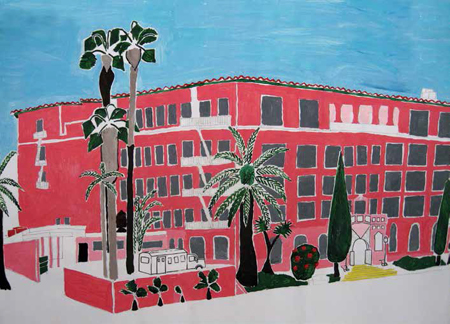
A portrait of Harbor View House by resident artist Ray Rodriguez

A portrait of Harbor View House by resident artist Ray Rodriguez

Among the first in the United States to champion the validity of outsider art were Janos Marton and Bolek Greczynki, two expat scholars out of Columbia University’s School of Visual Arts in the 1970s. Largely influenced by the idealistic, humanist approaches of artists and writers like Jean Dubuffet and André Breton, Marton and Greczynki later founded the first-ever art studio on the grounds of Creedmoor Psychiatric Hospital in Queens. This art studio, christened The Living Museum, sought to showcase the work of Creedmoor’s many untrained yet visionary patients, and was dedicated to the purposes of beauty and healing above all else.

 
Fifteen years ago, psychologist Dr. Israel Rubenstein flew out from Southern California to visit Creedmoor, and was so impressed by the hospital’s art studio that he decided to open a similar space at Harbor View House, an adult residential psychiatric facility in San Pedro. For the past four years, Alisa Stein has served as Art Director of The Living Museum Art Center at Harbor View House, a former racquetball court turned studio and gallery space for the Harbor View House residents—as well as anyone else who’d like to spend a morning chatting with the artists and viewing their work over a hot cup of fresh (free!) coffee, which is exactly how I first met Alisa Stein, as part of a class trip to the studio in one of Mady Schutzman’s graduate writing workshops at California Institute of the Arts. A few weeks later, I returned to the studio to talk one-on-one with Alisa about her work managing the atypical art space. The two of us discussed the psychological benefits of art-making, the realities of mental illness, and more.

ADRIANA WIDDOES: Who are the residents of Harbor View House and how do they get here?

ALISA STEIN: Everyone here has been diagnosed with a mental illness. In addition, they usually have drug and alcohol addictions, so prior to getting here most of them have lived on the streets—either on skid row or park benches. They usually have had some kind of altercation with the law or some other issue and end up at a psychiatric hospital in that way. Then from there they’re referred to living here at Harbor View House. But the number one reason for being here is mental illness. Most of our residents have schizophrenia or bipolar disorder.

AW: What do you think drives the residents of Harbor View House to create art?

AS: I think what drives them is that most of these people have never been accepted by society for whatever reason—whether that’s because of their mental illness or their addiction problems. Coming in here and being able to create gives them a sense of self worth that they can do something. They can make something that they can get recognized by. And that recognition is not just from a gallery or a museum. It’s also from me and other people who are working or living here. Because most of them have never been told that they were good at anything. They haven’t had a lot of success in their lives, so something as small as creating a tissue paper poinsettia can give them such a sense of self worth.

AW:
I agree that creating gives people a sense of purpose, and that’s not something special to people who suffer from mental illness either.

AS: It’s for everyone. We all want to feel creative. We all want to be able to do. People without a mental illness can get that feeling through many different avenues. But for people with mental illness it is so critical because they really lack so much support. Most of their families have just been tired by their illnesses and their addictions and the chaos that they cause, so they just sort of left them to be. So maybe creating tissue paper poinsettias doesn’t give them everything they need, but it’s still something. If they didn’t have that and had nothing instead, it would be even more traumatic.

AW: What are some of the obstacles for the artists that you work with here?

AS: One pretty common obstacle is that they are all on psychotropic drugs and some of them are heavily medicated. Just trying to function through a day when you’re taking 400mg of Lithium and 300mg of something else is difficult. It affects your sleeping and your eating. A lot of them are also trying to stay sober and unfortunately the neighborhood has a lot of drugs that are available. People have to fight off their demons just to not go outside and use. That is an obstacle. Some of the residents’ personalities here can be very volatile and sometimes the environment can be very unsafe, and they’ve got to deal with that. They might have a roommate who has stolen something or done something else bad. This is their home, but it can be a very difficult atmosphere.

AW: How do you experience the relationship between the Living Museum Art Center and the rest of the building, which is perhaps more clinically oriented?

AS: I think the art is such a blessing to this building. People come in and it’s like the oasis here. It has life, color and beauty. The building is otherwise pretty traditional in the sense that the walls are all white and it can feel very institutional. We try to hang art throughout the building and give it some life. The fact that the art wasn’t just done by some artist in downtown L.A. and is actually the art that has been created here gives it so much more meaning. When outsiders come to visit this place, they’re not expecting to see what they see in here, and it feels good to know that things are still going on here. Residents aren’t just milling around smoking cigarettes or lying in bed all day. They are actually producing something that gives the building life.

AW: Are you ever concerned that visitors might be coming to view the patients and not the art?

AS: I’ve never had that feeling. The artists actually really like it when they have visitors. They don’t feel that it’s an observation of them. I think they almost feel privileged that people are interested enough to come see what’s produced here and how this program works. It makes them feel good.

AW: Do you consider yourself an artist (trained or otherwise)?

AS: Not trained, not untrained. I am not an artist. I would say I’m a creative person, but the only F I got in school my whole entire life was when I got an F in art in 7th grade. My teacher at the time told me that I was the most uncreative person that she had ever met! I tell that story all the time. It really stuck with me, but lo and behold— I’m Art Director of a mental health facility creating projects. I think I’m artistic in the sense that I understand the elements of art, but I always tell my artists here that if they ask for help painting a portrait, I can’t.

AW: Do you think being untrained helps your dynamic with the artists working at LMAC?

AS: I do. I think their perception of me is as a leader and as someone who is able to explain and define things. I always tell them how talented they are—and they really are—and I think it’s a good balance. They have taught me a lot about art and drawing and painting. I feel they are not intimidated by me because 99% of the time I can’t out paint them and I can’t create something that looks lovelier than they can. It makes it a more comfortable atmosphere.

AW: How necessary do you feel art programs like LMAC are?

AS: Oh, they are so necessary. They are vital, and not just to provide an extracurricular activity; it has been proven that art-making enhances cognitive skills. There is just no downside to creating. It enhances people’s wellbeing tremendously. I see it first hand. I see the change in the artists’ expression. It just gives them a purpose to create something. That’s not something that anything else in their life offers them.

AW: Do you ever feel frustrated? Do you ever feel like what the art studio can provide the residents here is not enough?

AS: Of course. I feel frustrated when I’ve been working with an artist for 6 months and they’re really coming along and I can see some hope in their eyes and then I don’t see them for a month and I find out that they’ve started smoking crack again and are living on the streets. Then when they end up back at Harbor View they’re all beat up and we have to start from square one again. I get frustrated when I feel like all the work that an artist and I have been doing is lost in an instant. It’s hard to understand mental illness. It’s so different for everyone. Even the same diagnosis of schizophrenia can manifest so differently in each person— and it can be very frustrating. It’s frustrating when a 55-year-old woman doesn’t understand that she is making a poinsettia even though I’ve explained to her that a poinsettia’s leaves are red 15 times. That’s tough. But that woman did do something in the end. It’s all good—and she felt good about it.

AW: Is any of the art for sale?

AS: Yes, we do sell the art. 50% of the proceeds goes to the artist and 50% goes to buying supplies for the studio. Anyone who’s interested in purchasing something can view the art by contacting me and setting up an appointment. We don’t necessarily use the gallery for art sales or exhibits. It’s mostly just to showcase the larger pieces of art that artists have created here. We’ve tried in the past to open the gallery up to the outside, but because of its location on the third floor of the facility it’s difficult to get passersby up here. 95% of our sales happen in outside art galleries. We’ve exhibited in L.A. City Hall, Torrance Art Museum, Angels Gate Cultural Center—all various types of galleries.

The Living Museum Art Center is located at 921 S. Beacon Street in San Pedro, CA. To contact Alisa Stein, make a donation or become a volunteer, please visit the LMAC website.


By Adriana Widdoes

an Associate Editor for Black Clock and an MFA Writing candidate at CalArts

Black Clock 15 OST

Black Clock contributor Howard Hampton (issues 4 and 15) has compiled a soundtrack for the sweeping epic (during which no one will be seated!) that is our latest issue. Fire up your Maxwellian demon or tune into your imagination and viddy what scenes may come.

Black Clock 15
The soundtrack album that never was!

Compiled by Howard Hampton*


1. “Waiting for My Man,” The Yardbirds [from the film Kaleidoscope]

2. “Hankuri,” Mad Man Jaga [from the film A Clockwork Orange]

3. “America (She Can’t Say No),” Throwing Muses [from the film The Crying of Lot 49]

4. “Indifference,” Robert Plant [from the film The Monkey Wrench Gang]

5. “The Shadow World,” Sun Ra [from the film Elvis vs. Cthulhu]

6. “Stranger in My Home Town,” Elvis Presley [from the film Elvis vs. Cthulhu]

7. “Katrina,” James Blood Ulmer [from the film Katrina, Academy Award winner Best Picture, Song, and Director, Charles Burnett, 2009]

8. “Mother,” Lou Reed [from the film Baz Luhrmann’s Intolerance]

9. “Who Killed Marilyn?” The Misfits [from the film Hollywood Babylon]

10. “Stagger Lee,” Joan Baez [from the film Shaft in Space]

11. “Darktown Strutter’s Ball” / ”I’ve Got a Feeling,” Maria McKee [from the film A Confederacy of Dunces]

12. “A Cottage for Sale,” James Brown [from the film The Honeymoon Killers]

13. “War with My Soul,” Raven [from the film Ronnie Rocket]

14. “A Minute and Two Seconds,” John Cage [from the film Uncanny X-Men]

15. “See No Evil,” Wild Flag [from the film Angel Archer]

16. “Dead Flowers,” Ronnie Lane’s Slim Chance [from the film Maximum Dogbreath]

17. “Going Down the Road Feeling Bad,” The Carolina Chocolate Drops [from the film The Life of the Party]

18. “Pale Blue Eyes,” Laurie Anderson with Lou Reed [from the film The Lovely Bones]

19. “Tea for Two,” The Comedian Harmonists [from the film Kill Bill vol. 1]

20. “Face Place,” The Slits [from the film Who Killed Bambi]

21. “Let’s Submerge,” X-Ray Spex [from the film The Invisibles: Entropy in the UK]

22. “Year One,” X [from the film Footloose]

23. “I’m a Robot,” Miles Davis [from the film Tron]

*Almost all songs are from concert bootlegs or out-of-print albums that can be found on the internet by anyone with a modicum of ingenuity, a search engine, and a bit-torrent client.

A Tribute to: “Neil Hamburger Presents: A Tribute to Dora Hall”

When in the course of human events it becomes incumbent upon the people to recognize and, furthermore, to honor, deceased genius in whatsoever capacity and in whomsoever it had chosen to manifest itself, we should be extremely ignorant (and we shouldn’t be) not to call upon the services of another similarly gifted individual to preside over whatever bittersweet rites for that we can be assured their moldering object is the peacefuller (if hereafter forever unwitting).  This being the case, you can easily imagine how blithe I was when I heard that someone in the Cinefamily had the delicacy of taste and enough horse sense to get Neil Hamburger on the blower and beg him to rush to their home on Fairfax Avenue this past July 3 to host a belated tribute to one of the 20th century’s most beloved stars of the silver screen.

Tell me something.  Are you a drinker?  That is, do you like to drink?  Don’t be a fool, we all do.  And when you drink, you’re not just cupping at it with your hands like one of the lower animals that’s lucky enough to have hands.  No, of course you’re not.  You’re using a simple machine and I’ve already given you a hint as to what it’s called.  Give up?  Why, it’s a cup you wastrel.  Unless you like the taste of sweat and bodily oils, you probably use a cup every day and chances are, if you work or study in one of this proud nation’s many institutions, you’re using a Solo Cup, whose many lines of hardy, single use cups are depended upon by thirsty, hardworking men and women the world over.  Slurping down your sugared syrups and gas-inducing carbonics, you probably never even pause to think about the flesh and blood people and two people especially who sweated and strained and broke their backs just for the paltry cause of your refreshment as you belch away endlessly. Well, let me introduce them to you.  One of those people was Leo Hulseman, former Dixie Cup cup-wright turned genius designer of the revolutionary Solo Cup and founder of the multi-billion dollar enterprise of the same name.  The other was Dora Hall.

For every genius, there is a genius behind the genius.  That genius was Dora Hall.

“Gorgeous” Dolores Hall came of age in our nation’s finest hour, in the heart of the first great war and the “cando-ism” of that stalwart time left an indelible stamp upon her charming person.  This rosy-cheeked, corn-haired young dove from somewhere in the American midwest sang the kind of old-timey sentimental songs that could make you want to cry into your beer or raise up your voice and join in the general fun.  It wasn’t long before enterprising producers at the USO were whisking her away to exotic locales in Europe to entertain homesick troops with hot-to-trot song and dance numbers served up family style.  It also wasn’t long before she trotted into the heart of enterprising young cup-man Leo Hulseman, whereupon love put a lid on showbiz.  Soon they were married and before you could say “Minneola” her womb was rich with the first of what would be many young squires and squirettes.  With Leo busy with the nascent Solo empire, the task of remaining impregnated and raising children fell squarely on the shoulders of young Dora.  She accepted the grave and sacred responsibility with stoicism typical of her modest prairie upbringing, but under one condition.  Dora made her husband promise that once the fledglings had flown the coop, he would help her back to the stage where she might again share the brilliant lightness of her musical and dance routines with the entertainment hungry hoi polloi she had come to love so well.  Naturally, Leo consented like the gentleman he was and neither partner ever forgot the promise.

When at last the kids were packed away and the Solo Cup dream had become a reality, Dora drew against the check she and Leo had signed so long ago.  With more than “sufficient” funds, Dora was back in business.  Show business.

With the full faith and confidence of the Solo Cup company behind her, Dora got her groove back with a series of Solo financed LPs throughout the 1960s featuring a mixture of classic songs and mirth-inducing original sketch routines.  In a legendary bout of largesse these were provided to consumers at no additional cost along with purchases of Solo Cups products.  Having broken the sound barrier, Dora set her sights on celluloid and Leo was only too willing to oblige.  Throughout the next two decades, Dora scintillated viewers with a rich patina of entertainments from children’s programming, to gripping psychological drama to star-studded variety spectaculars—all offered free to the consumer either packaged with Solo products or delivered through the mail in exchange for proof of purchase. With a fan club numbering nearly 50,000, a full production studio in Solo subsidiary Premore inc. at her disposal, and no less than two awards of excellence from the film advisory board, this grandmother of 16 seemed poised to break into the big time even as she neared her 90th birthday.  Unfortunately, as the case so often is, fate had other plans and gentle Dora struck out solo before she truly struck out solo.

Thanks to the efforts of her legions of fans, the Cinefamily and world renowned entertainers such as Neil Hamburger, however, Dora’s name has not been lost to the ages.  At the very special July 3rd retrospective, on what would have been her one hundred and eleventh year on this Earth, the side-splitting class act Hamburger, waxed nostalgic as the curator of a heartfelt tribute to one of his heroes and a primary inspiration for his own brilliant brand of family-friendly, Borscht-belt broadsides. Like his tinsel-town godmother, Hall, Hamburger knows how to beat the blues without resorting to blue material, which made him the perfect pick to guide us through the sparkling legacy of the late comedienne, which he did with squeaky-clean humor and aplomb (along with his signature hacking cough and ever present old-fashioned), peppering the evening’s three heartwarming video presentations with personal anecdotes about growing up in the shadow of Dora along with a few trademark drolleries about the latest “stars” such as pop-idol Britney Spears and one particularly memorable dressing down of contemporary rock musician, Mick Jagger.

When the evening ended, there was nary a dry eye in the auditorium (this reviewer included), although that may have been the result of the hellacious issue that some disgusting nearby person was apparently incapable of suppressing until he or she exited the theater.  Therefore, I was not alone in my rage when, as the presentation concluded and Mr. Hamburger asked if anyone had any questions or comments regarding the material or Dora’s legacy, one drunken miscreant had the mendacity to suggest that the Solo Cup company had engineered the infamous “Two girls, One Cup” debacle of 2008 as some sort of sick publicity stunt, nor was I alone in raising my voice to chorus Hamburger’s emphatic recommendation to that same person to please, “CRAWL BACK INTO THE SEWER WHERE YOU LIVE!”

by Seth Blake
an Associate Editor for Black Clock and an MFA Writing candidate at CalArts

Heidi Julavits and Vendela Vida Read at The Hammer

It’s an odd room, part press-conference, part funeral parlor; black cloth and bunting, concrete floors and folding chairs, entirely scentless.  The stage is set with a lectern and next to that, inexplicably stands a small end table, hosting a vase of what look to be artificial flowers. The word “HAMMER” is projected in flickering electric purple letters at the center of a spotlight along the left-hand wall. I like the effect.  If the Oxy had displayed this on a marquee outside the building, the place might have been full; full of pleasantly surprised people who had come in cruising for burgers and gotten soul food instead, by which I mean a quality reading.  As it were though, the turnout’s not bad—maybe two-and-a-half dozen.  Not wrestling numbers, but the show still kicks ass.

First up is a man, balding, bearded, hip.  He seems to be a museum guy.  He introduces the reading, haltingly.  He introduces the first reader, Vendela Vida.  He does it poorly, but with an endearing warmth and humor—stumbling through his copy as though he is astonished at what it says.  He seems to know Vida; his tone says “I’m sorry, Vida, I have to read this.” She forgives him.  She begins. An excerpt from her latest novel, her third, The Lovers.

Critics call her “a careful, clever, stylist of literary dread” and it’s true, too.  The excerpt is mannerly memoir. Mid-century American blue-bloods Yvonne and Peter, graduate from Stanford and escape to Paris, where, everyone is certain, their nuptials will begin to impend.  Yvonne is polite, discrete, maybe even a bit of prude, so when nothing happens, nothing happens.  Even for his day and social bearing, Peter seems cut from a nobler cloth; a chaste one.  As nothing continues to happen, Yvonne gets fed up. At last, one night she presents herself boldly before Peter’s hotel-room door wearing only her bathrobe and a determination to be interpolated as woman and wife.  What follows is a revelation that recalls Haynes’ Far From Heaven.  It isn’t that Peter isn’t interested in a woman like Yvonne—it’s that he’s not interested in a woman.  It’s a great moment, and a showcase for Vida’s talents as a storyteller—one who is capable of wringing sensuous detail out of a brisk pace, and a complex blend of humor and heartbreak from understatement and elision, the stock and trade of her prim heroine.  While Vida’s own subdued reading style took a while for me to warm up to, I was thoroughly converted by the time the excerpt ended with what seemed like another nod to the Hollywood of Douglas Sirk, with Yvonne meeting and falling in love with another man named Peter, her polite, proper tone complicated by newfound notes of burgeoning wisdom born of loss and trial, which upon reflection, Vida had subtly invited the listener to discover from the start.

From then on it’s singlets, singlets, singlets.

Again, the guy gets up and just bombs.  I’m starting to think it’s part of the show.  Again, the reader takes it remarkably well.  I’m going to say that Heidi Julavits kissed the guy, but I don’t know, maybe that didn’t happen—it would have been the right thing to do though, he looked like he needed a hug, at least.

Everybody loves Heidi right off the bat because of a thing she says about her name.  Actually, this is funny, the guy who introduces her sort of makes this half joke (like I’m doing now) about Julavits rhyming with a part of the human body and everyone sort of titters. Then Heidi gets up and says kids used to call her Heidi “Juicy-Tits” and this was doubly silly because they were calling her this when she was about nine and this was obviously not the case.  She completely over-explains the joke (like I’m doing now) which of course is a lot funnier than the joke itself or the suggestion of it and everybody dies and is with her instantly and immediately forgets the one thing that the poor MC thought he got right.  Now I’m certain they must have planned this. Then, just when I thought things couldn’t get any better, she begins to read.

Track down “Multiples of Cohen.” If possible, track down Heidi Julavits and have her read “Multiples of Cohen.”  This is not to say that the piece doesn’t work as well on the page (I haven’t confirmed this, but I can’t imagine this is the case) only that it begs to be read aloud and with great aplomb.  The birth of a failed collaboration between the author and an unnamed visual artist who solicited Julavits to write a companion piece to an installation Julavits describes as “pretty, corpse-like visions of masculinity,” apparently featuring mens’ wrestling singlets in a prominent capacity, “Multiples of Cohen” is an absurd bildungsroman-in-brief about a cardiologist in aubergine pants who learns to overcome his effete, bourgeoise sensibilities with the help of a sweaty, overweight, singlet-wearing beefcake named Cohen.  Wielding cliché with as much self-conscious glee as the axiom-dispensing eponymous hero, Julavits inscribes a redemptively genuine appreciation over a familiar world in which all knowledge seems to teeter precipitously at the edge of irony and farce.  Though Cohen is in many ways a repulsive, cartoonish figure, described variously as “a mothball with legs full of overfed sperm,” smelling of “roast beef” or “off-gassed meat,” he is also the most charming, compelling and complex character in the lot.  It is Cohen who sweats, who jokes, makes inappropriate sexual overtures, cries unapologetically, and ultimately dies. Although a short story with a clear trajectory and tight-ending, “Multiples of Cohen” has that rare quality that is simultaneously able to move an audience and take pleasure in the often silly moves required to get us there. Julavits obviously delights in exhuming the “corpselike visions of masculinity” that star in “Multiples of Cohen,” and making them perform, but their dance is much more than a snarky invitation to laugh at their expense.  As another character, the nanny / narrative medicine acolyte, points out in one of the story’s more absurdly-poignant / poignantly-absurd moments “you are the curator of the suffering of others.” Which, I think suggests something to the effect of we can chose to gloat over the ruins of even something which has been demolished deservedly, or we can build something new out of it.

Vida and Julavits have clearly imbibed of their own medicine. Carving from the rump of nostalgias with pretty, glittering knives, they served up something hot, delicious and very nutritious under those burger-stand HAMMER lights.  Believe it.

by Seth Blake
Associate Editor for Black Clock and an MFA Writing candidate at CalArts
who attended Heidi Julavits and Vendela Vida’s June 9th reading at The Hammer

Listen to BC 11

It’s undeniable that music influences our sensory experience of the world–especially when we are in the position of the receiver of information. This is to say, it doesn’t take a professional film critic to know that the score or soundtrack is just about as important as what is being visually presented on the screen. What is thought about less often, perhaps, is music’s tie to the reading experience. To be sure, there is a great contingent of readers who prefer not to allow music to mingle with their experience of a text. However, a well-picked (or coincidentally synced) music selection can enhance our consumption of what’s on the page. As such, I’d like to offer the following playlist for Black Clock 11.

1. “NYC” by Interpol
2. “Sleep Alone” by Moby
3. “Twice” by Little Dragon
4. “Despicable Dogs” by Small Black
5. “Naked If I Want To” by Cat Power
6. “The Times They Are A-Changing” by Bob Dylan
7. “Graceland” by Paul Simon
8. “Signed, Sealed, Delivered I’m Yours” by Stevie Wonder
9. “Border Guards by The Rosebuds
10. “By This River” by Brian Eno
11. “Aperture” by Wes Willenbring
12. “We Have A Map of the Piano” by Mum
13. “Tomorrowtoday (part 2)” by Triosk
14. “Masonic Funeral Music” performed by Herbert Von Karajan; Vienna Philharmonic Orchestra
15. “Down the Line” by Jose Gonzalez

Track 1 rides the energy of issue 11’s first two pieces, while tracks 2 and 3 span the flow and length of Jenny Burman, Joanna Scott, and Veronica Gonzalez’s pieces. Track 4 picks up with the mood of Rebecca Newberger Goldstein’s piece. Track 5, Cat Power’s second cover of Moby Grape’s “Naked If I Want To” fittingly takes us into David Grubb’s meditation on the immortality of the recording. Tracks 6, 7, and 8 lift us up for Greil Marcus’s reflection on Election night. The twang of the Dylan track, referenced in the piece, flows into Paul Simon’s sweetly hopeful song for “Graceland;” and both of these tracks culminate in the campaign’s anthem, “Signed, Sealed, Delivered I’m Yours.” The pace begins to slow and the mood sombers with track 9 and Danielle Blau’s piece. Tracks 10, 11, and 12, and 13, take us through the magazine’s next five pieces. Track 14, an eerie classical composition, submerges us in Chris Abani’s piece, and track 15 launches us into Richard Powers’s novel excerpt, with the rush of being onboard a plane, fidgeting, glancing out the window, and a sense of impossible height.

by Mallory Farrugia
a writer and freelance editor living in Venice, CA

Black and White Clock

A photographic series of analog clocks in and around Los Angeles (plus one in San Diego) that illustrates Marie von Ebner-Eschenbach‘s truism, “Even a  stopped clock is right twice a day.”

Brand Boulevard & San Fernando Road

Glendale Boulevard

USC Doheny Library

USC Doheny Library II

Atwater Village, Apartment

Hotel, San Diego

Brentwood, House

San Fernando Road & Acacia Avenue

by Diana Arterian
who is currently earning her MFA in Poetry at CalArts and assists California Poet Laureate Carol Muske-Dukes;
her self-published chapbook
First Wind is available at Skylight Books

Staccato-Like

Attendees of this coming weekend’s 5th anniversary / 10th issue launch reading can look forward to mixing with a special selection of noir sounds as selected and sequenced by Black Clock editor Steve Erickson.

In fact, dig.


Limited Edition Soundtrack CD

1. “Générique” by Miles Davis
2. “The Big Sleep” by Max Steiner
3. “Double Indemnity” by Miklos Rosza
4. “Body Heat” by John Barry
5. “If You Go” by Helen Merrill
6. “Peter Gunn” by Henry Mancini
7. “Vertigo” by Bernard Herrmann
8. “The Bad And The Beautiful” by David Raksin
9. “Harlem Nocturne” by Harry James
10. “Touch Of Evil” by Henry Mancini
11. “It’s A Lonesome Old Town” by Frank Sinatra
12. “Laura” by David Raksin
13. “Marlowe” by David Shire
14. “Taxi Driver” by Bernard Herrmann
15. “Park Avenue Beat” by Fred Steiner
16. “The Fountainhead” by Max Steiner
17. “Long Ago And Far Away” by Jo Stafford
18. “Chinatown” by Jerry Goldsmith
