Singular, idiosyncratic and a little mysterious, Black Clock is one of America's leading literary journals.

Author Archive for Eleni Demetriou—

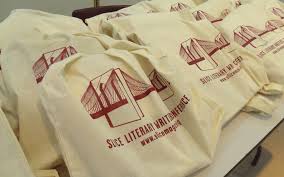
Through the Eyes of an Intern: Slice Literary Writers’ Conference

indexWhat’s interesting about the literary scene in New York—that one distinctive thing that is so very different from the literary scene in Los Angeles—is that it will always haunt you no matter where you are. Maybe it’s the city itself, or maybe it’s the kind of people it attracts, but if you’ve ever had the (mis)fortune of living within Gotham’s walls, you can understand how you cannot escape anything on this island.

Another thing about the literary scene in New York is the curious case of Williamsburg aka Hipsterville. It seems that writers flock to New York City and settle down in Williamsburg, far, far away from Manhattan.

And far, far away from me.

Which is how, on September 7th 2013 at 8:30AM, I found myself making the forty-minute journey from the Upper West Side to Brooklyn. (One stop on the downtown 1 to 96th street, and change to the 2 (or 3) until Borough Hall.) As a Slice Magazine intern, I was making my way to the writers’ conference we were hosting. I was in charge of setting up and making sure everyone who was attending knew where they were going and what they were doing.

I listened to Tom Waits as I held Eugenides’ Middlesex throughout the entire ride, all the while giving myself a little pep talk, which largely consisted of mantras not to make a fool of myself. (Needless to say as an awkward writer, this did not go as planned as I had a little run-in with literary agent Renée Zuckerbrot and editor Calvert Morgan. But more on that later.)

I wasn’t used to literary New Yorkers; what I knew was readings at the Downtown Los Angeles Library, at Stories café in Echo Park, at Griffith Park under brilliant sunshine. I knew forty-minute-commutes in the privacy of my car, I knew palm trees and warmth. But here I was, on a mildly dreary September day in the Empire State, and all I could think of was something I had read the previous summer while interning in Brooklyn that went something like: ‘I kept on wishing I was back in Los Angeles wishing I was back in New York wishing I was back in Los Angeles.’ I wished it then, and I kind of wished it now.

Forty minutes later, I arrived at St. Francis College where the Slice Literary Writers’ Conference was taking place. Slice Magazine is the beautiful creation of Maria Gagliano and Celia Johnson. They have provided the world with a wonderful literary magazine—a magazine that has received positive reviews from the community (see Junot Diaz, for example). It “aims to bridge the gap between emerging and established authors by offering a space where both are published side by side.” They were launching their thirteenth issue after the conference at the PowerHouse Arena in Dumbo, Brooklyn.

But let’s back up a bit to the conference. The lineup consisted of extraordinary people. Agents, editors, writers, interns. Panel after panel, workshop after workshop—from 10AM to 5PM—the building swelled with all the knowledge that was being oozed out and sucked in. Having said that, it was interesting to see how business-like most of the people were. And perhaps that is something that, sometimes, writers forget. Because, after all, the publishing aspect of writing—that ugly side, the side that is not really a side in our minds but the top of a mountain we’ll get to after years of climbing and sweating and writing—is a business. It’s supply and demand, it’s marketing, it’s profit-making.

The most extraordinary example of this business, however, was when I started pointing several aspiring writers to room 3204. (Or perhaps 3042. Maybe it wasn’t even a four-digit number, but 3 was in there.) In any case, Room X was on the third floor, and in that room sat four literary agents. Four business-minded, word-loving, book-adoring individuals with an impressive list of clients. That is where I made a fool of myself in front of Renée Zuckerbrot of Zuckerbrot Literary Agency as I showed her the way to the room for the afternoon. I was so nervous and careful not to say anything stupid, I didn’t say anything at all. In the silence that surrounded us, I was very aware of the noise our footsteps made and the chatter of people around us. I scratched my mind for something to say, something witty, but all I did was keep quiet and convinced myself that Ms. Zuckerbrot probably thought I was physically inept at social conventions such as talking.

These hungry writers with completed manuscripts had 15 minutes—that’s right, fifteen; one five—to sell it. Instead of an impersonal email with a pitch that barely gets 2 minutes of attention, these people had one quarter of an hour of face-to-face time with literary moguls. I can’t say how many of those writers actually got the ‘okay’ to send them the manuscript as I was busy making sure editors and publishers knew where their panels and workshops were, but it is a true testament to Slice that it has given the literary community such a rare opportunity.

It was such an opportunity that found me talking to Calvert Morgan—Executive Editor of Harper and Editorial Director at Harper Perennial—as we walked down the corridor towards his panel. It wasn’t a moment of enlightenment, nor was it an ‘aha’ moment, but it was the sort of advice that is given to you that just sits with you for a while and warms you up as time passes. It was a simple, “there is never such a thing as just a crew member,” in reply to me saying “I’m just a crew member.” And maybe I still feel like I made a fool of myself in front of him, but at least I got a few words from Mr. Morgan that will probably haunt me for the rest of my life.


By Eleni Demetriou
A Greek-Cypriot fiction writer who fell in love with New York City after living in Los Angeles for two years.
John. Chapter One. Verse One.

imagesAfter twenty-one hours of traveling, four different countries, three different planes, and three hundred and fifty pages, a litany kept repeating itself in my mind: my life, my time, my hope, my god, my faith, my love, my glory.
 

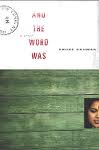
With his 2006 debut novel And The Word Was, Bruce Bauman has given us the gift of an honorable character and an honest man; a man who isn’t afraid to love. Neil Downs is an ER doctor from Queens who runs away from New York City after the tragic death of his son. He ends up in New Delhi, where a myriad of factors come together and blow up in front of the reader, ranging from the political to the philosophical to the hypocrisy that exists in our everyday lives.

Neil tracks down his favourite writer, Holocaust survivor Levi Furstenblum, whose writings are interspersed throughout the novel and are the catalysts to certain events. What was fascinating to me was Neil finding himself in the writings of Levi while Levi’s writing reflected what Neil is not. Levi might have lost his god, his family, and his faith in humanity, but Neil did not. Yes, Neil lost his son, his god, and even his wife for a while, but he was always on the path toward repairing this. Perhaps my favourite parts of the novel are the instances when Neil kneels down to help an injured young woman, and to place rocks on specific graves, as if he is brought to his knees from all the guilt, the tormented ghosts of his past, and his regrets.

(And perhaps my choice of Edith Piaf’s “Non, Je Ne Regrette Rien” wasn’t a random yearning that has been haunting me ever since I read Bauman’s first sentence.)

Curiously enough, “epistasis is the biological term, which science best defines as that nothing is simple and everything depends on everything else” (Bauman 230). The etymology of “epistasis” comes from the Greek word “epi,” meaning “upon,” and “stasis,” which means “stopping;” therefore “a stopping” or “stoppage.” While Neil is in this constant game of “stop and go” (something that Levi knows all too much about), they both need each other and everything that exists in the universe in order to survive.

In essence, this sums up Bauman’s novel beautifully (even if the science that has been carefully penned into this novel is sometimes out of my reach but hey! That is the beauty of fiction). When you lose a person you love, you lose a part of yourself. When you lose your god, your faith is shaken and you start to shatter into small fragments. Most of the time, those two are interrelated and I’m not quite sure which way the causal relationship works.

It is the tug of war that goes on in our entire universe. It is the debate of god and science, of love and loss, of death and life. It is the alienation that Neil feels wherever he may be, mentally or physically. It is his wish to go deaf—for silence in a world that is anything but silent. It is the desperation for something more and the unwillingness to accept that perhaps seeing is  believing. It is the bonding of people who are suffering and how they heal each other by searching for the truth together, consequently bringing each other to salvation.

I can’t stop thinking about the struggle that Holika, an intriguing upper-class Indian woman who had a brief affair with Neil, faced with the social norms that exist in India. I can’t help but think about Abraham and Isaac. About Rilke and “The minds of murderers are easily comprehended.” About the similarities between India and America. Between Israel and Palestine. All the corruption and death, but all of the underlying humanity that is surely found between them. Between, between, between . . .

Ultimately, the greatest tragedy is not Levi Furstenblum losing his family or his god. It is not Neil Downs losing his son in a savage hate crime. It is not the unfairness that plagues India, America, or the world. The tragedy, fundamentally, lies with Sarah Roberts—Neil’s wife who is lamentably silent throughout the first part of the novel—who has her own heavy cross to carry. A cross that is so heartbreaking and so intense, that not even words could contain her pain as most of her journey was off the page. She was alone. And when Neil hears the anguished words of what really happened, our stomachs are in our throats, too.

Because while every single one of the broken characters in the book lose faith in a god that lives out of reach, Sarah loses faith in the man she loves. She lost faith in herself. But as much faith as was stolen from her, she did not lose faith in humanity. Humanity—which Levi (spells ‘Evil,’ spells ‘Live’) Furstenblum only saw the most vicious, the most atrocious, the most horrible aspects. Humanity—which never cared about the agony that was found in the victims of the 20th century, a counterpart to the hatred that was felt by their torturers.

 
And The Word Was is a novel that teaches the reader that hope is often found in the strangest, dampest, and darkest of places. It tells the story of hope always dying last. While I willingly run to the city that Neil Downs has tried to leave behind, I realise that hope is time, and my time will last as long as I want.
 

By Eleni Demetriou
an Associate Editor for Black Clock and a graduate of the MFA Writing program at CalArts.

Next Words at Stories

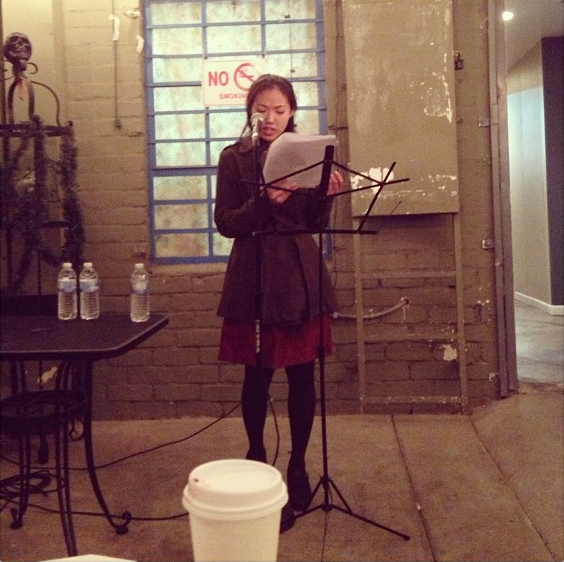
CalArts MFA candidate Colleen Hur

CalArts MFA candidate Colleen Hur

I cannot handle cold weather and, apparently, neither can Los Angeles. It was 55 degrees on the second Saturday of April, and I begged for a heater. Having a reading outside with winds straight from the mouth of Satan was not ideal. A heater. That should work.

Next Words is a transition. A reading series that features new work from the CalArts MFA Writing program. It’s the moment where all of our innovation, ambition, and experimental spirits come together as they are introduced to the community outside of CalArts. We the editors-slash-curators call Next Words “an exposure, a nebula, a metamorphosis. A constellation of words in flux—cleaving, becoming. We exit and enter at the same time.”

Stories Books & Café graciously hosted the third event on their outdoor patio in Echo Park. Independent or not, small or big, every bookstore has its own story, and Stories features a wealth of new and used books, as well as organic and fair trade coffee and espresso. I am not a coffee snob by any means—I like my Starbucks, my Coffee Bean, and my Silverlake coffee—and all I know is either way, where there is good coffee, there are good books. Et voilà, Stories. But perhaps this is also so much more than that, which is why the curators of this reading series chose this space to showcase the students; Stories supports local writers.

I chose my seat wisely, so I sat in the middle, only a few chairs away from the sole heater, my leather jacket zipped all the way to the top as I kept the time. (Yes, as an editor and curator of Next Words, I had certain responsibilities.)

Four writers, four different voices, ten minutes each. Jen Hutton—a writer, critic, artist, and translator from Toronto. Patrick Benjamin—an Associate Editor for Black Clock with a superbly-kept beard from Southern California. Colleen Hur, a YA writer from South Korea who had me in tears of laughter as she sped through her reading. And Peter Nichols—a wonk who is particularly proud of an interactive sculpture of his titled “Love in a time of Necrophilia.” I cannot take credit for these descriptions (well, not all of them anyway), as they were provided by the readers.

Faculty, former, current and prospective CalArts students, as well as the Los Angeles reading elite came out regardless of the weather. While I might be a sissy when it comes to cold weather—it does make my nose feel like an anchor and my chest like a cheese grater—I fully supported the outdoor patio reading. The turnout was incredible, and I fully consider my Saturday night to have been a success.

Los Angeles isn’t really home, but while my European habits might be made fun of and teased, these are the moments when I—you, we, writers—experience something other than the solitary and lonely act of writing. Stories, Next Words, the art of reading in front of a great crowd is an intimate act where the microphone amplifies the words and searches to enter ears and worlds. As seen on that Saturday, at 7PM, writers came together and for one moment, they were part of something greater.


By Eleni Demetriou
an Associate Editor for Black Clock and an MFA Writing candidate at CalArts.

The Strand: My Funny Valentine

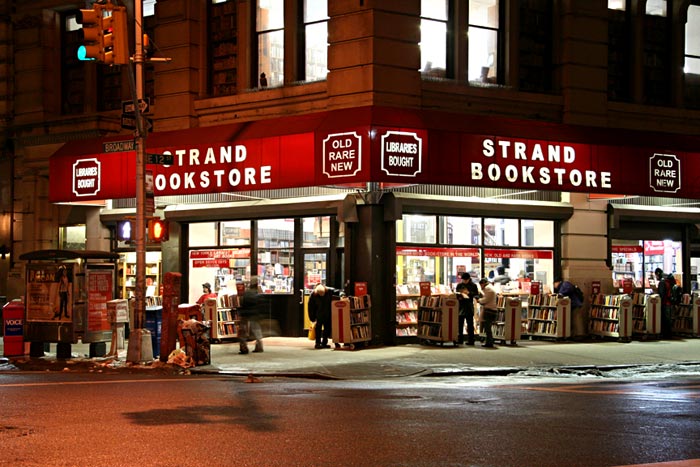
StrandIf I’m going to write about The Strand during February then I’m going to do it right. So “My Funny Valentine” starts to bleed into the shortest month with the carnival giving this red month an eerie air of celebration. Yet it is love and eros that resonates in peoples’ minds. And that is why I’m writing about The Strand—my darling, independent bookstore in New York City—where on the corner of 12th and Broadway I started to fall in love.

The Strand first opened its doors to book lovers in 1927 on Fourth Avenue as yet another bookstore on the legendary Book Row. Now, in 2013, it’s the only Book Row survivor, and can be found on 12th and Broadway covering 55,000 square feet with over 200 employees and more than 2.5 million used, new, and rare books. The owner, Nancy Bass Wyden, speaks of The Strand’s “18 Miles of Books” with great pride, something that is quite remarkable for a business that was, is, and probably always will be, family owned.

I first visited The Strand during the first time I stepped foot on the island of Manhattan. That was back in January of 2012, and on the tenth day of that month, I stood opposite the bookstore for a good ten minutes staring at the numerous trolleys with all the books that were about to fall off. These bookshelves-on-wheels sit right around the entrance, allowing passers-by to flick through them before, perhaps, having a hot chocolate at Max Brenner or joining the manic and eclectic crowd at Union Square. I’m horrified to admit that I must have stayed in the actual bookstore for two minutes at most—but that is for another time, another story—yet something kept taking me back again and again and again.

And again.

Maybe it’s the four floors that are filled with aisles and aisles of floor-to-ceiling bookshelves, a magical labyrinth that will surely leave you giddy with excitement as I can only describe being in The Strand as a treasure hunt where X marks multiple spots. Wooden shelves are abundant, the crammed books beckoning the bibliophile with their index finger to their secret garden. Or maybe it’s all the sections that are too many to list, where you might find yourself with your nose inside a heavy book as the hand of your lover is placed warmly on your lower back in the American History section on the first floor or in the Ocean/Marine Life in the basement. Personally, I think it’s the atmosphere that sits between a perfectly wonderful stale smell of books, pens, and memorabilia that moans into your ear as soon as you open the door.

I suggest listening to Polly Scattergood’s haunting cover of Minnelli’s “New York, New York” as you roam around their exquisite rare book collection on the third floor. Or possibly Simon & Garfunkel’s “The Only Living Boy In New York” while you’re gearing up for one of their many intense author events—heads up, Junot Diaz on the 10th of April at 7PM—and believe you me, they’re all worth it. What better soundtrack to fill your mind when you’re in a bookstore that makes you feel as if anything can happen?

I speak of New York fondly, one of my favourite memories lying in the heart of The Strand where I tried to find, unsuccessfully, H.D’s The Gift. The staff graciously helped me search for it—I toyed with the notion of them live-tweeting the hunt—but it was one book I could not tick off my thesis reading list at that moment. I made my way to the Economics section where a number of customers strolled around like they were home, and I found solace in the catacomb. That was when The Strand became a beacon for me; my beacon, my lighthouse shining the way.

This is where Billy Joel takes over—and it has to be Billy Joel with “New York State of Mind”—as on the tenth day of July I found myself on the verge of tears in front of Bukowski, Charles, in one of the many nooks and crannies that give the reader the safest hiding place in the world. This was a bookstore that offered you a warm embrace before presenting you with your own fairytale.

Essentially, The Strand isn’t just the greatest independent bookstore in the US of A. It is a body, mind, and soul experience. A way to fall in love all over again and learn how to breathe in a ruthless city that offers no second chances.


By Eleni Demetriou
an Associate Editor for Black Clock and an MFA Writing candidate at CalArts.

Tick Tock: I Wrote This For You

It was the only time I had taken a Metro-North train from Grand Central up to New Rochelle alone. It was the 4th of August 2012 (a Saturday night), and that’s when it all began.

My days in New York City were winding down fast and I was trying to comprehend how my summer had just flown by. Interning at BOMB magazine in Brooklyn for three months, as well as celebrating my 24th birthday on the Upper West Side on a rainy July day, was not something I had planned. But I’d be quite the disappointment of a Fitzgerald-worshipping, aspiring young writer if I didn’t spend at least some time being inspired in New York. Plus, Bruce, my short story instructor-slash-senior editor, is a firm believer in being young, and crazy, and just living in New York (or Paris) in your 20s.

I just never thought I’d end up falling in love with New York City.

The temperature on the train was ridiculously low, and I vaguely remember wishing I was back in Los Angeles where I could just get in my car and have complete control over the temperature instead of cursing at myself for not bringing a hoodie or a cardigan or something, when I realised I was staring at a man’s hands holding a couple of magazines. In hindsight, I must have come off as a stalker, but honestly, he was holding Black Clock #13. Our mixtape.

The only natural next step in my process of thought was to imagine Black Clock and BOMB dancing together a very elegant waltz on a pink cloud. The male lead being Black Clock in this scenario, and maybe I was onto something with BOMB magazine—being the artist’s voice since 1981—a graceful female artist that is oozing the sex appeal of Jessica Rabbit—while Black Clock is ‘singular, idiosyncratic, and a little mysterious’ since 2004 (perhaps channelling Humphrey Bogart). In true star-crossed lovers fashion, BOMB and Black Clock find themselves in each other; small, fractured pieces of their souls found in the pulse of their printed words. (New York City’s love affair with Los Angeles beautifully overcoming the distance between them).

Surely BOMB is Catherine, Maria, Padmé, Princess Diana to Black Clock’s Heathcliff, Tony, Anakin, Dodi Fayed, the difference lying in the swanlike grace of the quiet exchange that can be found in both magazines’ contributors lists. Steve Erickson, Bruce Bauman, Lynne Tillman, Jonathan Lethem, Rick Moody, Don DeLillo . . .

There is no tragic ending in this metaphor. There are, instead, stolen kisses at reading events (perhaps most notably at the McNally Jackson reading in March 2012 for Black Clock #15, where Lynne Tillman read from her piece “Two Serious Ladies: The Film” as Black Clock staff listened through the bookshelves); a quick exchange of glances via blog posts on upcoming events; even passing notes as contributors press light pecks between issues. (Or perhaps their love affair—soundtrack by Hans Zimmer—is sidetracking me.) My point being, if Black Clock had a delectable soulmate, it would be BOMB. (2,972 miles apart if we take the I-80 East from CalArts to Brooklyn.)

With the continuing trend of bookstores declining in the USA—a further 2% decrease from 30,4000 in 2011 to 29,795 in 2012—and the American Bookstores Association having 1,900 member stores (500 member stores fewer than in 2002), with eReaders on the rise, and fanfiction writers becoming  overnight sensations, my heart reverberates between two decades. Here I am, in the land where u’s have no place being next to o’s, and my favourite love story is written between the pages of two magazines that live on the two coasts. Their feelings are echoed and reflected in Editor’s Choices, in the breaths of line breaks and italics, and interviews. Where the short stories and poems that can be found in Black Clock share the same intimacy and give off the aura of BOMB’s First Proof. Where Artist on Artist interviews shine with contributors from the West Coast magazine.

Ultimately, Betsy Sussler and Steve Erickson have been transforming, pushing, and re-writing artistic and literary boundaries since 1981 and 2004, respectively, both providing readers with works of art.

So to the guy who was on that Metro-North train that night—thank you. Thank you for reminding me that a little love for the written word can go a long way.

I got off at Pelham.
 

By Eleni Demetriou
an Associate Editor for Black Clock and an MFA Writing candidate at CalArts