
Singular, idiosyncratic and a little mysterious, Black Clock is one of America's leading literary journals.

Author Archive for Bel Poblador—

Green Apple Books: Independent Bookstores Just Won’t Quit

The first time I walked into Green Apple Books in San Francisco, I remember thinking, “Oh yeah. This is definitely a nice bookstore.”

My tepid response was put on hold once I realized I was in the annex to the bookstore which holds merely a drop of Green Apple’s ocean of a collection. Once I entered the main building a few doors down, I was speechless–my eyes darting back and forth as I tried my best to take it in all at once.

Green Apple Books is a bibliophile’s utopia–stacked wall-to-wall with books of every genre, every size, new and used, from leather bound to hardback to paperback, and not a Starbucks counter in sight. And an even bigger surprise: the employees are knowledgeable and will go out of their way to help you. I was floored when I asked for a specific title and the attractive man with the beard, flannel shirt, and tattoos led me to a section that to me had no clear sorting system and, with the greatest of ease, plucked the one copy of my book from a seemingly impenetrable wall of words.

This is what a bookstore is supposed to be. Sure, they have sizable sections for other things like music and DVDs, but at Green Apple, the appetizers, main entrees, and desserts are the books themselves. The smell of old books on wooden shelves fills your nose as you walk over creaky floorboards. A visitor feels transported away from the vibrant activity of Clement Street and the modern world into another dimension where books are still printed on paper, the word “kindle” only refers to fire, and people love the feel of rifling through pages and having tiny gusts of wind hit their faces.

The bookstore itself is a veritable labyrinth–this is fitting, as this neighborhood bookstore has been open for 45 years. What started off in 1967 as a store of 750 square feet has grown to ten times its size according to the store’s website. The evolution of the bookstore is made evident by the fact that they provide a map for those visitors who have lost their way while perusing through fiction and have somehow found themselves in the adorably titled “Granny Smith Room” which houses books on linguistics, philosophy, and anthropology.

Within the main building they have a second floor as well as a large children’s book area, all in addition to the annex housed a couple of doors down. Continuing with the apple theme, they have a “Red Delicious Room” with books on subjects like Eastern religion and birds. On the stairways are books grouped by deliciously quirky themes like “Deep Dogs,” which has titles like The Art of Racing in the Rain, “This is What Happens When You Don’t Eat Your Vegetables” with books like Tokyo Vice, and my personal favorite “Sexy Time” with such books as She Comes First.

To say that there’s something for everyone here would be trite. But entirely true. Max Segal, a San Francisco native, tells me, “When I first came to Green Apple as a kid, I thought it was a produce market. It wasn’t until later that I realized they do actually produce something–just something entirely different than I thought.”

Green Apple Books is so much more than just a store that sells books–to describe it as such would be too impersonal. And Green Apple is anything but impersonal. It is a neighborhood landmark, a longstanding independent bookstore that survived the most recent recession, a well of knowledge and entertainment, and a source of community pride.

You can lose yourself for hours in its book-lined aisles–just make sure you bring your good credit card. Because leaving empty-handed just ain’t gonna happen.


By Bel Poblador
an Associate Editor for Black Clock and an MFA Writing candidate at CalArts. She is a Los Angeles native, a lover of San Francisco, and an advocate of all things dog-related
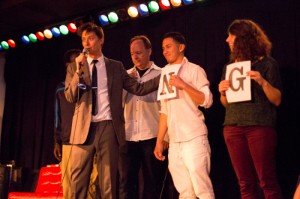

Literary Death Match: Bringing Bookish Cool to a City Near You

Todd Zuniga on stage with volunteers. Spot the Black Clock 15 contributor! (photo by Jason Gutierrez, courtesy of Literary Death Match)

On Tuesday, June 5, 2012, I felt cool.

I was in the company of some amazing writers at Busby’s East: Trinie Dalton, Dylan Hicks, Moshe Kasher, and Black Clock‘s own Anne-Marie Kinney.

But that’s not really why I felt cool.

I’ve always been aware and embraced the fact that I’ve never been, and probably will never be, what some would label as “mainstream cool” in Los Angeles.

As a child growing up in L.A., I wasn’t athletic or popular. I started wearing glasses in 2nd grade, and I prided myself on borrowing the maximum number of books possible from my local public library. As an undergrad not much changed: I didn’t like drinking games and felt out of place at Hollywood clubs. Even now, as an MFA student, the Writing department is in an area set apart from the main building. Event bartenders comment that writers are tame in comparison with the rowdier art students.

As I’ve begun to integrate myself into the writing community, I’ve noticed that there’s an expectation of how readings are commonly run. Literary aficionados will gather together to listen to writers read from their work. The event takes place in a lecture hall, museum, bookstore–or even a bar. The writers read, the guests listen, there’s applause, sometimes libations, maybe some book signage, followed by departure.

But then, Literary Death Match (LDM) happened.

A NERF gun, people talking about panties, guests clearly drunk, a judge mentions LSD, and ohmydeargod is that Michael C. Hall from Dexter?

It seemed that, in the midst of my first year of grad school, where I rarely spent evenings doing much other than homework, I’d somehow stumbled into the cool club, and I wasn’t sure what to make of it.

According to their website, “Literary Death Match, co-created by Todd Zuniga, marries the literary and performative aspects of Def Poetry Jam, rapier-witted quips of American Idol‘s judging (without any meanness), and the ridiculousness and hilarity of Double Dare.”

A standard LDM evening: four writers, each representing a literary publication or organization, read for seven minutes in front of an audience, as well as three judges of varying fame and funniness. Each round consists of two writers reading their work, and the winner of each round gets to go on to the final where the champ of the evening is decided by a battle of wits, know-how, brute strength–basically, a feat that would very loosely fall under the title of “literary.” I’m unsure if it’s protocol for fame-inclined members of society, like perhaps Michael C. Hall, to wander through LDM of their own accord. I’ll get back to you on that one.

The event’s name points to the hybrid entertainmentbeast attendees are about to experience. “Literary” and “Death Match” aren’t words many would immediately think to mash up.

I love that Zuniga helps create an event in which writers, literature fans, and non-literature fans alike are reminded of a seemingly obvious but oft-forgotten fact: words can be fun, yo. And he does this while wearing a tie and shooting NERF darts at four talented writers, ranging from the up-and-coming to the well-established.

Literature can be beautiful and inspiring, but it can also be absurd and pointless and just pure unadulterated fun. The writers who participated in this round of LDM enjoyed being able to entertain, interact with the audience, and be silly as well.

When Kinney–runner-up to LDM’s champion of the evening, Kasher–was asked what the match meant to her literary career, she responded with the apropos, “You know…nothing.” When Kasher was asked the same question, he commented, “I started writing to crush other writers.” On the sidelines, Michael C. Hall gently threw back his head in laughter, and I marveled at his strong jawline while munching on curly fries.

The three guest comedian judges were having just as much fun as the writers and audience members. Eliza Skinner, who was judging on Literary Merit, responded many times with a succinct and at times perplexed, “Good. Good job.” Eliza Coupe, judge of Performance, had a thing for the writers’ hands. Justin Ian Daniels, judging on Intangibles, let it be known outright that he had “no business being here,” as he sipped from his glass of red wine.

That was the great thing: it was okay. It was all okay. The judges didn’t know exactly how they should judge, and the writers didn’t seem to care how they were being judged.

But it was still so absurdly fun!

Whether guests want to focus on symbolism or tone in the readings or just drink themselves into a stupor and marvel at the fact that Michael C. Hall isn’t as tall as he seems when he’s hacking at bad guys on Dexter–well, both options are available.

For a moment, I caught a glimpse into another world: a world in which I could invite my non-writing friends to a literary event and not have them quickly decline. A world where guys who look like they auditioned to be on Jersey Shore could rub elbows with guys who decline invitations to go out so they can write. A world in which celebrities actually choose to hang out with writers instead of going to Chateau Marmont.

So, Michael C. Hall, call me. We can carpool to the next Literary Death Match in my VW Golf. I’ll pick you up, and I promise you won’t have to help pay for gas.


By Bel Poblador
an Editorial Assistant for Black Clock and an MFA Writing candidate at CalArts. She is a Los Angeles native, a lover of San Francisco, and an advocate of all things dog-related