
Singular, idiosyncratic and a little mysterious, Black Clock is one of America's leading literary journals.

Author Archive for Chrysanthe Tan—

Writing Rituals: Black Clock 17 Edition—Featuring Henry Bean, Antonia Crane, Dayna Dunne and Andrew Nicholls

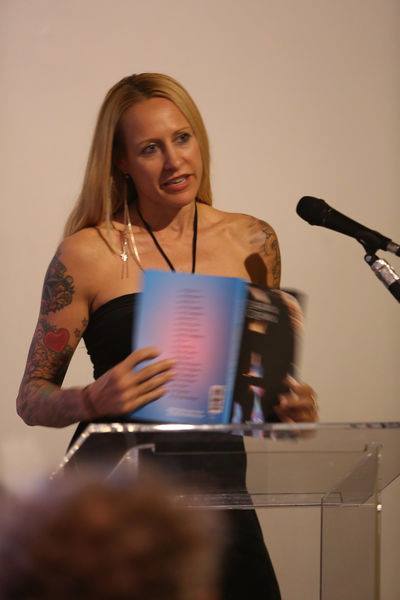
Antonia Crane reading from Black Clock 17

Antonia Crane reading from Black Clock 17

When it comes to writing, we each have particular rules and rituals, habits and quirks, methods and madnesses. Certainly, there is no “one-pen-fits-all” formula for creative productivity, yet still, it is hard not to be curious about the creative lives of others, especially those whom we read.

For our inaugural installment of “Writing Rituals,” we peek into the worlds of Black Clock 17 contributors Antonia Crane, Dayna Dunne, Henry Bean, and Andrew Nicholls, each of whom you may recognize from our recent launch parties in LA and NYC. I solicited these excerpts via email, simply asking the writers to share small snippets that give readers insight into their respective creative worlds. The responses are delightful. Read on to learn about Henry’s discipline, Andrew’s penchant for envisioning an abstract end mood, Dayna’s method of turning the writing process into a fun game, and Antonia’s seductive wooing of her inspiration muse.

Then, fellow readers and writers, do tell: What are your creative rituals? Please share your own quirks and habits in the comments section below!

Antonia Crane

I have a bulletin board of hope that contains inspirational images, quotes and cards from people I love and admire. I have a note from Sy Safranksy smack dab in the middle of my board that says “Dig Deeper. After that, dig even deeper. You can never really go deep enough.” I write first thing in the morning when I’m fresh and never with any music (because I love music too much and it steals my attention). I always light a candle—a dressed candle from New Orleans is preferable. I have a couple of talismans that I keep within reach: Denis Johnson’s Jesus’ Son and Cheryl Strayed’s essay, “The Love of My Life.” I use them to nudge me forward. If those don’t get me going, I turn to Steve Almond’s This Won’t Take But A Minute, Honey. I write on napkins, on the inside of books and in airports. I keep bits of paper in my wallet and dig them out when I sit down to write. Then I am surrounded by ripped scraps like a nut case and dive in. Inspiration comes when she comes and I’ve learned to never wait for her—also never keep her waiting. She’s capricious.

Andrew Nicholls

On the day the Challenger exploded, on the day that John Lennon died, I wrote jokes. I’ve written through kidney stones, food poisoning, Christmas, July 4th, multiple Thanksgivings. My writing partner and I once Sharpie-scrawled a comedy bit directly onto the cue-cards for a variety show sketch that had already begun taping. Production schedules have saved me from most of the pencil-sharpening quirks that plague writers, but I’ve developed one of my own, tricky to articulate. I need to know the end feeling, the shape or color of a thing, before I start it. Whether it’s a one-liner, a short story or a three-act play, I need to know if it’s aiming to be a modernist building or a landscape, if it’s Badfinger or Radiohead, a parfait or a steak. I need to know the feeling that having read it will generate. For “String” (Black Clock 17), I aimed at a shadowy purplish color, the humiliation of old clothes, a ropy texture, a smart sexy girl, metal and rain. If I get lost, armed with this feeling I can step backwards through my own snowprints and look for where I went off the trail. Though sometimes I belatedly realize the end-feeling was too subtle for words, or for my words; that it was a scent fugitive as a dream landscape.

Henry Bean

When I set out to become a writer, I gave myself rules. I had to arrive at the desk by nine each morning and work for three hours. During that time I was not allowed to eat, drink (except the coffee I’d come with), read (except what I’d written), make phone calls or talk to my housemates. I was permitted one trip to the bathroom. The discipline did not come easily; most mornings, by eleven I was counting the minutes. Twelve months later, I could do it for five hours. Soon, I had no trouble writing from morning to night; the hard part was stopping. I worked like that for thirty years.

Dayna Dunne

I’m tempted to say, I’m such a novice. Call me in ten years. Maybe I’ll know more then. But here goes.

I work best when I stay fluid. I don’t like authority (even my own) so it’s impossible for me to do the same thing or be in the same place every day without some inner pilgrim seizing up or freaking out and walking off trail. I have to make a game of this, an exploration, a step by step what-if adventure. I work most days, beginning after noon. The way I work depends on what step I’m on. Gathering is one step. In gathering I make myself available to whatever wants to hook me, making sure I have plenty of recording devices around. Then there’s the Laying It Down step. Laying it down requires sitting somewhere comfortable. Before I sit (and before all the subsequent steps) I have to be clean, fed, walked, and have devoted some portion of my day revering something beautiful. Positioning is important. I’ve got to feel good. Balanced. So I can focus. Developing requires time to be still with my fluctuating mental/emotional/visual aperture. It feels like this: I’m writing, writing, and all the while there’s this sensual lens opening and closing, steering me. Developing can happen anywhere. It likes white noise. Sometimes I’m at home with my cat on my lap, sometimes I’m out in public. If I’m out in public I’m in an environment I trust, an environment with good beverages. Reviewing has to happen at home, in quiet, because gathering and developing like to join forces with reviewing and if it isn’t quiet (that means no music, no car alarms, no leaf blowers, no phone) the reviewer gets annoyed. Dance breaks are important, particularly in the kitchen. Dancing burns out the base and bothersome, tightens my focus, and celebrates little victories. (Celebrating little victories keeps me going.) I used to think Editing was a drag––the masculine, non-creative part of writing. I mean, who wants to be masculine? But after reading Freeplay by Stephen Nachmanovitch I find editing to be just as fun as the other steps. I feel like I’m working when I edit. It requires me to be at my desk in front of my computer with my designated To Do pile on my left, and my Have Done pile somewhere behind me where I can’t see it anymore.


By Chrysanthe Tan
a composer, violinist, writer, and Communications Editor for Black Clock

Hey, this cookie is a book!

As readers, writers, and literature lovers, we have all had our lit-geek moments, whether it’s naming our dog after the protagonist in our favorite book or laughing at an obscure authorial reference in a movie. Some of the most rewarding moments, however, occur when we stumble across literature in decidedly non-literary places. The following is a random, by no means definitive, list of examples.

1) As I Lay Dying
This one’s a freebie. Yep, it’s a band. And a William Faulkner novel.

2) Myths of the Near Future
It’s a short story collection by J.G. Ballard, but it’s also the debut album name of the indie British band, Klaxons, as listed in the book 1001 Albums You Must Hear Before You Die. Bonus points: Track 1 of the album, “Atlantis to Interzone,” refers to both Atlantis, the mythical lost city, and Interzone, a short story collection by William S. Burroughs, while Track 7, “Gravity’s Rainbow,” is named after Thomas Pynchon’s postmodern novel of the same name.

3) Lorna Doone
An amazingly tasty, buttery shortbread cookie by Nabisco. Also a 1869 novel by Richard Doddridge Blackmore. The book’s full title is Lorna Doone: A Romance of Exmoor. Who would have known?

4) Taylor Swift’s Love Story
Couldn’t resist this one. Sure, the whole song draws unabashed comparisons to William Shakespeare’s Romeo and Juliet, but did anyone else notice the subtle, one-time reference to Nathaniel Hawthorne’s The Scarlet Letter? “Cause you were Romeo, I was a scarlet letter/And my daddy said stay away from Juliet”… Sorry for getting it stuck in your head.

5) The Beatles’ I Am the Walrus
The aforementioned walrus in this brilliant, famous, clearly acid-inspired song is a reference to the walrus in Lewis Carroll’s book Through the Looking-Glass, and What Alice Found There? Apparently, John Lennon didn’t realize that the walrus was a bad guy at the time, and he thought to himself, “Oh, shit, I picked the wrong guy. I should have said ‘I am the carpenter.’” Beatles fans around the world thank Lennon for his mistake.

6) Alice’s Adventures in Wonderland
While we’re on the subject of Lewis Carroll, it seems fitting to mention that Alice’s Adventures in Wonderland have been influential enough to warrant a Wikipedia page entitled Works based on Alice in Wonderland. From a neurological condition called “Alice in Wonderland Syndrome” to Salvador Dalí’s illustrations based on Alice in Wonderland to Gwen Stefani’s Alice-inspired video for “What You Waiting For?” the unexpected references are endless.

Lit-geek-out and share your literary references in non-literary places with us and the world by leaving a comment or tweeting @blackclockmag.

by Chrysanthe Tan
a singer-songwriter, actor, violinist, poet, Pisces, and Star Wars enthusiast

Internet Found Poem

no, they have not split
_______________ (the cork
_______________ & the dumb thumb)
real slick
_____twit-spank
__________shake it
_______________ like a shiny new mohawk
heading to rock sugar
an exciting underwear purchase
____________________ driving by an escalade
____________________ _______________ with the license plate: FNG SHUI
____________________ another harlem nocturne
____________________ _______________ like the periphery
____________________ she found her passport
____________________ she is just getting over the h1n1 flu
____________________ she almost missed the vermeer milkmaid at the met
____________________ she misses having even the slightest bit of discipline
____________________ she is eating dried mangos
____________________ she has skater boy hair
____________________ she thinks life is too short for a long story
____________________ ______________ (alternatively, the end is near, but not near enough)
____________________ she doesn’t want to hear any songs about sexin’ hos in a club bathroom
____________________ she wants to rollerdisco in central park
____________________ _________________________ all afternoon
____________________ i found a way
____________________ i found a reason
_________________________ getting sandwiches to go
____________________ i found love on a two way street
____________________ i just want to meet you
____________________ i found god on the corner of 1st and amistad
____________________ wearing a low cut green shirt, glasses, black jacket
____________________ the things that hold me hostage in this city are close to saving me
____________________ ready set go
____________________ shame
____________________ _____ is it the future?
____________________ soul
____________________ & apartment cleansing

I. PURPOSE + HYPOTHESIS

According to the Academy of American Poets, found poetry is the “literary equivalent of a collage.” The Found Poetry Project publishes found poetry and expounds on the definition, asserting that “poetry is everywhere…every phrase that rings in our minds, every two words that sound good together, every quote we want to remember, are each their own small poems.” The process of constructing a found poem differs for each “poet,” or “finder,” but here is the gist: gather existing text, rearrange it, and present it as a brilliant new piece of poetry.

I am constantly intrigued by the amount of losing and finding that takes place in the construction and result of a found poem. Lost snippets of text, often from various sources, find new context. Original sources of phrases and lines are often lost on readers, and eventually on writers as well. Old meanings and contexts are co-opted, colonized, contaminated, altered, exalted, exaggerated. Lines, words, and phrases intermingle and find other newly contextualized word friends, acquaintances, and enemies.

II. MATERIALS + METHODS

In order to highlight the interaction between lost and found imagery, I drew my sources from several types of internet media to construct this found poem.

Not surprisingly, the internet has proven itself as both a boon and a bane in the world of found poetry. Some poets and poem finders have embraced the medium. Most ignore it. And still a large contingent of poets mock it and use the internet satirically. “Flarf,” a genre of experimental-internet-search-engine poetry, is an example of how the internet has been invading and/or livening poetic spaces for the past decade. Flarf is, of course, completely controversial, as evinced in the discussions generated at Art Voice, Poets & Writers, and on the Poetry Foundation Journal.

Despite the unending debates about the value of the internet in poetry and society, one thing most people can agree on is the ephemeral nature of the medium, particularly on social media websites. As a frequent user of social media sites, I am amazed by how quickly I can watch various status updates appear on my news feed, only to get buried beneath a new flurry of information minutes later. As easy as it is to find information on the internet, it takes little effort to completely lose information as well.

I wanted to explore those sentiments in my found poem. To represent the ephemeral and lost, I incorporated status updates from popular social media websites Twitter.com and Facebook.com, as well as postings from other fast-paced, rapidly updated sites perezhilton.com and craigslist.org. In contrast, I used a google.com search on the phrase “I found.”

I let the process of gathering phrases and words guide the tone and eventual focus of the poem. I did searches on all the aforementioned websites and copied down the phrases that popped out at me the most. As I went along, I became more discerning in what phrases to collect, and I picked things that seemed to fit most aesthetically, emotionally, and intellectually with what I had already gathered.

III. RESULTS

Please see above.

IV. CONCLUSION

In the finished product, I hoped for the newly intermingling, random phrases to be able to interact with newfound meaning and cohesiveness. As the poem’s finder, I was fairly pleased with the result, as I was able to connect with the whole piece in a different way than I connected to the individual phrases I borrowed. In many ways, I felt like a co-author/co-poet, and I emerged with a newfound respect and understanding for the genre of found poetry. While I can certainly understand why found poetry may be a turnoff or considered not engaging or simply unimpressive for many readers – after all, the words and phrases themselves do not belong to the authors – I do think that we often don’t give found poetry enough of a chance. After going through the process myself, I realize that poem finders can have quite a bit of agency and creative control in the construction of a found poem. I also discovered that found poetry and “traditional” poetry have more in common than I previously assumed; in found poetry, we lift exact words and phrases from various sources, but in other forms of poetry, do we not “lift” a smattering of observations, anecdotes, vignettes, and even words and phrases from a variety of people and places as well? In a way, found poetry seems to me a more direct, literal exemplification of what we often consider poetry to be.

by Chrysanthe Tan
a singer-songwriter, actor, violinist, poet, Pisces, and Star Wars enthusiast
