
Singular, idiosyncratic and a little mysterious, Black Clock is one of America's leading literary journals.

Archive for 2015—

The Best Friends Learning Gang Talk Trash Fab

Dan “Handgun” Bustillo and Joey “Canon” Cannizzaro formed the Best Friends Learning Gang, a pedagogical initiative that uses happenings to incite decentralized learning. The BFLG host unguided workshops on topics they don’t know anything about.

***

Our decision to be obnoxious stems from a desire to gnaw at the rule of taste and expertise in a chaotic reclaiming of horizontal authority. Trash Fab is an aesthetic dissolvent we use: a cookbook, an attitude. We named our initiative The Best Friends Learning Gang because it’s a fucking ridiculous name and we wanted to scare off anyone with a stick up their ass, calling instead to the curious and the crooked.

There’s a long history of people making art using garbage (Assemblage, Arte Povera, Dada, etc.) and while trash is great, we want to talk about trashiness. When Marcia Tucker curated an exhibition called “Bad Painting” in 1978 at the New Museum of Contemporary Art, her intention was not to showcase outsider artists or amateurs who lacked technical proficiency, but rather to critique standards of “good” art. The press release for the exhibition said the mission of “bad painting” was to refute the conventions of representation by being “at once funny and moving, and often scandalous in its scorn for the standards of good taste.”¹ The pendulum of good taste swings very predictably; our obligation as trash people is simply to avoid it. Trash fab can’t be absolutist. We go for raunch and for noise, opting out of a regime that shames the masterless and the unknowing.

TRASH TAN: IN ESSEX YOU GLOW

Before the industrial revolution, when the rural poor worked long hours in the sun, the elite made every effort to look as pale and unexposed as possible; when the urban working class came about as a result of industrialization, having tan skin became an indicator of wealth because it exemplified leisure. Spray tanning is trash fab: it imitates the aesthetic of wealth so unrealistically that the skin telegraphs a desire for status and balloons it to the point of parody. It publicizes the conditions of inequality, politicizing the skin. The choice to use it in spite of its theatrical ridiculousness– in fact as a kind of celebratory gesture – mocks the suckers who flew all the way to St. Croix when they could have walked over to the dollar store and picked up a can of that fine orange mist.

Trash fab is not, however, an exclusively white trash aesthetic. Rather, trash fab moves beyond whiteness, working through a pasty normal. In an explanation of the cosmology of Jack Smith, José Esteban Muñoz cites one of Smith’s journal entries in which he shares that he “overcame pastiness.”² Muñoz pushes Smith’s “pastiness” through his use of the exotic. While they are different, the pasty and the exotic are both confined within the same regime of normalcy.  Trash fab oozes best when the pasty and the exotic are used in campy, frivolous and unsavory depictions of freakish otherness to refute different but equally oppressive normativities.

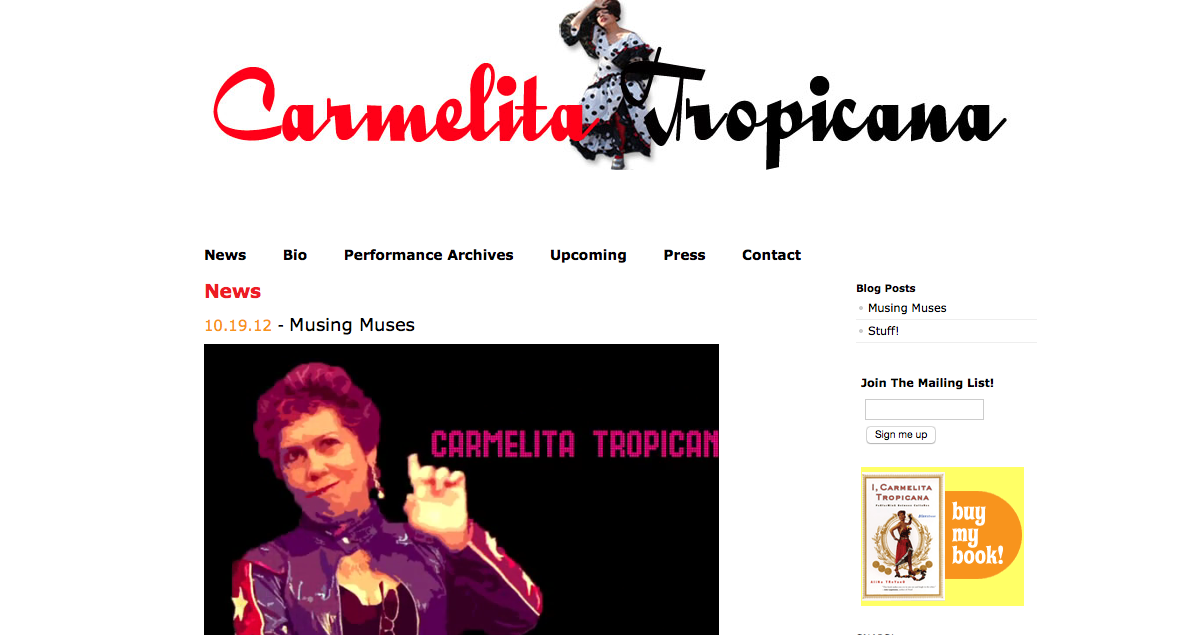
Muñoz refers to the performance artist Carmelita Tropicana as a “chusma performance deity.” He attributes her hyper exoticized stereotypes of Latinas to Smith’s legacy in the world of queer performance. Though a Latin American reference specific to the Caribbean that addresses a cheap, sleazy, overly accessorized and obnoxiously loud caricature of a Cuban lower class, “chusmería” drowns class etiquette in the rowdy and the glammed-out.  Performing “chusma” is trash fabulous not only because of the inherent trashiness of the typecast, but because as a Latina artist, Carmelita Tropicana dares to make room for the scummiest on stage and in the art world. She drags in and flaunts the “worst” of her own culture in public. Being from Miami and from a Cuban family, watching Carmelita talk like she has marbles in her mouth, in excessive chusma mode, makes me cringe-laugh. While her personae is indeed trashy, it is her choice to perform chusmería that is fab.
Trash fab flaunts a refusal to apologize for not being classy, polished and contained. It insists that the word classy be understood as classist, that it reinforces the cultural belief that poise and control are the only avenues by which to earn respect. As the Best Friends Learning Gang we try to identify and flout all facets of authoritarian control in every decision that we make; in this way, trash fab aesthetics are an inevitable outgrowth of our ideology. 

Trash fab doesn’t mean art has to look like shit. We use cheap materials out of necessity; we do so flamboyantly, choosing the fakest, the shiniest, the most bedazzled items; we show off our brokenness and in doing so deflate the myth of equality.  And we can still make art that’s fucking awesome.

I like when art looks magical. You look at it and you’re just like whoa, how the fuck does it look that way? It looks like it’s from another dimension or like it has some kind of curse on it or a blessing or something that makes it just pop the fuck out at you and seem like a portal to somewhere much less stuffy than this piece of shit gallery and with much better booze. Art that’s enchanting.

But I get really disappointed when I look at the materials list and I’m like oh that’s why it looks so magical and mysterious, because they used a heap of expensive materials that I’ve never heard of. It feels like the ultimate aim of this kind of art is to mystify an audience with pricey magic tricks when a Venice boardwalk Criss Angel knock off would be just as great (or better). Magic has never been out of reach; this kind of magic trick just tries to make us think it is. It’s much more interesting to make magic from nothing. Using available materials leaves little room for the audience to be mystified by the Holy Museum or the Messianic Artist. The audience is invited to also perform alchemy; we all have rocks we can turn into gold.

In Heaven and Hell, one of Aldous Huxley’s treatises on hallucinogens, he catalogues the human obsession with glitz:

“Most paradises are adorned with… gems. We are all familiar with the New Jerusalem. ‘And the building of the wall of it was of jasper, and the city was of pure gold, like unto clear glass. And the foundations of the wall of the city were garnished with all manner of precious stones.’ Similar descriptions are to be found in the eschatological literature of Hinduism, Buddhism, and Islam… Those who think of all human activities in terms of a social and economic frame of reference will give some such answer as this: Gems are very rare on earth. Few people possess them. To compensate themselves for these facts, the spokesmen for the poverty-stricken majority have filled their imaginary heavens with precious stones. This ‘pie in the sky’ hypothesis contains, no doubt, some element of truth; but it fails to explain why precious stones should have come to be regarded as precious in the first place.

…As soon as we take into account the facts of visionary experience, everything becomes clear. In vision, men perceive a profusion of what Ezekiel calls ‘stones of fire’, of what Weir Mitchell describes as ‘transparent fruit’. These things are self-luminous, exhibit a praeter-natural brilliance of colour and possess a praeternatural significance. The material objects which most nearly resemble these sources of visionary illumination are gem-stones. To acquire such a stone is to acquire something whose preciousness is guaranteed by the fact that it exists in the Other World.”³

Huxley claims that our capacity to feel reverence towards these precious objects comes from their shininess, taking Marx’s notion of fetish and reversing its cause and effect. He argues that humans became obsessed with gemstones because they are illuminated and allow us to experience something beyond the material world, something visionary and supernatural, as an intrinsic quality of their material, rather than a condition of their cost. Following this argument, it doesn’t matter whether bling is prohibitively authentic or fake as shit, it can still take on holy significance of an otherworldly portal.

Whether because of some inherent evocation of the sublime or because of deeply ingrained cultural experience, glitzy, bling, shiny things produce a reaction of awe and wonder. Is it always pure Debordian spectacle enrapturing the crowd in the mystery and dogma of capital? Or is it possible that trash fab glitter magic can invite us to participate in the divine through the vehicle of garbage? Maybe we can take all this plastic crap– crap that was fabricated to trick us into imitating the aesthetics of the elite, to convince us to admire and perform their style, reinscribing the power of their taste, their freedoms– and rhapsodize its undoing. We can flash the trashiness of not having and not knowing and get dazzled the fuck OUT.
1

This essay can be found in Tessex? (Image Text Ithaca, 2015) available HERE. 

Notes

¹http://archive.newmuseum.org/index.php/Detail/Occurrence/Show/occurrence_id/5

²Munñoz, José Esteban, Disidentifications, Queers of Color and the Performance of Politics, Preface, p. xii, Minnesota: University of Minnesota Press (1999)

³”The Doors of Perception and Heaven and Hell” pg. 83-85, Paperback, Harper (1954).
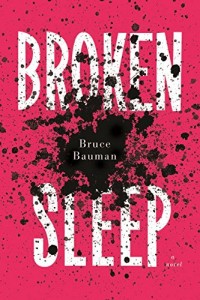
Bruce Bauman’s Broken Sleep (Other Press)

“A literary novel with a great plot…. [Broken Sleep] is a funny novel, but it’s also an incredibly serious emotional novel in a way we don’t get nowadays so much.” —David Kipen, KPCC “TAKE TWO”
“Bauman [has] the virtue of writing well in multiple registers. Salome’s perspective is free-wheeling and dreamlike, Moses’ sagely, and Alchemy is seen largely via tough-talking band mate Ambitious Mindswallow, who rises from a Queens street kid to member of the world’s biggest band. He’s a key allegorical figure in Bauman’s lament for a lost American dream where once upon a time anything was possible. A big-thinking…postmodern epic.” —Kirkus Reviews


Spanning 1940s to 2020s America and told with contagious vivacity, Broken Sleep knits the stories of four distinctly memorable characters into an indelible portrait of American culture that is at once sweeping, irreverent, and heartbreaking. When everyman Moses Teumer discovers that he has an aggressive form of leukemia, his search for a donor who can save him sets off a wild chain of events as he discovers that the woman who raised him is not his birth mother. Encompassing a Pynchon-esque saga of rock music, sex, drugs, art, and politics, this novel is an unforgettable examination of the secrets we keep and the risks we take in the name of commandeering our own destinies.

Hear Bruce Bauman read from his newest work at Skylight Books in Los Angeles:

Event date: Thursday, October 29, 2015 – 7:30pm

Event address: 1818 N Vermont Ave, Los Angeles, CA 90027


Crawling Down Cahuenga: An Interview with author David Smay

David Smay, co-editor of Bubblegum Music Is the Naked Truth, and Lost In the Grooves (both in collaboration with Kim Cooper), and author of Swordfishtrombones (Bloomsbury, 33 1/3 series), discusses Tom Waits and the changing nature of Los Angeles with Sr. Associate Editor Emma Kemp. David is a regular contributor to the website HiLobrow, and has published in such magazines as Oxford American.  He lives in San Francisco with his wife and two children. Read his work at: http://hilobrow.com/author/dsmay/.


EMMA E. KEMP: Hi David. We recently met on Esotouric’s Crawling Down Cahuenga: Tom Waits’ L.A – an alternative bus tour revealing the hidden secrets of Los Angeles through the lore of Tom Waits. I’d like to start at the beginning and work our way back to the bus…

Can you talk about your relationship to Tom Waits? Do you remember your introduction to Tom’s music?

DAVID SMAY: I became an obsessed Tom Waits fan when Frank’s Wild Years came out. I remember standing in my friend’s bedroom as he played “Hang On St. Christopher” and I could tell something very different and distinctive was happening.  It didn’t exactly appeal to me at first, so much as it challenged me.  There was something there to explore and discover.

I went back and completely immersed myself in the previous two albums in the Frank Trilogy (Swordfistrombones and Rain Dogs) and then desperately looked for anything that sounded remotely like that. (There wasn’t much at the time.)  I had heard some earlier albums through a friend who was a big fan of Blue Valentine, and, in fact, I remembered seeing Tom on the Mike Douglas Show back in the 70s when I was just a kid.  But I wasn’t converted until I heard his albums on Island Records.

EEK: You’re the author of Swordfishtrombones published by Bloomsbury as part of their 33 1/3 series, can you talk a little about the experience of writing this book? How did you become involved with the series, and how did you approach long-form criticism?

DS: My friend and co-editor, Kim Cooper, had written a book for the 33⅓ series on Neutral Milk Hotel and encouraged me when Continuum Press had their open call for proposal. It’s an opportunity to work in long-form criticism, which is increasingly rare.  This series provides a platform to dig deeper into a work than market driven reviews can allow.

EEK: Did you have a clear agenda when you set out? Did this change as the book progressed?

DS: I knew I wasn’t planning on doing a standard critical book. I’d done plenty of record reviews in my day, and I wanted to use the longer form of a full book to explore Swordfishtrombones in a different way. As I noted in my introduction, it would have been exceedingly perverse to “explain” an album like Swordfishtrombones, an album which works best because of its provocations and mysteries. I had to find a structure which would allow entrance into the work without spelling everything out.

EEK: How did you go about researching and writing this project?

DS: There’s a huge amount of Tom Waits material available online. I spent two years researching everything about his career, reading literally hundreds of interviews. Spending time and taking lots of notes on all of his albums – not just Swordfishtrombones. Since it’s such a fulcrum in his career I really needed to understand what lead up to it, and what followed. With Swordfishtrombones, Tom Waits began to transition from a culture figure to an icon. Somebody whose work influenced so many artists who came after, often in subtle ways.  So many younger artists tap into that sonic palette that he developed, the exotic instruments, the distorted vocals, the bang-on-a-can aesthetic.  And his lyrics changed too, though they’ve proven harder to imitate without parody. The lyrics became very concrete, specific and detailed but at the same time he left space between them, a very controlled ambiguity.  It’s a very masterful way to approach songwriting but it allows him to build depth and mystery into his songs.

EEK: How did the book impact your relationship to Waits? I’m interested in how this relationship may have evolved, moving from fan, to aficionado, to scholar…? Has the book influenced how you listen to the music now?

DS: When you spend so much time and research on one artist it’s easy to become burned out on them. That never happened with Tom Waits – he’s created such a rich and varied musical legacy that I still love it. However, the process of writing the book did exhaust my questions about him. I understood his personal history, his creative methods, his favorite themes and sonic palette.  In a way, when you answer so many questions about an artist you lose some of the magnetic draw towards them.  In comparison, I’m a huge Kinks fan but because I haven’t studied Ray Davies so exhaustively I still have things to discover about him and his work. 

EEK: Were there difficulties in writing about an infamous figure in such an intimate way? Is the “cult of celebrity” difficult to transcend in a project like this?

DS: All of my critical writing tends to burrow under the perceived notion or narrative of an artist or their work. There is a tendency for critical assessments to become calcified and rigid over time and they can distort more than they reveal.  So getting past Tom’s persona and into his work was my standard strategy.  I did have a couple of pangs when I found buried little biographical details which he had obviously wanted kept hidden, or were painful to him.  But they were relevant to discussing his work so I wrote about them anyway.

EEK: During our first meeting, you were at the helm of a passenger coach pointing out choice spots in the underbelly of L.A significant to the Tom Waits chronology; how important is this particular city to the story of Tom Waits? What is it about L.A that lends itself to this kind of figure? Or did the figure create the city? How significant is geography in the construction of artistic identity? You’re obviously extremely familiar with Los Angeles, but you live in San Francisco, which has its own unique counter-cultural/literary history… how does this shape your own thinking/writing?

DS: Los Angeles is by far the most important city in Tom’s work and his relationship with L.A. is intimate and profound.  While the rest of the music industry was tucked away in Laurel Canyon in the Seventies, Tom Waits was the first musician to write about the Los Angeles of the streets.   He’s so specific about neighborhoods and intersections and bars and hotels and that kind of creative attention lends them a kind of myth.  He created a certain idea of Los Angeles which still has currency.  You have to look at movies like Cassavetes The Killing of a Chinese Bookie, or Barfly or Altman’s The Long Goodbye to see that Los Angeles. 

I lived in L.A. before I moved to San Francisco, so I’m familiar with both cities and their cultures.  There were times during the Beat era, and also during the punk era when LA/SF were more united than at odds with each other.  All those bands bombing up and down I-5 in their beat up vans to play at the Mab or the Whiskey.  Rebecca Solnit’s book The Secret Exhibition gave me a lot of insight into Wallace Berman’s circle and the artists associated with the Beat era and that’s a lens I bring to seeing Tom’s work.  More even than the actual writers like Kerouac and Bukowski who directly influenced Tom Waits.

EEK: You lead the Tom Waits bus tour once a year, how does this reenergise your relationship to Tom, and to your book? Did you spend a lot of time exploring these places during your research, or did the relationship between the music and the city come after, when you had the opportunity to do the tour?

DS: Every year I go back and revisit my book and my research before I do the tour. I try to change around the AV portion of the tour from year to year so that gives me something different to extemporize from.  Obviously we used his Letterman appearance before this year’s tour.  And, yes, I do learn something new from the passengers every tour.  Tom’s had such a long career and I’ve met more than a few people who saw his legendary Steppenwolf production of Frank’s Wild Years in Chicago in the 80s, or locals who saw him perform in a play called Demon Wine.  I’ve met people who did lighting and sound on the Big Time movie. It all adds to the picture. 

When we first did the tour, I gave Kim and Richard a list of specific places I’d like to visit and they figure out how that could work as a tour, but it’s really over time that I’ve come to really grasp what you might call the psychogeography of his work.  There’s always more historical context to fill out, more layers of history, more interesting stories to discuss.  Kim and Richard do an incredible job of explicating what was going on in Los Angeles politically, culturally, scandalously in any era so you can see how it all fits together.

EEK: I love that the tour connects you to such a diverse range of Tom Waits fans, how has this experience enhanced your relationship with Tom and the city?

DS: I love it! My favorite part is talking to the people on the tour when we stop at Canter’s.  Get to find out their discovery of Tom, what they’ve seen and heard.  Oftentimes people travel a long way just to do the tour, and that’s always an honor.  By the very nature of his work, Tom Waits attracts intelligent, interesting, creative people.

EEK: Can you talk a little about the changes sweeping DTLA? What’s your prognosis for the types of artists that can/will inhabit this new L.A?

DS: Downtown has changed so much in just 8 years (or so) we’ve been doing this tour.  It really had been frozen in amber since the Freeways went in, and when we started you still had many skid row bars and amazing cultural institutions like Clifton’s Cafeteria (where we used to end the tour).  But finally the desire for urban density has landed in Los Angeles, that most spread out and car-defined of cities, and it’s remaking downtown.  Certainly there are things I love about the changes – the Last Bookstore is exactly the kind of thing which can sustain and create its own cultural energy.  But if it just follows the standard gentrification of upper middle class and wealthy white people razing and developing indiscriminately, displacing long running locally owned business (as is happening at the Grand Central Market), we’re going to lose so much.  Los Angeles has not generally done a great job of preserving its incredible legacy (despite the heroic efforts of people like Kim and Richard, and many other preservationists).  The people of Los Angeles need to wake up to the fact that they are on the cusp of losing so much of their cultural history.  It’s in the balance right now.

EEK: What are you working on right now?

DS: I write for the website HiLobrow most recently doing a piece on the great fantasy and horror writer, Fritz Leiber (another creator with strong ties to both LA and SF).  I did a critical/analytical series for them on Early Sixties Horror movies which fascinated me (The Haunting, The Innocents, Blood and Roses, Eyes Without a Face, et al).  It’s a great outlet for the range of my interests which allows me to write about everything from Jack Kirby’s comics to Anna Ahkmatova’s poetry.

EEK: Do you have any advice for folks who may be putting together a 33 1/3 proposal for this year’s open call?

DS: Every correspondence is an advertisement for your writing, so sweat your emails and be cognizant of every word you’re putting down. The proposal is intended to present your depth of interest and give a hint of how the book is going work. I think giving substantial insight of what book will look like, while showcasing your technical ability, makes for a successful proposal across the board. For this series, you have to pitch a work you’re not going to get bored of. I was able to write about the breadth of Tom’s career, what went into it and what came out of it, so be creative in how you approach the topic, because there are many ways to do it. Take a chance, and don’t fuck it up!

Catch David in Pasadena on July 23rd at the Pasadena Central Library as he and co-presenters Kim Cooper, Gene Sculatti and Becky Ebenkamp discuss the history of Bubblegum Music. For more details visit http://www.lavatransforms.org/bubblegum.

Emerson Whitney’s Ghost Box: An Interview

Ghost Box is based on the true story of Emily, who, in the fall of 2012, arrived in the parking lot of a vacant big-box store, or “ghost box,” near downtown Los Angeles with 45-pound bags of cat food. She converted the otherwise vacant property into an impromptu bird sanctuary, and evaded arrest by the LAPD for months. Emerson Whitney adventures into the weirdness of Emily’s story and the strangeness of vacant urban space, writing wildness and ferocity into the strip mall. Ghost Box is gross and wry, gorgeous and feral, a hoarse cry from abandoned city space: “we want to be beautiful too.”

Sr. Associate Editor Emma Kemp interviews Emerson Whitney on his new book, Ghost Box (Timeless, Infinite Light, 2014)


EMMA E. KEMP: How did you arrive at the ghost box?


EMERSON WHITNEY: I was often stuck at this light on the corner of San Fernando and Fletcher. Nearly every time I was stuck at the light, a towering cloud of birds seemed to rise from this giant empty lot adjacent to the intersection. The scene just started to seem strange, every time I passed, there were more birds and more birds. I was curious. Just before I started the project, I looked it up and found YouTube videos and Instagram photos of the lot and its birds. We were all marvelling, I guess.


EEK: Can you talk about your first visit to the lot?


EW: Well, I realised my intention was really just to work out why the birds were there. And I figured part of my reason for wanting to do so was because I was also having a lot of strong feelings about living in a space that was so dry. We just made it through a really uncomfortable hot season and I was feeling really distressed by the landscape, partially because I had grown up in a similar environment in Dallas, hot and concretized and full of strip malls with blowing trash. I grew up on the access road to a highway. There’s always been some part of me that wanted to investigate the potential beauty of man-made detritus. I wanted to know there was something I could wrestle out of the mess, something that I could love.


EEK: So you saw the birds as a guiding force, directing you to this new perspective?


EW: Yes! That’s a great way of putting it. I saw the birds as a way in. It also raises questions for me about “natural,” which is something I think about all the time. Ideas of ‘nature’ and ‘natural’ in relation to queerness and gender identity, trans-ness, is often hissed at as “unnatural.” I’m curious about the implications of “nature” as a tool used to exclude, exterminate, etc…

In other words, the lot would not have been interesting if it weren’t for the birds. They were a way for me to understand that this place was alive, and really, who am I to question its beauty? Who am I to say that’s not natural or nature? Maybe it’s even perfect.


EEK: Do you feel like you arrived at some kind of resolution in terms of your relation to space? If not, then what new questions did the inquiry propose?


EW: It did actually shift the lens a little bit, writing this made me realize that have been asking these same questions constantly and forever. Now, I feel a different level of serenity around that space and spaces like it.


EEK: I’m curious about your relationship with the ‘man with rake’? I wonder if you could talk a little about how you initially encountered him as an individual, and how over the course of time you spent with him your relationship changed.


EW: I met him one Sunday when I was sitting in my car at the lot, planning on spending some time writing, making some audio recordings.


I watched the man with rake pull up in front of me from far away. I forget the acreage, but it’s a pretty sizeable space. He got out of his car with the rake and started going at the concrete with the rake like he was trying to kill it. I knew I needed to talk to this guy, but I very much recall feeling squeamish about walking up to him because the ground was covered in fresh, wet poop–it was literally multi-colored poop because (I later found out) Emily was feeding them all this multi-colored cat food.


I think I told him I was a reporter at first, rather than a poet because I figured he’d actually talk to me if I said I was a reporter. But he ignored me and asked if I was a producer for a reality TV show, that’s when I said, no, I’m a poet. And he really wanted to talk to me about everything. He seemed so excited to have a witness.


EEK: Who was paying him to rake all day?


EW: Home Depot. Because Home Depot had purchased the lot but the actual building of a new Home Depot was thwarted by community activists, this is the thing with “ghost box” stores (I learned this term from the ‘man with the rake’) that there’s a whole network within the big box store community (is it a community?) of empty, foreclosed big boxes. Remember when all the RadioShack’s and all the K-Marts were closing? Because the floor plans are gigantic, the sale of a big box store doesn’t generally happen quickly. There’s a whole industry of folks who are paid to upkeep the “ghost boxes.”


EEK: Have you been back there since releasing the book?


EW: Yes. It’s now a fancy new Goodwill, and my partner and I have shopped there a handful of times.


EEK: Is Emily still there?


EW: I doubt it. I would be very surprised. There are no birds now either.


EEK: What birds were they?


EW: Actually, I called an ornithologist at the Natural History Museum to try and find out, the people I spoke with said the birds were a mix of seagulls, pigeons, some wild parrots, yellow finches, occasional hawks. The ornithologist said they thought it was beach. That they read the concrete as sand. And it was disgusting, wall-to-wall with poop.


EEK: It’s interesting hearing you talk about Emily in this way. At a certain point in the book, I felt protective of her, even though I never see her except as an absence, an absent space of poetics, and I feel frustrated with the man-with-rake at certain points over his relentless pursuing of Emily. Though in a way, Emily thrives from this chase because it reinforces her presence in a world where no one else but the birds even acknowledges that she exists. Its a really interesting relationship that these two solitary figures have, they have no one else to talk to but are communicating with each other in a game of cat and mouse; they each have a purpose – hers to avoid being caught and his to catch the criminal. You, as the writer, do not interfere or judge either position in any way, and I wonder if you experienced any frustration yourself?


EW: I think it reads more quickly in the book than how it felt in real life, but for some reason, the lot was vacant for 10 years and then I put my attention to it, and within three months it was over. There was a flash of activity. Even the man with the rake described it as that. He was taken by surprise by the changing circumstances that accompanied my arrival. The moment that I felt truly dedicated to this project was when I had been visiting it for like 2 or 3 weeks and then there was all of a sudden, in front of where I’d been parking, a sign that said NO TRESPASSING, NO LOITERING, FEEDING BIRDS OR WILDLIFE. I just stared at that sign for something like 30 minutes thinking about the term “wildlife,” and wondering about the power of the woman who caused someone to make this significant signage – it seemed so absurd.


Because my background is in journalism I’m much more comfortable staying out of a story and letting events unfold. I tried not to interfere in writing or in real life, aside from the impact of being a documenter, which undoubtedly has significant impact.


I have a whole bunch of projects that are similar, a kind of anti-journalism. I don’t feel like I’m doing the antithesis of journalism, but I’m taking some of the techniques of reportage and looking at the absence of story. I’m going to the cold place. I’m curious about showing up and seeing what happens and that being my work. I guess I’m interested in letting the words occupy the vacancy and animate it.


EEK: Do you own personal or moral reactions come into play?


EW: Oh absolutely, I think that’s why I wrote it. My partner’s brother was dying of cancer when I was working on the editing of this book, and I think there was part of me that felt the heft of that information that the man with the rake had, that he knew Emily had cancer but wasn’t moved by it at all. He just wanted her out of the lot.


I was also really curious about the density, the area around the lot is so dense with businesses and housing and traffic, that for there to be a vacancy seemed incredible. The building was in such disrepair. The man with the rake told me that people had gutted it numerous times, stolen the copper wiring from inside.


EEK: Can you talk about why you avoided using his name?


EW: It’s funny because when you said that thing about him seeming like this symbolic figure, when I was writing it, I saw him as this sort of weird, pastel, fuzzy figure.


EEK: Is this part of your synesthesia?


EW: Maybe, yes, but it was like watching through the camera on the first season of RuPaul’s drag race. Do you know what I mean? All the shots specifically reserved for Ru were filtered through this hazy sort-of ‘70s lense. You know? I wanted him to have that sort of haze. I wanted Emily to be in-focus and highly saturated. I wanted her to have the name.


EEK: Did you really never see Emily?


EW: Never! But she was always there. There would be cat food and bags around, I knew she had been there. I was concerned when things with the lot visibly started to change, when the birds were leaving. But by that point I was kind of disgusted with being there. It’s right next to McDonalds and so loud, so much traffic. When I noticed Emily’s departure, I felt a little relieved.


EEK: Reading the book, a part of me thought for a moment that Emily might be you. Not physically, but if Emily was a symbolic construction: performing those acts, the wildness of her doing what she needs to do in the confines of that space, against all the odds of her situation, speaks to me of the wildness in you, the wildness of self in other texts that I’ve read by you…


EW: Yes, I’m very curious about that space between a cultural reality and “difference.” So, our cultural reality would suggest that this person is mad, and that madness is wildness to some extent because she is not “domesticated,” is feral. I don’t know if that’s true, but I am always curious about the cultural ‘stepping out’ that people choose or are forced to do. I think about this a lot in my work, as someone who has moved from one gender to another, something that’s supposed to be fixed and undoable. I’ve allowed something to grow wild that was otherwise tightly controlled, this kind of move really does trip the wire a little bit, like now I constantly wonder, what else about my person (or our persons) is being domesticated without my consent?

EEK: That makes a lot of sense. The fact that Emily is in this raw, poetic, state, or, perhaps that Emily manifests in poetry, she is up against these terrible odds. And we have the man-with-rake who is designated only by a description of the utilitarian object he holds. He is frustrated, he just wants to find Emily, but he never does. In a larger sense this portrays what capitalism inspires, an endless desire for something we cannot hold, which I guess, essentially, is freedom distorted through the vessel of money. And then we have Emily who is living outside of that framework, and not that we can say that she’s happy or not, but from the way she’s written, we experience her with so much more vitality than we experience the man-with-rake even.


EW: Yes! These are the things that I hoped would be there in the text. That’s what I wanted to write.


EEK: Have you considered donating any of these books to Goodwill?


EW: Haha, yes. Someone did suggest that I take some over there. Wanna go with me?
