Singular, idiosyncratic and a little mysterious, Black Clock is one of America's leading literary journals.

Archive for the ‘Inside’ Category—

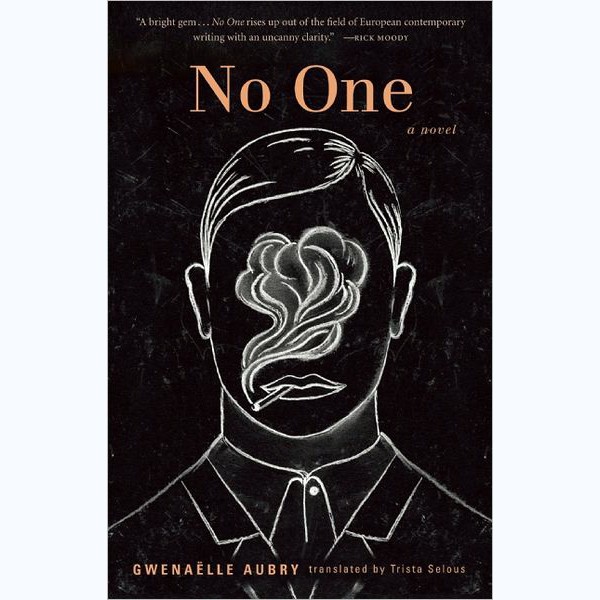
Peering Into the Void: A Review of Gwenaëlle Aubry’s “No One”

noonenovel“Here again I don’t know what, in all of this, is wisdom, what is madness.”

How do we write madness? What language can accurately encompass something as personal and unknowable as mental illness? In her latest book, No One, French philosopher and writer Gwenaëlle Aubry seeks to find that language. Piecing together her own fragile recollections with excerpts from the handwritten, autobiographical manuscript (titled The Melancholic Black Sheep) left behind by her late father with the note “to be novelized,” Aubry explores the life of a man who disappeared from view long before his death: Francois-Xavier Aubry, a once brilliant and distinguished Paris lawyer whose crippling bipolar disorder eventually left him a penniless drifter, in and out of mental institutions for most of his daughter’s life. At once lucid and mystifying, No One is Aubry’s beautifully wrought attempt at creating a portrait of someone whose internal reality she knew so little about, someone who, in the end, strived to be anyone but himself.

Were No One a conventional memoir in the popular American sense we might read Aubry’s story through detailed, chronological scenes in which each family member is cast as a distinct character. It seems necessary to note, however, that No One is the first of Aubry’s books to be translated into English, and in writing it Aubry appears acutely aware of the French literary tradition of “autofiction,” a contemporary genre that blurs the boundaries between autobiography and fiction. Much in the way we saw the life story of Roland Barthes presented to us in Roland Barthes (1977), No One favors compact and poetic philosophical ruminations over dialogue-centered prose. And perhaps also recalling Primo Levi’s The Periodic Table (1975), Aubry shapes her own memoir similarly: this time in dictionary form, with each letter of the alphabet offering another hopeful entryway into her father’s warped psyche.

From the clinically depressed poet/playwright Antonin Artaud to Woody Allen’s chameleon-like 1983 character Zelig, readers accompany Aubry through this idiosyncratic dictionary with curiosity, moving easily between both her father’s poignant, chaotic voice and her own of understated elegance. What we experience then is one author’s exquisite struggle to put a face to a man whose identity was forever unstable, preferring always to be, in his own words, “away from the guerillas of the past, unknown to all, without a label.” The result is a sparkling yet melancholy elegy, a restrained kind of mourning from a wounded daughter to her tragically afflicted father, full of grief and quiet love.

And while we can’t say for certain whether parts of Aubry’s memoir are indeed fictionalized, what is clear is the author’s interest in cultivating this energy of the unknown, something characteristic of autofiction in particular. Readers will notice immediately the contrast between Aubry’s rigidity of form and the cloudiness of her investigation into her father’s true persona, which, like the mental illness that took hold of it, evades, ever so slightly, all attempts at categorization, at being fully known. The task that Aubry has taken on in No One is undoubtedly a difficult one. But the form that she has chosen for her work provides a much-needed, albeit only somewhat helpful, structure in which to look at something formless. It isn’t until the book’s last pages that Aubry comes to a critical realization about her father: “I felt as though, having tried so hard to forget, my memory was now going mad. He didn’t want to remember, didn’t want to know.”

Perhaps it is this exact cloudiness, this frustration of memory and knowing that Aubry laments, that is the greatest triumph of No One. For in the end the truth that Aubry discovers is one even greater than that of her father’s story: It is the truth that madness can never be adequately contained. Though readers may fail to reach a precise explanation of what madness is, they have peered deep into the void along with the brave Aubry herself, who has thus achieved the ultimate act of filial devotion: She has spoken her father’s name, despite everything, again and again and again.

No One
Tin House Books (February 2012)
170 pages; $12.95

By Adriana Widdoes
an Editorial Assistant for Black Clock and an MFA Writing candidate at CalArts

Monster Mashup: The Union of Books and Music

At the risk of flogging a dead horse I haven’t ridden, I’ll relay some recent news. Beyond how bad or boring (or potentially great) Fifty Shades of Grey is, inside one will find myriad references to classical composers. Or so I’ve heard. Also, I’ve read that EMI Classics, in an obviously gluttonous but altogether wise move, is releasing a reading soundtrack. Something to enjoy sonically while you relish E L James’s Twilight fan-fiction adapted book. This all got me thinking, what music do we listen to while we read?  What do we hear when reading? Does it make any difference?

When I asked my sister what she listens to while reading she responded, “I listen to the Wicked soundtrack while I’m reading Wicked. And you should listen to classical music while you’re doing the Sunday crossword puzzle because you need to listen to smarty-pants stuff for that.”

She’s a voracious e-reader. She tore through the Dragon Tattoo series in a week of lunch breaks. The Hunger Games series she finished in a weekend. All this reading in silence.

Despite her jokes, she admitted she listened to nothing while reading. I was and am baffled. Silence is nosy and distracting. But on it went. Many friends, to my surprise, read in that non-place with nothing to keep pace, no friends but the characters. Many said they didn’t read. Only some were joking.

I’m sure there are plenty of studies about children engaging their latent genius via Beethoven or something. Whatever . . . All I know is there’s no way we’re going to make it as readers in this alleged silence–full of city sounds, buses and freeway traffic, garbage collectors and arguing neighbors. And if you happen to live in the country, don’t count yourself out. What of the crickets, the wind, the mental lists of things not yet accomplished, the fears that will probably soon be realized? No. Silence is not an option.

This morning I tried pairing the instrumental tracks from Trojan’s Reggae Chill-Out box set to William H. Gass’s In the Heart of the Heart of the Country. No dice. But also, no surprise. I bounced around: Erik Satie is too somber somehow, Yann Tiersen too lively. J Dilla, just silly. So, back to the Trojan collection. And it worked, they clicked: I read. Time and/or patience are sometimes all you need.

Forcing the union canwork. Sometimes a larger contrast can be best. Perhaps too appropriately I’d been listening to Ennio Morricone’s score to Once Upon a Time in the West while hobbling through Cormac McCarthy’s Blood Meridian. Only when I needed to define ocotillo or pyracanthra or any of the other hundreds of terms and words I’d never before encountered did I notice how funny it was, sitting pajama-clad in the sun, looking up what an ignis fatuus was while that haunting harmonica clashed with the manicured lawn, the mother persuading her children into her SUV, the city-allocated outsized bins of recycling, yard waste, trash. Loud city things that almost made me give up what I thought would be the perfect mixture of music and story.

I got through it, but the whole scene, day after day, felt silly. Like I was standing in the yard ready to draw a pistol on a passing Acura. So let’s mix it up, I thought. Henry Miller’s Sexus is the first of his books that has in it no French. How vaguely funny then that I’d chose Julie Doiron’s Desormais, tonally, a terribly sad album. Seeing as how I can comprehend but a handful of French words and phrases, and Doiron’s vocals, all in French on Desormais save one English track I omitted, the typically intrusive human voice is no bother. I’ve also found this to be true with much bossa nova and more occasionally tropicalia. The mood of Desormais isn’t the mood of Sexus. It took hours of listening to Doiron’s 2001 release while reading Miller’s 1962 novel for them to wed in a way that wasn’t catching me up. And when they finally did they were inseparable. Moments away from their partner were grueling, pointless. The paranormally calm sixth track from Doiron’s album does nothing for me now.  It’s become inextricably fused with Miller’s description of the Bronx.  I’m listening to it presently.  As the especially staccato guitar intro plays I see nothing but Miller borrowing money from this or that person . . . and a man across the street whacking weeds with his weed-whacker.

This amalgamated, rhetorical relationship has both its benefits and its disadvantages. For instance, I doubt I’ll again be able to consider anything but Raskolnikov wishing his family would leave him the hell alone each time I hear “My Angel Rocks Back And Forth” from Four Tet’s 2003 album Rounds. At the same time, when I want to hear his multi-layered complaints for solitude, that’s the song I put on.  I imagine the synesthetes have something to say about all this.

Pairings I have proven to work:

  • William Gibson’s Burning Chrome and Nathan Johnson’s score to Brick
  • Kelly Link’s Stranger Things Happen and Dirty Three’s Cinder
  • Anne-Marie Kinney’s Radio Iris and Kazumasa Hashimoto’s score to Tokyo Sonata.


Some records do double duty. Cliff Martinez’s score for Drive pulled me through the cold worlds of J.G Ballard’s Crash as well as Don DeLillo’s Cosmoplis, the latter tempered with shuffled Throbbing Gristle and Whitehouse albums, but only after a few drinks. Finally, as fun or funny as you think it might be to read Poe and listen to “Monster Mash” on repeat, it isn’t. It’s stupid and you feel stupid doing it.

To read a version of this discussion in practice, from the horses’ mouths if you will, I highly suggest checking out David Gutowski’s Largehearted Boy. There you’ll find, as is stated on the site: “Book Notes, which has authors create a mixtape relating to their latest book; Note Books, where musicians I admire explore their literary side; Soundtracked, where directors and composers discuss their film’s soundtrack; and The Largehearted Boy Cross-Cultural Media Exchange Program, where authors interview musicians (and vice-versa).”

Perhaps the most relevant of these features is “Book Notes,” with participants that include Ben Ehrenreich, Ben Lerner, Blake Butler, Aimee Bender, Eileen Myles, Jeff VanderMeer, Grace Krilanovich, Rosanne Cash, Sam Lipsyte, Matthew Specktor, Brian Evenson, Amelia Gray, Veronica Gonzalez, Bret Easton Ellis, Dana Spiotta, the list goes on.

Almost everyone I’ve mentioned this concern to says, in one way or another, I should shut up and try to get some work done. Well, to them I say: yes I will. I’m sorry to have wasted your time . . .

. . . but when in doubt always put on Chopin’s Nocturnes.


By Patrick Benjamin
an Associate Editor for Black Clock and an MFA Writing candidate at CalArts.

Not Your Momma’s Demon Theater

PhantasmagoriaI am often frightened in New York City. It might not appear so, but honestly, I’ve turned into a half-hearted hypochondriac who subsists on a white-collar diet of cute acronyms and frequent pings from beyond my cube walls. I am agitated when I excessively sweat or am sweated on, crushed when I think of the distance between myself and my parents’ bounty (read: their palm-treeed homestead and plentiful foodstuffs), and feel put-upon when the smell of fresh piss reaches my nostrils before 9 a.m.

Phantasmagoria, a New York-based, literary event series and the brainchild of one Leland Pitts-Gonzalez, is not reminiscent of the New York that, after more than two years of living here, still unsettles my bones – rather, it is the kind of assaulting experience that presses against my whole body, and upon quiet desistance, makes me want to say, “What the fuck just happened?”

“I like doing readings, but I often feel like they’re simply another vehicle to advertise the written text. I’d like to help elevate ‘the reading’ to a more engaging art-form,” says Pitts-Gonzalez, who read a selection from his novel, The Blood Poetry, and collaborated with others, including dancer and choreographer Belinda He, to create a two-part, theatrical piece involving a medical diagnostic and several psychosis induced “visions” contorting between the chairs of a tightly-packed audience.

Held on August 8th at KGB Bar, a literary watering hole and the type of place you’d expect to witness a bloodletting, Phantasmagoria began with the curtains drawn, a single desk light, and a microphone that may or may not have actually worked.

Nick Dillenburg, the event’s unofficial, official MC had me cringing for my Californian brethren, Natalie Mitchell delivered one meeeean, Margaret Hamilton-esque cackle, and Seth Michael May proved that he is anything but spotlight-adverse, enduring acupuncture needles straight to the dome for over thirty minutes. This is the same man who, while donning a hospital gown over his trousers, allowed me to share a neighboring booth, citing that he “has no friends,” before the reading. Thank you, again.

Rachel Sherman delivered a demure rendition of her novel in progress, Your House Without You In It, and was followed by a putrid, cacophonic selection from Grace Krilanovich’s debut novel, The Orange Eats Creeps.

So what can we expect from the players of subsequent installments of Phantasmagoria? “I always feel that what is normally considered literary or “serious” fiction has to follow certain conventions: generally tasteful, socially-conscious, and reality-based,” says Pitts-Gonzalez. “However, I want to support a variety of literary styles. Personally, I’m drawn to artists who can shock me into new a form of understanding whether it’s a type of character, voice, or an idea.”

Phantasmagoria: Language & Technology of Suffering, a newfangled series of happenings that integrates dark fiction, digital art and film, and performance, is next available for your most demented viewing and listening pleasure at WORD bookstore in Brooklyn on August 29.

By Ashley Tomeck
Ashley Tomeck is a working-class girl making her dreams come true in the ‘Big City’ — partly by throwing her tiny hat into the air at every possible moment

Literary Death Match: Bringing Bookish Cool to a City Near You

Todd Zuniga on stage with volunteers. Spot the Black Clock 15 contributor! (photo by Jason Gutierrez, courtesy of Literary Death Match)

On Tuesday, June 5, 2012, I felt cool.

I was in the company of some amazing writers at Busby’s East: Trinie Dalton, Dylan Hicks, Moshe Kasher, and Black Clock‘s own Anne-Marie Kinney.

But that’s not really why I felt cool.

I’ve always been aware and embraced the fact that I’ve never been, and probably will never be, what some would label as “mainstream cool” in Los Angeles.

As a child growing up in L.A., I wasn’t athletic or popular. I started wearing glasses in 2nd grade, and I prided myself on borrowing the maximum number of books possible from my local public library. As an undergrad not much changed: I didn’t like drinking games and felt out of place at Hollywood clubs. Even now, as an MFA student, the Writing department is in an area set apart from the main building. Event bartenders comment that writers are tame in comparison with the rowdier art students.

As I’ve begun to integrate myself into the writing community, I’ve noticed that there’s an expectation of how readings are commonly run. Literary aficionados will gather together to listen to writers read from their work. The event takes place in a lecture hall, museum, bookstore–or even a bar. The writers read, the guests listen, there’s applause, sometimes libations, maybe some book signage, followed by departure.

But then, Literary Death Match (LDM) happened.

A NERF gun, people talking about panties, guests clearly drunk, a judge mentions LSD, and ohmydeargod is that Michael C. Hall from Dexter?

It seemed that, in the midst of my first year of grad school, where I rarely spent evenings doing much other than homework, I’d somehow stumbled into the cool club, and I wasn’t sure what to make of it.

According to their website, “Literary Death Match, co-created by Todd Zuniga, marries the literary and performative aspects of Def Poetry Jam, rapier-witted quips of American Idol‘s judging (without any meanness), and the ridiculousness and hilarity of Double Dare.”

A standard LDM evening: four writers, each representing a literary publication or organization, read for seven minutes in front of an audience, as well as three judges of varying fame and funniness. Each round consists of two writers reading their work, and the winner of each round gets to go on to the final where the champ of the evening is decided by a battle of wits, know-how, brute strength–basically, a feat that would very loosely fall under the title of “literary.” I’m unsure if it’s protocol for fame-inclined members of society, like perhaps Michael C. Hall, to wander through LDM of their own accord. I’ll get back to you on that one.

The event’s name points to the hybrid entertainmentbeast attendees are about to experience. “Literary” and “Death Match” aren’t words many would immediately think to mash up.

I love that Zuniga helps create an event in which writers, literature fans, and non-literature fans alike are reminded of a seemingly obvious but oft-forgotten fact: words can be fun, yo. And he does this while wearing a tie and shooting NERF darts at four talented writers, ranging from the up-and-coming to the well-established.

Literature can be beautiful and inspiring, but it can also be absurd and pointless and just pure unadulterated fun. The writers who participated in this round of LDM enjoyed being able to entertain, interact with the audience, and be silly as well.

When Kinney–runner-up to LDM’s champion of the evening, Kasher–was asked what the match meant to her literary career, she responded with the apropos, “You know…nothing.” When Kasher was asked the same question, he commented, “I started writing to crush other writers.” On the sidelines, Michael C. Hall gently threw back his head in laughter, and I marveled at his strong jawline while munching on curly fries.

The three guest comedian judges were having just as much fun as the writers and audience members. Eliza Skinner, who was judging on Literary Merit, responded many times with a succinct and at times perplexed, “Good. Good job.” Eliza Coupe, judge of Performance, had a thing for the writers’ hands. Justin Ian Daniels, judging on Intangibles, let it be known outright that he had “no business being here,” as he sipped from his glass of red wine.

That was the great thing: it was okay. It was all okay. The judges didn’t know exactly how they should judge, and the writers didn’t seem to care how they were being judged.

But it was still so absurdly fun!

Whether guests want to focus on symbolism or tone in the readings or just drink themselves into a stupor and marvel at the fact that Michael C. Hall isn’t as tall as he seems when he’s hacking at bad guys on Dexter–well, both options are available.

For a moment, I caught a glimpse into another world: a world in which I could invite my non-writing friends to a literary event and not have them quickly decline. A world where guys who look like they auditioned to be on Jersey Shore could rub elbows with guys who decline invitations to go out so they can write. A world in which celebrities actually choose to hang out with writers instead of going to Chateau Marmont.

So, Michael C. Hall, call me. We can carpool to the next Literary Death Match in my VW Golf. I’ll pick you up, and I promise you won’t have to help pay for gas.


By Bel Poblador
an Editorial Assistant for Black Clock and an MFA Writing candidate at CalArts. She is a Los Angeles native, a lover of San Francisco, and an advocate of all things dog-related

Black Clock Accepting Submissions Through 10/10/11

Black Clock is accepting unsolicited fiction, poetry and creative nonfiction from September 19th, 2011 until October 10th, 2011. If you have a manuscript you would like to submit for consideration, please consult the Black Clock website for additional details.

On a Mission Creek

The Mission Creek Festival cannot compare to the LA Times Festival of Books, The Frankfurt Book Fair, or the London Book Fair in glitz or breadth. The significance of a festival like Mission Creek is that it brings literati and publishing trends to nooks of the cultural universe beyond the campuses of sweeping grandeur and vitalized urban centers. These smaller fairs and festivals are microcosms full of innovative presses, journals and authors. They happen in places often considered far between.

The Mission Creek Festival, which took place from March 28th to April 4th in Iowa City, is just one of the many growing gatherings.  And its continued success shows that yes, people care about books. People care about literary journals. People care about Tao Lin. Drawing crowds of people to see authors like the beatific Tao Lin at the Prairie Lights Bookstore, and the risible Sam Lipsyte at The Mill, the festival flooded The Ped Mall with musical acts and readings spanning a week. This included a lit crawl that featured twenty-five different writers reading “quickies” in six different locations including the Foxhead, famed hangout of the Iowa Writers’ Workshop folks. Joe Tiefenthaler, one of the organizers took the time to fill Black Clock in on some of his thoughts on the festival this year.

BLACK CLOCK: What surprised you about the festival this year?

JOE TIEFENTHALER: Turnout. We all sort of wondered early-on whether or not the events this year would work… there were just so many of them, on more days than ever before, but more people came out than I could have imagined. Speaking on the literary side of the festival’s events, the fair had well over 350 people walk through the tables, nearly double last year, and I saw arms stacked with books walking away. At the lit crawl, audiences of 20 per event would have made me happy enough, but more than 50 showed up at each event–at any point, more than 150 people were out somewhere downtown engaging emerging young authors doing their thing… I’m ecstatic!

What is the most rewarding part of putting on a festival like Mission Creek?

Just that, what the audiences took away, whether it was books or having just seen one of their idols in person (the number of times I heard “I can’t believe I just saw Guided By Voices,” “Sonic Youth,” and “John Waters.”) And everyone new to town loved this place, so the reward is just that–the town and artists we love supporting and excited about having just engaged with one another.

What do you feel Iowa City lends to the experience?

Iowa City is tight-knit, and ready to devour so much… a town of diehard fans ready to consume a range of artistic (and athletic) endeavors in places they frequent and love. It’s a town of people that like to stay engaged, and whether through financial support (a la buying tickets or sponsoring) or volunteering, the community will participate in any way it can.

What are your hopes for the future of the literary portion of the festival?

I’ve already met with other head producers (Andre Perry, our Director, and Chris Wiersema) on the ways in which the literary programming can rival the music, including the pieces of the puzzle we just won’t sacrifice. More events, a larger book fair, etc. My best advice, stay tuned in for next year…

by Sara Gerot
a writer and Associate Editor of Black Clock

Poets as Prophets

Literature as it is generally defined–works of creative prose and poetry–has become an obsolete and irrelevant art for the average American. Recent statistics prove this beyond any doubt. A much-publicized study in 2007 found that, in the preceding year, one in four Americans had not read a single book.[1] Even those that do read tend to stay away from literary works; in a separate study, fewer than half of American adults stated that they ever read literary titles.[2] For young adults, the findings are even more depressing: more than half of all Americans aged 18-24 admit to never reading any kind of book for pleasure.[3] Compare this to the average of five hours per day spent watching television, and literature’s decline makes some sense.[4] Nefarious as television may seem, however, no one forces people to spend nearly a third of their waking hours passively engaged before it, rather than reading. That the choice is so commonly made to pass over books, to consider reading “boring” or “pointless,” indicates some deeper shift in the way Americans relate to literature, and especially poetry, which a scant ten percent of people read. (Gifford)

Almost twenty years ago, Dana Gioia, poet and eventual chairman of the National Endowment for the Arts, bemoaned the irrelevance of poetry in contemporary America, and identified several reasons for its decline.[5] The most important is also the most obvious, especially for those invested in poetry, and Gioia states it in the first sentence of his essay: “American poetry now belongs to a subculture.” Poetry, and creative writing in general, has migrated firmly into the realm of academia, and has thus divorced itself from the daily realities of most Americans. Poetry is largely composed and read within the same closed group: MFAs or other students of creative writing, generating reams of material that never reaches a wider audience. There may still be some cultural mystique attached to the label of ‘writer’ or ‘poet’, but “as individual artists they are almost invisible” (Gioia).

Much of this can be attributed to the post-WWII boom of creative writing programs, through which a student can begin a career path with none of the usual instability historically associated with writing. Rather than living or dying by publication, writers, once credentialed, can theoretically expect to find employment as a teacher of creative writing themselves. Ironically, though less Americans read now than ever, the rise of MFA programs has brought about a veritable explosion of literary production. In 2009, there were 822 creative writing programs in America alone.[6] If each of those programs only admit five to ten new students per year, that’s a production of 60,000 professional writers per decade—many of whom will seek to publish within the pages of literary magazines, which are themselves a dwindling industry. Due to a shrinking audience, the average literary magazine now publishes scarcely 1500 copies of each issue. The collision of these two numbers–60,000 new writers every decade, 1500 annual copies of each typical forum for these writers’ productions—suggests that “no one is reading all this newly produced literature—not even the writers themselves. And with that in mind, writers have become less and less interested in reaching out to readers” (Genoways).

Here there can be seen the confluence of two elements which, together, have created the perfect storm for literature’s decline: a reading public made continually smaller through the encroachment of alternative entertainments, like television, and a rapidly-expanding writing class hermetically sealed in an insular world that cannot support the weight of their publications. These factors herald a general cheapening of the written word, both in terms of how the public values it, and the diluting effect of an exponentially increasing output. Both are negative effects of the democratization of literature, a process that Jacques Rancière identifies as having started in the mid-19th century.[7]

Literature, being comprised of the language that we speak, is inextricably imbedded in and reflective of the world in which it is written. Therefore, as political realities have evolved, so has literature, along with its place and function in society. Rancière identifies this phenomenon as “the politics of literature,” and defines it as, “literature … involved in [the] partition of the visible and the sayable, in [the] intertwining of being, doing and saying that frames a polemical common world” (10). When literature began to reflect in itself the rise of social democratic institutions at the beginning of the 19th century, its very nature changed. This change was crystallized in the mid-19th century in the works of Gustave Flaubert, whose “disregard for any difference between high and low subject matters, for any hierarchy between foreground and background, and ultimately between men and things, was the hallmark of democracy” (12). This marked a distinct break with the classical rhetorical distinctions outlined in Aristotle’s poetics, which elevate the noble art of poetic writing above the base art of historical writing, reflecting a hierarchal sensibility that also places action–deeds and speeches–in the province of persons upon a higher plane than those “who do nothing but ‘live’, who are enclosed in the sphere of a reproductive and meaning-less life” (13). With Aristotle, and continuing through the Renaissance, Elizabethan era, and early Enlightenment, “there was a homology between the rationality of poetic fiction and the intelligibility of human actions, conceived of as an adequation between ways of being, ways of doing and ways of speaking” (13). The functions of literature were thus divided into a hierarchal scheme, defined by the role and intent of the speaker or writer. Ecclesiastical writings, composed by a priest, were meant to improve the spirit; the speech of a rhetorician inspired listeners and spurred them to action; poetry, seen as a transcendent art, revealed hidden layers of reality. Each of these functions had a proper language of its own, and differed from everyday speech in the same way that a Shakespearean king’s manner of speaking differed from that of a peasant.

Rancière defines this system of writing as the “representational regime”, which “was based on a definite idea of the speech-act” (14). At the core of the representational system was “the idea of speaking as using words to produce appropriate aims: specific moves in the souls and motions of bodies” (15). The collapse of the hierarchal system in society brought with it a collapse of the hierarchal organization of language, and thus an end to any definite performative aspect. “The rules and hierarchies of representation hung onto a definite link between saying and doing . . . the highest accomplishment of human action was supposed to be the action made by speaking itself” (15).

In the democratic regime of literature, exemplified by Flaubert and continuing into the present, the “connection between meaning and willing” (15) is utterly dismissed; the writer becomes anybody, as does the reader, and the original function of literature goes into abeyance. Rancière sees democratic literature as composed of “mute letters,” which speak “to anybody, without knowing to whom it had to speak, and to whom it had not” (14). Signaling the end of the age of rhetoric, meaning as communicated through literature is no longer a meeting between two distinct wills. It becomes “a relationship between signs and other signs” (15). The realistic novel exemplifies this new purpose for literature, which presents the entire spectrum of mundane activity as a fabric of signs that, once put on display, are open to decipherment. Language itself has no voice, but provides testimony to the current state of the world, the objective truth of things, instead of the subjective communications of orators. “The words of literature . . . display and decipher the signs and symptoms written in a ‘mute writing’ on the body of things and in the fabric of language” (17). Rancière cites the fabric of literature as comprised of a Balzacian “curiosity shop,” in which all images are equal, “sensitive form[s] that [are] a fabric of signs. All these objects [wear] a history on their body,” in which the realist writer “displays the fossils and heiroglyphs of history and civilization” (19).

We can see this phenomenon manifested clearly in the current vogue for literature that showcases the reality, or soul, of the age. This trend covers the entire literary spectrum, from the works of Nobel laureates, like Orhan Pamuk and Herta Muller, who state their intent as holding a mirror to the society they write from, to the grossly personal and self-reflexive phenomenon of “confessional” literature, in the glut of popular memoirs like Eat, Pray, Love, Million Little Pieces, and Angela’s Ashes. The problem with finding any meaning in such literature, when literature has been divested of the ability to communicate its own meaning, is that the attempts at critical explanation rely upon the same system of “mute letters,” or signs, that support the practice of literature itself (20). “Explaining close-to-hand realities as phantasmagorias bearing witness to the hidden truth of a society, this pattern of intelligibility [is] the invention of literature itself” (20).

Some writers, specifically the literary Modernists, like James Joyce and Samuel Beckett, saw through this charade, the pointlessness of signs pointing to signs, and sought to make literature that existed only for its own sake, without any pretense of meaning. This kind of writing “would no longer be the silent language engraved in the flesh of material things. It would fit the radical muteness of things, which have neither will nor meaning. It would express . . . the nonsense of life in general” (22). The democratization of language had laid bare the infinite materials of language and experience and divorced them from any imbued communicative capability. The writer is left with two options: literature that “covert[s] any scrap of everyday life into a sign of history” (23), or literature that says, and thus accomplishes, nothing at all. The illusion that the former pursuit may bear any transformative benefit–may truly teach anything–becomes subject to the paradox of an interpretation causing the transformation of the interpreted object. This is, as Rancière puts its, the “contradiction of literature” (23).

It becomes obvious why literature’s importance has waned in contemporary society: literature no longer does anything. People do not need literature to frame their experience of a shared world. For this they have political commentators, movies, and television. In order for literature to regain value in the minds of the public, writers must reclaim for themselves something of the hierarchal prestige that preceded our current, fully democratized state. Literature must become again the vessel for specialized communication, for knowledge that exists perfectly outside of the common experience. At the end of the 19th century, the French poet Arthur Rimbaud attempted to create a new type of literature that would not simply reflect life, or the meaninglessness inherent in life, but reveal life more clearly to itself, and “change the self-interpretation of life into a new kind of poem, taking part in the framing of a new world and a new collective life” (22). Rimbaud called for a new literature that would no longer describe the world as it appears, but instead leap ahead of it, in advance of life, to reveal the ultimate communality of all things, and the shades of reality hidden beneath the dross of mundane experience. “He called for poems filled with numbers and harmony, for a language open to the five sense, a language of the soul for the soul, containing everything – smells, sounds and colors. This idea of a poetry of the future was in line with the romantic idea of ancient Greek poetry as the music of a collective body” (22).

The importance of this for the continued relevance of literature, and the need for it in our firmly grounded, realist era, cannot be overstated. Rimbaud, in his revolutionary poetics, sought to resuscitate an ancient, visionary purpose for poetry, first exemplified in the Greek Orphic tradition, and carried through the traditions of early Christianity in the mystical writings of Catholic Saints. These two strains, while seemingly divergent in their theology, can be seen as reconciled in their poetic message and intent, and unified in the writings and life of Arthur Rimbaud himself.

by Doug Matus
a writer from Texas who now lives in Los Angeles

____________________________________________________________________________________

[1] Fram, Alan. “One in Four Read No Books Last Year.” The Washington Post 21 Aug. 2007.
[2] Gifford, Sally. “Literary Reading in Dramatic Decline.” National Endowment for the Arts. 8 July 2004. Web. 23 Feb. 2010. <http://www.nea.gov/news/news04/ReadingAtRisk.html>
[3] Allen, Erin. “Americans Read, Understand Less.” Library of Congress. June 2008. Web. 23 Feb. 2010. <http://www.loc.gov/loc/lcib/0806/reading.html>
[4] Semuels, Alana. “Television Viewing at All-Time High.” The Los Angeles Times 24 Feb. 2009.
[5] Gioia, Dana. “Can Poetry Matter?” The Atlantic Monthly May 1991: 94-106.
[6] Genoways, Ted. “The Death of Fiction?” Mother Jones Jan. 2010. Web.
[7] Rancière, Jacques. “The Politics of Literature.” SubStance 33.1 (2004): 10-24. Project Muse. Web.

The Westwood Borders

Recently, my adapted grandparents both died. I say “adapted” because, through no fault of their own, my biological grandparents were not overtly present in my childhood, so my brother and I adapted our neighbors as grandparents. By recently, I mean days ago. Both of them within a week of one another; Daddy Bob from old age, sepsis, and diabetic complications, and Grandma Barb from heartbreak, worry, fear, old age, or something else I do not yet understand. As I write this first draft, I’m missing Bob’s funeral, but Grandma Barb has not yet been planted–she died this morning before she saw him off. As I am stuck in zip code 90028 with 33,086 others, I likely will not make the second service either. But I have learned something talking to my mother as she hustles around organizing: Every community is good at something. My hometown is good at funerals, and I do not mean this in a morbid way. We stand unopposed in celebrating a life. In a town of 439, it’s not uncommon to get 500 plus. I do not mean to go too far, but when I mentioned this to my mother the last time we were on the phone this evening, she said, “Yeah. People are just dying to have their funerals here.”

* * *

You don’t have to live in Los Angeles to know what this city is known to be good at; really, it’d be a waste to of time to list the obvious.  If you were to say L.A. is good at literature, you might easily be dismissed. But since I moved here six months ago, I have been exploring the spread community of its literati guided on suggestions from peers and profs at CalArts, from store and library pin-ups and emails, and from announcements tucked here and there in L.A.’s worthwhile Weekly, and I have found several venues worthy of note.

Of the bookstores I have found so far, Skylight is my favorite as it tastes the best in many ways; I wrote a post on it that can also found in this blog. I have also been to readings all over town. My favorite to date, perhaps because I was starstruck, was an ALOUD event hosted at Los Angeles’ Central Library. In conversation that evening were Leslie Marmon-Silko—from which I was starstruck—and Judith Freeman. But I have also been to small readings, held in galleries and homes that have been almost equally as entertaining. (Just a tip, almost all of these smaller readings come with free beer, but be careful, as to get to a literary event like any other event in Los Angeles, you almost always have to drive).

LA Weekly‘s “Border’s Denouement” article tipped me off to my most recent literary outing. The first line read, “Ding Dong, the Borders Books and Music superstore in Westwood is dead.” Its closing sale had been going on nearly a week by the time I read the article, but I was ecstatic. I called to ask, “Will you still be open tomorrow?”

“Yeah, at ten,” said the worker who answered—he sounded asleep and I wondered how many people had asked before me—”But if you’re wanting the sales, all the popular stuff is already gone.”

I had never been to that particular Borders, but to some extent, if you have been to one, you have been to them all, right? This was—as the Weekly exaggerated—a superstore.  At one point, there were two stories stuffed with loot, but the day I went, there were merely remnants. The merchandise was reduced to a desperate arrangement of floor shelving with cheap detective fiction and romance paperbacks selling for “99 Cents!!!” and even the shelves, chairs, benches, and tables were already picked off according to sticky-notes that read “Reserved for…”

As for the fiction section, the shelves were surprisingly full. Missing were all García Márquez, Hannah, Faulkner, Kesey, and Proulx titles I have on my reading list, but books had been carted from the back that (probably) should have been tossed away long ago for their lack of popularity. Quickly, I realized the real value of this event was to get me to find different titles by lesser known and forgotten writers, those writers and books everyone else passed time and again.  I tried hard not to pick any based on a cool cover, so I judged them on their first few pages, looking for perspective, narrative, and aesthetic choices that interest me.

The books I found have been really great and, for the most part, truly different from others in my small library. Some are by small presses, some are old, and some are esoterically foreign. I remind myself as I write, each was bought at Borders, and begin to wonder if housing such unpopular titles is why this particular Borders died.

Of the few purchases I have read so far, all have gone beyond expectation. The best is Ellen Foster, a 120 page novella (please do not be offended if Kaye Gibbons is your favorite writer and you feel she is well-known).  But my bias might be unfairly toward it as I am still riding a two-month high from Barry Hannah’s Ray. Really, as I write the second draft of this—I am in LAX, waiting impatiently for my flight home—I am amazed at the quality of almost every book I found. I recognize how silly this is; of course they were good, they were for sale, right? When I remind myself each was from Borders, I am almost disappointed that first, the books did not come from Skylight or Booksoup, and second, that the Borders is no longer.

* * *

As I sit in my apartment in Hollywood a few days after Grandma Barb’s funeral to work my third draft, I am still a bit tired, meaning I’ve been slow to get back to this. I realize there is a need to wrap this together though I am not inclined to do so, just as I don’t want to hear from anyone from home because I’ve talked to all of them too much lately. So I’m not going to. Instead, I will end on a thought that the Father (it was a secular affair, as was Bob’s, but the man in town who always heads the funerals is the Catholic priest) provided at the beginning of Grandma Barb’s service. He said, “A funeral is a sometimes confusing affair. There will be pain. Sadness. Regret. And longing. But with that, there will be happiness. Pride. And good memories. She would want that like she wanted it for Bob’s service. She was a gal who would be annoyed some of us even wore black today. Please forgive me, Barb…”

About the now defunct Westwood Borders? I would have gone back. Too late now.

by Justus Caudell
an Editorial Assistant for Black Clock and an MFA Writing candidate at CalArts

Black Clock Now Accepting Submissions

Black Clock is accepting unsolicited fiction, poetry and creative nonfiction from January 3rd, 2011 until January 17th, 2011. If you have a manuscript you would like to submit for consideration, please consult the Black Clock website for additional details.

Walking LA: Chinatown

This is part of a series of literary meditations on that rare urban pastime of exploring Los Angeles on foot.

Ethnic neighborhoods are as American as apple pie–or pad thai, chop suey, or tacos–and Los Angeles’s Chinatown is a prime example of this. A conflation of demolished old and manufactured new, Italian and Chinese immigrant cultures and histories, traditional recipes and innovative cuisine, cryptic apothecaries and contemporary art galleries, Chinatown is not only a quintessential American urban exercise in contrasts, but a classic example of the rich, complicated, and oft-contradictory fallout of reinvention that is Los Angeles.

L.A. is a beautiful, lush city, but it was not always like this; one has to remember that most of the flora, even the palm trees, were imported, and the City of Angels is as much an artificial production as any Hollywood blockbuster. Without a water redirection program that is truly gargantuan in its scope and scale—not to mention controversial–Los Angeles as we know it would simply not exist. Leveled in 1939 to make room for the construction of Union Station, the original Chinatown, which was established in the 1880s, was the victim of a similar lust for development. Chinese residents were resettled and the development of “New Chinatown” emphasized a kitschy adherence to stereotypical tourist expectations. In a sense, New Chinatown was just another Hollywood set, constructed around a large, “authentic” Central Plaza complete with Chinese style palaces and tiny side streets with names like “Gin Ling Way” and “Bamboo Lane.”

So it’s no accident that Roman Polanski’s 1974 classic film about the political intrigue around L.A. water rights and land distribution—disputes that grew more and more contentious as the metropolis bloomed in its desert confines—was set in and titled, well, Chinatown. It’s hard to say whether Polanski’s immortalized Chinatown’s neo-noir reputation or vice versa.  The historical reasons for Chinatown’s association with noir are twofold: Angelenos, who were raised on tales of “the exotic Orient” and Charlie Chan movies, flocked to the neighborhood for a taste of folkloric intrigue and mystique; secondly, the spectral presence of an entrenched local Italian mafia created atmospheric undercurrent of intrigue for decades.  The most obvious remnant of the old Italian stamp on the neighborhood is the famous Little Joe’s Italian American restaurant, which stands at the corner of Broadway and College. Though currently shuttered, the restaurant was a local fixture for over seventy-six years.  It is fitting that Little Joe’s stands at the north end of Chinatown, just a few blocks away from the official entrance: a massive steelwork archway that features two dueling Chinese dragons, complete with fog emitters for a touch of ‘authenticity.’

Chinatown extends for several blocks in either direction, but College Street is the principal thoroughfare and main attraction. On weekends, Chinatown is crawling with tourists, to the extent that one must weigh the benefits of a right turn against the likely demolition of several ambling, clueless, photo-snappers. On Saturdays it becomes clear why the New Chinatown is the way it is: it’s a theme park. The cheap souvenir shops do steady business in machine manufactured buddhas, cheap paper fans, and other claptrap.

The most striking aspects of the Chinatown experience are the smells. It seems like every other storefront is a cookery of some sort, most of which proudly display their products in the open air or behind a storefront window. Whole Cantonese ducks roll on spits, bronzed and perfect, dripping juices like the cumulative attention of so many hungry eyes makes them sweat from nervousness. To find the best dim sum, one has to venture into one of the small open-air malls, and follow the nostrils past electronics and toys stores, insurance agencies and salons. The street signs in Chinatown are all bilingual, many of the store signs are not, and menus are often the source of hilarious mistranslations. Ever been curious to try “human pickles?” Me neither. Another item worth investigation is one of the large tea and herb vendors, like P.C.T. Ginseng and Herbs. The casual customer will become overwhelmed by the sheer variety of herbs, medicines, and victuals on offer here, not to mention the creativity of the hypochondriac element displayed through the proliferation of so many cures.

But let’s be honest. Dim sum and ducks are all fine and good, as are authentic herb stores, but what keeps an individual pounding the same sidewalks over again, after an initial cursory exploration, is the presence of unique and interesting bars. Chinatown’s Mountain Bar more than fits the bill. Part of its charm is its inscrutability. The posted hours are 6pm-2am, but they may as well be “whenever-whenever.” One must show up on faith, and if the stars are aligned, the doors of the Mountain Bar will open. Located in the Central Plaza, there is no sign, but it is strangely hard to miss. Sandwiched between two atrocious souvenir shops, its charm beams forth unimpeded.

The Mountain Bar is blessed with a striking interior. Chinese themed decor and embellishments are illuminated in soft red light, such that the late drinker feels he/she has descended into the heart of the world’s depravity. Bartenders and fellow patrons take on a sinister air in the shadowy, Tartarusan splendor of the Mountain Bar, and one almost expects to see Jack Nicholson and Faye Dunaway hunched toward each other in a corner booth. The Mountain Bar also hosts periodic literary readings, which is another mark in its favor; it is a typical destination for locals newly freed from the confines of a gallery opening, of which Chinatown hosts dozens in any given month.

Contemporary art galleries abound in the small streets around Central Plaza, and are a source of much of the nightlife in and around the area. I’m not entirely sure how “Chinese” it all is, but it’s nice nonetheless. In a sense, Chinatown could stand as a microcosm for Los Angeles, that glorious epitome of all contradictions. But that might be over thinking it; it’s best probably to settle in over a pint at the Mountain Bar and forget all about it; after all, Jake, it’s Chinatown.

by Doug Matus
a writer from Texas who now lives in Los Angeles