Singular, idiosyncratic and a little mysterious, Black Clock is one of America's leading literary journals.

Archive for 2013—

Writing Rituals: Black Clock 17 Edition—Featuring Henry Bean, Antonia Crane, Dayna Dunne and Andrew Nicholls

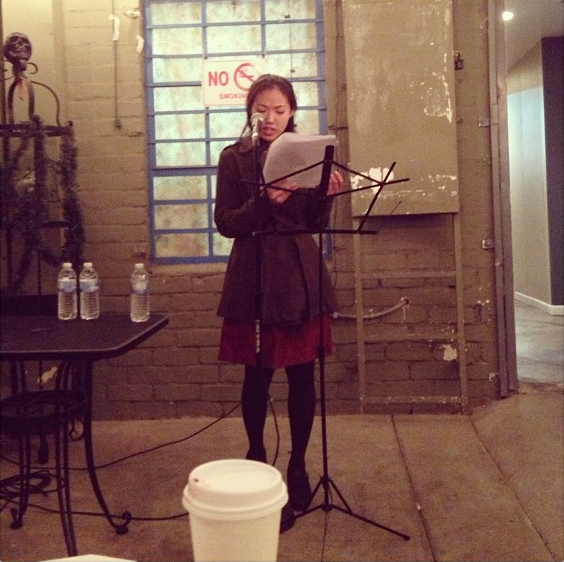
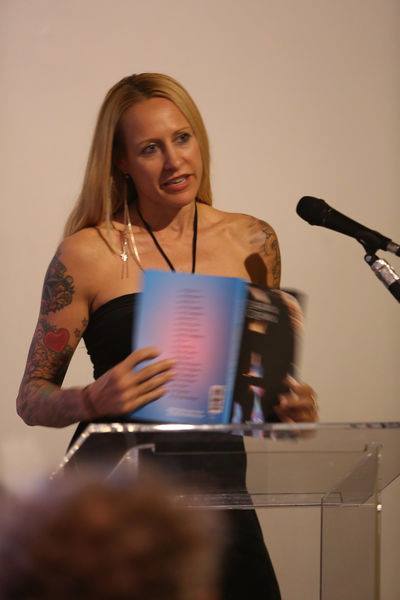
Antonia Crane reading from Black Clock 17

Antonia Crane reading from Black Clock 17

When it comes to writing, we each have particular rules and rituals, habits and quirks, methods and madnesses. Certainly, there is no “one-pen-fits-all” formula for creative productivity, yet still, it is hard not to be curious about the creative lives of others, especially those whom we read.

For our inaugural installment of “Writing Rituals,” we peek into the worlds of Black Clock 17 contributors Antonia Crane, Dayna Dunne, Henry Bean, and Andrew Nicholls, each of whom you may recognize from our recent launch parties in LA and NYC. I solicited these excerpts via email, simply asking the writers to share small snippets that give readers insight into their respective creative worlds. The responses are delightful. Read on to learn about Henry’s discipline, Andrew’s penchant for envisioning an abstract end mood, Dayna’s method of turning the writing process into a fun game, and Antonia’s seductive wooing of her inspiration muse.

Then, fellow readers and writers, do tell: What are your creative rituals? Please share your own quirks and habits in the comments section below!

Antonia Crane

I have a bulletin board of hope that contains inspirational images, quotes and cards from people I love and admire. I have a note from Sy Safranksy smack dab in the middle of my board that says “Dig Deeper. After that, dig even deeper. You can never really go deep enough.” I write first thing in the morning when I’m fresh and never with any music (because I love music too much and it steals my attention). I always light a candle—a dressed candle from New Orleans is preferable. I have a couple of talismans that I keep within reach: Denis Johnson’s Jesus’ Son and Cheryl Strayed’s essay, “The Love of My Life.” I use them to nudge me forward. If those don’t get me going, I turn to Steve Almond’s This Won’t Take But A Minute, Honey. I write on napkins, on the inside of books and in airports. I keep bits of paper in my wallet and dig them out when I sit down to write. Then I am surrounded by ripped scraps like a nut case and dive in. Inspiration comes when she comes and I’ve learned to never wait for her—also never keep her waiting. She’s capricious.

Andrew Nicholls

On the day the Challenger exploded, on the day that John Lennon died, I wrote jokes. I’ve written through kidney stones, food poisoning, Christmas, July 4th, multiple Thanksgivings. My writing partner and I once Sharpie-scrawled a comedy bit directly onto the cue-cards for a variety show sketch that had already begun taping. Production schedules have saved me from most of the pencil-sharpening quirks that plague writers, but I’ve developed one of my own, tricky to articulate. I need to know the end feeling, the shape or color of a thing, before I start it. Whether it’s a one-liner, a short story or a three-act play, I need to know if it’s aiming to be a modernist building or a landscape, if it’s Badfinger or Radiohead, a parfait or a steak. I need to know the feeling that having read it will generate. For “String” (Black Clock 17), I aimed at a shadowy purplish color, the humiliation of old clothes, a ropy texture, a smart sexy girl, metal and rain. If I get lost, armed with this feeling I can step backwards through my own snowprints and look for where I went off the trail. Though sometimes I belatedly realize the end-feeling was too subtle for words, or for my words; that it was a scent fugitive as a dream landscape.

Henry Bean

When I set out to become a writer, I gave myself rules. I had to arrive at the desk by nine each morning and work for three hours. During that time I was not allowed to eat, drink (except the coffee I’d come with), read (except what I’d written), make phone calls or talk to my housemates. I was permitted one trip to the bathroom. The discipline did not come easily; most mornings, by eleven I was counting the minutes. Twelve months later, I could do it for five hours. Soon, I had no trouble writing from morning to night; the hard part was stopping. I worked like that for thirty years.

Dayna Dunne

I’m tempted to say, I’m such a novice. Call me in ten years. Maybe I’ll know more then. But here goes.

I work best when I stay fluid. I don’t like authority (even my own) so it’s impossible for me to do the same thing or be in the same place every day without some inner pilgrim seizing up or freaking out and walking off trail. I have to make a game of this, an exploration, a step by step what-if adventure. I work most days, beginning after noon. The way I work depends on what step I’m on. Gathering is one step. In gathering I make myself available to whatever wants to hook me, making sure I have plenty of recording devices around. Then there’s the Laying It Down step. Laying it down requires sitting somewhere comfortable. Before I sit (and before all the subsequent steps) I have to be clean, fed, walked, and have devoted some portion of my day revering something beautiful. Positioning is important. I’ve got to feel good. Balanced. So I can focus. Developing requires time to be still with my fluctuating mental/emotional/visual aperture. It feels like this: I’m writing, writing, and all the while there’s this sensual lens opening and closing, steering me. Developing can happen anywhere. It likes white noise. Sometimes I’m at home with my cat on my lap, sometimes I’m out in public. If I’m out in public I’m in an environment I trust, an environment with good beverages. Reviewing has to happen at home, in quiet, because gathering and developing like to join forces with reviewing and if it isn’t quiet (that means no music, no car alarms, no leaf blowers, no phone) the reviewer gets annoyed. Dance breaks are important, particularly in the kitchen. Dancing burns out the base and bothersome, tightens my focus, and celebrates little victories. (Celebrating little victories keeps me going.) I used to think Editing was a drag––the masculine, non-creative part of writing. I mean, who wants to be masculine? But after reading Freeplay by Stephen Nachmanovitch I find editing to be just as fun as the other steps. I feel like I’m working when I edit. It requires me to be at my desk in front of my computer with my designated To Do pile on my left, and my Have Done pile somewhere behind me where I can’t see it anymore.


By Chrysanthe Tan
a composer, violinist, writer, and Communications Editor for Black Clock

Writing Rituals:Black Clock17 Edition—Featuring Antonia Crane, Dayna Dunne, Henry Bean, and Andrew Nicholls

Photo by Stephen A. Gunther

Photo by Stephen A. Gunther

When it comes to writing, we all have our particular rules and rituals, habits and quirks, methods and madnesses. Certainly, there is no “one-pen-fits-all” formula for creative productivity, yet still, it is hard not to be curious about the creative lives of others, especially those whom we read.

For our inaugural installment of “Writing Rituals,” we peek into the worlds of Black Clock 17 contributors Antonia Crane, Dayna Dunne, Henry Bean, and Andrew Nicholls, each of whom you may recognize from our recent launch parties in LA and NYC. I solicited these responses via email, simply asking them to “share a small snippet that may give readers a glimpse into your creative world.” I was delighted by their responses. I learned about Henry’s admirable discipline, Andrew’s unusual penchant for envisioning an abstract end mood, Dayna’s method of turning the writing process into a fun game, and Antonia’s seductive wooing of her inspiration muse. Without further ado, here are their full responses:

Antonia Crane:

I have a bulletin board of hope that contains inspirational images, quotes and cards from people I love and admire. I have a note from Sy Safranksy smack dab in the middle of my board that says “Dig Deeper. After that, dig even deeper. You can never really go deep enough.” I write first thing in the morning when I’m fresh and never with any music (because I love music too much and it steals my attention). I always light a candle—a dressed candle from New Orleans is preferable. I have a couple of talismans that I keep within reach: Denis Johnson’s Jesus’ Son and Cheryl Strayed’s essay, “The Love of My Life.” I use them to nudge me forward. If those don’t get me going, I turn to Steve Almond’s This Won’t Take But A Minute, Honey. I write on napkins, on the inside of books and in airports. I keep bits of paper in my wallet and dig them out when I sit down to write. Then I am surrounded by ripped scraps like a nut case and dive in. Inspiration comes when she comes and I’ve learned to never wait for her—also never keep her waiting. She’s capricious.

Andrew Nicholls

On the day the Challenger exploded, on the day that John Lennon died, I wrote jokes. I’ve written through kidney stones, food poisoning, Christmas, July 4th, multiple Thanksgivings. My writing partner and I once Sharpie-scrawled a comedy bit directly onto the cue-cards for a variety show sketch that had already begun taping. Production schedules have saved me from most of the pencil-sharpening quirks that plague writers, but I’ve developed one of my own, tricky to articulate. I need to know the end feeling, the shape or color of a thing, before I start it. Whether it’s a one-liner, a short story or a three-act play, I need to know if it’s aiming to be a modernist building or a landscape, if it’s Badfinger or Radiohead, a parfait or a steak. I need to know the feeling that having read it will generate. For “String” (Black Clock 17), I aimed at a shadowy purplish color, the humiliation of old clothes, a ropy texture, a smart sexy girl, metal and rain. If I get lost, armed with this feeling I can step backwards through my own snowprints and look for where I went off the trail. Though sometimes I belatedly realize the end-feeling was too subtle for words, or for my words; that it was a scent fugitive as a dream landscape.

Henry Bean

When I set out to become a writer, I gave myself rules. I had to arrive at the desk by nine each morning and work for three hours. During that time I was not allowed to eat, drink (except the coffee I’d come with), read (except what I’d written), make phone calls or talk to my housemates. I was permitted one trip to the bathroom. The discipline did not come easily; most mornings, by eleven I was counting the minutes. Twelve months later, I could do it for five hours. Soon, I had no trouble writing from morning to night; the hard part was stopping. I worked like that for thirty years.

Dayna Dunne

I’m tempted to say, I’m such a novice. Call me in ten years. Maybe I’ll know more then. But here goes.

I work best when I stay fluid. I don’t like authority (even my own) so it’s impossible for me to do the same thing or be in the same place every day without some inner pilgrim seizing up or freaking out and walking off trail. I have to make a game of this, an exploration, a step by step what-if adventure. I work most days, beginning after noon. The way I work depends on what step I’m on. Gathering is one step. In gathering I make myself available to whatever wants to hook me, making sure I have plenty of recording devices around. Then there’s the Laying It Down step. Laying it down requires sitting somewhere comfortable. Before I sit (and before all the subsequent steps) I have to be clean, fed, walked, and have devoted some portion of my day revering something beautiful. Positioning is important. I’ve got to feel good. Balanced. So I can focus. Developing requires time to be still with my fluctuating mental/emotional/visual aperture. It feels like this: I’m writing, writing, and all the while there’s this sensual lens opening and closing, steering me. Developing can happen anywhere. It likes white noise. Sometimes I’m at home with my cat on my lap, sometimes I’m out in public. If I’m out in public I’m in an environment I trust, an environment with good beverages. Reviewing has to happen at home, in quiet, because gathering and developing like to join forces with reviewing and if it isn’t quiet (that means no music, no car alarms, no leaf blowers, no phone) the reviewer gets annoyed. Dance breaks are important, particularly in the kitchen. Dancing burns out the base and bothersome, tightens my focus, and celebrates little victories. (Celebrating little victories keeps me going.) I used to think Editing was a drag––the masculine, non-creative part of writing. I mean, who wants to be masculine? But after reading Freeplay by Stephen Nachmanovitch I find editing to be just as fun as the other steps. I feel like I’m working when I edit. It requires me to be at my desk in front of my computer with my designated To Do pile on my left, and my Have Done pile somewhere behind me where I can’t see it anymore.

Turning the writing process into a game is something I have flirted with, and after reading this succinct breakdown, I am inspired to push the approach even further.

So, fellow writers, what are your creative rituals? Do you sit down at your computer every morning rain or shine, or must you first seduce your inner muse? Do you take dance breaks? Are you a rebel who refuses to follow rules? Do your methods work for you or are you striving to adopt new habits? Please share in the comments section below!

By Chrysanthe Tan
composer, violinist, writer, and Communications Editor for Black Clock.

The Lives of Used Books, Their Purveyor & His Dog, Sunshine

Richard West

If you exit the Metro Gold Line at the South Pasadena stop, you’ll find a lawn that hosts picnickers and their tottering toddlers for Thursday evening farmers markets and summer movies. Head east along the South side of Mission, and you’ll discover the building housing The Battery Books & Music.

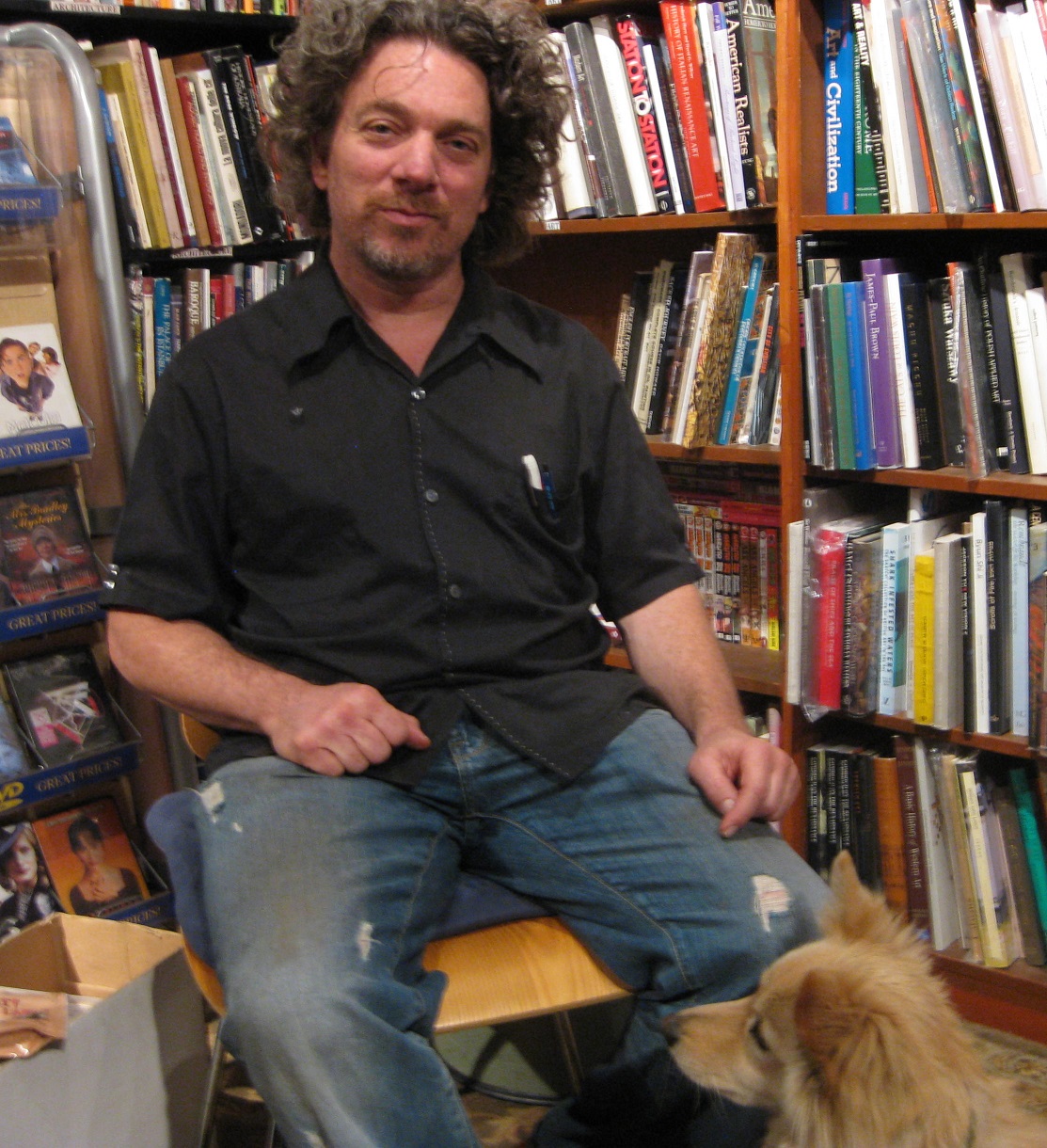
The aisles are narrow, tight and seem to wind instead of stand in rows. You can sit in the stacks to peruse the bottom shelf and smell coffee and tobacco and breakfast in bed while it rains. Each book has a history. Perhaps the one you open has red lipstick smears on the page or a name written in the margin. Owner Richard West, a man in jeans with a wild nest of greying curls, heads towards you, so you fold yourself into these books that have lived and been loved, so the two of you can linger.

T: How did you get into the used book business?

R: I was desperate for a job in 1991, and my customer, when I was working at a coffee shop, was Mark Sailor, and he managed or at least did a lot of pricing at Cliff’s Books, and I just went in there and kept bugging him, and he finally gave me a job. Cliff’s Books, 1991 through 1994. You know used books in general is just somewhere to hang. I always hung out in used bookstores.

T: So you hung out in used bookstores and then…

 R: Yeah, even as a kid I remember buying Mrs. Murphy’s Underpants by Fredic Brown at House of Fiction when he was on Walnut, and Bill Tunila, he passed away a few years ago, Mark Sailor did too just a couple of years ago. But anyway, I’m not too sure what to say about that. Out of desperation did I actually start making a living at…

T: At used books, so why used books?

 R: Yeah why used books? I did apply at Vroman’s, but I don’t really remember when. It must have been a few years later when I was back from Europe. It didn’t appeal to me. What I think is great about used books is a certain casualness about the way people run their businesses. There’s a fringe element to it all that I really like. Reminds me of the kind of music I play.

T: I couldn’t imagine a better thing to do than to sit surrounded by books, actually.

 R: Exactly. I like doing the books. It’s not exactly what I thought I’d be doing when I was 50, but here I am, so.

T: Tell me a little bit about this store in particular.

 R: Oh, well I went to South Pas High, and I don’t know if that has anything to do with this store, but I know this space. I feel like I know this space anyway, but this store, in particular, we sell a lot of fiction, a lot of lit, but I’m always surprised by what does sell. We sell unusual items. I love that we have a huge books in Spanish section. I let the workers play their music which can be really intense when I walk in sometimes.

T: (laughter)

 R: Age group appropriate, at times. I like that it’s a hanging out place for some of the neighbors. We have seats in here, and people can sit down. Don’t necessarily have to buy stuff, and they can just actually keep me company although that is harder to make rent.

T: Any characters? It’s okay. We won’t know who they are.

R: Well recently there’s been a comic who’s been hanging out. Probably the most depressing comic I’ve ever met. He has a show coming up, and he’ll admit to it, but he likes our psychology section, which is also very funny to me. Let’s see who else, who comes and hangs, oh my friend, who’s in his 70s, and he gives me relationship advice and…

T: So tell me some of his relationship advice.

 R: Stay healthy. He always parts with that bit of advice. Stick with the woman I’m seeing which is not necessarily my choice since she’s not willing to stick with me. Let’s see what else?  God, I don’t know, he likes Michael Chabon.

T: So do I.

 R: I’m listening to Summerland right now on audio. I turned him onto Jonathan Lethem, and that was great because that made him go into Chabon. I’m trying to think of who else I had him read, not Jeffrey Eugenides.

T: You mentioned that you’re surprised by some things that do sell, so what are some of the surprises?

R: I’ve worked in a lot of bookstores. I know that there’s an array of books out there, and there are going to be all different type tastes, but I’m surprised by how much philosophy sells, how much poetry sells, and obscure stuff, not really anything, not your run-of-the-mill poetry. I’m always amazed, and I love it when people come in and buy an engineering book. I just love it. I’m not an engineer, and I don’t do all that well in math or biology, but I just love that or a higher math book, you know, and say something like, “I’m really happy you have this in.” As opposed to whatever obvious things one should have in a store like Harry Potter books or Stephenie Meyer.

T: Who comes and digs through your vinyls? I see good stuff, Gladys Knight and The Pips, we got The Wizard of Oz…

 R: That’s an odd one. It doesn’t have the booklet in it, but that’s really an odd one. I’ve never seen it before to be honest.

T: I love to sing along. You’ve got banjo and bluegrass, a Czech classic…

 R: A wide variety, and we have all kinds of live music. Although I try to get live music that’s a little more experimental and not so mainstream because there’s not really a place for that anywhere in the area, including Pasadena. You’re going to have to go downtown or the Valley to get anything more experimental.

 T: Experimental, tell me a little bit what you mean by that.

R. Oh let’s see, whether it be improvisational stuff or even ambient, but experimental in terms of what sound is, how we approach sound. Recently, I had some guys come in, and sure they were playing their instruments, their trumpet and trombone, but they had run it through on processors on their laptops, and then they were definitely making it sound really different, whether it be rhythmic or whatever, it was just coming out a whole different way through their processors. The drummer was unbelievable.

T: What nights are the music?

 R: Usually Thursdays, sometimes Fridays. I think we have something this Thursday, Clark Chimp, who claims he’s from outer space, and actually he’s pretty mainstream pop singer, but he tends to play solo.

T: He’s mainstream pop, but he claims he’s from outer space?

R: That makes it a little edgy. I just like his songs, so we’re just going to go with it, and so I’m contradicting what I said before. I tend to have experimental. I do like the pop once in awhile, and he brings his…I can’t say it’s a good…poetry is better for people actually buying books for whatever reason. People who come to see music really don’t buy anything.

T: You also do some poetry in terms of your events as well.

R: Yeah. We like to. More so. When Dottie was still alive, Dottie Grossman. We haven’t had as many as I like to. Here we are a bookstore, and we have music. I would prefer to have readings more. I don’t know why. I don’t know why we don’t have more. I have a podium and everything.

T: So can people find out who’s playing?

R: It’s usually on our website, and we also have a mailing list.

T: I can find out on the website or get on the mailing list, and you’re going to figure out some kind of way of making music sell more books.

R: That’s right. We have a live streaming. This is live streaming I put together. It changes every day. The music does. You can also log onto that at Battery Books.

T: You know how they do wine and cheese pairings? You can do music and book pairings.

R: Yeah that’s a good idea. That’s a really good idea. I’m trying to get rid of my hoarding instincts, and that’s why I have this bookstore, and the other thing my social life, unbelievable, I have so many friends now. It can get lonely in here, especially late at night, but I do this shift for just that reason because I can handle the loneliness. I don’t think many people can. It’s hard, and it can get really crickety you know.

T: What’s her name? {Dog Enters}

 R: That’s Sunshine.

 T: Is Sunshine a particular breed?

 R: She’s like a Corgi mix. I do enjoy having her here.

You don’t make friends online. Here’s the thing, I was online for thirteen years before I opened the store selling books. I didn’t make any friends. No friends. Thirteen years. You know you don’t have a social life. You sit in front of a computer. You put books on and that’s your life.

T: You enjoy having the shop because it’s much different than being online, but I think there’s probably something also for the people who come in right?

 R: I hope so

 T: What’s your sense?

R: I hope I’m not an annoyance.

T: No, I mean they could go online right?

 R: Well that’s the thing, we did have a sort of guiding principle when we, well we have to. That’s our competition. It’s not other bookstores. In fact, just the opposite. It’s like let’s add a couple more. I try to convince friends to get some in the neighborhood or at least closer by. I mean you can go to Read Books or you can go to Century. Cliff’s is closed now, but they’re the two next closest. Read Books is in Eagle Rock; Century’s in Pasadena, but, and I tell my workers, “Look if we don’t have it, you send them there or Book Out.” Because, our competition’s the Internet.

T: It’s the culture. It’s creating the culture of the community of the bookstores coming in.

R: Yeah, what do you have online? Anonymity. I don’t know if that’s what we need more of. I don’t know. It’s so weird. There’s so much pressure. It’s draining. I hate that it’s controlled our lives. I hate it. Actually, you are forced to deal with it.

 T: So what kind of questions do you get from customers?

 R: Have you read all these? Is this your dog? I’m going to start charging for every pet that they give her. There’s these places in Japan and Tokyo where people because they have such small places. You know they live in smaller quarters. They don’t have room even for a cat, so they have a place, a cat cafe, where you go pet a cat. I’ve seen pictures of them. There’s fifty cats in a room being pet by people. It’s hilarious, and I’m thinking of charging. I’ll rename the store.

T: The dog is the attraction.

 R: It becomes the attraction. “Is your dog here? No? Ok, bye.”

T: (laughter) but there’s something, right, in the human interaction that you don’t get when you’re, not just for you, but for customers.

R: Well sure, sure, admittedly online, it’s fun. It’s easy, and it’s really quick, super immediate. Unless they don’t have it, in which case, you do have to go searching.

T: It’s not as immediate as going in and taking a book home with you though.

R: Good point, and the doctor’s in. Good advice on the way. You gotta change that tie. Or those shoes look nice. Yeah, I don’t know. I hope so, and I think I’ve hired people who’ve been pretty, what’s the word? I’ll just go with friendly, but sometimes overly so. I got one employee, oh my god, talks up a storm and knows a lot about classical music, and we’ve got another who plays jazz, pretty straight ahead jazz. I love that.

T: OK last one, so considering some people collect books as a hobby, and you collect books as a business, what do you do as a hobby?

 R: Well, let’s see. You know I think this is my hobby doing the live stream. I love it. I used to compose. Goddamn it. Over the summer I was composing again, so I guess you’d consider it a hobby. I still play music. It’s a hobby. Sadly, I hate coming to that point where music’s become a hobby because I’d taken it so seriously for so long. Playing basketball. I still play 50 years old. I read. I love it. I go see shows.

 T: It’s kind of nice in this space, at night.

R: It is all right. Yeah, I agree. The traffic going by.

T: You’ve got books. You’ve got the music.

R: You got to love it if you have books. I mean unless you forget your glasses. I play chess. I started playing chess last year. I can’t wait ‘til my chess partner shows up tonight, we’re going to play back here. It’s always here.

T: You’re a dad.

 R: Yeah. That’s the thing, you know. You don’t really get the luxury of hobbies anymore. I quit collecting. I’m selling off everything. How many times can I listen to this record in my lifetime? Or read this book? I don’t have any more time.

T: I’m not allowed to go into bookstores because I already have too many. The books have taken over my house.

R: I had a formula before kids before I got into the book business.

T: Growing towers.

R: Yeah. But I could actually sell off, and I love that about used bookstores. You could do that and trade and get.

 T. I get attached.

 R: I know. I know. I know that problem. Really well. You should see my house. I’m serious.

T: My books are arranged by Dewey Decimal.

 R: You lie.

 T: I’m, I’m serious.

R: You need to leave.

T: I have a book in every section.

R: Really?

T: That’s what really surprised me. I organized them. I just moved not that long ago. I could never find the book I was looking for. So there’s an organization system. It’s called Dewey Decimal.

R: I know. It’s amazing. Have you read High Fidelity?

T: My husband totally gives me so much crap for that.

R: I think it’s totally cool. I used to be perfect about organization.

T: He moves books just to see if I’ll notice.

R: No way.

T: But I do have towers too growing in places. When I start reading…

R: Sure, sure, you have to. That’s a really great thing, I love that. I love having books at the night table or books stacked that I’m reading. It’s cool.


By T.M. Semrad
an Editorial Assistant for Black Clock and an MFA Writing candidate at CalArts

Can the Written Address the Speechless?: Renee Gladman’s Event Factory

GladmanOctober 22. 7pm-9pm. CalArts, Butler Building 4: Renee Gladman will read from and discuss her ongoing series about the invented city-state of Ravicka. Her visit is part of a public lecture series  connected to the MA Aesthetics and Politics and MFA Creative Writing course, Interventions: A Wor(l)ding Project. Free to the public. Reception to follow.
 
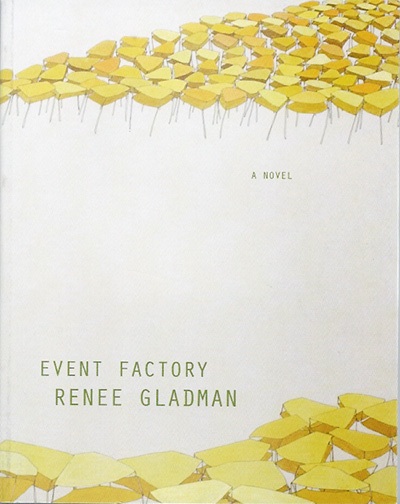
Event Factory, the first novel in Gladman’s series, concerns a linguist tourist bent on exploring the landscape and customs of Ravicka. She arrives to find the inhabitants fleeing from a mysterious yellow fog. Events happen. But how should one digest the “happening” if meaning continually eludes?


Does the city reflect the consciousness of its maker?

In an interview with Volta, Gladman says, “At no time in the three centuries of western thought I studied did I ever feel my subjectivity was being considered. A black, queer woman was not a problem in philosophy; rather it was a zero.”

In another with Bomb: “The sentence is at once a map of where we have gone and where we wish to go.”


Has a city ever held you tender?

Critics puzzle: how to name Gladman’s Event Factory. Is this the world of science or speculative fiction? In the Acknowledgements section Gladman gives thanks “most especially to Samuel R. Delany, for Dhalgren”.  Surely that must be a sign! How else to read the yellowed air, the “emptying out”, the seen/unseen bulbous growths in the streets? But the narrator disrupts the attempt to name. She warns: “Do not misunderstand me. I am not insinuating there is anything extraterrestrial about this place. How could there be?”  The reader wanders through Gladman’s world, unmoored by the twinned opacity and spectrality of experiences. Is this a planet? A dream? A misunderstanding?


If language performs chaos does that mean language can stand outside of chaos?

Critics puzzle once more. In that case we are in the world of the social sciences, yes? Seen in this light, Event Factory would appear to cast linguistics as the science of interest. The narrator, unnamed and unknown, comes to Ravicka as an eager linguist-traveler well-versed in various languages. Despite her fluency in Ravic she remains unable to deeply place herself within the city. Meaning, “in high Ravickian form”, continually hides itself in gesture and obfuscation.  Our linguist stumbles upon a language that refuses to be known. Rather the signifying leads to spaces  dizzyingly further from the signified. Spaces that crumble, multiply, roam. She encounters the Esaleyons, a group of people who speak “in gaps and air.” She ponders: can the written capture the speechless? If not, what of the spaces, those gaps of air?


What (who) structures consciousness?

Gladman maps her ontological questions right onto the architecture of Ravicka. We begin to wonder: if our city vanishes, do we? Gladman resists digestible interpretation. Like the citizens of Ravicka she “hides the story in a dance.” Her prose envelops you in a lucid trance daring you to question its supposed unreality or fiction. You come to wonder if it matters in the end. I think of the scene where the narrator has stumbled upon an underground camp of resistance members. Gladman deflates the importance of the whats, the whys, the how comes. These are just dances that hide the meanings. Our narrator misses the cues of their revolution.  Instead she focuses on their slippery talk of “the shape and nature of things”. Soon the experience eclipses the questions: “”Water gathered around my feet. I tried to capture it with my mind…[b]ut it was water. Water you cannot hold. I look around: everything filling that space shone magnificently, shining with this or that iconic power⎯old and extraordinary and arranged complete out of sync with time”.”


Event Factory slows the deafening, chaotic blur of existence.


Within we will attempt to seek, understand and gather meaning.


But water you cannot hold.


By Allison Conner
an Editorial Assistant for Black Clock and an MFA Writing candidate at CalArts
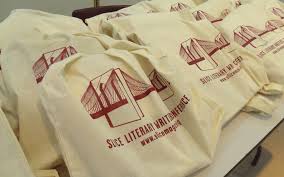
Through the Eyes of an Intern: Slice Literary Writers’ Conference

indexWhat’s interesting about the literary scene in New York—that one distinctive thing that is so very different from the literary scene in Los Angeles—is that it will always haunt you no matter where you are. Maybe it’s the city itself, or maybe it’s the kind of people it attracts, but if you’ve ever had the (mis)fortune of living within Gotham’s walls, you can understand how you cannot escape anything on this island.

Another thing about the literary scene in New York is the curious case of Williamsburg aka Hipsterville. It seems that writers flock to New York City and settle down in Williamsburg, far, far away from Manhattan.

And far, far away from me.

Which is how, on September 7th 2013 at 8:30AM, I found myself making the forty-minute journey from the Upper West Side to Brooklyn. (One stop on the downtown 1 to 96th street, and change to the 2 (or 3) until Borough Hall.) As a Slice Magazine intern, I was making my way to the writers’ conference we were hosting. I was in charge of setting up and making sure everyone who was attending knew where they were going and what they were doing.

I listened to Tom Waits as I held Eugenides’ Middlesex throughout the entire ride, all the while giving myself a little pep talk, which largely consisted of mantras not to make a fool of myself. (Needless to say as an awkward writer, this did not go as planned as I had a little run-in with literary agent Renée Zuckerbrot and editor Calvert Morgan. But more on that later.)

I wasn’t used to literary New Yorkers; what I knew was readings at the Downtown Los Angeles Library, at Stories café in Echo Park, at Griffith Park under brilliant sunshine. I knew forty-minute-commutes in the privacy of my car, I knew palm trees and warmth. But here I was, on a mildly dreary September day in the Empire State, and all I could think of was something I had read the previous summer while interning in Brooklyn that went something like: ‘I kept on wishing I was back in Los Angeles wishing I was back in New York wishing I was back in Los Angeles.’ I wished it then, and I kind of wished it now.

Forty minutes later, I arrived at St. Francis College where the Slice Literary Writers’ Conference was taking place. Slice Magazine is the beautiful creation of Maria Gagliano and Celia Johnson. They have provided the world with a wonderful literary magazine—a magazine that has received positive reviews from the community (see Junot Diaz, for example). It “aims to bridge the gap between emerging and established authors by offering a space where both are published side by side.” They were launching their thirteenth issue after the conference at the PowerHouse Arena in Dumbo, Brooklyn.

But let’s back up a bit to the conference. The lineup consisted of extraordinary people. Agents, editors, writers, interns. Panel after panel, workshop after workshop—from 10AM to 5PM—the building swelled with all the knowledge that was being oozed out and sucked in. Having said that, it was interesting to see how business-like most of the people were. And perhaps that is something that, sometimes, writers forget. Because, after all, the publishing aspect of writing—that ugly side, the side that is not really a side in our minds but the top of a mountain we’ll get to after years of climbing and sweating and writing—is a business. It’s supply and demand, it’s marketing, it’s profit-making.

The most extraordinary example of this business, however, was when I started pointing several aspiring writers to room 3204. (Or perhaps 3042. Maybe it wasn’t even a four-digit number, but 3 was in there.) In any case, Room X was on the third floor, and in that room sat four literary agents. Four business-minded, word-loving, book-adoring individuals with an impressive list of clients. That is where I made a fool of myself in front of Renée Zuckerbrot of Zuckerbrot Literary Agency as I showed her the way to the room for the afternoon. I was so nervous and careful not to say anything stupid, I didn’t say anything at all. In the silence that surrounded us, I was very aware of the noise our footsteps made and the chatter of people around us. I scratched my mind for something to say, something witty, but all I did was keep quiet and convinced myself that Ms. Zuckerbrot probably thought I was physically inept at social conventions such as talking.

These hungry writers with completed manuscripts had 15 minutes—that’s right, fifteen; one five—to sell it. Instead of an impersonal email with a pitch that barely gets 2 minutes of attention, these people had one quarter of an hour of face-to-face time with literary moguls. I can’t say how many of those writers actually got the ‘okay’ to send them the manuscript as I was busy making sure editors and publishers knew where their panels and workshops were, but it is a true testament to Slice that it has given the literary community such a rare opportunity.

It was such an opportunity that found me talking to Calvert Morgan—Executive Editor of Harper and Editorial Director at Harper Perennial—as we walked down the corridor towards his panel. It wasn’t a moment of enlightenment, nor was it an ‘aha’ moment, but it was the sort of advice that is given to you that just sits with you for a while and warms you up as time passes. It was a simple, “there is never such a thing as just a crew member,” in reply to me saying “I’m just a crew member.” And maybe I still feel like I made a fool of myself in front of him, but at least I got a few words from Mr. Morgan that will probably haunt me for the rest of my life.


By Eleni Demetriou
A Greek-Cypriot fiction writer who fell in love with New York City after living in Los Angeles for two years.

Brian Teare and the Politics of Tiny Press

braineteareBrian Teare of Albion Books, a one-man micropress specializing in limited edition poetry chapbooks, broadsides and print ephemera talks to Black Clock Associate Editor Emma E. Kemp about the politics of tiny press practice.

Emma E Kemp: On your website, you say that Albion Books takes its name from its first home–Albion Street in San Francisco–though the inspiration to use it came from William Blake’s “Visions of the Daughters of Albion.” Albion is also the oldest known name of the island of Great Britain. Today, it is still sometimes used poetically to refer to the island and is a popular pub name; there were 82 English public houses with this name in 2012! Do you have any ties to the UK? You can’t hear my voice but I’m actually from London. I just moved here to the States last September and when Jen introduced me to your press, I felt an almost natural kinship because it made me think of home; FISH AND CHIPS! On this note, how has living in California affected your writing / printing / thinking?

Brian Teare: I love your reaction to the name of the press! My only initial reservation about using “Albion” as the moniker was that it might seem nationalist to someone from the UK. But my only tie to the UK is ancestral: my grandfather emigrated to the US from the Isle of Man. And though my father identified strongly with his Manx roots, I’ve never been there and have only the sketchiest notion of what “Manx roots” might actually be.

As for part two of your question—living in the San Francisco Bay Area changed my life almost entirely. Because it’s impossible to summarize how totally my time there affected me as a thinker and writer, I’ll try to address its effect on my practice as a printer and binder. 

The Bay Area has a really rich book culture: there are lots of printers and binders in the community, and they’re doing everything from DIY punk publishing projects to fine bindings in limited editions sold only to collectors. The Bay Area also has a really rich literary history in which experimental poetry, bookmaking, and regional identity are intertwined: I think of Graham MackIntosh in particular, who printed Jack Spicer’s early books for White Rabbit Press and helped usher a whole generation of radical Bay Area poets into print as he himself learned the trade.  

So on the one hand, the rich book culture means that there’s a San Francisco Center for the Book where the aspiring bookmaker can get trained in everything from typesetting with lead and wood type to binding in leather to making polymer plates. And there are lots of amateur and community bookmakers and collectives generating a lot of print matter: broadsides, zines, chapbooks, and inventive ephemera. 

On the other hand, the rich literary history in which poets and printers collaborate and, in doing so, help articulate a regional identity means that many of the community and collective bookmaking endeavors I encountered centered around poetry and politics at the local level. These endeavors became a necessary, radical counterpoint to the formal education I received at the Center for the Book, and it was because of them that I found myself wanting to do something that might bridge fine printing with more DIY practices of scavenging and gifting.

EEK: You taught in the MFA Writing and Consciousness program at the New College of California – can you talk a little about this experience? How did you end up being a teacher? What role does the word ‘consciousness’ play in the title of the program – can one write unconsciously? What is the relationship between writing, or any art form for that matter, and (un)consciousness?

BT: New College had a mission, a vision of education as “just, sacred, and sustainable.” An open enrollment institution, all of its undergraduate and graduate programs combined social justice, spirituality, and ecology. As you might expect, then, the “Consciousness” in Writing and Consciousness was polyvalent. On the one hand, our graduate students studied philosophy and critical thinking from antiquity to the present. On the other hand, “consciousness raising” was definitely a part of the program, with a curricular emphasis on social justice. As for the unconscious, the program made the same assumptions that all writing programs make: there are good kinds of unconscious writing (revelatory and/or inspired), and there are bad kinds of unconscious writing (violent and/or uninspired), and part of the point of training the critical faculties is to help the writer recognize the difference and to know what to do with revelation and violence alike. As for your broader question—“What is the relationship between writing…and (un)consciousness”—I think there is no one relationship, but a thousand ways of relating writing to consciousness, writing to the unconscious. 

EEK: How does the creative process of book design begin for you? Does a particular form / vision appear upon reading the manuscript or is it more of a considered, ‘conscious’ design process?

BT: Usually I decide to ask for a manuscript when I hear the poet reading the work. I already have some feel for it then—but when I read it on the page, I begin to get the real ideas about size, shape, color. I have to work within a lot of constraints, I’m constantly adjusting these ideas in relation to material reality—but what I like about this process is that it becomes quite improvisatory, a game of chance, the constraints generating new ideas about book forms and the process of making them. I always formalize my ideas into a design because I have to cut paper, etc., but I’m always surprised at how open the design remains in terms of typesetting and coloration, sometimes quite far into the process of fabrication. 

EEK: Can you isolate a particular design aesthetic uniting your printed books?

BT: I never quite feel qualified to answer this question. By which I mean I think it might be easier for readers familiar with the press to say whether or not there’s a coherent design aesthetic. I’m not being evasive—I know that I have an aesthetic. It’s just very hard for me to parse it into qualities. If I had to list three aspects of design that characterize my practice it would be these:

I respect constraint and accident, both, and work with them constantly. I print on a Kelsey tabletop, 6 x 10, so by virtue of its platen, the press itself makes demands I have to accommodate within the design. Because I do not make polymer plates, and only own three fonts and a limited amount of ornaments, the typesetting has to be as inventive as possible within certain limits. And when designing the book, I also often start with scavenged paper stock of odd sizes or colors, and I try to match the right paper with the right book so that the material constraint acts as a frame for the book and not a cage. All of this is an ethic as well as an aesthetic—letterpress printing can be precious, and such preciousness usually costs a lot of money in terms of fine paper and/or polymer plate making. I print as cheaply as possible while printing as beautifully as possible. 

I really love color—it’s a vocabulary that the interior text largely doesn’t get to use, so whenever possible I try to employ that language in ways that excite the eye and rhyme with the book’s contents.

I respect the poems—the entire book, from trim size to binding style, is designed to hold the poems, even if that means I end up having to do a lot of work to make a book that holds the poems accurately. 

EEK: To what extent do the writers dictate the graphic decisions of the book? i.e., page layout, font, spacing, etc…?

BT: When I approach a poet with the desire to do a book with them, I let them know that these decisions can be made in a variety of ways: with a lot of input from them, with no input from them, or with an ongoing dialogue between us. Most poets choose to forgo input or to participate in some form of dialogue, largely on the minimal side. And though I encourage their input, I also let them know up front what the constraints are going to be: what kind of paper I have to work with, what kinds of fonts we have to choose from, etc. Because the constraints can be quite severe and are also part of the point of the press, most poets respect that, and have been quite happy to have me do the design work and consult with them at crucial junctures.  

EEK: Albion Press began in 2008 – have you noticed much change in the small press world over the last five years?

BT: It seems to me that the micropress focusing on the chapbook has become as prevalent a national trend among young poets as has a return to fine binding and letterpress printing, to the book as craft. In 2008, that wasn’t so much the case, though there were such things happening in Portland and Minneapolis and New York, among other places with large poetry and book arts communities. I think the recently founded dual MFA in book arts and poetry at Mills College and the CUNY Chapbook Fest are good examples of how crucial micropress and fine press work have become to young poets in particular, but outside of the poetry world, there’s also a huge surge of interest in book arts. The thing that excites me most about this renaissance is that a lot of young book people are thinking about the ecology of the book—utilizing soy-based inks and non-toxic biodegradable cleaning solvents for their presses, and finding new sustainable sources for the raw materials for their books. 

EEK: How has the rise of web 2.0 impacted your practice?

BT: I am by nature a Luddite and have been slow to adapt to the digital world. I find the material, phenomenal world interesting and challenging and valuable and mysterious enough in and of itself—and our time here is short. So I don’t twitter or tumblr; I’m not on facebook. I have deep reservations about how the web has infiltrated our lives so quickly and so thoroughly, and because of that, I am careful around it. It so easily turns leisure activities into unpaid labor for major corporations (which is something you don’t often say about taking a walk). Though many users are hooked by the promise of payment for said labor in the form of cultural capital, I have reservations about the cultural capital gained in this manner as well. For all of these reasons and many more, I’m not sure that the web itself has had any impact on my practice qua practice, though it has certainly meant that I’ve been able to continue printing in Philly, a community with such scant letterpress resources I’ve resorted to ordering supplies online.

EEK: How much value do you place on your website insofar as it being (or not being) a webular extension of your printing practice? Do you consider them two completely singular, separate spaces or do they work together in some way?

BT: Ideally, the website would be an archive of all the books and ephemera I’ve made and the texts of the authors I’ve published as well as a way of distributing and selling copies to the public. But because I have only so much time in which to work, and given my ambivalence about the internet, I pretty much use the website for distribution and sales. I admire sites like Ugly Duckling’s, which has converted its out of print chapbooks into digital artifacts you can read online, and I think that’s probably the best way to go with limited editions. However, there’s value in the constraint a limited editions places upon an object: there are only so many, and then there are no more. If free market capitalism is all about the illusion of endless resources, why not insist on limitation? And why not insist that limitation is not precious (i.e. pricey), but rather the most common and endless resource around? I suppose I’m dedicated to preserving the limitations inherent in the limited edition without fetishizing the books through inflated pricing.    

EEK: On a scale of 0-10, how hard is it to run a one-man press? How do you measure success?

BT: Given that I haven’t run any other kind of press, I can’t say where on this scale my labors fall. Probably it varies. Right now it feels like an 8, but I am behind in assembling an edition and I am low on cash. It is certainly very hard. And I have a lot of doubts. And I get tired. And I run out of money. And it seems thankless. But that is true of all art. It is also effortless. And I have deep faith in the process and the end result. And I feel energized and deeply rewarded. 

I measure success by the fact that I feel more rewarded than abjected, the books and their authors more treasured than neglected. I measure success by the relationships I have with the writers I publish, and their pleasure in the objects I’ve made to hold their work. I measure success by selling out of a chapbook. I measure success by seeing the books in places I don’t expect, being read by people I don’t know. I measure success by answering questions like this one, by being in dialogue with readers and makers such as yourself.

EEK: Through your printing endeavors and indie press communities, have you uncovered any writers by whom you’ve been totally awed / gone on to work with? Is this a common happening?

BT: Many of the poets whose work I’ve published I met in other ways, mostly at reading or through friends. But I’ve certainly encountered presses that publish work I’ve been awed by. Erin Morrill’s Trafficker Press has published a ton of flawless work, including early chaps by Esther Lee and Jared Stanley. Both of Michael Cross’s presses—first Atticus/Finch and now Compline—have introduced me to fabulous writers like Julian Brolaski and CJ Martin. And the list could go on for pages. Given the renaissance of micro- and small poetry presses, being wowed by what others publish is definitely a common occurrence.

EEK: What’s your relation to the visual arts?

BT: That’s a good question. I did not grow up in a family that went to museums or appreciated visual art (though my parents did appreciate classical music), so I did not begin learning the many ways to look at or think about visual art until I was in my late twenties. In fact, my lack of education in visual art kept me from pursuing book arts until I was in my thirties; despite great interest, I thought I was not someone who could do this kind of work, that I was somehow unfit or “too late.” A hands-on education in the printing and binding studios gave me ways of thinking about visual art not just as something you look at, but also as something that is made, and whose manner of making has everything to do with what is seen. That was a way in. Now I have a strong interest in the histories of the book and of photography, late 20th century and contemporary drawing and sculpture, and feminist and queer performance art, but I can’t say how these interests have informed my practice as a book artist. 

EEK: How do you think of‘ THE BOOK’ in 2013?

BT: Of course the most prominent discourse around THE BOOK is around the perceived BATTLE between print and digital books. Of course there is no single BOOK and there is no one BATTLE. This is a discourse about capitalism and technology and its relationship to our private lives, a discourse that, frankly, the book has long been involved with. You could say that, since the 1800s, the printed book has in fact been at the center of this discourse. The Industrial Revolution upped the number of impressions per hour a printing press could make—from 240 to 2,400!—and it also enabled presses to print on both sides of the page at once. Both facts greatly increased the number of books available to the public, and lowered the price of printed matter; these facts led, eventually, to a steady rise in the number of literate citizens, which in turn changed the body politic. Given the class politics of digital technology, it is less clear what kinds of changes will occur as books move onto digital platforms. It is especially less clear with regards to poetry. I confess that these questions do not worry me much, though I remain curious as to the outcomes.

Other questions are interesting to me. At the recent Ecopoetics Conference at UC Berkeley, I moderated a panel called “The Book as Ecopoetic Instrument.” Why was I surprised that none of the panelists actually talked about books? Why was I surprised that they all talked about bringing reading out of the boundaries of binding and print and into spaces and among people and things? I was so wrapped up in the book as a made thing that I wasn’t thinking about the book as a technology that individuates the reader and temporarily separates them from others. So the panel gave me new ways of thinking about reading and its relationship to the book: what would happen if we shifted our horizon from the page (or screen) to the site or bioregion? 

EEK: Do you accept submissions? How does that process work for you?

BT: No. I ask for work by a poet whose work I love; I ask for text that I’ve heard the poet read. Publishing for me is a response to the poet’s work, a desire to be further engaged in it as a critical and artisanal thinker. 

One chapbook did come out of an interaction that was not even really a submission. I guess in advertising they’d call it a pitch. The poet approached me and said: here’s the work I have and here’s the kind of book I’m envisioning. I already liked his work, and I liked his idea and so I said yes. 

EEK: What, if anything, keeps you up at night?

BT: Given the range of concerns I’ve covered in this interview, you can probably guess. I try to meditate regularly so that I can stay lucid, awake and engaged, rather than sleeplessly worrying and raging over endless grievances against unjust global political and economic systems.


By Emma E. Kemp
an Associate Editor for Black Clock and an MFA Writing candidate at CalArts
John. Chapter One. Verse One.

imagesAfter twenty-one hours of traveling, four different countries, three different planes, and three hundred and fifty pages, a litany kept repeating itself in my mind: my life, my time, my hope, my god, my faith, my love, my glory.
 

With his 2006 debut novel And The Word Was, Bruce Bauman has given us the gift of an honorable character and an honest man; a man who isn’t afraid to love. Neil Downs is an ER doctor from Queens who runs away from New York City after the tragic death of his son. He ends up in New Delhi, where a myriad of factors come together and blow up in front of the reader, ranging from the political to the philosophical to the hypocrisy that exists in our everyday lives.

Neil tracks down his favourite writer, Holocaust survivor Levi Furstenblum, whose writings are interspersed throughout the novel and are the catalysts to certain events. What was fascinating to me was Neil finding himself in the writings of Levi while Levi’s writing reflected what Neil is not. Levi might have lost his god, his family, and his faith in humanity, but Neil did not. Yes, Neil lost his son, his god, and even his wife for a while, but he was always on the path toward repairing this. Perhaps my favourite parts of the novel are the instances when Neil kneels down to help an injured young woman, and to place rocks on specific graves, as if he is brought to his knees from all the guilt, the tormented ghosts of his past, and his regrets.

(And perhaps my choice of Edith Piaf’s “Non, Je Ne Regrette Rien” wasn’t a random yearning that has been haunting me ever since I read Bauman’s first sentence.)

Curiously enough, “epistasis is the biological term, which science best defines as that nothing is simple and everything depends on everything else” (Bauman 230). The etymology of “epistasis” comes from the Greek word “epi,” meaning “upon,” and “stasis,” which means “stopping;” therefore “a stopping” or “stoppage.” While Neil is in this constant game of “stop and go” (something that Levi knows all too much about), they both need each other and everything that exists in the universe in order to survive.

In essence, this sums up Bauman’s novel beautifully (even if the science that has been carefully penned into this novel is sometimes out of my reach but hey! That is the beauty of fiction). When you lose a person you love, you lose a part of yourself. When you lose your god, your faith is shaken and you start to shatter into small fragments. Most of the time, those two are interrelated and I’m not quite sure which way the causal relationship works.

It is the tug of war that goes on in our entire universe. It is the debate of god and science, of love and loss, of death and life. It is the alienation that Neil feels wherever he may be, mentally or physically. It is his wish to go deaf—for silence in a world that is anything but silent. It is the desperation for something more and the unwillingness to accept that perhaps seeing is  believing. It is the bonding of people who are suffering and how they heal each other by searching for the truth together, consequently bringing each other to salvation.

I can’t stop thinking about the struggle that Holika, an intriguing upper-class Indian woman who had a brief affair with Neil, faced with the social norms that exist in India. I can’t help but think about Abraham and Isaac. About Rilke and “The minds of murderers are easily comprehended.” About the similarities between India and America. Between Israel and Palestine. All the corruption and death, but all of the underlying humanity that is surely found between them. Between, between, between . . .

Ultimately, the greatest tragedy is not Levi Furstenblum losing his family or his god. It is not Neil Downs losing his son in a savage hate crime. It is not the unfairness that plagues India, America, or the world. The tragedy, fundamentally, lies with Sarah Roberts—Neil’s wife who is lamentably silent throughout the first part of the novel—who has her own heavy cross to carry. A cross that is so heartbreaking and so intense, that not even words could contain her pain as most of her journey was off the page. She was alone. And when Neil hears the anguished words of what really happened, our stomachs are in our throats, too.

Because while every single one of the broken characters in the book lose faith in a god that lives out of reach, Sarah loses faith in the man she loves. She lost faith in herself. But as much faith as was stolen from her, she did not lose faith in humanity. Humanity—which Levi (spells ‘Evil,’ spells ‘Live’) Furstenblum only saw the most vicious, the most atrocious, the most horrible aspects. Humanity—which never cared about the agony that was found in the victims of the 20th century, a counterpart to the hatred that was felt by their torturers.

 
And The Word Was is a novel that teaches the reader that hope is often found in the strangest, dampest, and darkest of places. It tells the story of hope always dying last. While I willingly run to the city that Neil Downs has tried to leave behind, I realise that hope is time, and my time will last as long as I want.
 

By Eleni Demetriou
an Associate Editor for Black Clock and a graduate of the MFA Writing program at CalArts.

Peering Into the Void: A Review of Gwenaëlle Aubry’s “No One”

noonenovel“Here again I don’t know what, in all of this, is wisdom, what is madness.”

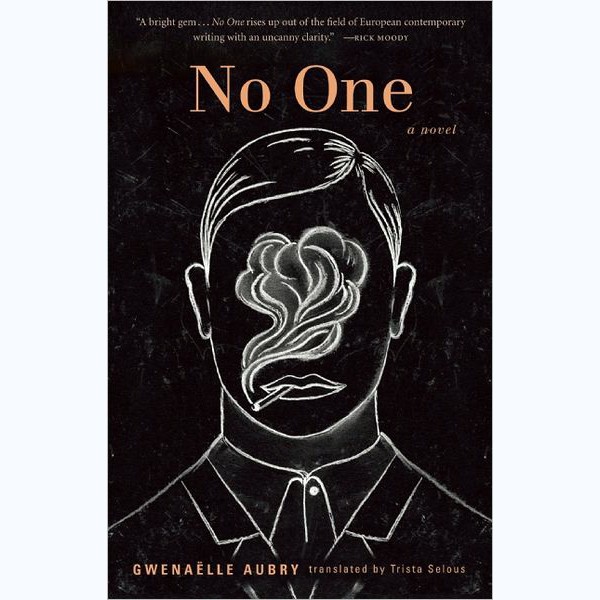
How do we write madness? What language can accurately encompass something as personal and unknowable as mental illness? In her latest book, No One, French philosopher and writer Gwenaëlle Aubry seeks to find that language. Piecing together her own fragile recollections with excerpts from the handwritten, autobiographical manuscript (titled The Melancholic Black Sheep) left behind by her late father with the note “to be novelized,” Aubry explores the life of a man who disappeared from view long before his death: Francois-Xavier Aubry, a once brilliant and distinguished Paris lawyer whose crippling bipolar disorder eventually left him a penniless drifter, in and out of mental institutions for most of his daughter’s life. At once lucid and mystifying, No One is Aubry’s beautifully wrought attempt at creating a portrait of someone whose internal reality she knew so little about, someone who, in the end, strived to be anyone but himself.

Were No One a conventional memoir in the popular American sense we might read Aubry’s story through detailed, chronological scenes in which each family member is cast as a distinct character. It seems necessary to note, however, that No One is the first of Aubry’s books to be translated into English, and in writing it Aubry appears acutely aware of the French literary tradition of “autofiction,” a contemporary genre that blurs the boundaries between autobiography and fiction. Much in the way we saw the life story of Roland Barthes presented to us in Roland Barthes (1977), No One favors compact and poetic philosophical ruminations over dialogue-centered prose. And perhaps also recalling Primo Levi’s The Periodic Table (1975), Aubry shapes her own memoir similarly: this time in dictionary form, with each letter of the alphabet offering another hopeful entryway into her father’s warped psyche.

From the clinically depressed poet/playwright Antonin Artaud to Woody Allen’s chameleon-like 1983 character Zelig, readers accompany Aubry through this idiosyncratic dictionary with curiosity, moving easily between both her father’s poignant, chaotic voice and her own of understated elegance. What we experience then is one author’s exquisite struggle to put a face to a man whose identity was forever unstable, preferring always to be, in his own words, “away from the guerillas of the past, unknown to all, without a label.” The result is a sparkling yet melancholy elegy, a restrained kind of mourning from a wounded daughter to her tragically afflicted father, full of grief and quiet love.

And while we can’t say for certain whether parts of Aubry’s memoir are indeed fictionalized, what is clear is the author’s interest in cultivating this energy of the unknown, something characteristic of autofiction in particular. Readers will notice immediately the contrast between Aubry’s rigidity of form and the cloudiness of her investigation into her father’s true persona, which, like the mental illness that took hold of it, evades, ever so slightly, all attempts at categorization, at being fully known. The task that Aubry has taken on in No One is undoubtedly a difficult one. But the form that she has chosen for her work provides a much-needed, albeit only somewhat helpful, structure in which to look at something formless. It isn’t until the book’s last pages that Aubry comes to a critical realization about her father: “I felt as though, having tried so hard to forget, my memory was now going mad. He didn’t want to remember, didn’t want to know.”

Perhaps it is this exact cloudiness, this frustration of memory and knowing that Aubry laments, that is the greatest triumph of No One. For in the end the truth that Aubry discovers is one even greater than that of her father’s story: It is the truth that madness can never be adequately contained. Though readers may fail to reach a precise explanation of what madness is, they have peered deep into the void along with the brave Aubry herself, who has thus achieved the ultimate act of filial devotion: She has spoken her father’s name, despite everything, again and again and again.

No One
Tin House Books (February 2012)
170 pages; $12.95

By Adriana Widdoes
an Editorial Assistant for Black Clock and an MFA Writing candidate at CalArts
Next Words at Stories

CalArts MFA candidate Colleen Hur

CalArts MFA candidate Colleen Hur

I cannot handle cold weather and, apparently, neither can Los Angeles. It was 55 degrees on the second Saturday of April, and I begged for a heater. Having a reading outside with winds straight from the mouth of Satan was not ideal. A heater. That should work.

Next Words is a transition. A reading series that features new work from the CalArts MFA Writing program. It’s the moment where all of our innovation, ambition, and experimental spirits come together as they are introduced to the community outside of CalArts. We the editors-slash-curators call Next Words “an exposure, a nebula, a metamorphosis. A constellation of words in flux—cleaving, becoming. We exit and enter at the same time.”

Stories Books & Café graciously hosted the third event on their outdoor patio in Echo Park. Independent or not, small or big, every bookstore has its own story, and Stories features a wealth of new and used books, as well as organic and fair trade coffee and espresso. I am not a coffee snob by any means—I like my Starbucks, my Coffee Bean, and my Silverlake coffee—and all I know is either way, where there is good coffee, there are good books. Et voilà, Stories. But perhaps this is also so much more than that, which is why the curators of this reading series chose this space to showcase the students; Stories supports local writers.

I chose my seat wisely, so I sat in the middle, only a few chairs away from the sole heater, my leather jacket zipped all the way to the top as I kept the time. (Yes, as an editor and curator of Next Words, I had certain responsibilities.)

Four writers, four different voices, ten minutes each. Jen Hutton—a writer, critic, artist, and translator from Toronto. Patrick Benjamin—an Associate Editor for Black Clock with a superbly-kept beard from Southern California. Colleen Hur, a YA writer from South Korea who had me in tears of laughter as she sped through her reading. And Peter Nichols—a wonk who is particularly proud of an interactive sculpture of his titled “Love in a time of Necrophilia.” I cannot take credit for these descriptions (well, not all of them anyway), as they were provided by the readers.

Faculty, former, current and prospective CalArts students, as well as the Los Angeles reading elite came out regardless of the weather. While I might be a sissy when it comes to cold weather—it does make my nose feel like an anchor and my chest like a cheese grater—I fully supported the outdoor patio reading. The turnout was incredible, and I fully consider my Saturday night to have been a success.

Los Angeles isn’t really home, but while my European habits might be made fun of and teased, these are the moments when I—you, we, writers—experience something other than the solitary and lonely act of writing. Stories, Next Words, the art of reading in front of a great crowd is an intimate act where the microphone amplifies the words and searches to enter ears and worlds. As seen on that Saturday, at 7PM, writers came together and for one moment, they were part of something greater.


By Eleni Demetriou
an Associate Editor for Black Clock and an MFA Writing candidate at CalArts.

Blood in the Wine, Semen on the Snack Cakes: Giving My Time to Poppy Z. Brite

Photo by Deirdre Brinlee

Photo by Deirdre Brinlee

Brace yourself, for the book I am about to discuss may be beneath Black Clock’s usual literary standards. Though Poppy Z. Brite’s 1992 novel Lost Souls may not be as high as the penciled brows of its many gothic readers, I feel that it deserves a bit of critical attention, even if only as a vehicle to sort out my own tenuous attraction to it.

I must begin by saying that I don’t get to do a lot of “frivolous” reading. One of my most influential professors in college, Dr. Rachel Crawford, put forth the motto: “read promiscuously.” While purposefully embracing its sexual connotations, she meant it in its most literal sense, to read indiscriminately, to absorb all that is available. Though I wished to follow this approach, I felt unable to abide. Not because I was so excessively busy or because I devoted my attention to only the most acclaimed classics, but because, simply and tragically, I am just a slow reader. You might say that’s not a bad thing, that it means I savor the words and let them flourish into images rather than merely speeding through information. And to a certain extent, this is true. But I am actually clinically slow, diagnosed with a processing disability that has me reading about three times slower than “normal.” (Note, the quotes around “normal” are important. Normal is relative, and I do not mean to imply that you, the reader, must be normal simply because you are not me.) So, when I decide on a book to read, it is a serious commitment. I made this commitment to the debatably deserving novel at the behest of my boyfriend, who had read it in the mid-’90s, in the throes of his ultra-goth youth. While Lost Souls may not hold a place in the pantheon of critically lauded literature, Poppy Z. Brite does hold a role as something of a modern gothic cult figure. And thus seemed worthy enough of my attention.

It is hard to discuss New Orleans vampire fiction (which is exactly what Lost Souls is) without mention of Anne Rice, and with her Interview with the Vampire series having been published almost two decades before Lost Souls, it might be easy to snidely assume that Brite was merely riding Rice’s velvet coattails. However, New Orleans vampire lore predates both authors by, oh, a couple centuries, and both authors claim this unique city as home. So while it may be fair to say that Rice blazed a pulpy trail, I am of the belief that there is little thieving going on here.

Brite’s story anchors itself in modern (well, ’90s goth) subculture, teenage longings, and the search for identity–insofar as it can be found by hedonistic whim. The first half of the novel consists of vignette-style chapters featuring clusters of characters scattered across the American south, until they all converge in New Orleans to begin a decadent downward spiral. At the center of this spiral is a boy named Nothing, who embodies the most basic of misfit teenage fantasies: unable to relate to his family or even his alternative and sexually explorative friends, he finds out that he is not only adopted, but perhaps something other than human. His quest to uncover his true identity begins–as seems realistic for an aimless yet musically obsessed teenager–when he leaves his hometown in search of an obscure band to whom he feels a connection, called Lost Souls?. On his hitchhiking course toward the band members, he is intercepted by three captivating creatures who lure him eagerly into their dingy yet intoxicating van. These vagabond vampires spend their days carousing in their van, drinking blood and booze and eating substanceless sweets. The head of the triumvirate is petite, androgynous, and deliciously charismatic Zillah, flanked by his flunkies Twig and Molochai, who are really more like interchangeable props than actual characters. If there are any outside comparisons to be made, I would say that Brite’s creation would resemble an X-rated The Lost Boys (1987) with a Bowie and Bauhaus soundtrack.

Lost Souls is not plot-heavy by any stretch of anything, and with many tangents of sex and violence, sometimes reads as if it comes with its own built-in fan fiction. However, I do not think these are necessarily failures on the author’s part. Whether intentional or not, this near-plotlessness reflects the necessary aimlessness that stems from the combination of a lost teenager and thoroughly un-obligated immortals. When their myriad wanderings culminate in an unsurprising bloodbath, there is little catharsis despite Oedipal allusions. Amorality reigns from start to finish.

Every vampire tale contains slightly different mythology, and the Lost Souls vampires are rather unique. Unlike most characters of their kind, these vampires are a race of their own, rather than the result of some kind of supernatural blood-born pathogen. Humans cannot be turned, but they can be impregnated. However, when a vampire baby is born, it is of a gory process that inevitably kills the mother, whether she is human or vampire. Evolutionarily speaking, this could account for the extreme lack of women in the novel; The only two noteworthy human women never meet, and die of the aforementioned cause. The one female vampire exists only in a second hand flashback, and suffers the same fate. Though Lost Souls utterly fails the Bechdel Test, I’m not as wary of this as I could be. Perhaps it’s because all of the men are fucking each other via graphic and surprisingly elegant prose.

Perhaps author and text should be kept separate for text’s integrity, but I feel that isn’t the case here (debatable integrity of the text aside). In recent years, Brite has made a transition not only in writing, but in identity. Poppy Z. Brite is now Billy Martin, and uses masculine pronouns. Writing this article has posed an interesting case of what I am going to refer to as genderqueer timetravel. Initially, I wondered if it would seem disrespectful to refer to him as “her” and even as “Poppy Z. Brite,” especially since he has always been infamous for identifying as a gay man in a woman’s body–which for many years was only taken at camp value. Brite/Martin has always clearly had an investment in the fluidity of gender and sexuality, which is evidenced by the writing on his personal website, though the bio has not been updated since 2004. I expect that this fluidity (A.K.A. “genderqueer timetravel”) in my own writing of this piece, as opposed to retrospective pronoun alteration, would feel appropriate and not dismissive. The big red letters on the cover of the novel read Poppy Z. Brite, which essentially brands the novel as a product of one point in its author’s life.

Upon the publication of Lost Souls in 1992, Brite was only 24 years old. This was her first full-length novel, and already it had gained the endorsement of Stephen King. Coincidentally, I happened to be the same age upon reading it. Despite the arbitrary connection that this evoked, I couldn’t help but wish I were younger. Out of curiosity about its reception by the public, I began reading book reviews on Amazon and Goodreads.com and was surprised to find an overwhelming consensus: when read by teenagers, the book was breathtaking, engrossing, titillating. But most of these reviews are by adults reflecting upon this, many who say they have been tempted to reread the book in recent years, but have decided against it, for fear of ruining the memory. Or rather, not so much out of a fear that it might be, but a knowledge that it will be, ruined. Interestingly, this is precisely how I feel about Anne Rice, having read her novels at fourteen. I even remember underlining sentences that I would like to emulate in my own writing–though as a now allegedly-adult writer, I do not write fiction. But I could easily see a text like Brite’s coming out of someone of comparable age in my own MFA writing program, though it would be a marked (and perhaps easier to market) difference from the poetic non-fiction weirdness that myself and many of my colleagues spend our time on. Must it be bad that a work by such a young person might be better suited for even younger people? I think not, especially because this shift in audience is not due to a lack of sincere and innovative prose, but rather because of a certain kind of escape fantasy suffused with shock value.

My own relationship to the book consists of a strange combination of defense, dismissal, and affinity. I must admit that the latter may be more circumstantial than anything to do with artistic integrity. When I started the book, I had just returned from my first ever trip to New Orleans, after two of my friends moved there. Reading the book at this opportune time allowed for a kind of mental re-tourism, rather than blindly following a literary tour of a mythic city so often associated with vampires and a living-legendary level of public drunkenness. And it is not that Brite is not competent enough to lead this tour; having been there just adds a seemingly necessary visceral element to a text that capitalizes on the visceral. If you are a normal human who absorbs bestsellers at the rate of a couple of weeks a pop, I say, hey, why not give Lost Souls a shot. But having lingered with Poppy, Nothing, Zillah, friends, and foes for a couple of months, I am not exaggerating to say that I feel I have made a terrible new group of friends–the pretty kind that you are drawn to at a club, but have little else going for them. Truth be told, I have no regrets.


By Vesta Seltzer
an Editorial Assistant for Black Clock and an MFA Writing candidate at CalArts