Singular, idiosyncratic and a little mysterious, Black Clock is one of America's leading literary journals.

Archive for 2010—

Walking LA: Chinatown

This is part of a series of literary meditations on that rare urban pastime of exploring Los Angeles on foot.

Ethnic neighborhoods are as American as apple pie–or pad thai, chop suey, or tacos–and Los Angeles’s Chinatown is a prime example of this. A conflation of demolished old and manufactured new, Italian and Chinese immigrant cultures and histories, traditional recipes and innovative cuisine, cryptic apothecaries and contemporary art galleries, Chinatown is not only a quintessential American urban exercise in contrasts, but a classic example of the rich, complicated, and oft-contradictory fallout of reinvention that is Los Angeles.

L.A. is a beautiful, lush city, but it was not always like this; one has to remember that most of the flora, even the palm trees, were imported, and the City of Angels is as much an artificial production as any Hollywood blockbuster. Without a water redirection program that is truly gargantuan in its scope and scale—not to mention controversial–Los Angeles as we know it would simply not exist. Leveled in 1939 to make room for the construction of Union Station, the original Chinatown, which was established in the 1880s, was the victim of a similar lust for development. Chinese residents were resettled and the development of “New Chinatown” emphasized a kitschy adherence to stereotypical tourist expectations. In a sense, New Chinatown was just another Hollywood set, constructed around a large, “authentic” Central Plaza complete with Chinese style palaces and tiny side streets with names like “Gin Ling Way” and “Bamboo Lane.”

So it’s no accident that Roman Polanski’s 1974 classic film about the political intrigue around L.A. water rights and land distribution—disputes that grew more and more contentious as the metropolis bloomed in its desert confines—was set in and titled, well, Chinatown. It’s hard to say whether Polanski’s immortalized Chinatown’s neo-noir reputation or vice versa.  The historical reasons for Chinatown’s association with noir are twofold: Angelenos, who were raised on tales of “the exotic Orient” and Charlie Chan movies, flocked to the neighborhood for a taste of folkloric intrigue and mystique; secondly, the spectral presence of an entrenched local Italian mafia created atmospheric undercurrent of intrigue for decades.  The most obvious remnant of the old Italian stamp on the neighborhood is the famous Little Joe’s Italian American restaurant, which stands at the corner of Broadway and College. Though currently shuttered, the restaurant was a local fixture for over seventy-six years.  It is fitting that Little Joe’s stands at the north end of Chinatown, just a few blocks away from the official entrance: a massive steelwork archway that features two dueling Chinese dragons, complete with fog emitters for a touch of ‘authenticity.’

Chinatown extends for several blocks in either direction, but College Street is the principal thoroughfare and main attraction. On weekends, Chinatown is crawling with tourists, to the extent that one must weigh the benefits of a right turn against the likely demolition of several ambling, clueless, photo-snappers. On Saturdays it becomes clear why the New Chinatown is the way it is: it’s a theme park. The cheap souvenir shops do steady business in machine manufactured buddhas, cheap paper fans, and other claptrap.

The most striking aspects of the Chinatown experience are the smells. It seems like every other storefront is a cookery of some sort, most of which proudly display their products in the open air or behind a storefront window. Whole Cantonese ducks roll on spits, bronzed and perfect, dripping juices like the cumulative attention of so many hungry eyes makes them sweat from nervousness. To find the best dim sum, one has to venture into one of the small open-air malls, and follow the nostrils past electronics and toys stores, insurance agencies and salons. The street signs in Chinatown are all bilingual, many of the store signs are not, and menus are often the source of hilarious mistranslations. Ever been curious to try “human pickles?” Me neither. Another item worth investigation is one of the large tea and herb vendors, like P.C.T. Ginseng and Herbs. The casual customer will become overwhelmed by the sheer variety of herbs, medicines, and victuals on offer here, not to mention the creativity of the hypochondriac element displayed through the proliferation of so many cures.

But let’s be honest. Dim sum and ducks are all fine and good, as are authentic herb stores, but what keeps an individual pounding the same sidewalks over again, after an initial cursory exploration, is the presence of unique and interesting bars. Chinatown’s Mountain Bar more than fits the bill. Part of its charm is its inscrutability. The posted hours are 6pm-2am, but they may as well be “whenever-whenever.” One must show up on faith, and if the stars are aligned, the doors of the Mountain Bar will open. Located in the Central Plaza, there is no sign, but it is strangely hard to miss. Sandwiched between two atrocious souvenir shops, its charm beams forth unimpeded.

The Mountain Bar is blessed with a striking interior. Chinese themed decor and embellishments are illuminated in soft red light, such that the late drinker feels he/she has descended into the heart of the world’s depravity. Bartenders and fellow patrons take on a sinister air in the shadowy, Tartarusan splendor of the Mountain Bar, and one almost expects to see Jack Nicholson and Faye Dunaway hunched toward each other in a corner booth. The Mountain Bar also hosts periodic literary readings, which is another mark in its favor; it is a typical destination for locals newly freed from the confines of a gallery opening, of which Chinatown hosts dozens in any given month.

Contemporary art galleries abound in the small streets around Central Plaza, and are a source of much of the nightlife in and around the area. I’m not entirely sure how “Chinese” it all is, but it’s nice nonetheless. In a sense, Chinatown could stand as a microcosm for Los Angeles, that glorious epitome of all contradictions. But that might be over thinking it; it’s best probably to settle in over a pint at the Mountain Bar and forget all about it; after all, Jake, it’s Chinatown.

by Doug Matus
a writer from Texas who now lives in Los Angeles

Loved and the Strange Frontiers of Interactive Storytelling

This is the first in Playing Between The Lines, a series of expeditions into the evolving space of interactive storytelling, its praxes and practical benefits.

Alexander Ocias describes his brief, open-ended browser-based game Loved as “A short story in the form of a flash platformer.”

“What’s this?” you cry.  Perhaps your narrative sensibilities have been outraged. “Platformers?  Like that Super Mario?  Where can a story possibly exist in something like that?”  As we shall see, the answer is: everywhere and nowhere.

“JUMP OVER THAT PIT OF BARBS.”

On first glance, Loved does resemble, superficially at least, some of the red-capped plumber’s more famous adventures.  Although the ambient, melancholy music track and stark palette scream “art game,” you’ll spend much of the five to ten minutes it takes to “win” this “short story” jumping gaps and avoiding obstacles or enemies.  Where was that story again?

Ocias answers this question with his own statement of intent: “to build something confrontational, that would engage players to give thought to what they are doing both in and out of game.”  In other words, Loved treads a fine, ambiguous storyline that spurs heated debates as to whether it’s an allegory for abusive spousal, human-animal, or parent-child relationships, and about the extent to which a parent / guardian / government’s seemingly cruel, arbitrary commands ultimately benefit the child / ward / citizen.  Despite the ambiguity and sparseness of the apparent narrative, Loved still successfully engages the player as an interactive story by explicitly dealing with its own form and means of production.

“WILL I TEACH YOU HOW TO PLAY?  OR NOT?”

When seeking a better understanding of interactive storytelling, it’s useful to examine those interactive stories that are both overtly self-referential and overtly game-like.  Being games, they necessarily include a set of rules and goals.  When content mirrors form, and vice versa, we get a glimpse into both the rules that govern a game and the rules that govern the creation of a game.  And once we grasp these rules, we can begin to formulate a sort of player’s manual for the writing and reading of interactive storytelling, its inherent strengths and weaknesses, and insight into what interactive and static narrative–the ergodic and the nonergodic, if you prefer–offer one another.

Gaming is rife with extradiagetic or metatextual statements.  The classic and pervasive command “Press Start to Begin,” for example, makes no sense in the context of the game world (“Who is pressing start to begin what and why?”), and therefore exists only on the level of metafiction.  From control tutorials to Game Over screens and pleas to “Insert More Tokens,” this tendency arises as a matter of course from the interactive nature of the medium.  Gaming necessitates a constant re-education of the audience for two reasons: one, it is still a relatively new medium, reaching virgin audiences (no jokes, please) on a daily basis; and two, new games advertise themselves by flaunting innovations in methods of interaction.  Therefore, if an audience is to interact with the work in a meaningful way, electronic games must provide a set of instructions to facilitate unfamiliar interactions.

In your “typical” electronic games, the disembodied, authoritative voice speaking above the story quickly ceases to faze its audience, and thereby ceases to be meta at all. The “Press Start” screen can be likened the title page of a book; in both instances, the omnipresence of extradiagetic information does not detract in any important way from the story itself.

In a strange twist, interactive games like Loved that integrate things like “Press Start” seamlessly into the narrative on an intradiagetic level, i.e. within the world of the story, draw more attention to the story’s construction, and consequently to the narrative techniques that drew attention in the first place. An early example is Konami’s 1987 Metal Gear, an espionage game in which the protagonist has a specific radio frequency for saving his data and the game’s villain, appropriately named Big Boss, sends him messages imploring him to turn off his computer and walk away.(1)

The metafiction in Loved functions on a similar level.  When play begins, the unseen narrator asks “Will I teach you how to play?  Or not?”–a variation on a common method of toggling tutorial messages for new or veteran audiences.  The statement that follows, however, jettisons convention and cements the identity of the narrator / guide as a character within the story: “You do not deserve it” the faceless voice coldly informs us, proceeding somewhat paradoxically to issue a series of commands, some more helpful than others, which may be read as goals or missions or even a form of tutorial: “Jump over that pit of barbs,” “Touch the statue,” and later contrary or redundant commands such as “Do not move” or “Do not fail.”

“YOU ARE WRONG.”

Now, interactive stories achieve their interactivity by building feedback between the audience and the story: one could technically interact with, say, a painting in various ways, by touching it or reciting incantations before it, but it will never react meaningfully; there is no feedback.  In contrast, Loved provides feedback on two primary levels: there is the genre-standard navigation of basic hazards, failure in which will undo some of the player-character’s progress, and there is also the way the game-world reacts, textually and visually, to the player’s responses to the aforementioned commands.  Obedience adds detail and definition to the visuals: it is only after jumping over the barbs, for example, that they are recognizable as such.  Disobedience produces a visually confounding effect: fat, rainbow-colored pixels obscure elements of the interface, reminiscent of the “corrupted environments” often caused by programming glitches.

This corruption, more blatantly than the corrupt affection of the disembodied voice, forms the basis of Loved’s metafiction.  The interactive story deals implicitly and explicitly with the basic dilemma of the interactive storyteller: the balance between a guided narrative and the illusion of choice.  A well-formed story should take the audience by surprise, either emotionally or intellectually; otherwise, it devolves into an exercise in self-congratulation, at best.  However, interactive storytelling by its very nature must offer the player, and provide feedback for, some degree of control over narrative progression.  Hence the storyteller’s dilemma: a game in which the player exercises complete control over the narrative offers no opportunity for narrative surprise, but if the author exerts too obvious a pull, the player feels cheated and the interactive effect, a crucial element of the medium’s immersive and empathetic capabilities, is lost.

A more concrete example might be helpful here.  Let’s imagine for a moment that the story of Oedipus: The Game(2) hinges on the reveal that the grunt the player killed in the level 1 was actually the player-character’s father.  If the player doesn’t kill the grunt in level 1, the narrative ceases to function; it literally becomes corrupted.  However, unless the player willfully kills the grunt by choice, the impact of the latter revelation becomes softened to the point of impotence.  The author cannot simply wrest control away from the player and dispatch the grunt in a cinematic, or report his death second-hand.  A simple and common work-around would introduce an impediment, lifted by the grunt’s death, that literally arrests the narrative until the desired action has been performed: the unmanned chariot crashes through a roadblock, allowing poor Oedipus access to Thebes.  However, this trick has the danger of becoming obvious with repeated use, and the more blatant it appears the less the action feels like a true choice.  This inherent dissatisfaction drives the player to “trick” the system, to find that marginal, glitch-inducing alternative route to Thebes.  This is known as sequence breaking.

Loved plays with this concept of pushing at the edges of a structured narrative.  When the player follows the arbitrary script set by the disembodied author / narrator / guide / voice, he or she is rewarded with a defined, clearly delineated game-world: by playing the story the way the author intended, the world–and the narrative that unfolds within it, for story and setting are never far removed in electronic games–take on some degree of depth.  The temptation always exists, however, to do things differently: when the voice commands “Travel the lower path,” and yet a higher one devoid of obstacles is so clearly visible, it betrays the arbitrariness of the player-character’s proscribed actions.  Why must we take the lower path?  Because the obstacles within it provide the conflict that shapes the story.

In other words, Loved illustrates that place where an author’s authority becomes authoritarian.  When the voice commands “Throw yourself into the barbs,” we do so because the story demands a sacrifice, the sacrifice of choice and freedom for the glory of a meaningful narrative.  When the game denies our claims of manhood, and instead insists that “You are a girl,” or vice versa if we claim femininity, we acquiesce because this is, after all, the story of a girl, isn’t it?  When our manhood–or womanhood–is later restored, we feel victorious, forgetting that the same voice now rewarding once denied.  Our ennoblement can only take place after we’ve been degraded, and both moves are equally calculated to serve the caprices of the narrative.

“YOU WILL FAIL.”

Things only begin to fall apart when the player takes the high road rather than the low.  Although providing the illusion of a fully realized narrative space, Loved, like all narrative, is only as wide as it has been written.  Push beyond the pixel-thin borders at your peril: there you will find naught but chaos and madness.

And yet it chafes, this higher road denied us.  Why?  Nobody questioned Scout’s double-X chromosomes when Harper Lee told us it was so.  Nobody looked for a workaround to Oedipus’s inevitable self-blinding.  There is an authorial power that we passively accept in static storytelling: the construction of paragraphs or the framing of shots are much more constrictive than the arbitrary edges of an interactive narrative, the higher path left totally occluded from view.  Sequence breaking only exists in literature insofar as one could, conceivably, skip to the last chapter to find out whodunit.

Why should this be so?  As readers, shouldn’t we have the right, the desire to re-cast Scout as boy rather than tom-boy, and explore the narrative from those darkened, corrupted corridors?  As writers, shouldn’t we remain open to the possibility that some may travel avenues in our narrative that we never realized were there?  What could be more exciting, more terrifying and exhilarating, than a space within a narrative where even the author daren’t venture?

In the spirit of Loved’s abrupt, ambiguous ending, I conclude less with a solid declaration than with an open-ended question, or a rallying-cry for writers and readers: Where do the edges of our fictions lie, and who among us can claim to have braved the frontiers beyond?

(1) The Metal Gear series has since become famous, or infamous, for this particular style of breaking the fourth wall.  A non-exhaustive list can be found at Metal Gear Wiki.
(2) Although this example was intended somewhat farcically, it should be noted that a few attempts have been made to turn Sophocles’s play into a game, the most successful of these being Singapore-MIT GAMBIT Game Labs’ Seer.

by Byron Alexander Campbell
a Black Clock Editorial Assistant preoccupied by dreams and theories of interactivity

Best Music Writing 2010 Reading (12/15@7PM, LA)

when December 15, 2010 @ 7:00pm
where 826LA-Venice, 685 Venice Blvd, Los Angeles, CA

Admission is free.

You’re invited to the Los Angeles Best Music Writing 2010 reading hosted by Guest Editor Ann Powers and featuring 2010 contributors Nikki Darling, Josh Kun, Randall Roberts, Mark Swed, and Michelle Tea.

Almost Famous Reading Series (12/12@2pm, NYC)

when December 12, 2010 @ 2:00pm
where apexart, 291 Church Street, New York, NY 10013, 212-431-5270

Admission is free.

Black Clock contributor John Haskell will be reading with Aaron Garretson, Fiona Maazel, Syreeta McFadden, Tao Lin, and Emma Straub at apexart’s third edition of the Almost Famous Reading Series.

Aaron Garretson was shortlisted for the Best American Nonrequired Reading 2009, and has twice been nominated for the Pushcart Prize.

John Haskell was awarded a 2009 Guggenheim award, and has taught writing and literature at Columbia, Cal Arts, and the University of Leipzig.

Tao Lin is the author of six books of fiction and poetry, the most recent of which is Richard Yates (Melville House, 2010).

Fiona Maazel is the winner of the Bard Prize for Fiction in 2009. Her work has appeared in The New York Times, The Village Voice, Bomb, and elsewhere.

Syreeta McFadden is the managing editor of Union Station Magazine and her writing has appeared in The New York Times, Religion Dispatches, Black Commentator and elsewhere.

Emma Straub‘s writing has appeared in The Paris Review Daily, 52 Stories, Gargoyle, and elsewhere. Her next short story collection will be published in February 2011.

Black Clock 13

A good mix-tape isn’t a collection of greatest hits. Rather it provides the revelation of familiar work placed in different contexts and thereby rendered new. “From the beginning,” writes editor Steve Erickson in Black Clock 13‘s introduction, “this is a magazine that has sought to define itself by its voices, and to that end, this particular issue means not to be a ‘best-of’ but an autobiographical document of what the magazine has been so far.” Black Clock’s biggest issue yet, lucky number 13 is a self-portrait, amassing from the previous twelve issues more than thirty visions and sensibilities representing the magazine’s constant evolution since its inception in 2004.

In Black Clock 13, we are pleased to bring you work by the following authors:

AIMEE BENDER On a Saturday Afternoon
TOM CARSON Katmandu
SAMUEL R. DELANY A Conversation
DON DELILLO Woman in the Distance
ROBERT EISELE Threnodies
STEVE ERICKSON The Art of the Mix-Tape
BRIAN EVENSON Invisible Box
MONICA FERRELL The Third One
JANET FITCH Room 721
ANDREW HULTKRANS Revolution Blues
SHELLEY JACKSON Here is the Church
HEIDI JULAVITS The Eternal Helen
JONATHAN LETHEM Monster Eyes
GREIL MARCUS This is How the Past Turns Up
LOU MATHEWS The Moon Reaches Down for Me Like the Fist in a Siqueiros Painting
JOSEPH MCELROY Annals of Plagiary
ANGE MLINKO Art Hotels and the Global Café
ALBERT MOBILIO Emergency Ruin
RICK MOODY The Republican Diaries
REBECCA NEWBERGER GOLDSTEIN The Afterlife of Skeptics
GEOFF NICHOLSON A Walk Around the World
ROBERT POLITO Paris Hilton Calls on Jesus
RICHARD POWERS Over the Limit
NINA REVOYR Charlie and Me
HOWARD A. RODMAN The Double-Goer
JOANNA SCOTT The Sting of Irrelevancy
DARCEY STEINKE Milk
SUSAN STRAIGHT Her Royal Highness
LISA TEASLEY Joie de Vivre
LYNNE TILLMAN Later
MICHAEL VENTURA A Strange Up-Flinging
DIANA WAGMAN The Five Elements of Noir
EMILY WHITE The Romance

Black Clock is published semi-annually by the CalArts MFA Writing Program. One-year subscription (2 issues): $20. Single issue cover price:$13. To subscribe, consult Black Clock‘s subscription agent fictionondemand.com or write to [email protected]. For more information see blackclock.org.

Now That’s Good Copy

Probably, you don’t need me to tell you this but people are trying to sell you things. Take this morning, for example. As usual, I awoke to find myself at the kitchen table cradling a pot of coffee to my bosom, a burning sensation in my nose, throat and bosom. On the plate in front of me sat a naked banana. So far, this was acceptable. Suddenly, however, I happened to blink and whammo—there was the ad for Zoo Balls™ flickering away on the inside of my eyelids, the sound and the fury of its manic battle hymn ringing in my ears.

You remember Zoo Balls™—“What looks like an animal and bounces like a ball? Here come Zoo Balls™!” As advertisement copy, this simple call and response jingle is highly effective though it is neither rhymed nor particularly sexy. First, it gets your gears cranking with a playful interrogative. Indeed, what is it  (for an it it seems to be) that recalls an “animal” in its physical aspect (the mind is a ferment of swirling taxonomies: Bird? Beast? Reptile? Damn—it could be most anything!) and yet also may be said to “bounce(s) like a ball” (blood and steam pour from your ears)? Clearly, there is no sane answer but before you can realize this and forgive yourself for failing to reply immediately, you’re savaged by the seeming non-sequitur, “Here come Zoo Balls™!” The message is suddenly clear. Not only is there, in fact, a product that “looks like an animal and bounces like a ball” but it is not content waiting around for you, or anyone else. A chorus of hyper-caffeinated adults sing the jingle, children dance, whip Zoo Balls™ at one another, cuddle them, juggle them and shove them dangerously close to the camera lens. “Something is happening here and you don’t know what it is, do you?” Young and old alike; Zoo Balls™; no time; immediately!

Of course, the Zoo Balls™ commercial was hardly remarkable for its time. Anyone who cares to look back will remember the mid / late 1990s adscape as having a particularly feverish hyperrealist bent, with speed and hyperbole (visual and otherwise) being the stylistic elements most highly prized and frequently employed—saturated colors, truly unhinged voiceovers, manic montage, teeming frames, criminally catchy jingles. I remember Zoo Balls ™mostly because my father, who occasionally has trouble hearing, was once walking down the hall past the living room while the advertisement was blaring, when he paused, poked his head in and asked, “Did they just say, ‘what looks like an enema and bounces like a ball’?” Perhaps this was mere coincidence, but I often wonder just how much guile goes into ad production, especially in these times of comparative sublimity and subtlety. Could whoever designed the Zoo Balls™ ad have intended to make “animal” sound like “enema” as a secret seed of transcendent strangeness that would enable it to flower into a maddening, permanent distraction; endlessly recursive, fecund, fetid, unforgettable (unless perhaps you cough up and buy one)? What other agents are covertly traversing my brains even now, installing wires, practicing handshakes, learning my schedule, studying my habits, talking to my friends, sipping coffee, waiting? Yes, I fear they have long understood that even seeming disruptions in communicative efficacy can often be the most efficacious communicators.

But, I have an idea. I think we can disrupt their stratagems. They want us to never forget and in service to that cause they have erected seemingly absurd matrices of word, image, and sound whose elements have been specially calibrated to communicate only this; “pay attention.” In order to break their code, we need to study it, co-opt it, employ it against them to our own enlargement and their travail. We can re-enchant their language. We can make it ours again by doing what they have done better than they have done themselves. We can make it self-consciously, transcendentally, gloriously silly. We can rob their seemingly absurd matrices of their efficacy to promote purchasing by examining each element in isolation. In so doing, we can reveal the true absurdity of their cohabitation. We can turn their nonsense into non-sense. It’ll be a game. Like many of us, perhaps, I am not much of a poet but I know how to use scissors.

The field of play: This blog.
Materials: Remixed ad copy. For now, I shall work only with print copy. Babysteps. If the experiment is successful, I may move on to radio and television ad scripts.
Objectives: Identify what kind of product to which the remixed copy is referring.
Conditions for Victory: Correctly identify the type of product to which the remixed copy is referring / Incorrectly identify the type of product to which the remixed copy is referring / Amusement.
Conditions for Defeat: Surrender / Madness.
Proscriptions: N/A
Spoils: Satisfaction, baby!
Begin: Now.

***

The contemporary guise will look attractive

either home or business

Stainless Steel Finish

Clean White.

Clean Black.


Upgraded / Mesh / Now just 2 payments / Vitality / 1st Edition / hand-picked /

low rate

Extraction Technology
Surgical Quality
The Ultimate
Food Grade Material

Classic
Quality
Just one component
You’ll also receive
Safe, Secure

Utilize the Whole

The unit
With the exception of
Removable Silicon Gasket

(This is a personal preference)

The speed

Incredible

As a family
I want to give you thanks

hugs

traps

completely disassemble

titanium-reinforced

naturally thick

Out of the Box experience

You will need it to check out

dual safety interlock system

offers added peace of mind

For years we have proudly supplied the world
machines and other equipment
designed tough for commercial use, yet elegant enough
just the way you want

items as firm as
Crushing Ribs
highly efficient
Centrifugal Style

look no further
the equipment you need
The best power

100%
O-ring

Illustrated step-by-step instructions

Not assembled properly

prevent over-pulverizing

just the way you want

Stylish enough
impressive machine
Introducing the new
Revolutionary
Froth Separator
delivering all the power
in 5 seconds.


Whisper Quiet


Results will vary™


by Seth Blake
an Editorial Assistant for Black Clock and an MFA Writing candidate at CalArts

Skylight Books: Los Angeles’ Neighborhood Lit Shop

Before Black Clock 12 ‘s release reading in September, editors Bruce Bauman and Steve Erickson looked at each other—this was one the first meetings with the new interns—and agreed Skylight Books was one of the few, good independent book stores around. Really, they couldn’t think of others that have survived Amazon, Barnes and Noble, and the well-told condition of the publishing world nearly as well. In the recent “Best Of” issue, LA Weekly pitched Skylight as the “Indie-est Indie Bookstore,” topping Book Soup based mostly on its high-falutin’—“the Botoxed celebs, and the hellish parking situation, and the almost certain fact that you will have a ticket for not rotating your wheels toward the curb upon your return”—location. This is not to criticize—being new to L.A., I sometimes find myself enamored by the Botoxed celebs—as Book Soup does many similar things for contemporary reading as Skylight, and my one dig against Skylight, like Book Soup, is the parking situation. Maybe this is an L.A. dig. Steve and Bruce both pointed this out too: Be sure to go early if headed to one of the store’s many events. That said, above all, be sure to check out the events. The bookstore manages to bring tons of great authors to read and discuss their works. Even a cursory glance at the store’s calendar will show Skylight is constantly hosting a diverse group of artists. In the last two months, they’ve had James Ellroy, Tao Lin, Rick Moody, and even Judd Apatow to name a few. Yet, Skylight manages, as they claim, to be “what a neighborhood book store should be.”

“The neighborhood is trendy,” this is what a Hollywood local told me, “Yeah, kind of artsy, I guess.” The nearest Borders is two miles away. The nearest Starbucks, respectively, is at the end of the block, far from Skylight and businesses like Pyschobabble Café, Squaresville, Fred 62 (after the reading, a fellow CalArts MFA student said, “Man, you’ve got to eat there. It’s like a big thing,” so we went) and PopKiller. Yet, Skylight is far from trendy. They’re real and concerned. Just read the online reviews or go in and ask if it’s the culture of the neighborhood that’s made them so unique. They’ll say, “Well, I hope it’s actually that we’ve got a level of expertise.” This was my experience. Skylight is simultaneously from the Los Feliz neighborhood and beyond it, encompassing all of Los Angeles—they brought in Judd Apatow, remember—to become the city’s best vehicle to a national and international literary world. This is the feeling I get as I go. This comes just before the optimistic (is this a fallacy?) realization people do read books that aren’t written by Sarah Palin, Snookie, or Mario Lopez and even that there’s a productive literary culture still creating art. It’s intimidating, reassuring, and exciting for a young writer. I think: This is why I have come to Los Angeles to study. There’s opportunity—and maybe this is a fallacy too, but like the last it’s something I have to live on—if you want to work to find it. But this is about Skylight.

Like most real bookstores—this is told to me because my undergraduate college experience was spent in orders from Hastings and Amazon—employees have personalized favorite lists that are easy to delve into. This isn’t unlike the science behind Pandora or, sadly I admit, Amazon—“You might also like…”—just more intimate. I think even Borders is doing something like this now. Of course, independent bookstores did it first, but even in the rural, off-grid manner that my parents raised me in almost no independent bookstores existed. If I didn’t order a book through the Northwest Public Library or if neither my mom nor dad had it, I didn’t read it. So in ways, experiencing Skylight is new and nostalgic. They’ve got a collection of zines—available online because this is how a small bookstore survives—and chapbooks. They’ve a full collection of L.A. literature. They’ve a collection of real poets: Recently, Eileen Myles was in and now signed copies of her new novel, Inferno (A Poet’s Novel), are available on the shelves. They even have a special section for L.A. poets. Through talking with one of the workers, I got turned onto a great book by Pat Lawrence, Bedford, I’m confident I would never found otherwise. Not only do people here read; L.A. reads a lot. Skylight—I get this as I ask, “Excuse me, is this seat taken?”—is a knowledgeable community center celebrating literature.

For the Black Clock 12 reading there was standing room only. Bruce thanked everyone for coming(I think he said “Wow.”) and tossed up that Steve was probably somewhere enjoying a black russian before telling how the manager who’d just introduced him was a CalArts alum. This isn’t a shout out to CalArts. I just think it speaks to the community. Skylight is a neighborhood bookstore, welcoming, comfortable—there’s a tree inside, a high, domelike wood ceiling with skylights, and an open arrangement of shelves that invite movement—and intelligent but hip. Our reading was on a Sunday. The Post Office across the street was closed, so parking was free if only with a small risk; my other experiences have been cruising the side streets for a meter but if you’re of the mind, try L.A.’s metro (red line stop at Sunset and Vermont). But please don’t be deterred by parking. The effort is worth it. It’s not a tourist trap promising so much that seems aggressively used up by the time you make it. It’s Bruce giving away Black Clock garb to anyone who can answer: “Who was the only pitcher to ever throw a no-hitter on acid?” It’s Tod Goldberg rasping about golf and character Kip’s struggle with The Yips. It’s Paul Cullum reading his piece, “Why I Hate Sports” for all those who aren’t fanatics. It’s the comment from the front row, “Who scheduled this the same time as the best [football] game of the day?” just after Monica Carter spins Brett Farve’s thoughts during the biggest game of his literally endless career. There’s fulfillment and hope. It makes me realize a romantic thought about the culture of writing isn’t too ridiculous because there’s something intangible shared at Skylight that talks to that.

by Justus Caudell
an Editorial Assistant for Black Clock and an MFA Writing candidate at CalArts

33 1/3: Not Just for Gramophones Anymore

For many writers, music plays a healthy role in our writing process (HUGE role, in this writer’s case).  Whether spurring the first flicker of an idea, forming the soundtrack to the tale we set out to tell, or used as a helper to click into the weepy/depressed/energetic/lovesick mood we seek to capture in words, music is often the key; it is the format that is able to get us into a moment or feeling, invoking memories of our own in just about three minutes.  Just a chorus and a few verses married to the perfect arrangement of instruments, that’s all a singer-songwriter needs.  (It’s almost enough to invoke envy, isn’t it?)
When looking for inspiration, many of us have our old standbys, an album that hits just the right chord, the one we never tire of and never goads us to hit SKIP.  For me it might be a James Morrison record, maybe some Rilo Kiley, or if I’m having one of those days, The White Album.  Whichever record it is for you, it’s the one that leads to endless inspiration.  We imagine the experiences the singer is emoting, remembering and reliving.  With a little bit of luck, the album sweeps us away, enticing us to dream up a story linking the songs.  Maybe you, like me, imagine it like a series of music videos, the same characters appearing, track to track.  Or maybe you imagine it in words.

The book series 33 1/3 caters to these imaginings, and many more.  In 33 1/3, each volume explores a single album and is written by a single author, many of them telling the story the album has inspired in themselves, while others take a glance at the album of choice from an insider’s look or from a cultural commentator’s standpoint.  The series, published by Continuum International Publishing Group and edited by David Barker, is so named for the speed of an LP album: 33 1/3 revolutions per minute.  To date, 33 1/3 has published 74 volumes covering albums by everyone from The Beatles to Nas and Nirvana, even Celine Dion.  The publication’s blog not only makes available excerpts from upcoming volumes, but posts articles and promotes writing about music.  And, occasionally, they hold contests.  Their latest tied into the release of Highway to Hell by Joe Bonomo: In 500 words or less, tell why you love (or hate) AC/DC.  What might’ve been waiting for you if your AC/DC love/hate story was chosen as the winner?  Well, a personalized copy of Bonomo’s book, of course.

Though many favorites—such as Bob Dylan’s Highway 61 Revisited, ABBA Gold: Greatest Hits and Exile on Main St. by The Rolling Stones—have already been written on and published by 33 1/3 authors, and proposal submissions to be a part of the 33 1/3 project are currently closed, there’s nothing to stop all of us from letting those and other albums inspire our next writing venture.

If you’re new to the 33 1/3 series, check out veteran Black Clock author Andrew Hultkrans’s take on Love’s Forever Changes.  Looking for a music writing fix to get you started?  Download a copy of Black Clock 2, our “lost music of the imagination” issue to get your creative juices flowing.  Or, if you would like to see some music integrated into your everyday Black Clock reading, check out Mallory Farrugia’s post, “Listen to BC 11,” where she has compiled a playlist to go along with the issue.

by Rachel Kolb
an Editorial Assistant for Black Clock and an MFA Writing candidate at CalArts

Books Take Shape On (But Mostly Off) the Page

The New York Art Book Fair, which occurred over the weekend of November 5 – 7, was somewhat reminiscent of those book fairs from second grade except only the nerdy kids have consequently become the motley individuals (myself included) milling through the halls of MOMA PS1. Hundreds packed onto each of the building’s three floors, the former site of the first public school in Long Island City. Over 200 small presses, publishers, bookbinders, artists, and activists attended to sell, trade, or give away what they love most–their ideas made tangible.
Printed Matter, a non-profit supporter of “artwork for the page,” hosted the fair in celebration of the book in its traditional form, but also as a vessel that may take many forms. Robbin Ami Silverberg, local artist and papermaker, displayed some recent work that included a small collection of spools threaded with paper from her own Dobbin Mill in Brooklyn. Printed on each thread are a series of misogynistic remarks or proverbs that are then woven into a tangled lattice around wooden spools of varying sizes. Her artwork, which could be described as both delicate and conspicuous, is thoughtful in that it extends the metaphor beyond the domestic and feminine to suggest that the printed word can be overwhelmingly binding.

The Thing, a quarterly “object-based publication” that proves that pages are not always necessary, boasts such contributors as Miranda July, Jonathan Lethem, and James Franco (why?). For each new issue, The Thing asks a different writer, artist, or creative mind to thematically integrate both visual and written elements that often result in an artifact that interrupts everyday connotations with a charming nugget of perspective. Issue 10, a cutting board accompanied by an essay entitled “Crying Instructions” by Starlee Kine, was my favorite by far. The reader is urged to actually employ the issue as it is naturally intended, preferably while cooking and especially after a breakup. Kine suggests chopping onions. A close second to Kine’s work might be Miranda July’s window shade.

For the novice self-publisher, Full Tilt handed out information advertising affordable bookbinding classes of varying technique. I walked away with a How to Make Books book and a keener sense that the consumption of literature is not a solitary activity, but an ongoing act of exchange and participation.

by Ashley Tomeck
who lives and writes in New York City

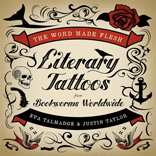
The Word Made Flesh

Clustered in glittering bundles of memory, words have the power to stay with us, resonant and guiding. In rising numbers, some of us are choosing to keep these words in more than just our heads. Editors Eva Talmadge and Justin Taylor recently released The Word Made Flesh: Literary Tattoos from Bookworms Worldwide, a collection of over 150 photographs documenting the power that words have on our bodies. Alongside the rich imagery showing us everything from illustrations to portraits of authors to scrolling lines of verse, we also get the back-stories from the bearers, giving testimony for the choices they have made. Tempting us further:

The Word Made Flesh is part collection of photographs, part literary anthology written on skin. Special features include a reprint of a short story by Donald Barthelme (along with the tattoo it inspired on the author’s daughter), an interview with Brian Evenson about seeing his own work tattooed on someone else, Shelley Jackson’s SKIN Project and Rick Moody’s Shelley Jackson tattoo, Jonathan Lethem’s homage to Philip K. Dick, Tao Lin’s Tao Lin tattoo, and much much more.

On their blog, Talmadge and Taylor share with us a new literary tattoo every day, demonstrating that the internet, like the world, is studded with inky literati. There are some for whom visiting a library is a sufficient sojourn with the written word, but there are others for whom the library is carried in their skin, and the preservation happens most bodily, with a tattoo gun and a bouquet of the right words.

by Patricia Cram
an Editorial Assistant for Black Clock and an MFA Writing candidate at CalArts