
Dan “Handgun” Bustillo and Joey “Canon” Cannizzaro formed the Best Friends Learning Gang, a pedagogical initiative that uses happenings to incite decentralized learning. The BFLG host unguided workshops on topics they don’t know anything about.
***
Our decision to be obnoxious stems from a desire to gnaw at the rule of taste and expertise in a chaotic reclaiming of horizontal authority. Trash Fab is an aesthetic dissolvent we use: a cookbook, an attitude. We named our initiative The Best Friends Learning Gang because it’s a fucking ridiculous name and we wanted to scare off anyone with a stick up their ass, calling instead to the curious and the crooked.
There’s a long history of people making art using garbage (Assemblage, Arte Povera, Dada, etc.) and while trash is great, we want to talk about trashiness. When Marcia Tucker curated an exhibition called “Bad Painting” in 1978 at the New Museum of Contemporary Art, her intention was not to showcase outsider artists or amateurs who lacked technical proficiency, but rather to critique standards of “good” art. The press release for the exhibition said the mission of “bad painting” was to refute the conventions of representation by being “at once funny and moving, and often scandalous in its scorn for the standards of good taste.”¹ The pendulum of good taste swings very predictably; our obligation as trash people is simply to avoid it. Trash fab can’t be absolutist. We go for raunch and for noise, opting out of a regime that shames the masterless and the unknowing.

TRASH TAN: IN ESSEX YOU GLOW
Before the industrial revolution, when the rural poor worked long hours in the sun, the elite made every effort to look as pale and unexposed as possible; when the urban working class came about as a result of industrialization, having tan skin became an indicator of wealth because it exemplified leisure. Spray tanning is trash fab: it imitates the aesthetic of wealth so unrealistically that the skin telegraphs a desire for status and balloons it to the point of parody. It publicizes the conditions of inequality, politicizing the skin. The choice to use it in spite of its theatrical ridiculousness– in fact as a kind of celebratory gesture – mocks the suckers who flew all the way to St. Croix when they could have walked over to the dollar store and picked up a can of that fine orange mist.

Trash fab is not, however, an exclusively white trash aesthetic. Rather, trash fab moves beyond whiteness, working through a pasty normal. In an explanation of the cosmology of Jack Smith, José Esteban Muñoz cites one of Smith’s journal entries in which he shares that he “overcame pastiness.”² Muñoz pushes Smith’s “pastiness” through his use of the exotic. While they are different, the pasty and the exotic are both confined within the same regime of normalcy. Trash fab oozes best when the pasty and the exotic are used in campy, frivolous and unsavory depictions of freakish otherness to refute different but equally oppressive normativities.
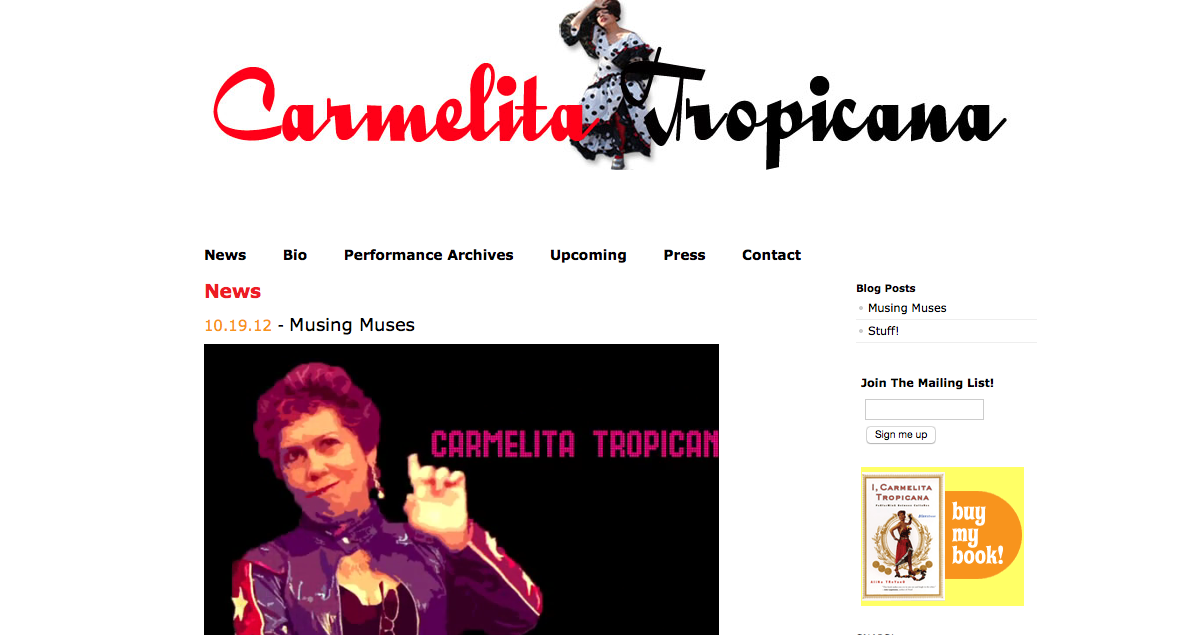
Muñoz refers to the performance artist Carmelita Tropicana as a “chusma performance deity.” He attributes her hyper exoticized stereotypes of Latinas to Smith’s legacy in the world of queer performance. Though a Latin American reference specific to the Caribbean that addresses a cheap, sleazy, overly accessorized and obnoxiously loud caricature of a Cuban lower class, “chusmería” drowns class etiquette in the rowdy and the glammed-out. Performing “chusma” is trash fabulous not only because of the inherent trashiness of the typecast, but because as a Latina artist, Carmelita Tropicana dares to make room for the scummiest on stage and in the art world. She drags in and flaunts the “worst” of her own culture in public. Being from Miami and from a Cuban family, watching Carmelita talk like she has marbles in her mouth, in excessive chusma mode, makes me cringe-laugh. While her personae is indeed trashy, it is her choice to perform chusmería that is fab.
Trash fab flaunts a refusal to apologize for not being classy, polished and contained. It insists that the word classy be understood as classist, that it reinforces the cultural belief that poise and control are the only avenues by which to earn respect. As the Best Friends Learning Gang we try to identify and flout all facets of authoritarian control in every decision that we make; in this way, trash fab aesthetics are an inevitable outgrowth of our ideology.
Trash fab doesn’t mean art has to look like shit. We use cheap materials out of necessity; we do so flamboyantly, choosing the fakest, the shiniest, the most bedazzled items; we show off our brokenness and in doing so deflate the myth of equality. And we can still make art that’s fucking awesome.
I like when art looks magical. You look at it and you’re just like whoa, how the fuck does it look that way? It looks like it’s from another dimension or like it has some kind of curse on it or a blessing or something that makes it just pop the fuck out at you and seem like a portal to somewhere much less stuffy than this piece of shit gallery and with much better booze. Art that’s enchanting.
But I get really disappointed when I look at the materials list and I’m like oh that’s why it looks so magical and mysterious, because they used a heap of expensive materials that I’ve never heard of. It feels like the ultimate aim of this kind of art is to mystify an audience with pricey magic tricks when a Venice boardwalk Criss Angel knock off would be just as great (or better). Magic has never been out of reach; this kind of magic trick just tries to make us think it is. It’s much more interesting to make magic from nothing. Using available materials leaves little room for the audience to be mystified by the Holy Museum or the Messianic Artist. The audience is invited to also perform alchemy; we all have rocks we can turn into gold.
In Heaven and Hell, one of Aldous Huxley’s treatises on hallucinogens, he catalogues the human obsession with glitz:
“Most paradises are adorned with… gems. We are all familiar with the New Jerusalem. ‘And the building of the wall of it was of jasper, and the city was of pure gold, like unto clear glass. And the foundations of the wall of the city were garnished with all manner of precious stones.’ Similar descriptions are to be found in the eschatological literature of Hinduism, Buddhism, and Islam… Those who think of all human activities in terms of a social and economic frame of reference will give some such answer as this: Gems are very rare on earth. Few people possess them. To compensate themselves for these facts, the spokesmen for the poverty-stricken majority have filled their imaginary heavens with precious stones. This ‘pie in the sky’ hypothesis contains, no doubt, some element of truth; but it fails to explain why precious stones should have come to be regarded as precious in the first place.
…As soon as we take into account the facts of visionary experience, everything becomes clear. In vision, men perceive a profusion of what Ezekiel calls ‘stones of fire’, of what Weir Mitchell describes as ‘transparent fruit’. These things are self-luminous, exhibit a praeter-natural brilliance of colour and possess a praeternatural significance. The material objects which most nearly resemble these sources of visionary illumination are gem-stones. To acquire such a stone is to acquire something whose preciousness is guaranteed by the fact that it exists in the Other World.”³
Huxley claims that our capacity to feel reverence towards these precious objects comes from their shininess, taking Marx’s notion of fetish and reversing its cause and effect. He argues that humans became obsessed with gemstones because they are illuminated and allow us to experience something beyond the material world, something visionary and supernatural, as an intrinsic quality of their material, rather than a condition of their cost. Following this argument, it doesn’t matter whether bling is prohibitively authentic or fake as shit, it can still take on holy significance of an otherworldly portal.
Whether because of some inherent evocation of the sublime or because of deeply ingrained cultural experience, glitzy, bling, shiny things produce a reaction of awe and wonder. Is it always pure Debordian spectacle enrapturing the crowd in the mystery and dogma of capital? Or is it possible that trash fab glitter magic can invite us to participate in the divine through the vehicle of garbage? Maybe we can take all this plastic crap– crap that was fabricated to trick us into imitating the aesthetics of the elite, to convince us to admire and perform their style, reinscribing the power of their taste, their freedoms– and rhapsodize its undoing. We can flash the trashiness of not having and not knowing and get dazzled the fuck OUT.
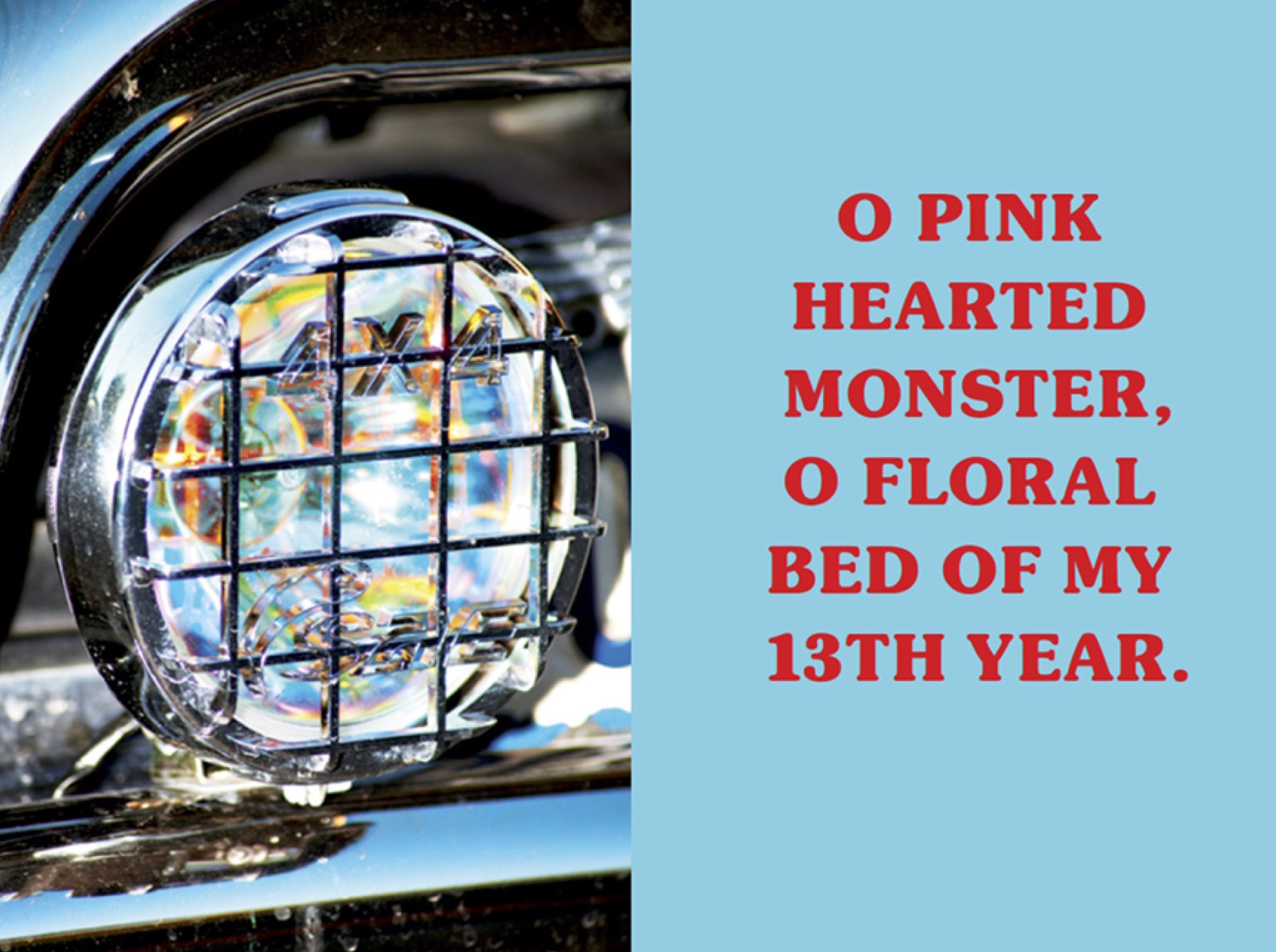
This essay can be found in Tessex? (Image Text Ithaca, 2015) available HERE.
Notes
¹http://archive.newmuseum.org/index.php/Detail/Occurrence/Show/occurrence_id/5
²Munñoz, José Esteban, Disidentifications, Queers of Color and the Performance of Politics, Preface, p. xii, Minnesota: University of Minnesota Press (1999)
³”The Doors of Perception and Heaven and Hell” pg. 83-85, Paperback, Harper (1954).
