
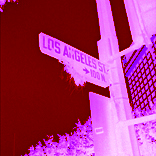
 This is part of a series of literary meditations on that rare urban pastime of exploring Los Angeles on foot.
Ethnic neighborhoods are as American as apple pie–or pad thai, chop suey, or tacos–and Los Angeles’s Chinatown is a prime example of this. A conflation of demolished old and manufactured new, Italian and Chinese immigrant cultures and histories, traditional recipes and innovative cuisine, cryptic apothecaries and contemporary art galleries, Chinatown is not only a quintessential American urban exercise in contrasts, but a classic example of the rich, complicated, and oft-contradictory fallout of reinvention that is Los Angeles.
L.A. is a beautiful, lush city, but it was not always like this; one has to remember that most of the flora, even the palm trees, were imported, and the City of Angels is as much an artificial production as any Hollywood blockbuster. Without a water redirection program that is truly gargantuan in its scope and scale—not to mention controversial–Los Angeles as we know it would simply not exist. Leveled in 1939 to make room for the construction of Union Station, the original Chinatown, which was established in the 1880s, was the victim of a similar lust for development. Chinese residents were resettled and the development of “New Chinatown” emphasized a kitschy adherence to stereotypical tourist expectations. In a sense, New Chinatown was just another Hollywood set, constructed around a large, “authentic” Central Plaza complete with Chinese style palaces and tiny side streets with names like “Gin Ling Way” and “Bamboo Lane.”
So it’s no accident that Roman Polanski’s 1974 classic film about the political intrigue around L.A. water rights and land distribution—disputes that grew more and more contentious as the metropolis bloomed in its desert confines—was set in and titled, well, Chinatown. It’s hard to say whether Polanski’s immortalized Chinatown’s neo-noir reputation or vice versa. The historical reasons for Chinatown’s association with noir are twofold: Angelenos, who were raised on tales of “the exotic Orient” and Charlie Chan movies, flocked to the neighborhood for a taste of folkloric intrigue and mystique; secondly, the spectral presence of an entrenched local Italian mafia created atmospheric undercurrent of intrigue for decades. The most obvious remnant of the old Italian stamp on the neighborhood is the famous Little Joe’s Italian American restaurant, which stands at the corner of Broadway and College. Though currently shuttered, the restaurant was a local fixture for over seventy-six years. It is fitting that Little Joe’s stands at the north end of Chinatown, just a few blocks away from the official entrance: a massive steelwork archway that features two dueling Chinese dragons, complete with fog emitters for a touch of ‘authenticity.’
Chinatown extends for several blocks in either direction, but College Street is the principal thoroughfare and main attraction. On weekends, Chinatown is crawling with tourists, to the extent that one must weigh the benefits of a right turn against the likely demolition of several ambling, clueless, photo-snappers. On Saturdays it becomes clear why the New Chinatown is the way it is: it’s a theme park. The cheap souvenir shops do steady business in machine manufactured buddhas, cheap paper fans, and other claptrap.
The most striking aspects of the Chinatown experience are the smells. It seems like every other storefront is a cookery of some sort, most of which proudly display their products in the open air or behind a storefront window. Whole Cantonese ducks roll on spits, bronzed and perfect, dripping juices like the cumulative attention of so many hungry eyes makes them sweat from nervousness. To find the best dim sum, one has to venture into one of the small open-air malls, and follow the nostrils past electronics and toys stores, insurance agencies and salons. The street signs in Chinatown are all bilingual, many of the store signs are not, and menus are often the source of hilarious mistranslations. Ever been curious to try “human pickles?” Me neither. Another item worth investigation is one of the large tea and herb vendors, like P.C.T. Ginseng and Herbs. The casual customer will become overwhelmed by the sheer variety of herbs, medicines, and victuals on offer here, not to mention the creativity of the hypochondriac element displayed through the proliferation of so many cures.
But let’s be honest. Dim sum and ducks are all fine and good, as are authentic herb stores, but what keeps an individual pounding the same sidewalks over again, after an initial cursory exploration, is the presence of unique and interesting bars. Chinatown’s Mountain Bar more than fits the bill. Part of its charm is its inscrutability. The posted hours are 6pm-2am, but they may as well be “whenever-whenever.” One must show up on faith, and if the stars are aligned, the doors of the Mountain Bar will open. Located in the Central Plaza, there is no sign, but it is strangely hard to miss. Sandwiched between two atrocious souvenir shops, its charm beams forth unimpeded.
The Mountain Bar is blessed with a striking interior. Chinese themed decor and embellishments are illuminated in soft red light, such that the late drinker feels he/she has descended into the heart of the world’s depravity. Bartenders and fellow patrons take on a sinister air in the shadowy, Tartarusan splendor of the Mountain Bar, and one almost expects to see Jack Nicholson and Faye Dunaway hunched toward each other in a corner booth. The Mountain Bar also hosts periodic literary readings, which is another mark in its favor; it is a typical destination for locals newly freed from the confines of a gallery opening, of which Chinatown hosts dozens in any given month.
Contemporary art galleries abound in the small streets around Central Plaza, and are a source of much of the nightlife in and around the area. I’m not entirely sure how “Chinese” it all is, but it’s nice nonetheless. In a sense, Chinatown could stand as a microcosm for Los Angeles, that glorious epitome of all contradictions. But that might be over thinking it; it’s best probably to settle in over a pint at the Mountain Bar and forget all about it; after all, Jake, it’s Chinatown.
by Doug Matus
a writer from Texas who now lives in Los Angeles
