 Rick Moody is the author of eight books including The Ice Storm, The Black Veil and most recently, Right Livelihoods, and his fiction and essays have appeared in The New Yorker, Esquire, Harper’s, and elsewhere. His band, the Wingdale Community Singers, released their first album on Plain Recordings in 2005. Moody’s “Primary Notes 2008: The Republican Diaries,” appearing in issue 9, marks his fourth contribution to Black Clock.
In this interview, conducted via email over the course of our nation’s birthday week, Moody gives some further thoughts on the Republican party, the “Third Way,” embarrassment, and prog rock.
BLACK CLOCK: In “Primary Notes 2008: The Republican Diaries,” you discuss all the characters who became major players in the Republican primaries, from the unelectable but “witty” Huckabee to the “what the fuck” Fred Thompson. Now that McCain is the Republican candidate, the new crop of characters are the possible running mates. Do you have any thoughts on these hopefuls, such as the erstwhile exorcist Bobby Jindal? How does Tim Pawlenty’s mullet play into your theory of “Republican hair”?
RICK MOODY: Pawlenty reminds me of that SNL skit from long ago that was meant to be at the expense of Canadians: The Great White North. Pawlenty is like Bob or Doug McKenzie. He actually played hockey as a kid. I bet his favorite band was Rush, before he realized that he should simply avoid talking about his favorite band. I don’t actually believe Pawlenty is in play as a running mate, because I don’t see what he gets McCain. He’s a Republican governor in a pretty moderate state, not one that is normally a swing state. I suppose having converted from Catholicism to evangelical Protestantism is pretty attractive, but what about OH or PA or FL? Pawlenty’s mullet, which is really an ersatz mullet, unfortunately, is probably a reflection of his provinciality. He wouldn’t trigger McCain’s temper, because he doesn’t trigger anything. He makes insufficient waves. But I still don’t think he’s really under consideration, and I think the same is true of Jindal. Jindal comes out of Louisiana, and that is the center of a nullity where rules of politics do not prevail. Interestingly, he attended my alma mater, Brown University, and seems to have emerged without any of the intellectual hallmarks thereof. Meanwhile, he’s 36! We don’t know enough about him! McCain won’t pick him, because, again, there’s just not enough benefit. Amazingly, Mitt Romney is back in the running mate discussion. I suspect someone of that kind of stature is inevitable. McCain is behind in the polls, and he has to veer to the center, but he’s already functioning without the Republican base. He needs a real conservative icon. Mitt gives him some of that. Plus the hair.
Speaking of Mitt Romney, you mention that part of Romney’s lack of appeal for you is a “resistance to aspects of the L.D.S. church. “ Do you think that enough people have that same wariness about the L.D.S. church as to make Romney a liability to McCain? And, just on a ticket chemistry level, how would you imagine McCain and Romney getting along?
I’m not sure it matters how they get along. Look at Nixon and Eisenhower or Kennedy and Johnson. People do what they have to do to get elected, and if that means sharing the ticket with a stuffed shirt, so be it. I assume McCain would expect total loyalty from Romney, of a sort that Bush, because of his weakness, was never able to expect from Cheney, who imagined and has even argued that he was not part of the executive branch. Romney’s adherence to the Mormon faith probably would be a campaign issue, but I’m willing to bet it’s less of an issue in a vice presidential candidate than in the top slot. If you look at his concession speech as I quote from it in the diary, it’s clear that he is positioning himself as true blue, and it’s on that basis that he would serve as v.p. With an eye on getting his chance if McCain for some reason cannot serve out two terms.
Huckabee seems to want to be v.p. too. But please.
Although McCain has drifted toward the center on some issues, you say that a McCain White House would still be disastrous given the fact that he will have to sway Republican Party loyalists to his side, a party that you argue is defined by its “deficit in the department of sympathy. “ Do you think McCain is a true Republican by your definition, or simply needs to appeal to the “sympathy deficit crowd ” in order to have a hope of winning?
Well, he might have a pustulating bit of cardiological tissue in there somewhere, but it has long since been layered over with scar tissue, enough so that he now, especially now, resembles a Republican in full.
In the opening of “The Republican Diaries, ” you say that you have insight into the Republican mindset because you are related to so many of them. Do you think this insight has come in handy in other areas of your life and/or work?
On the contrary. Often I know what needs to be done, or can imagine it, when thinking like a heartless person, if by “what needs to be done” we are speaking of the imperialist impulse, but then I am unable to do it, the unilateralist thing, and this just creates great cognitive dissonance. When younger, I thought I was supposed to yield to the impulse to behave like a cad in order to get what I wanted, and when I was unable to do so, I felt like I was letting someone down. But then I lurched into middle age and I stopped caring. I became good at repression, or suppression, or maybe I just got soft. It is good for a novelist to understand all the opposing viewpoints and then to attempt to render this complexity. Republicans are unable to do so, to understand the other side of the aisle, because the “liberal” impulse is mystifying, embarrassing to them. It’s like dogshit on the soles of their cordovans. They just want to rub it off and are unable to suffer it long enough even to feel what is to be felt.
So, do you think that liberals are more able to understand conservatives than vice versa, or only those liberals who have close contact with conservatives? Where does that leave us in terms of transcending our divisiveness and getting to what you call the “Third Way, ” which “circumnavigates the partisanship of the last eight years “?
I suspect that there are liberals who are just as divisive and malevolent as some of the conservatives. I sort of dislike the word “liberals,” because I don’t really know what it means, and the same, actually, holds true for “conservatives.” For example: the word “conservationist” is often used to denote a certain kind of environmental regulation that is, actually, “conservative.” Whereas the far right “conservative” point of view collides with “libertarian” principles, which are clearly “liberal” principles gone dangerously awry. There are always these spots where the yin and yang seem to be admixed. The third way recognizes this. But the rigors of the general election, while they demand the third way, also require a dangerous adherence to party loyalty — which amounts to the converse of the third way, a repudiation. My hope and wish is that a candidate like Obama (though there is some potential with McCain, if one is feeling charitable about him) will do the old infiltrate-and-double-cross dance and, upon assuming the presidency, will govern from the more fertile middle. If he does so, I hope he nonetheless avoids the pitfalls of Clintonian triangulation: which, after all, gave us welfare reform and the Defense of Marriage Act.
“The Republican Diaries ” is your first contribution to Black Clock since “Prog Rock Confessional ” from issue 4 (“Guilty Pleasures And Lost Causes”). Is the Brooklyn Record Club still meeting, and have you had any more chances to dig into embarrassing territory with your selections?
Brooklyn Record Club is alive and well. I don’t think I have played anything nearly as embarrassing as the Jethro Tull song I wrote about in “Prog Rock Confessional,” but I have since investigated some other prog rock bands from the period that I could have included in that piece — in the spirit of writing about deeply embarrassing things. Gentle Giant and Gryphon. They were both really interesting bands, bands in which the movement in and out of medieval music is essential to the sound. Gryphon played a lot of contrabassoon and instruments like that. Gentle Giant favored recorders. I actually have a little piece about Gentle Giant coming out in another magazine next month. The Record Club, meanwhile, convened in May and I brought a song by Robin Williamson, another current favorite, whose work in the somewhat neglected Incredible String Band I also find very, very interesting. And just in case people think I am a total geek, I am also into Rhys Chatham’s Guitar Trio Is My Life and Michael Harrison’s album of piano solos in just intonation: Revelation.
Do you get a certain enjoyment out of writing about deeply embarrassing things?
In most cases, I find embarrassing things deeply embarrassing, and I’m not sure there is any kind of enjoyment in that. I do, however, like the truth. I feel like when you observe something correctly, some phenomenon, or some thing in the world, that you are doing a good deed. That the world is mainly layered over with bullshit and imprecision seems to be undeniable. When language peels back that layers of imprecision to see things as they are, there’s a kind of a revelatory feeling for me, as a reader thereof. Personally, I am not as good at this as I wish I were. Nabokov, for example, could describe things, and get at their essences, like no one else. Nicholson Baker is also very good at it. I wish I were better. But that attempt at precision seems to me part of my job, and the deeply embarrassing stuff is a subset of observations of the precise sort. I hope.
What has been your experience as a frequent contributor to Black Clock? Does the limited editorial interference make a difference in your process?
Limited editorial interference is always very, very satisfying. I also like that there is usually a specific assignment: write on music, write on politics, etc. I do well with assignments. In Erickson’s regime we find a perfect alignment of approaches designed to make it impossible for me to refuse. Most of the time. I guess I failed on the sexuality issue. But one day…
by Anne-Marie Kinney
a writer and graduate of the MFA Writing Program at CalArts,
who lives and works in the San Fernando Valley and has just completed her first novel

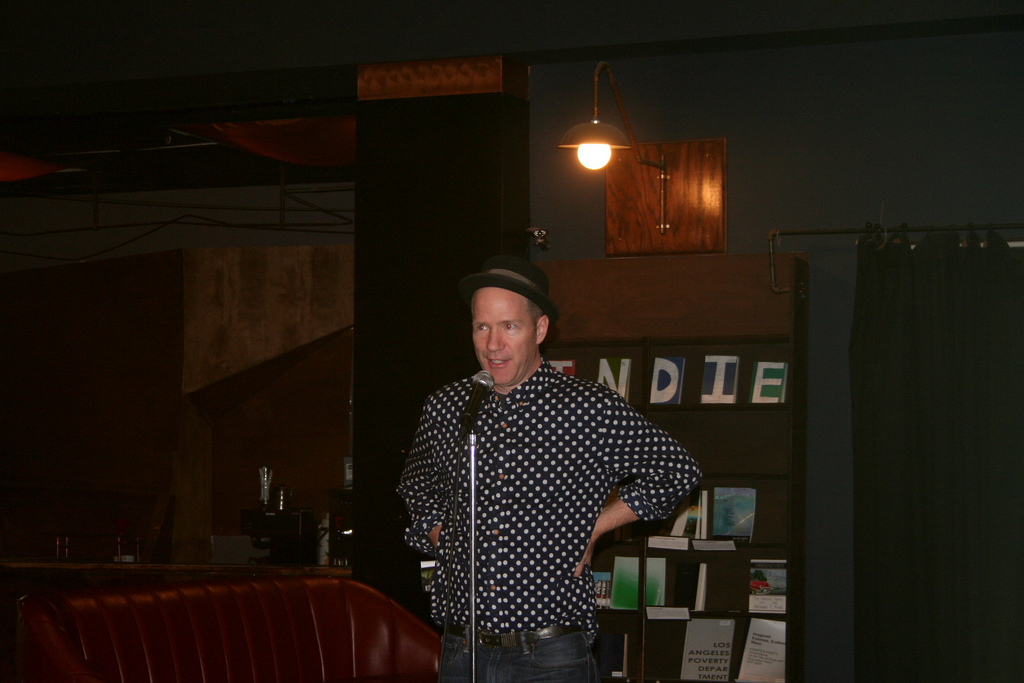 Last Sunday, writers and readers alike convened at downtown L.A.’s The Last Bookstore to celebrate the much-anticipated release of Black Clock 16. Located in an old bank building fit with tall columns, dim lighting and an arched ceiling, the cathedral-like Last Bookstore hosts a massive collection of new and used books and vinyl records (many for as cheap as $1!) that requires seriously superhuman strength not to peruse for hours on end. What’s more, with such artful installations as its eerie flying typewriter sculpture and a walk-through tunnel made of books, The Last Bookstore offered Black Clock the perfect setting in which to launch its dystopic Issue No. 16. As KCRW’s Michael Silverblatt put it to the crowd on Sunday: “This is an entire issue of how we’re falling apart. Here at The Last Bookstore we can come together and not fall apart.”


