
 “Here again I don’t know what, in all of this, is wisdom, what is madness.”
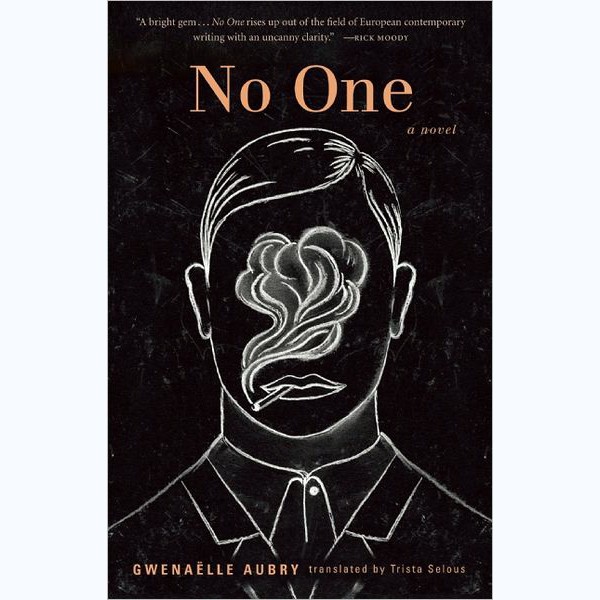
How do we write madness? What language can accurately encompass something as personal and unknowable as mental illness? In her latest book, No One, French philosopher and writer Gwenaëlle Aubry seeks to find that language. Piecing together her own fragile recollections with excerpts from the handwritten, autobiographical manuscript (titled The Melancholic Black Sheep) left behind by her late father with the note “to be novelized,” Aubry explores the life of a man who disappeared from view long before his death: Francois-Xavier Aubry, a once brilliant and distinguished Paris lawyer whose crippling bipolar disorder eventually left him a penniless drifter, in and out of mental institutions for most of his daughter’s life. At once lucid and mystifying, No One is Aubry’s beautifully wrought attempt at creating a portrait of someone whose internal reality she knew so little about, someone who, in the end, strived to be anyone but himself.
Were No One a conventional memoir in the popular American sense we might read Aubry’s story through detailed, chronological scenes in which each family member is cast as a distinct character. It seems necessary to note, however, that No One is the first of Aubry’s books to be translated into English, and in writing it Aubry appears acutely aware of the French literary tradition of “autofiction,” a contemporary genre that blurs the boundaries between autobiography and fiction. Much in the way we saw the life story of Roland Barthes presented to us in Roland Barthes (1977), No One favors compact and poetic philosophical ruminations over dialogue-centered prose. And perhaps also recalling Primo Levi’s The Periodic Table (1975), Aubry shapes her own memoir similarly: this time in dictionary form, with each letter of the alphabet offering another hopeful entryway into her father’s warped psyche.
From the clinically depressed poet/playwright Antonin Artaud to Woody Allen’s chameleon-like 1983 character Zelig, readers accompany Aubry through this idiosyncratic dictionary with curiosity, moving easily between both her father’s poignant, chaotic voice and her own of understated elegance. What we experience then is one author’s exquisite struggle to put a face to a man whose identity was forever unstable, preferring always to be, in his own words, “away from the guerillas of the past, unknown to all, without a label.” The result is a sparkling yet melancholy elegy, a restrained kind of mourning from a wounded daughter to her tragically afflicted father, full of grief and quiet love.
And while we can’t say for certain whether parts of Aubry’s memoir are indeed fictionalized, what is clear is the author’s interest in cultivating this energy of the unknown, something characteristic of autofiction in particular. Readers will notice immediately the contrast between Aubry’s rigidity of form and the cloudiness of her investigation into her father’s true persona, which, like the mental illness that took hold of it, evades, ever so slightly, all attempts at categorization, at being fully known. The task that Aubry has taken on in No One is undoubtedly a difficult one. But the form that she has chosen for her work provides a much-needed, albeit only somewhat helpful, structure in which to look at something formless. It isn’t until the book’s last pages that Aubry comes to a critical realization about her father: “I felt as though, having tried so hard to forget, my memory was now going mad. He didn’t want to remember, didn’t want to know.”
Perhaps it is this exact cloudiness, this frustration of memory and knowing that Aubry laments, that is the greatest triumph of No One. For in the end the truth that Aubry discovers is one even greater than that of her father’s story: It is the truth that madness can never be adequately contained. Though readers may fail to reach a precise explanation of what madness is, they have peered deep into the void along with the brave Aubry herself, who has thus achieved the ultimate act of filial devotion: She has spoken her father’s name, despite everything, again and again and again.
No One
Tin House Books (February 2012)
170 pages; $12.95
By Adriana Widdoes
an Editorial Assistant for Black Clock and an MFA Writing candidate at CalArts
