
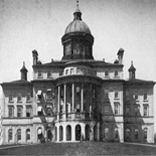
 This is the first in a series of columns that circles some very large, very unwieldy, and–for precisely these reasons–very tantalizing questions about knowledge, creativity, teaching, writing, and the university.
Let’s face it: this is a bad time to be an artist, and a worse time to be an intellectual. It’s popular to say that the university as we know it, and especially the English department as we know it, is in ruins, or is going to ruins, or we thought it was ruined but we didn’t really know ruin until the economy woke up from the last decade with a bad, bad hangover. My situation, for example, which is really not unusual, is that of a writer who, in order to write, needs to hold down a job. Because I love teaching, and develop facial tics at even the mention of a 9 to 5, I’ve chosen to teach college. Because I’d like to be as succulent a hire as possible, I decided to earn a PhPD after getting my MFA. If this were Hollywood in the 50’s, let’s just say I’d be learning to sing and dance. What a clever plan, which so many other writers before, with, and after me, have also cleverly planned. For many, it has worked. Teaching in academia, while not necessarily the golden ticket, has been a more or less reliable meal ticket for many, many writers. While it’s afforded few nightly five course affairs, most can scrape together a shake for breakfast, a shake for lunch, and a sensible dinner. It’s popular now to say that those days appear to be over.
At my own university – a large, publicly funded state school – the perks of making a graduate students sub-living-wage have finally become clear. We are, as it turns out, immune to the mandatory furloughs, paycuts, and the like – which the school has begun to implement since the state stopped paying its bills a few months ago. We simply make too little money to be chopped. Hurrah. However, it looks to many of us (and some faculty in my department will openly declare, with attitudes ranging from cynic glee to vindicated Eor-ism to open sorrow to righteous indignation) that we are training for a profession which no longer exists. Which provokes the question: if writers – even the marginally employed adjunct or lecturer – can no longer produce books during their mornings off and lean summers, when we produce books at all?
Ok, so that question isn’t the real question, and it carries a whole lot of assumptions with it – assumptions about who writers are and where they work and what they do and how they produce. The real questions have something to do with the future of and for our craft. Not only how will we do it, but who will read it (already writers are increasingly their own audiences, a closed field in which the producers are also the critics are also the connoisseurs)? English departments, which historically have produced good readers (it’s their main job for heaven’s sake!) are going the way of history and philosophy departments (at least, if you listen to the Eors and the weathermen): increasingly marginalized, increasingly shrunk, increasingly asked to prove their worth, to prove their relevance, to prove their market value.
One way to immediately increase your market value – or at least, your fiscal value to the university – is to start up a Creative Writing program. Students will pay, and pay in droves, to study in these programs. It has to be said: while many graduate and undergraduate programs surely offer their students fine educations (as mine did), they can also be a gentle-eyed cash cow. No labs, no rehearsal spaces, no special equipment, need to be bought or built. (No overhead!) A moderate-to-big-name writer may need to be hired and paid accordingly to direct the program, but (see above) finding one of these in need of steady employment is not exactly at a level of difficulty on par with, for example, locating the last surviving Nazi war criminals in deepest Paraguay. And what dividends! Eager sudents line up around the block to pay for the privilege of studying with Professor Moderate-to-Big-Name-Writer. The English department grows, and everybody wins.
Another good way, if you are an English department needing to explain to the person who signs the checks exactly why you should get to be around and what you’re good for, is to point to your Freshman composition program. It is not, of course, fashionable, to describe your program as such. But whether you are teaching students something called “English 101” or something called “Communications Fluency for Today’s Freshman Student” it is much more sensible to argue that your program teaches students marketable skills. And, not only marketable skills, but skills which are also valuable to the student regardless of her degree program: skills the student must master to write papers for her other classes, think critically about the readings and assignments in other classes, and, ultimately, put together a good resume and cover letter. Now, I’m not claiming that writing classes should not, or do not do these things. Certainly no one should graduate from college without the ability to craft a coherent English sentence or a coherent argument. What is striking, though, is the extent to which English departments sometimes rely on Freshman composition programs not as an intellectual but as an economic enterprise: if the student is a consumer, a Freshman composition course is something whose worth can be more easily argued for and defended than, say, a course in Medieval British Literature. What good will reading Chaucer do anyone in the here and now? I, for one, have a hard time answering that question, despite the fact that only a few weeks ago my students were discussing the Wife of Bath in my classroom. But the good of knowing how to present oneself well on paper – for that, the argument hardly needs to be made.
What I am gesturing at here is a scenario in which the act of writing – both creatively and, shall we say, critically, or practically – occupies multitudinous, and frequently contradictory (and even more frequently uninterrogated) positions within a range of interacting economies. I have a hunch – both creative and practical – that circling these questions (vulture-like, if need be) could tell us a lot about what’s going on just now with our craft, our knowledge, and our teaching.
by Jenn Hawe
who lives, writes, and cooks in Chicago
