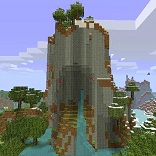
This, the fourth entry in “Playing Between The Lines” (a series of expeditions into the evolving space of interactive storytelling, its praxes and practical benefits), concludes the investigation of the narratological implications of Minecraft begun here.
In Part 1, I expressed some of why I find the experience of watching other people play Minecraft rewarding. It speaks to my views on what makes all interactive storytelling rewarding. I’ve described the symptom in enough detail, at this point, that it’s probably time to look at the cause, to begin to unpack the three narrative types I mentioned earlier and to figure out how exactly they’ve come up with this digital distillation of the private soul that we’re calling Minecraft.
LORE
I’ll begin with the most familiar, the one most people refer to simply as “narrative.” When Karen/Ebert besmirches the video game “story,” this is what they’re referring to. Even those who share my enthusiasm about the interactive form have a tendency to place the “story” in its own bracket, to block it off from the aspects of the experience with which they pretend to concern themselves. In reality, because the lines of distinction between these three narrative forms become nebulous in good interactive design, their distinct characteristics and interplay are often rendered invisible: it’s often difficult to tell where “story,” as the Karen/Ebert is using it, ends and where the rest of the experience begins.
To avoid implications that any one of these three forms is subordinate to the others, I’m going to swap the term “narrative” here for a slightly more fraught, but less problematical, one: “lore.” When interactive aficionados discuss lore, they refer to the largely unspoken but internally consistent rules and backstory that govern the behavior of the secondary characters and the setting they inhabit. The recent Bioware title Dragon Age: Origins, for example, includes a rich vein of lore in its virtual codex, a hypertextual compendium of terms, figures, history and beliefs concerning the high fantasy realm in which it is situated. This is a very different approach to how From Software’s Demon’s Souls characterizes its high fantasy setting: the latter employs minimal but effective dialogue, focusing instead on evocative architectural structures and the telling placement of characters, objects, and creatures within them. This, too, is lore.
Minecraft’s lore is diverse and plentiful, though more deeply buried than in the previous examples. Lore can be something as simple as where friendly or hostile creatures (known as “mobs”) are likely to appear, how they behave, and what sorts of materials they drop when killed, especially when the results are particularly esoteric or unexpected. It’s important to note that the actual mechanics of the AI and whatnot aren’t lore — that’s just coding — but the player’s understanding of those mechanics can be. If the player finds a saddle, for example, it can be used to ride a pig, for whatever small pleasures that conveys. The green moss covering the walls of all Minecraft dungeons (small randomly-appearing chambers containing treasure chests and mob-spawning mechanism) is lore. Recipes for refining and crafting items from raw materials are part of the lore. Alternately, lore can be as complex as The Nether: an underworld added in October 2010, accessible only via portals generated when the player constructs a 4X5 archway of pure obsidian blocks. The Nether comes attached with all sorts of delicious and evocative rules or exceptions: any distance traveled in The Nether is multiplied by eight when the player transports back to the world above, clocks and compasses fail to work, and it contains its own unique set of creatures and materials.
Lore, in the specific sense suggested by these examples, can be understood as an effort to suggest a much larger framing narrative fueling and lending interpretation to the player-character’s passage through the interactive world. World-building would be an acceptable alternative term, as might paratextuality.
I think it would be useful, though, to consider lore more broadly: not simply as the hidden details or worked surface surrounding the narrative, but as every aspect of the narrative that is fixed in place. Lore is the only degree of control the author of an interactive story has over the way the story will shape up, even in the most linear of interactive stories. This would make the blocky visual appearance of everything in Minecraft part of its lore. It makes any prologue or supplement found in an instruction manual, or on the back of a game case, lore. Lore now includes the actions mapped to individual buttons or commands, the player-character’s library of verbs.
It also includes things like the non-interactive cinematic reel that introduces virtually every video game. It includes the ending, or multiple endings. It includes every line of dialogue, every scripted gesture. By this broader definition, “The princess is in another castle” is part of the lore of Super Mario Bros.
This is more than just a taxonomic whim. Lore, as I said before, suggests and interprets the actions of the player-character. Because the protagonists acts outside the direct control of the interactive story’s author, we have to take into account where the authorial hand does show itself. Doing so, we find it to be equally present, and operating in much the same way, in the environmental minutiae of the story-world (lore specific) and in the forty-five-minute movie that precedes the climactic battle (lore general): both feed, emotionally and narratively, into how the player approaches and experiences that fated clash. Even previous experiences of failure or success can be lore, as they alter the interactor’s attitude toward and understanding of the task at hand. People who build a wall between “story” and “gameplay,” or anything else, forget that without story, gameplay would be a purely technical exercise.
POTENTIAL
Let’s not forget, though, that the opposite is equally true. Just as a game’s interactive elements cannibalize from its lore for their emotive and narrative impact, so a game’s story must include every interaction the player provides, regardless of their apparent lack of importance. This is the key to understanding the concept of potential narrative.
The term “potential narrative” is fairly self-explanatory. In traditional narratives of the kind Great-Aunt Ebert champions, the author writes us from A to B to C, from the exposition all the way up until the denouement. To utilize a Minecraft-appropriate analogy, writing traditional narrative is like building a rollercoaster: it might be full of surprises, twists and turns, it might speed up and slow down, it might lull you into a comfortable rhythm only to pull the ground out from under you, and it might be intricately constructed and beautiful as hell. But the tracks don’t change. It’s the same plot from reading to reading, though our understanding of it may vary (see: emergence).
In a potential narrative, the plot is built from the interplay between information the author has provided, or lore, and input the interactor provides, and thus varies from reader to reader and from reading to reading. The author simply lays a groundwork from which conflict and resolution may naturally develop. In Minecraft terms, reading a potential narrative is like traversing a dungeon: you know there will be skeletons, and you know there will be treasure, but it’s up to you how and in what order you choose to encounter and resolve these plot points.
Minecraft, which keeps its scripted elements as invisible as possible(there’s no introductory reel, no set goal, and no way to win, in fact no end to the story except in death) isn’t the best model for clarifying potential narrative. For a more concrete example, we need look no further than Andrew Plotkin’s Hunter, in Darkness, mentioned in this series’ previous entry. Hunter, in Darkness begins with the lines “Nearly — nearly. The animal stink is rank and close. You raise your crossbow, try to peer beyond dark, wet stone.” This is an immutable element of the story; every potential narrative will begin the same way. From there, the player-character may venture forward into the darkness … to be immediately devoured by the lurking beast. Thus ends one potential narrative. In another potential narrative, the player-character investigates a side chamber to the left, where a swarm of bats necessitate a blind dive into a pit. There’s another pit to the right of the starting point: most attempts to descend this will result in protracted but inevitable death (capping their respective potential narratives). The option to fire blindly at the beast, wounding it but allowing it to escape, also exists, but all paths lead eventually to death, or to the bottom of a pit with a wounded hand and blood-hungry bats on your trail. If we rule out death and failure (which are, rightly, potential narratives of their own), this and the opening, along with several other milestones leading to the conclusion, are fixed narrative elements. They anchor all the potential stories together, allowing for the illusion of a unified narrative. These fixed milestones are what most people refer to when they talk about the “story” of a video game or other interactive work, but in reality each experience with an interactive story is its own potential narrative. Actions such as shooting the beast, which have repercussions on the written narrative, or making closer investigations of the pit and other elements of the cave system, which emotionally flavor the overall text, are far from trivial additions to be judged separately from the fixed “plot.”
It’s important enough to repeat: everything that unfolds within the interactive story, regardless of its apparent significance, is a part of the potential narrative. That means that, in Minecraft, placing a block in the middle of the field, then immediately reducing it to rubble, must still be counted in the potential narrative, even though it will have no repercussions on the ending (if Minecraft had an ending). Taking a step forward then back, or standing in one place, likewise contribute. After all, in the absence of other signifiers of character, how are we to tell if Minecraft Guy is decisive or vacillatory, adventurous or lazy?
To provide some literary context: in 1960, author Raymond Queneau and mathematician François Le Lionnais joined forces to create the Ouvroir de Littérature Potentielle, or Oulipo, with the goal not of creating works of literature themselves, but of discovering new metaphorical machines for generating works of potential literature. Noted authors as different in aesthetic orientation as George Perec and Italo Calvino have employed Oulipian constraints and algorithmic processes to produce literary works that they regard less as books than as models of potential literary processes. What many people fail to consider, however, is that every interactive story, from the most linear shooting game to open-ended playgrounds for self-expression like Minecraft, is its own machine for generating potential narratives. As with the Oulipian texts, the literary quality of the narratives produced, like the content of the narratives themselves, cannot be accurately predicted.
I’m not interested in Minecraft as a game. If I were, I would have played it by now. No, in my addiction I see it not as a game at all, but as a generator of potential narratives.
EMERGENCE
Which, it turns out, has only a little bit to do with narrative as we would normally conceive it, as even the Oulipo conceived it. It has everything, on the other hand, to do with emergence.
Emergence arises when interaction governed by a simple set of rules transforms into something significantly more complex. While you could view it as a question of degrees — emergent narrative is one notch up from potential narrative — they’re actually complementary concepts. The easiest distinction to make is that potential narratives are, at least conceptually, measurable and recordable. Emergent narratives, on the other hand, can’t be found in the screen or on the page. They are entirely psychic phenomena, and can afflict, without warning, any person tuned in to receive them.
Generally, emergent narratives emerge when the input from the audience and the feedback from the interactive story approaches a 1:1 relation. In most potential narratives, the player-character’s actions are built from the lore provided by the author. In emergent narratives, the player-character’s actions are built from the actions of the player-character. It’s the same process by which we make narratives out of dreams and fevers. Noby Noby Boy, Keita Takahashi’s interactive art game thing, is emergent to the point of abstraction due to its literally elastic controls and high level of unpredictability.
If potential narrative is like a dungeon full of monsters and treasure, emergent narrative is like Survival mode itself. A dungeon can be carefully crafted out of lore to lead adventurers to discover certain paths. Trick floor panels and pitfalls can be installed. Ancient scrolls detailing the terrible, primordial, and prophesied evils that dwell in the deepest locked room can be scattered about, usually next to the key to that very room. Not to put too fine a point on it, a dungeon can be constructed. Minecraft’s Survival mode, on the other hand, procedurally generates entire worlds, complete with forests, oceans, islands, mountains, and cave systems. Procedural generation, to oversimplify things, means that the content is, for all intents and purposes, random. Algorithms are put into use to ensure that bits of lava aren’t floating around in midair above an ice floe, but that’s as far as the authorial hand extends.
Which means that caves in Minecraft aren’t guaranteed to contain treasure, or skeletons, although the chances of the latter are fairly high. They certainly won’t contain ancient scrolls and mysterious keys. They don’t contain, in short, anything remotely resembling a plot. What they do contain is the unknown in its purest form. Every block you uncover in Minecraft is another cubic meter of uncharted wilderness, a frontier virgin to the eyes of man.
Emergence is why the minutiae and tedium of potential narratives — that 1000th skeleton vanquished, those hours spent mining wood from trees — remain vital. Emergent narratives are unpredictable, and can therefore reliably be expected to adhere to the least expected moments. In an emergent system, subtle changes, such as those introduced in Survival mode, can engender profound effects.
Advertising for video games, which are by and large fairly linear potential narratives, often make a big fuss about the choices presented to the player, all of which tend to fall into uninteresting binary categories. “Will you be a hero? Or a villain? Will you save the world? Or destroy it?” An emergent narrative, on the other hand, doesn’t ask such questions. It doesn’t offer choices. It simply offers a space in which the player is free to act as they see fit. Most potential narratives are multiple choice tests. Emergent narratives are Rorschach tests.
The previously cited Minecraft videos illustrate one of the most exciting benefits of creating emergent or potential narratives: they come to reveal at least as much, if not more, about the interactor as they do about the author. Of course, this comes with fairly steep trade-off: the more emergent the narrative is, the more tongue-tied it leaves the author, an issue closely related to the interactive author’s dilemma in Alexander Ocias’s very different independent work Loved. Notch isn’t making a statement with Minecraft. He is building an increasingly rich and varied environment in which his players can express themselves, or in which they find themselves expressed, for the emergent narrative is often as much of a surprise to the interactor as it is to the original author.
Simply put, if you have more answers than questions, you’d be a fool to try to express them emergently. It’s no place for political commentary. But when the goal becomes unlocking things neither the author nor the audience knows are there….
Even with that in mind, there’s another hurdle. It’s 600 meters tall and made of flaming cubes of magma. Even in something as unpredictable and open-ended as Minecraft, there’s no guarantee a narrative will emerge, and if it does, its form will be entirely unpredictable. There’s only a small chance that anything meaningful will arise at all; it will depend entirely on the audience. In short, one does not write an emergent narrative; to do so would go against the very nature of the thing.
Which isn’t the same thing as saying there’s no such thing as an emergent text. “But I know nothing of interactive storytelling!” you quaver, in your best staunchest luddite impersonation. Bosh, I say. As much as they take advantage of the interactive form, emergent or potential narratives can exist, and even thrive, outside of electronic media. Interactivity is an element of the way a work is conceived and received; it isn’t tied to medium. Go read a poem: symbolism, slippage, sensorially supercharged abstraction … these are all fertile grounds for emergent meaning. Sure, you aren’t likely to read the novelization of Minecraft any time soon. Any book emergent on the same level of Minecraft would look like a crossword puzzle, or a collection of abstract ASCII art. Both the author and the reader would have to relinquish control. If potential narratives are about choice, then there must exist a choice to view the page as something more than a self-contained box of text, as a mere staging ground for an as-yet-unwritten drama. I’m thinking of collaboration, of revision, of adaptation and appropriation.
I don’t know if such a book yet exists. I don’t even know if it would be worth writing. A good narrative can be very reassuring. There’s an existential anguish in casting about in a wilderness, finding nothing but random patterns and a meaningless wash of your own inputs. It takes a great deal of dedication to press on into that world of darkness and of your own reflections, in the hope that you will discover something of meaning, something beyond solipsism. If the Minecraft novel existed, I don’t know if I could read it. But it would still excite the hell out of me.
As I said above, unpredictable narratives emerge when a simple set of rules yields something more complex. What could be more simple, and more complex, than written language?
A box of Legos, perhaps. A starship made out of toy blocks.
by Byron Alexander Campbell
a Black Clock Editorial Assistant preoccupied by dreams and theories of interactivity