Singular, idiosyncratic and a little mysterious, Black Clock is one of America's leading literary journals.

Posts Tagged ‘Los Angeles’—

Crawling Down Cahuenga: An Interview with author David Smay

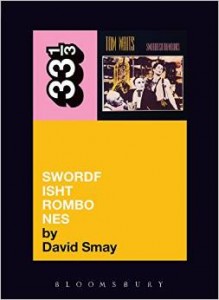
David Smay, co-editor of Bubblegum Music Is the Naked Truth, and Lost In the Grooves (both in collaboration with Kim Cooper), and author of Swordfishtrombones (Bloomsbury, 33 1/3 series), discusses Tom Waits and the changing nature of Los Angeles with Sr. Associate Editor Emma Kemp. David is a regular contributor to the website HiLobrow, and has published in such magazines as Oxford American.  He lives in San Francisco with his wife and two children. Read his work at: http://hilobrow.com/author/dsmay/.


EMMA E. KEMP: Hi David. We recently met on Esotouric’s Crawling Down Cahuenga: Tom Waits’ L.A – an alternative bus tour revealing the hidden secrets of Los Angeles through the lore of Tom Waits. I’d like to start at the beginning and work our way back to the bus…

Can you talk about your relationship to Tom Waits? Do you remember your introduction to Tom’s music?

DAVID SMAY: I became an obsessed Tom Waits fan when Frank’s Wild Years came out. I remember standing in my friend’s bedroom as he played “Hang On St. Christopher” and I could tell something very different and distinctive was happening.  It didn’t exactly appeal to me at first, so much as it challenged me.  There was something there to explore and discover.

I went back and completely immersed myself in the previous two albums in the Frank Trilogy (Swordfistrombones and Rain Dogs) and then desperately looked for anything that sounded remotely like that. (There wasn’t much at the time.)  I had heard some earlier albums through a friend who was a big fan of Blue Valentine, and, in fact, I remembered seeing Tom on the Mike Douglas Show back in the 70s when I was just a kid.  But I wasn’t converted until I heard his albums on Island Records.

EEK: You’re the author of Swordfishtrombones published by Bloomsbury as part of their 33 1/3 series, can you talk a little about the experience of writing this book? How did you become involved with the series, and how did you approach long-form criticism?

DS: My friend and co-editor, Kim Cooper, had written a book for the 33⅓ series on Neutral Milk Hotel and encouraged me when Continuum Press had their open call for proposal. It’s an opportunity to work in long-form criticism, which is increasingly rare.  This series provides a platform to dig deeper into a work than market driven reviews can allow.

EEK: Did you have a clear agenda when you set out? Did this change as the book progressed?

DS: I knew I wasn’t planning on doing a standard critical book. I’d done plenty of record reviews in my day, and I wanted to use the longer form of a full book to explore Swordfishtrombones in a different way. As I noted in my introduction, it would have been exceedingly perverse to “explain” an album like Swordfishtrombones, an album which works best because of its provocations and mysteries. I had to find a structure which would allow entrance into the work without spelling everything out.

EEK: How did you go about researching and writing this project?

DS: There’s a huge amount of Tom Waits material available online. I spent two years researching everything about his career, reading literally hundreds of interviews. Spending time and taking lots of notes on all of his albums – not just Swordfishtrombones. Since it’s such a fulcrum in his career I really needed to understand what lead up to it, and what followed. With Swordfishtrombones, Tom Waits began to transition from a culture figure to an icon. Somebody whose work influenced so many artists who came after, often in subtle ways.  So many younger artists tap into that sonic palette that he developed, the exotic instruments, the distorted vocals, the bang-on-a-can aesthetic.  And his lyrics changed too, though they’ve proven harder to imitate without parody. The lyrics became very concrete, specific and detailed but at the same time he left space between them, a very controlled ambiguity.  It’s a very masterful way to approach songwriting but it allows him to build depth and mystery into his songs.

EEK: How did the book impact your relationship to Waits? I’m interested in how this relationship may have evolved, moving from fan, to aficionado, to scholar…? Has the book influenced how you listen to the music now?

DS: When you spend so much time and research on one artist it’s easy to become burned out on them. That never happened with Tom Waits – he’s created such a rich and varied musical legacy that I still love it. However, the process of writing the book did exhaust my questions about him. I understood his personal history, his creative methods, his favorite themes and sonic palette.  In a way, when you answer so many questions about an artist you lose some of the magnetic draw towards them.  In comparison, I’m a huge Kinks fan but because I haven’t studied Ray Davies so exhaustively I still have things to discover about him and his work. 

EEK: Were there difficulties in writing about an infamous figure in such an intimate way? Is the “cult of celebrity” difficult to transcend in a project like this?

DS: All of my critical writing tends to burrow under the perceived notion or narrative of an artist or their work. There is a tendency for critical assessments to become calcified and rigid over time and they can distort more than they reveal.  So getting past Tom’s persona and into his work was my standard strategy.  I did have a couple of pangs when I found buried little biographical details which he had obviously wanted kept hidden, or were painful to him.  But they were relevant to discussing his work so I wrote about them anyway.

EEK: During our first meeting, you were at the helm of a passenger coach pointing out choice spots in the underbelly of L.A significant to the Tom Waits chronology; how important is this particular city to the story of Tom Waits? What is it about L.A that lends itself to this kind of figure? Or did the figure create the city? How significant is geography in the construction of artistic identity? You’re obviously extremely familiar with Los Angeles, but you live in San Francisco, which has its own unique counter-cultural/literary history… how does this shape your own thinking/writing?

DS: Los Angeles is by far the most important city in Tom’s work and his relationship with L.A. is intimate and profound.  While the rest of the music industry was tucked away in Laurel Canyon in the Seventies, Tom Waits was the first musician to write about the Los Angeles of the streets.   He’s so specific about neighborhoods and intersections and bars and hotels and that kind of creative attention lends them a kind of myth.  He created a certain idea of Los Angeles which still has currency.  You have to look at movies like Cassavetes The Killing of a Chinese Bookie, or Barfly or Altman’s The Long Goodbye to see that Los Angeles. 

I lived in L.A. before I moved to San Francisco, so I’m familiar with both cities and their cultures.  There were times during the Beat era, and also during the punk era when LA/SF were more united than at odds with each other.  All those bands bombing up and down I-5 in their beat up vans to play at the Mab or the Whiskey.  Rebecca Solnit’s book The Secret Exhibition gave me a lot of insight into Wallace Berman’s circle and the artists associated with the Beat era and that’s a lens I bring to seeing Tom’s work.  More even than the actual writers like Kerouac and Bukowski who directly influenced Tom Waits.

EEK: You lead the Tom Waits bus tour once a year, how does this reenergise your relationship to Tom, and to your book? Did you spend a lot of time exploring these places during your research, or did the relationship between the music and the city come after, when you had the opportunity to do the tour?

DS: Every year I go back and revisit my book and my research before I do the tour. I try to change around the AV portion of the tour from year to year so that gives me something different to extemporize from.  Obviously we used his Letterman appearance before this year’s tour.  And, yes, I do learn something new from the passengers every tour.  Tom’s had such a long career and I’ve met more than a few people who saw his legendary Steppenwolf production of Frank’s Wild Years in Chicago in the 80s, or locals who saw him perform in a play called Demon Wine.  I’ve met people who did lighting and sound on the Big Time movie. It all adds to the picture. 

When we first did the tour, I gave Kim and Richard a list of specific places I’d like to visit and they figure out how that could work as a tour, but it’s really over time that I’ve come to really grasp what you might call the psychogeography of his work.  There’s always more historical context to fill out, more layers of history, more interesting stories to discuss.  Kim and Richard do an incredible job of explicating what was going on in Los Angeles politically, culturally, scandalously in any era so you can see how it all fits together.

EEK: I love that the tour connects you to such a diverse range of Tom Waits fans, how has this experience enhanced your relationship with Tom and the city?

DS: I love it! My favorite part is talking to the people on the tour when we stop at Canter’s.  Get to find out their discovery of Tom, what they’ve seen and heard.  Oftentimes people travel a long way just to do the tour, and that’s always an honor.  By the very nature of his work, Tom Waits attracts intelligent, interesting, creative people.

EEK: Can you talk a little about the changes sweeping DTLA? What’s your prognosis for the types of artists that can/will inhabit this new L.A?

DS: Downtown has changed so much in just 8 years (or so) we’ve been doing this tour.  It really had been frozen in amber since the Freeways went in, and when we started you still had many skid row bars and amazing cultural institutions like Clifton’s Cafeteria (where we used to end the tour).  But finally the desire for urban density has landed in Los Angeles, that most spread out and car-defined of cities, and it’s remaking downtown.  Certainly there are things I love about the changes – the Last Bookstore is exactly the kind of thing which can sustain and create its own cultural energy.  But if it just follows the standard gentrification of upper middle class and wealthy white people razing and developing indiscriminately, displacing long running locally owned business (as is happening at the Grand Central Market), we’re going to lose so much.  Los Angeles has not generally done a great job of preserving its incredible legacy (despite the heroic efforts of people like Kim and Richard, and many other preservationists).  The people of Los Angeles need to wake up to the fact that they are on the cusp of losing so much of their cultural history.  It’s in the balance right now.

EEK: What are you working on right now?

DS: I write for the website HiLobrow most recently doing a piece on the great fantasy and horror writer, Fritz Leiber (another creator with strong ties to both LA and SF).  I did a critical/analytical series for them on Early Sixties Horror movies which fascinated me (The Haunting, The Innocents, Blood and Roses, Eyes Without a Face, et al).  It’s a great outlet for the range of my interests which allows me to write about everything from Jack Kirby’s comics to Anna Ahkmatova’s poetry.

EEK: Do you have any advice for folks who may be putting together a 33 1/3 proposal for this year’s open call?

DS: Every correspondence is an advertisement for your writing, so sweat your emails and be cognizant of every word you’re putting down. The proposal is intended to present your depth of interest and give a hint of how the book is going work. I think giving substantial insight of what book will look like, while showcasing your technical ability, makes for a successful proposal across the board. For this series, you have to pitch a work you’re not going to get bored of. I was able to write about the breadth of Tom’s career, what went into it and what came out of it, so be creative in how you approach the topic, because there are many ways to do it. Take a chance, and don’t fuck it up!

Catch David in Pasadena on July 23rd at the Pasadena Central Library as he and co-presenters Kim Cooper, Gene Sculatti and Becky Ebenkamp discuss the history of Bubblegum Music. For more details visit http://www.lavatransforms.org/bubblegum.
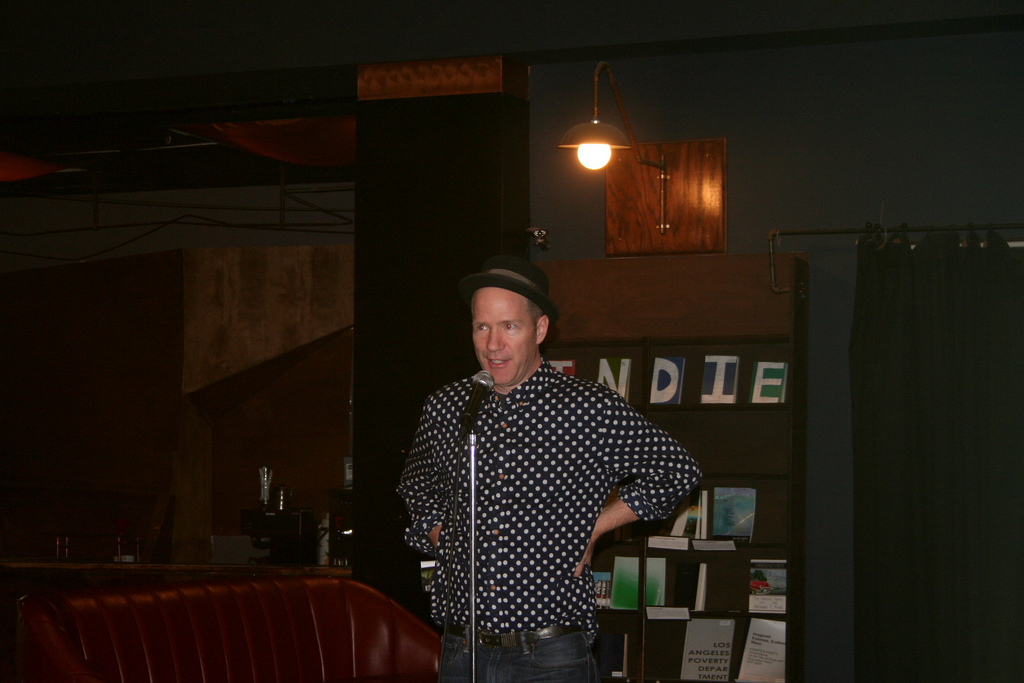
Black Clock 16 Launch at The Last Bookstore

moody1Last Sunday, writers and readers alike convened at downtown L.A.’s The Last Bookstore to celebrate the much-anticipated release of Black Clock 16. Located in an old bank building fit with tall columns, dim lighting and an arched ceiling, the cathedral-like Last Bookstore hosts a massive collection of new and used books and vinyl records (many for as cheap as $1!) that requires seriously superhuman strength not to peruse for hours on end. What’s more, with such artful installations as its eerie flying typewriter sculpture and a walk-through tunnel made of books, The Last Bookstore offered Black Clock the perfect setting in which to launch its dystopic Issue No. 16. As KCRW’s Michael Silverblatt put it to the crowd on Sunday: “This is an entire issue of how we’re falling apart. Here at The Last Bookstore we can come together and not fall apart.”

Seats filled quickly and stragglers settled for standing room only as Black Clock Editor Steve Erickson took the stage to present the night’s readers. Up first was Claire Phillips (author of Black Market Babies and a previous contributor to Black Clock 15) reading the entirety of her short yet impactful story “Tubular,” a science fiction piece set in a disturbingly familiar, near-future Los Angeles which has succumbed to mass societal collapse after the 2010 B.P. oil spill. Attendees on Sunday listened intently as Phillips’ characters navigated their strange, new landscape with necessary wit and numbness, even in the face of 10-foot “land-faring mutant worms.”

Next was The Contortionist’s Handbook and Dermaphoria author Craig Clevenger, who read an excerpt from his short story “Chicken Wire” while clad in a pair of snakeskin cowboy boots. Also set in and around Los Angeles, “Chicken Wire” tells the ominously humorous story of Jimmy Wynn, a failed metal band guitarist turned cab driver who spends most of his time in the Mojave desert begging his rough-and-tumble customers to pay their fares. Fans should look out for Six Finger Films’ “Smoke & Mirrors,” a short written by Clevenger and based on a chapter of his current novel-in-progress, scheduled for release later this year.

Last in the line-up was Rick Moody, author of The Ice Storm and most recently, On Celestial Music: And Other Adventures in Listening. Before reading, Moody took a moment to affectionately warn the audience, “If you happen to be of the Red State persuasion, you might want to go get coffee now.” This turned out to be good advice in the end: Moody read from his latest piece of nonfiction, entitled “Election Diary 2012” and chock full of unforgettable, fiery opinions regarding our country’s most recent presidential election race. Last Sunday’s listeners were especially tickled by his November 25, 2011 entry, in which Moody engages in a lengthy imagining of Newt Gingrich wearing diapers.

As the event came to a close, attendees mingled with the night’s readers and Black Clock staff in the relaxed atmosphere of The Last Bookstore’s main floor before slowly filtering out onto the twilit streets of downtown L.A. It was a night that proved truly surreal. Just like the issue it celebrated.


By Adriana Widdoes
an Editorial Assistant for Black Clock and an MFA Writing candidate at CalArts

Pop-Hop: The evolution of the bookstore at its finest

As a writer and a reader there’s something I can’t/won’t/refuse to shake, and that’s a good bookstore. With the threat of e-books taking over as the popular form of publication, I tremble with rage at the thought that we might lose my favorite kind of business.

When I first moved to Los Angeles in 2008 I found it incredibly difficult to locate a good bookstore. I went so far as to follow half complete directions to a used bookstore somewhere between Malibu and some hills only to find it had been dissolved years before. Do you know that disappointment? Does it permeate your city too? I blame the Internet, I think it goes out of its way to forget bookstores still exist. I’m sure it’s intentional, and I hope someone more versed in conspiracy theory is already on this, because I don’t really have the time.

However, in spite of the Internet’s selective memory, I’ve managed to locate bookstores here and there throughout the last four years. From The Last Bookstore downtown to Iliad Bookshop in North Hollywood, the book business is hanging in there. Then there are the special places that are doing more than hanging in there, that are making their own distinct presence known by building a community, and one of those places is Pop-Hop Books & Print, “[a] bookshop, print studio & salon in the Highland Park neighborhood of Los Angeles”.

If you haven’t been to Pop-Hop yet, well shame on you, but really, you should make the trip. Recently opened in May 2012 by friends Robey Clark and Sarah Balcomb, Pop-Hop is what I dream my home library will look like someday. Sturdy shelves installed by friends line the right side of this narrow, long, and high ceilinged space. The shop gives off an air of clean and clear purpose. The white walls contrast with what might look like items from your grandmother’s attic. At first glance, to the non-bookish eye, the books and items gracing these shelves don’t seem all that special – mostly used, with a handful of newer books, and scattered lost objects. But these shelves are weighed down by something very specific. Love. Sarah loves books, you can see it in the way she has carefully chosen, organized, and alphabetized her shop, and in the little color coordinated display that lingers by the register. First editions pop up every other grab. Lovingly read books creak open to show you their unique stories and odd photos. You’ll find cookbooks, children’s stories both old and new, psychology and social science books, fiction, non-fiction, local handmade books, and maybe even something as unusual as an instruction book on the best ways to kiss a woman: titled The Art of Kissing (copyright 1936, reprinted in 1988).

This last example is why I have a particular affinity for Pop-Hop. I’m a person who will pick up old communist manifestos and books from the 1900s on how to learn Esperanto, and at Pop-Hop, Sarah displays this same affinity for the odd and rare little book. If you’re looking for a surprising read, or a gift for the book loving person in your life, Pop-Hop is the place to go.

You should also swing by if you’re looking for that yard sale item that’s escaped you, or fun handmade art by local artists. Scattered around the shelves, bits of scrap art mingle with very precious French mugs, and it’s not at all unusual to see very small screen-printing screens acting as bookends. Another aspect to the Pop-Hop shop is its screen-printing studio run by Robey. The walls are hung with bags, t-shirts, and baby clothes that were all screen-printed in house. They run weekend workshops where you can learn to screen print, or make a handmade book. Also on weekends they host story times for kids as well as readings and music performances open to the public, and participate in the NELA bi-weekly art walk. Basically their feet aren’t just wet, they’re soaked from all the activities they’ve both started and become involved with in only the first year of their existence. They’ve created an inviting open space where everyone is welcome, and they’re flourishing.

I appreciate what Pop-Hop does, that they’re helping to keep the printed book circulating and doing it with verve. Their unique and constant interaction with their neighborhood is creating a community, and a community with an appreciation for books and art. A community with this kind of appreciation isn’t going to let a place like Pop-Hop slip away in the oncoming storm of electronic books. Pop-Hop is a lesson in the adaptability of the bookstore, and it’s a lesson I hope other aspiring bookstore owners can pick up, make their own, and run with.


By Jessica Marie Felleman
an Associate Editor for Black Clock and an MFA Writing candidate at CalArts.

Walking LA: Chinatown

This is part of a series of literary meditations on that rare urban pastime of exploring Los Angeles on foot.

Ethnic neighborhoods are as American as apple pie–or pad thai, chop suey, or tacos–and Los Angeles’s Chinatown is a prime example of this. A conflation of demolished old and manufactured new, Italian and Chinese immigrant cultures and histories, traditional recipes and innovative cuisine, cryptic apothecaries and contemporary art galleries, Chinatown is not only a quintessential American urban exercise in contrasts, but a classic example of the rich, complicated, and oft-contradictory fallout of reinvention that is Los Angeles.

L.A. is a beautiful, lush city, but it was not always like this; one has to remember that most of the flora, even the palm trees, were imported, and the City of Angels is as much an artificial production as any Hollywood blockbuster. Without a water redirection program that is truly gargantuan in its scope and scale—not to mention controversial–Los Angeles as we know it would simply not exist. Leveled in 1939 to make room for the construction of Union Station, the original Chinatown, which was established in the 1880s, was the victim of a similar lust for development. Chinese residents were resettled and the development of “New Chinatown” emphasized a kitschy adherence to stereotypical tourist expectations. In a sense, New Chinatown was just another Hollywood set, constructed around a large, “authentic” Central Plaza complete with Chinese style palaces and tiny side streets with names like “Gin Ling Way” and “Bamboo Lane.”

So it’s no accident that Roman Polanski’s 1974 classic film about the political intrigue around L.A. water rights and land distribution—disputes that grew more and more contentious as the metropolis bloomed in its desert confines—was set in and titled, well, Chinatown. It’s hard to say whether Polanski’s immortalized Chinatown’s neo-noir reputation or vice versa.  The historical reasons for Chinatown’s association with noir are twofold: Angelenos, who were raised on tales of “the exotic Orient” and Charlie Chan movies, flocked to the neighborhood for a taste of folkloric intrigue and mystique; secondly, the spectral presence of an entrenched local Italian mafia created atmospheric undercurrent of intrigue for decades.  The most obvious remnant of the old Italian stamp on the neighborhood is the famous Little Joe’s Italian American restaurant, which stands at the corner of Broadway and College. Though currently shuttered, the restaurant was a local fixture for over seventy-six years.  It is fitting that Little Joe’s stands at the north end of Chinatown, just a few blocks away from the official entrance: a massive steelwork archway that features two dueling Chinese dragons, complete with fog emitters for a touch of ‘authenticity.’

Chinatown extends for several blocks in either direction, but College Street is the principal thoroughfare and main attraction. On weekends, Chinatown is crawling with tourists, to the extent that one must weigh the benefits of a right turn against the likely demolition of several ambling, clueless, photo-snappers. On Saturdays it becomes clear why the New Chinatown is the way it is: it’s a theme park. The cheap souvenir shops do steady business in machine manufactured buddhas, cheap paper fans, and other claptrap.

The most striking aspects of the Chinatown experience are the smells. It seems like every other storefront is a cookery of some sort, most of which proudly display their products in the open air or behind a storefront window. Whole Cantonese ducks roll on spits, bronzed and perfect, dripping juices like the cumulative attention of so many hungry eyes makes them sweat from nervousness. To find the best dim sum, one has to venture into one of the small open-air malls, and follow the nostrils past electronics and toys stores, insurance agencies and salons. The street signs in Chinatown are all bilingual, many of the store signs are not, and menus are often the source of hilarious mistranslations. Ever been curious to try “human pickles?” Me neither. Another item worth investigation is one of the large tea and herb vendors, like P.C.T. Ginseng and Herbs. The casual customer will become overwhelmed by the sheer variety of herbs, medicines, and victuals on offer here, not to mention the creativity of the hypochondriac element displayed through the proliferation of so many cures.

But let’s be honest. Dim sum and ducks are all fine and good, as are authentic herb stores, but what keeps an individual pounding the same sidewalks over again, after an initial cursory exploration, is the presence of unique and interesting bars. Chinatown’s Mountain Bar more than fits the bill. Part of its charm is its inscrutability. The posted hours are 6pm-2am, but they may as well be “whenever-whenever.” One must show up on faith, and if the stars are aligned, the doors of the Mountain Bar will open. Located in the Central Plaza, there is no sign, but it is strangely hard to miss. Sandwiched between two atrocious souvenir shops, its charm beams forth unimpeded.

The Mountain Bar is blessed with a striking interior. Chinese themed decor and embellishments are illuminated in soft red light, such that the late drinker feels he/she has descended into the heart of the world’s depravity. Bartenders and fellow patrons take on a sinister air in the shadowy, Tartarusan splendor of the Mountain Bar, and one almost expects to see Jack Nicholson and Faye Dunaway hunched toward each other in a corner booth. The Mountain Bar also hosts periodic literary readings, which is another mark in its favor; it is a typical destination for locals newly freed from the confines of a gallery opening, of which Chinatown hosts dozens in any given month.

Contemporary art galleries abound in the small streets around Central Plaza, and are a source of much of the nightlife in and around the area. I’m not entirely sure how “Chinese” it all is, but it’s nice nonetheless. In a sense, Chinatown could stand as a microcosm for Los Angeles, that glorious epitome of all contradictions. But that might be over thinking it; it’s best probably to settle in over a pint at the Mountain Bar and forget all about it; after all, Jake, it’s Chinatown.

by Doug Matus
a writer from Texas who now lives in Los Angeles

Vermin on the Mount: A Night of Irreverent Readings (9/26@8PM)

when September 26, 2010 @ 8:00pm
where The Mountain Bar, 475 Gin Ling Way, Los Angeles, CA 90027 (313) 660-1175

Admission is free.

Black Clock 4 and 7 contributor Grace Krilanovich reads with Steve De Jarnat, Joshua Mohr, and Matt Stewart at the next Vermin on the Mount reading.

Jonathan Lethem Goes West

To his fans, Jonathan Lethem is one who always pushes into new avenues of form and genre, of kidnapping kangaroos and scouring the Zendo for a killer, and he is certainly synonymous with New York. With novels like Motherless Brooklyn and The Fortress of Solitude that have so deeply imbibed into their pages the grit of New York City, it is impossible to separate the two. Chronic City, Lethem’s latest novel, returns to New York once more, but this spring he is set to do the unthinkable. Brooklyn will be sure to bemoan turning Lethemless in 2011 when he trades in New York for Los Angeles as the Roy E. Disney Professor in Creative Writing at Pomona College.

BLACK CLOCK: You have had a long relationship with Black Clock, dating back to the first issue. What was your initial draw to the magazine and what has kept you coming back?

JONATHAN LETHEM: So simple: I’m a fan of Steve Erickson’s, going back to before I’d published fiction myself, and well before I had the luck of becoming his friend as well. Only “fan” puts it too gently: Steve’s accumulating shelf is of the great flares burning out there, lighting up the landscape, and when I heard from him that he wanted me involved in his magazine, I couldn’t imagine saying no. That it turned out to be a really singular and strange and effective publishing adventure wasn’t any kind of surprise. It’s made a great home for some work that might not have fit anywhere else, and a couple of the pieces that were effectively ‘commissioned’ for Black Clock are among my favorite of my recent short works.

Last year you did a series of readings in which you read the entirety of your newest novel, Chronic City, over eight days in New York City. A pretty astonishing task, one that makes my vocal chords ache in sympathy. How did it work out? Is it something you would like to do again?

It was a great one-of-a-kind experience, and I’d never do it again. I made the decision based on several terrific misunderstandings with myself and the actual length of the book.

On your website (http://www.jonathanlethem.com) you have a project running called Promiscuous Stories, where you welcome other artists to lift your stories and lyrics. Art influences art like nothing else can, and I believe it to be a vital part of the creative process. How did you come to the decision to “let go” of some of your work? What sort of response have you gotten?

Well, of course there’s been all variety of results by now, as was pretty much inevitable given the shotgun-blast/messages-in-bottles nature of the internet, and the project itself: good art, bad art, interesting attempts, unfinished works of great intrigue and promise, a few altered careers and opinions. Also, needless to say, loads of people have ignored the whole thing outright, as they were always also welcome to do. A theater troupe in Chicago actually renamed themselves The Plagiarists based on the thing. And there’s a very exciting “anthology film” in the works. But the important thing to say about the kind of letting go that I did on the site is that it isn’t actually an original or particularly unusual gesture. In fact, writers (and other artists) are constantly giving other artists (often filmmakers) “free options” on things all the time, without making a big deal of it. And, conversely, artists of all kinds (including writers) are taking the resources and inspiration and even the plot details they need for their own work from the work of others, without even asking, let alone seeking a formal permission–also without making a big deal of it. What my project consists of is framing these activities so they become visible. Making a big–or at least a medium–deal of it, in order to make a political point that these aren’t shameful or incidental or wayward transmissions, but in fact something to celebrate as central to art practice per se.

You have a strong opinion on “plagiarism;” can you speak a little about that?

I use the word provocatively, trying to nudge people into seeing how few of the “borrowings” they’ve been invited to become incensed about really are worth the name. Palming someone else’s efforts off as your own, covertly and lazily–even this isn’t much of a moral disaster. And most people witch-hunted as plagiarists are doing something much more honest, interesting, worthwhile, and inspiring than that.

Which writers and artists have influenced your work?

Too many to mention. A new one every day. A few go right to the bone of my work: Kafka, Hitchcock, Lewis Carroll.

It seems that everyone I speak to about Lionel in Motherless Brooklyn finds something they identify with in his ticcing. I have caught myself doing Lionel-like tics in my day-to-day life. Did you recognize ticcing as a universal act, something that many could potentially relate to? What inspired this decision on his character?

I’m always looking for metaphors that can serve as a net to catch every meaning that wanders past. Tourette’s, while I was writing that book, became a lens for contemplating zones of myself, areas of human culture, streets of Brooklyn, and aspects of human voicing I was fascinated with trying to bring to the page: insults, jokes, self-revelation in the form Freudian slips, etc. Lionel’s condition certainly also became a kind of weird verbal machine, too, for producing ticcishness in myself and others. He goes on making that impression, a decade later–I guess I got lucky.

Rumor is that Edward Norton is set to adapt, direct and star in Motherless Brooklyn. (An absolutely brilliant choice, I think.) What has been your experience with the adaptation so far? Are there any plans for future adaptations for the big screen or otherwise?

I mostly stay away from the work–or non-work–that goes on when my books enter the film adaptation process. It usually isn’t something I can be particularly helpful with. And the frustrations that go with that work get under my skin very easily. So, I don’t know where the Motherless Brooklyn project stands, or if it stands at all. It might be on its knees. Or taking a nap. Some other books have new dance partners just now: Fortress of Solitude, As She Climbed Across the Table, Gun with Occasional Music and Girl in Landscape. It all sounds very exciting, and it arouses all sorts of silly feelings in the author, but what we’re really contemplating consists of someone else’s–several someones–improbable and mostly excruciating art-attempts. I wish them all well.

Music comes up often in your work. You Don’t Love Me Yet surrounds a band of struggling musicians. In The Fortress of Solitude, life is very nearly dictated by music. You also had the enviable chance to interview Mister Bob Dylan himself. How does music serve your writing?

I use music as an emotional touchstone for my writing (and not only for my writing). I listen to it constantly. At the very least it keeps me still for my work, which is no small thing. At its frequent best it reminds me of who I am and why I bother. I can only hope that a handful of readers are drawn into a projected relationship to one or another of my books anywhere near as rich as my projected relationship with, say, Mister Bob Dylan. It’s actually creepy to talk about these things, but they’re what we all wish for.

The writing of liner notes takes place in both The Fortress of Solitude and Chronic City. Is it your secret ambition to be a writer of such notes?

Either that or a philatelist.

Crossing genres is something you often do, moving through genres from work to work and many times merging them in a single work. In some stores your books can be found in general fiction, others mystery or science fiction. What do you think of genre boundaries? Is genre something that you dwell on during the writing process? Is there an area you would like to explore more deeply?

I started out quite naively excited about the idea of “genres,” but by now it seems more like a matter for critics than for writers–and mostly, alas, a matter for critics to mishandle. It’s at least a very confusing term to bring into descriptions of what it is I (consciously) set out to do in my work. I draw tremendous energy from all sorts of what I like to call ‘vernacular culture’–comics, animation, pulp crime and science fiction writing, rock and roll, etc.–and always will, but the sorts of novels I like to read, and write, have always been all over the high-low map, as well as drifting in and out of the publishing categories that most people are talking about when they use the word “genre.” For me, I see genres where others don’t, and vice versa. The “academic satire” (I wrote one in As She Climbed Across the Table) is a form as precise as a sonnet–now, there’s a genre. Whereas what gets jumbled up in the publishing category of SF–dystopias both evocative and pedantic, vicarious power fantasies, grindingly earnest advocacy for space exploration, etc.–doesn’t make any literary-critical sense as a “genre” — it’s more like a tradition, or an “area” (or, prestige-wise, a backwater, which is a wearisome matter to combat, but also to pretend to ignore). So, what do I think of boundaries? Useless. Descriptions, that’s what I like–fresh descriptions more than tired or received ones. But descriptions come after the fact.

It’s no secret that New York is your home. Many of your novels take place in the City, picking up different cliques to center each. Often, the City is much more than a setting, becoming a fully rounded character. As someone who has yet to have the chance to visit the City, can you describe what about New York has served as a muse for you?

Just as we write this, Claremont California is about to be my home. Which may be my best excuse, if there’s any excuse, for dodging your question. I’ve spent so many fictional pages trying to evoke–not encompass–the contradictory and ambivalent force of my ongoing reaction to that place, and to my being “from” that place, that it doesn’t feel good to me to try to come up with some reductive paraphrase. I did so too many times in the past. But you should visit.

Your latest work, Chronic City returns to New York. Can you speak about it and its eclectic cast?

I wanted to make an absurd snapshot of Manhattan in the middle of the “aughts,” and then blow it up and explore it meticulously, lavishly–my first joke about the book was that I wanted to write the book Gogol would have if he’d been commissioned to novelize Saul Steinberg’s famous New Yorker cover (the one showing the Upper West Side in the foreground, the midwest and China in the background). The disparity between the grim depth of the historical facts surrounding the way we lived between 9/11 and the economic meltdown, and the amnesiac cartoon thinness of how many of us actually lived in those years. Which sounds very punitive, doesn’t it? But as for the eclectic cast, I loved and love them all. I feel very forgiving towards even the worst of them.

For those aspiring writers, can you discuss your experience with publishing and your journey as a writer so far?

Oh, I’ve been absurdly lucky in my journey, which puts me in no position to help anyone else with theirs. Except I’d say how important it is, from the permanently and in many ways rightly defiant and embattled stance of an artist in a capitalist system, to remember that now, more than ever, the people you’ll meet in publishing are doing what they’re doing out of sheer love. If they were into exploitation, they’d find another career.

What is up next for you?

I’m publishing a tiny book about John Carpenter’s They Live in the Fall. Just barely in time to accredit myself as a “Los Angeles writer,” I hope.

by Rachel Kolb
an MFA Writing candidate at CalArts

Grace Krilanovich + Joshua Mohr Read (9/09@7:30PM in LA)

when September 9, 2010 @ 7:30PM
where Skylight Books, 1818 N Vermont Ave, Los Angeles, CA 90027 (313) 660-1175

Admission is free.

Black Clock contributor Grace Krilanovich reads from her debut novel, The Orange Creeps, which we loved so much we published excerpts from it in Issue 4 AND Issue 7.  Fellow Two Dollar Radio author Joshua Mohr reads from his new highly-praised book, Termite Parade.

Grace Krilanovich has been a MacDowell Colony Fellow, and a finalist for the Starcherone Prize. Her first book, The Orange Eats Creeps, is the only novel to be excerpted twice in Black Clock.

Joshua Mohr is the author of the novel Some Things that Meant the World to Me, which was a San Francisco Chronicle bestseller and one of Oprah Magazine‘s Top 10 reads of 2009. His second novel, the newly released Termite Parade, has been called “No small achievement” by The New York Times Book Review. He has an MFA from the University of San Francisco and has published numerous short stories and essays in publications such as 7×7, the Bay Guardian, Zyzzyva, The Rumpus, Other Voices, the Cimarron Review, Gulf Coast and Pleiades, among many others. He lives in San Francisco and teaches fiction writing. Please visit him at joshuamohr.net.

More information is available on the Skylight Books website.

Rick Moody Reads (9/01@7:30PM in LA)

when September 1, 2010 @ 7:30PM
where Skylight Books, 1818 N Vermont Ave, Los Angeles, CA 90027 (313) 660-1175

Admission is free.

Rick Moody—Black Clock contributor (Issues 1, 2, 4, and 9) and award-winning author of Black Veil, Demonology, The Diviners, Garden State, The Ice Storm, Purple America, and Right Livelihoods—reads from his new novel The Four Fingers of Death.

“The book is entertaining and often poignant, probing the limits of technology, consciousness, and language in the face of grief.” — The New Yorker

“The Four Fingers of Death reads […] like a 700-page Kurt Vonnegut book.” — Time Out New York

Dog Days: A Reading of Sorts… (7/17@8PM)

when July 17, 2010 @ 8:00pm
where 820 Industrial Street, Los Angeles, CA 90021

Black Clock 12 author Katy Petty is reading/performing this dog of a Saturday with The Shone, Senia Moon, Ani Raya-Flores, Jared Woodland, Stephen van Dyck, Captain Alex Machiavelli, “a special guest…and you.”

“Dog Days: A Readings of Sorts…” is “a reading, but it’s also not a reading, it’s a performance, it’s a party, it’s a gun club, it’s a play, it’s a powwow, it’s a street fight, a strip club, a circus tent, a vacation spot, the vatican, church, a bon fire, a rehab clinic…So…come enjoy some shit, have a beer, bring a beer, bring a friend, bring pirates, bring nerve endings, a scalpel, bring your mom, smoke a joint, crack anyone? I think the point is, you don’t have to like literature, you just gotta like good old fashioned fun!”

Walking LA

This is the first in a series of literary meditations on that rare urban pastime of exploring Los Angeles on foot.

L.A. has a reputation as a driver’s city.  I know this, because I’ve read it described elsewhere, endlessly, in peoples’ reflections on the place; and also, because of my first experience of L.A., which came through an old girlfriend who once laughed in my face when I asked her if there were any cool bars or coffee shops within ‘walking distance’ of her house. There are certain things that contribute to L.A.’s demarcation in this regard. First of all, the place is huge; it’s an official “mega-city,” with the metropolitan area comprising almost 500 square miles and containing nearly 15 million souls. Whether you were born and raised in Watts or the OC, chances are that, when asked in polite conversation where you’re from, you’ll respond “L.A.” But who would be willing to hoof the distance between these two areas? Public transport is insufficient. As a new transplant, I’ve seen more shuttered subway stops than functioning ones, and the prospect of navigating a bus system in a place where single streets can stretch for 24 miles (Sunset Blvd.), or the famous highway system regularly suffers the daily glut of seven million cars, leaves me anxious and uninspired. Public transport, in order to be successful, has to be fast and easy. In L.A., it is neither of these, which leaves most residents with no option but to hop behind the wheel, and add their presence to the communal cluster of the 110, 5, 10, or 101.

In reality, L.A. is an imminently walkable city, at least within the neighborhood regions that comprise it. Los Angeles is a city, of course, and an immensely large one; but it is also a conglomerate of individual communities, many of which feel like autonomous regions and have much to offer the foot-bound voyager. So how do we find our feet in this great mecca of urban development? Easy. By putting our feet on the ground, and breaking the city down into the neighborhood elements that comprise its body and soul. There’s a lot of history here, and for such a vehicular city, a vibrant street culture, with food vendors, pedestrians, small storefronts, and a rich visual texture of beautiful buildings, graffiti, flora, and vistas to reward the urban spelunker. In this series of essays I will explore the practice of walking L.A., a project that I hope will endear me more to this strange place that inspires such intense reactions of love and hate. A secondary goal will be to root out the variegated strands of literary culture persistent here at the end of our continent. As Henry Miller stated, great literature is born of the streets; yet Los Angeles, the entertainment capital of the world, has never possessed in the popular imagination a literary heritage comparable to, say, New York. Of course, as with everything here, appearances are deceiving. The great writers of Los Angeles – Chandler, Fante, Bukowski – have all celebrated the city in microcosm, and to read their writings without an awareness of place is to miss half the point. Los Angeles is beautiful and complex, and bears the attention of prolonged study. This fact was made apparent to me continually in the course of my first walk, which centered around the city’s historic Pueblo center.

It was a fantastically beautiful day. This is not strange, noting the locale, but worth mention due to the effervescence the sunshine extracts from the clean white lines of the downtown architecture, interspersed with the oases of public gardens and parks. Los Angeles is a fascinating city architecturally. In the past few decades, attention has been drawn to the fabrication of monolithic wonders, like the Frank Gehry designed Disney Concert Hall. As a city of spectacle, though, L.A. has always been the sight of showy building accomplishment, from the stately halls of public administration to the boutique wonders of homes in the hills. At the center of it all is one of its true stone wonders: Union Station, a New Mission monolith built to much fanfare in 1930 that continues to provide the beginning and end to many West Coast experiences.

If Los Angeles is the Paris of the Americas (and why not?), then Union Station is its Gare Saint-Lazare. This beauteous terminal has been amply represented in cinema and literature, and can serve as a useful representation of the city it serves. Union Station would seem intimidating. After all, it is the downtown transportation hub that links a massive city to its equally massive airport, LAX. Union Station is also an Amtrak and bus terminal, with direct service up and down the West Coast, and east to Texas. It is not intimidating, however; neither its majestic mission facade, rising next to the similarly designed USPS Terminal Annex, nor its generous interior layout. I parked my motorcycle across the street (one must, of course, drive to walk here), entered through the front doors, and was immediately greeted with a splendor of space: a direct line, defined in polished oak and vaulted ceilings, from the curb, straight through the waiting area, to the terminals and bus station. To the left of the entryway, barred to foot-traffic but eminently viewable, is the old ticket-hall, a huge room with a mighty row of art-deco counters, polished marble floors, and paneled-wood ceilings. Its grandiosity and enforced barrenness inspired thoughts of tragic, sudden departures, a teary movie heroine in shades of celluloid buying the first ticket to nowhere, with everyone wearing hats and smoking cigarettes. Opposite this is a nice-looking bar (too early in the day for me to sample, but I’m sure a welcome retreat for weary travelers) and a breezeway that leads to a garden and shuttered restaurant. The gardens that bookend this main area are massive and lush, the kind of arboreal design indulgence one doesn’t find very much out East. The shuttered restaurant is ghostly and romantic, like an old wedding photo. A sign advertised it as available for filming.

The Pueblo lies roughly across the street from Union Station, a fitting welcome for new visitors to the city. The Pueblo was the center of the first incarnation of L.A., El Pueblo de Nuestra Senora la Reina de los Angeles del Rio de Porciuncula, founded in 1781. I’m not sure when the settlement’s name was shortened to “Los Angeles,” but I imagine it came as a relief to natives whose querents would fall asleep during the answer to the question of “Where are you from?” The Pueblo area later became the site of the city’s first Chinatown; hence the references to “New Chinatown,” in regard to the current district. The history of L.A.’s Chinatown, and its reason for relocation, are detailed at the Chinese-American Museum, right off the main Pueblo plaza. Apparently, the original Chinatown was leveled and the residents forcibly removed for the construction of the Union Station I so eulogize in the preceding paragraph.

From my perspective, the two most interesting landmarks on the Pueblo Plaza are La Placita and the Avila Adobe. La Placita was L.A.’s first established church, in 1814, and still provides a full range of services. I walked into the little chapel, where a golden icon was on display behind the altar, and a group of elderly folk were knelt at various pews in quiet prayer and reflection. At the opposite end was an impressive depiction of the crucified Christ, enclosed in a glass coffin and surrounded by a heap of flowers. A couple of people waited in line to pay homage and perform silent reflection. It takes an advanced cynic not to respect the spirit of such a place; such disconnect is out of my reach.

Across the Plaza from La Placita is Olvera Street. This narrow passage, lined with souvenir and trinket shops, is the home of many historic buildings, including the Avila Adobe, built in 1821, and recognized as L.A.’s oldest surviving residence. The place is fairly palatial, with several large rooms surrounding a contained garden; it was constructed by one of the first settlers to make their fortune in ranching, and was later used as the U.S. Army headquarters during the Mexican-American War. Olvera St., with its shaded, brick-paved confines, empties out onto E. Cesar Chavez, one of modern downtown’s main thoroughfares. The contrast between the quiet, adobe lined lanes of the Plaza and the traffic signals and exhaust of the City of Commuters is profound, but a necessary reminder of the L.A.’s depth and complexity. In the words of Emerson, “Do I contradict myself? Well, I contradict myself. I contain multitudes.” So it can be that a city centered around a driving culture can reveal so much to the sidewalk wanderer.

by Doug Matus
a writer from Texas who now lives in Los Angeles