Singular, idiosyncratic and a little mysterious, Black Clock is one of America's leading literary journals.

Posts Tagged ‘Look Out’—

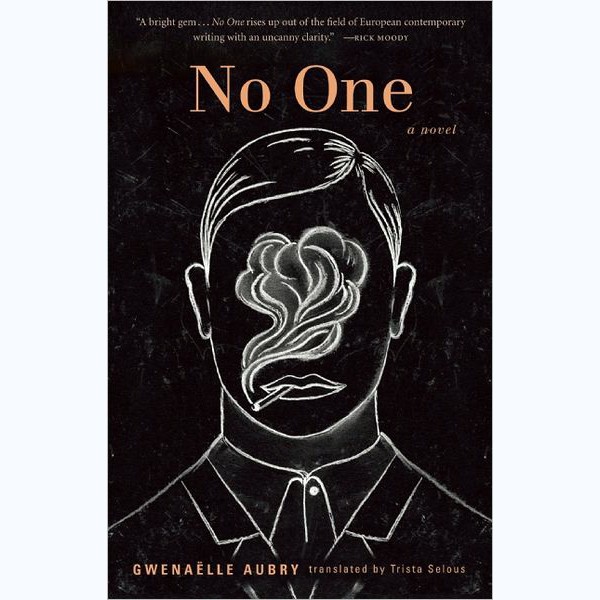
Peering Into the Void: A Review of Gwenaëlle Aubry’s “No One”

noonenovel“Here again I don’t know what, in all of this, is wisdom, what is madness.”

How do we write madness? What language can accurately encompass something as personal and unknowable as mental illness? In her latest book, No One, French philosopher and writer Gwenaëlle Aubry seeks to find that language. Piecing together her own fragile recollections with excerpts from the handwritten, autobiographical manuscript (titled The Melancholic Black Sheep) left behind by her late father with the note “to be novelized,” Aubry explores the life of a man who disappeared from view long before his death: Francois-Xavier Aubry, a once brilliant and distinguished Paris lawyer whose crippling bipolar disorder eventually left him a penniless drifter, in and out of mental institutions for most of his daughter’s life. At once lucid and mystifying, No One is Aubry’s beautifully wrought attempt at creating a portrait of someone whose internal reality she knew so little about, someone who, in the end, strived to be anyone but himself.

Were No One a conventional memoir in the popular American sense we might read Aubry’s story through detailed, chronological scenes in which each family member is cast as a distinct character. It seems necessary to note, however, that No One is the first of Aubry’s books to be translated into English, and in writing it Aubry appears acutely aware of the French literary tradition of “autofiction,” a contemporary genre that blurs the boundaries between autobiography and fiction. Much in the way we saw the life story of Roland Barthes presented to us in Roland Barthes (1977), No One favors compact and poetic philosophical ruminations over dialogue-centered prose. And perhaps also recalling Primo Levi’s The Periodic Table (1975), Aubry shapes her own memoir similarly: this time in dictionary form, with each letter of the alphabet offering another hopeful entryway into her father’s warped psyche.

From the clinically depressed poet/playwright Antonin Artaud to Woody Allen’s chameleon-like 1983 character Zelig, readers accompany Aubry through this idiosyncratic dictionary with curiosity, moving easily between both her father’s poignant, chaotic voice and her own of understated elegance. What we experience then is one author’s exquisite struggle to put a face to a man whose identity was forever unstable, preferring always to be, in his own words, “away from the guerillas of the past, unknown to all, without a label.” The result is a sparkling yet melancholy elegy, a restrained kind of mourning from a wounded daughter to her tragically afflicted father, full of grief and quiet love.

And while we can’t say for certain whether parts of Aubry’s memoir are indeed fictionalized, what is clear is the author’s interest in cultivating this energy of the unknown, something characteristic of autofiction in particular. Readers will notice immediately the contrast between Aubry’s rigidity of form and the cloudiness of her investigation into her father’s true persona, which, like the mental illness that took hold of it, evades, ever so slightly, all attempts at categorization, at being fully known. The task that Aubry has taken on in No One is undoubtedly a difficult one. But the form that she has chosen for her work provides a much-needed, albeit only somewhat helpful, structure in which to look at something formless. It isn’t until the book’s last pages that Aubry comes to a critical realization about her father: “I felt as though, having tried so hard to forget, my memory was now going mad. He didn’t want to remember, didn’t want to know.”

Perhaps it is this exact cloudiness, this frustration of memory and knowing that Aubry laments, that is the greatest triumph of No One. For in the end the truth that Aubry discovers is one even greater than that of her father’s story: It is the truth that madness can never be adequately contained. Though readers may fail to reach a precise explanation of what madness is, they have peered deep into the void along with the brave Aubry herself, who has thus achieved the ultimate act of filial devotion: She has spoken her father’s name, despite everything, again and again and again.

No One
Tin House Books (February 2012)
170 pages; $12.95

By Adriana Widdoes
an Editorial Assistant for Black Clock and an MFA Writing candidate at CalArts
The Stages of Falling for the Deliberate Love of Humans: A review of Aimee Bender’s “Willful Creatures”

Reading Aimee Bender’s Willful Creatures is uniquely emboldening. The ride is all magic and turmoil in open air, and you finish smiling, face taut from being smacked with the full range of human capabilities. Bender shows us how we all have the potential to be willful, to act unreasonably or deliberately to a fault, and how doing so can be just as heartbreaking as it is inspiring. In this collection, Bender locates and exposes the multiple layers of what it means to truly act with willful intent. Her characters open up and move the reader to understanding his/her own desires. From a man who cannot see theperfect woman, to a pumpkinhead mother who cannot help her ironhead son sleep, to a woman weighed down by grief equaling exactly the same as seven potatoes, Bender’s characters bring you into their world and expel you just as quickly with a slight whiplash that is well worth it.

Separated into three parts, Willful Creatures acts as a coming-of-age tutor. A more apt title for “Part One” might be Childhood, as the characters in this section all share an immaturity. They are mean as they torture; they are stubborn as they defy themselves; and they underestimate their emotions as they act rashly. Watch the doomed men in “Death Watch” cry, run away, beat the ground, and then completely miss out on their own lessons. Detest the big man in “End of the Line” when, after he has committed many unthinkable deeds, he stops not through an understanding of his crimes, but from a renewed selfish feeling of entitlement. Scream at the driven girl in “Off” as she drowns all of her opportunity for greatness in stubborn games. Feel the pain of “Debbieland”–the pain that we bring to others in order to get rid of our own. Savor the familiar tingling in your hands from the urge to shake these characters, caress them, or push them down a flight of stairs.

Enter the lives of Bender’s characters in “Part Two” who feel older, but are yet still incompetent in their limbo-ridden world of indecision–who show us the weakness of being weak. An investigation of intimacy and emotion,“Motherfucker” leaves you wandering your own house of desire and all the memories of times you left it too widely open, thus missing out on something true. Captivated by the magic of a few moments of change, the characters in both “Fruits and Words” and “I Will Pick Out Your Ribs (from My Teeth)” suffer in all-too-familiar suspended weightless fields of danger and uncertainty, and make you wish they would break like poorly made plates, not out of malice, but as a way to redemption.

As in the Kübler-Ross model of the five stages of grief, the last section of Willful Creatures takes us through acceptance. Hold your breath while reading “Job’s Jobs” in which our hero has everything taken from him but still oozes that soul-crushing ability to love what he can do. Here, Bender finally lets you shout “TAKE THAT!” at God and shove his face in the human ability to continue striving for happiness in spite of any obstacles. In “The Case of the Salt and Pepper Shakers” Bender examines the equality that can be found in discord, and in “The Leading Man” she explores the process of self-discovery with the acceptance of every subsequent reveal. The characters in Part Three feel ancient, wise and self-assured compared to the volatile creatures in the first two sections. “Hymn,” a story of acceptance of perfection in a seemingly chaotic town where everyone can find a true purpose, finishes the book off like a perfectly sculpted tower of whipped cream. It is as unifying as a comfortable close hug between warring sisters.

To read Willful Creatures is to submerge oneself into the thick fiction of Aimee Bender’s creation, to swallow every story whole, to feel her characters tap at you from the inside as you digest them, and to glow in their aftereffects. It is an experience made for lovers and dedicated students of the human condition, and a revelation into what it means to be able to act with intent. Read it, feel yourself judged not worthy of the will you have, and then go out and be as unreasonably stubborn as you can possibly be.

By Jessica Marie Felleman
an Editorial Assistant for Black Clock and an MFA Writing candidate at CalArts

Miller Walks

millerwalks.com

Cool in general and of particular interest to Henry Miller fans, this site uses Google Maps to chart out Henry Miller’s adventures, from his ramblings in Clichy to Paris to New York, and everywhere in between. Google’s street-view feature allows you to zoom in and take a contemporary stroll through Miller’s old stomping grounds. The site is also updated with academic tidbits, essays, and archival marginalia about Miller and his coterie.

by Doug Matus
a writer from Texas who now lives in Los Angeles

Marc Fitten’s Indie 100

indie100mfitten.wordpress.com

Marc Fitten is on a quest. He’s taking a cross-country road trip, visiting one-hundred independent bookstores, and documenting the process on a blog. As of this posting, he’s over halfway there, having most recently visited bookstore number sixty-five, Kramerbooks & Afterwords Cafe in Washington, D.C.. Fitten’s already made his sweep through Los Angeles, and it’s interesting to read his final impressions in light of an initial biased confession in which he admits, “I didn’t expect much in the way of Los Angeles bookstores after the bonanza by the Bay, but…”.

by Doug Matus
a writer from Texas who now lives in Los Angeles

Being Born

www.bornmagazine.org

Born Magazine would make any Marxist proud. Its meshing of media and text — the collaborative volunteer outcomes of artists, writers, musicians, and other creative types — is rendered and wrought at times with tenderness, at times with brashness, and is never boring.

The second issue of Born Magazine is particularly captivating. My personal favorite is the work “Zoology” done by Sasha West and Ernesto Lavendera. The subtle sort of interaction that it requires allows the viewer to have this sort of light participation: comfortable, no decisions, except whether to go on, and I couldn’t imagine not wanting to read the provoking text to the last.

by Sara Gerot
a writer and an Associate Editor of Black Clock

image of Karl Marx happy after reading Born Magazine

mid)rib

Spartan in design and mysterious in origin as only a web-based poetry magazine can be, mid)rib has published five issues of interesting, enigmatic, and occasionally indecipherable poetry with nothing more than two names and a Gmail address on the masthead. The apparently DIY character of the site is balanced, however, by the consistent high quality of the material presented, and by a careful, clean design. One gets the feeling that mid)rib is created not by mad geniuses, but by academics in exile—gone, indeed, a bit mad. If Dr. Moreau had created magazines rather than monsters, this one could well have had a place on the island. Indeed, “The Island of Dr. Toupee” from issue two defines a reoccurring theme for the magazine—that of an experiment, (which may be poetry or modernity, or something else altogether) gone horribly awry.

mid)rib’s editorial aesthetic embraces the austere, the dense, the translated and the untranslatable. The magazine’s name is swiped from botany (the midrib is the central vein of a leaf) and many of the poems reflect a certain scientific bent—as if they are pages from a complete poetic classification of the world. Cross-disciplinary and generative work seems to have become increasingly a focus for the magazine. While mid)rib remains first and foremost a poetry magazine, recent issues have included fiction, artwork, translations, videos, and some decidedly indefinable amalgamations of some or all of the above.

Like any good online poetry zine, mid)rib’s production schedule is a thing quite unknowable, but new issues are well worth watching out for. The current five should provide more than enough material to last us through the wait.

by Emily Kiernan
a native of the decaying Pennsylvania steel town from the Billy Joel song, who writes about islands, vaudeville, implacable but unjustified feelings of abandonment, the West, and places that aren’t the way she remembered them

image from mid)rib

HENRY MILLER (+ ANIMAL COLLECTIVE) WAS HERE

Sometimes, when I’m stuck in a writing rut, I find myself surfing the Internet, imagining what it would be like to be one of the literary greats. My searches have included the likes of Anton Chekov, Nikolai Gogol, Samuel Beckett, Shelley Jackson, and Kierkegaard, to name a few. But by far, the most Googled author in my search history is Henry Miller. Perhaps because I think, rather subjectively, that he may be one of the greatest authors of all time and also partly because I find the pictures of him and Anais Nin on a beach somewhere fantastic, the racy covers of his books, and the bizarre videos of his pornography-plastered bathroom utterly fascinating (a quick Google search should serve my point). Which brings me to one of my most exciting finds as a result of writing procrastination: The Henry Miller Memorial Library.

The Henry Miller Memorial Library is situated on Highway One (Pacific Coast Highway) in the picturesque Big Sur, California over-looking the Pacific Ocean. The library itself stands as a living homage to the late Henry Miller (and should you not know who Henry Miller is—I resist here admonishing you—he is the author of classics Tropic of Cancer and the Rosy Crucifixion among others.) This non-profit library teems with literary history and screams VISIT ME!

It’s said that when Henry Miller first visited Big Sur in 1944, upon arriving, he uttered, “Here I will find peace. Here I shall find strength to do the work I was meant to do.” He lived in Big Sur with his third wife and two children. Miller wrote; “Peace and solitude! I have had a taste of it, even here in America.”

Henry Miller was enormously influenced by the environment in Big Sur, California. Miller’s amorous fascination is best exemplified in his classic, Big Sur and the Oranges of Hieronymus Bosch, within which he wrote, “This place can be a paradise. It is now, for those who live it. But then will be another paradise, one in which all share, all participate. The only paradise, after all.” (pp. 403-404).

A man named Emil White can be thanked for producing the Henry Miller Memorial Library. White had been one of Miller’s closest friends. So close that should you flip through the last few pages of Big Sur and the Oranges of Hieronymus Bosch, you will find Miller’s dedicated inscription of the book which reads, “To Emil White of Anderson Creek one of the few friend who has never failed me …” (Big Sur and the Oranges of Hieronymous Bosch, 1957).

After having been deemed a revolutionary by the Hungarian Army and narrowly escaping death by firing squad, Emil White immigrated to the United States. White found a job at a bookstore and it is there that Henry Miller and Emil White met for the first time. White had been a huge fan of Miller’s, despite the fact that his work was relatively unknown in the United States at this time. Emil joined Miller in Big Sur after the author asked him to work as both his caretaker and personal secretary for five dollars a week.

Once settled in Big Sur, White took up painting and produced tour guide brochures for a living. It is said that the profit from these guides is what funded White’s founding of the library in 1987 after Henry Miller’s death. Emil White bought the property upon which the library now stands; an astonishing meadow gated with colossal redwoods. Upon Miller’s death, White decided to maintain the property to serve as a memorial to Henry Miller and as a haven for local artists to showcase their work. Emil stated in his will that his property would be an homage to the great author and to future scholarly research on Henry Miller.

Emil White’s wishes have been granted. Today, the library functions as so much more than a memorial. In 1997, it became accredited as an official 501(c)3 non-profit organization. It is a place of literature, music, culture and beauty. With an incredible outdoor performance stage, the library has been host to performances by Animal Collective, Neil Young, Patti Smith and Henry Rollins, to name a few. The library holds frequent workshops, readings, poetry slams, art exhibits, private events, and educational fairs.

In one of Emil White’s last interviews, he was asked if he had any regrets. He remarked, “I only wished I had moved to Big Sur sooner.” Three hours from San Francisco and six and a half from Los Angeles make this iconic library the perfect literary excursion. The library’s devotion to literature and to the work and life of great author Henry Miller solidifies it as an important literary place.

Surrounded by beauty and enveloped in a rich world of writers, poets, and artists, it may be the exact inspiration you need to finish that story and start your novel. Or maybe that’s the inspiration I need—nevertheless, I plan on making the scenic trip up there the first chance I get. And none of this could be possible without my daily dose of procrastination. Which is why I’ve included some links below; because discovery is important, no matter what you put off doing to get there. As Henry Miller once said, “Whatever there be of progress in life comes not through adaptation but through daring, through obeying the blind urge.” Exactly.

For more info on the exciting things taking place at the Henry Miller Library and about founder Emil White and Henry Miller, check out their website.  Also worth tuning into are NPR’s Bob Edwards interview Henry Miller Library Director Magnus Toren and this YouTube video which features the great Miller reminising about his favorite place.

by Katie Manderfield
an MFA candidate at CalArts, an editorial assistant for
Black Clock, and is constructing an experimental literary journal for women; her work has been published or is forthcoming in Pindeldyboz, 3:AM, and dogmatika

photography from The Henry Miller Memorial Library

frieze Magazine’s “Ideal Syllabus” Series

On the prowl for new reads, I discovered a gold mine of literary insight in an unlikely place—in an art magazine. To be fair, frieze Magazine is known to be on the cutting edge of arts and culture, and I often look their way for some of the most provoking and relevant writing being published in contemporary periodicals, critical or not, “art-genre” or not. Their “Ideal Syllabus” series is, in their words, an ongoing series that “asks an artist, curator or writer to list the books that have influenced them.” Contributors include writer and academic Maria Fusco, visual artist Carol Bove, and painter Monika Baer, to name a few. Though at first expecting to see manifestos, philosophy, or other canonized essays (which indeed populate several if not many of the subjects’ lists), I perked up when I came to Tom McCarthy’s list of books—a bounty of fiction.

McCarthy, whose artistic pursuits include the spearheading of an avant-garde organization and a novel (the highly touted Remainder) and a critical study of the work of Hergé, shows a compelling appreciation for both narrative classicism and innovation, with his colorful—dare I say good humored?—sequencing of titles. Praise for Maurice Sendak’s Where the Wild Things Are is sandwiched in between Conrad’s Heart of Darkness and Joyce’s Finnegans Wake. The Adventures of Tintin made the list, as did Pynchon’s chef d’oeuvre. He hails The Sound and the Fury as the “single best novel ever written.” And although I don’t share McCarthy’s enthusiasm for all of his picks, I was absolutely inspired to investigate those that were foreign to me⎯most notably, Alain Robbe-Grillet’s The Voyeur.

You can find the article series in print and online at www.frieze.com/magazine.

by Mallory Farrugia
a writer and freelance editor living in Venice, CA

Bookslut: Review of Reviews

www.bookslut.com

Bookslut archived columns go back to 2002 and it is easy to get caught up in the back issues.  It is a webzine and blog that reviews books, and publishes essays on topics in current literature.  A great space to gather directions for reading less conventional titles that slip away from the mainstream, making them difficult to find.  Some of their recent reviews include The Discreet Pleasures of Rejection, French author Martin Page’s second novel; the first novel of Adam Haslett entitled Union Atlantic; and the Three Novellas by Austrian writer Thomas Bernhard.

There are reviews for more than just fiction.  Bookslut makes an effort to include reviews of most any genre of published text, favoring the independent publishers, including even cookbooks.  The interviews with writers such as Nate Pritts, the poet Zachary German, and one of Black Clock’s editors Bruce Bauman are insightful and fresh takes on the writing process and the literary world of work and publishing.  There are essays on the industry, cover art, and irreverent takes on literary industry propaganda such as a reformed “summer reading list.”

Full of great links, more material than one could possibly read, Bookslut is one to bookmark.

by Sara Gerot
a writer and an Associate Editor of Black Clock