
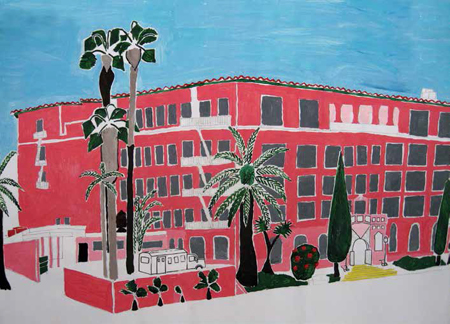
A portrait of Harbor View House by resident artist Ray Rodriguez
Among the first in the United States to champion the validity of outsider art were Janos Marton and Bolek Greczynki, two expat scholars out of Columbia University’s School of Visual Arts in the 1970s. Largely influenced by the idealistic, humanist approaches of artists and writers like Jean Dubuffet and André Breton, Marton and Greczynki later founded the first-ever art studio on the grounds of Creedmoor Psychiatric Hospital in Queens. This art studio, christened The Living Museum, sought to showcase the work of Creedmoor’s many untrained yet visionary patients, and was dedicated to the purposes of beauty and healing above all else.
Fifteen years ago, psychologist Dr. Israel Rubenstein flew out from Southern California to visit Creedmoor, and was so impressed by the hospital’s art studio that he decided to open a similar space at Harbor View House, an adult residential psychiatric facility in San Pedro. For the past four years, Alisa Stein has served as Art Director of The Living Museum Art Center at Harbor View House, a former racquetball court turned studio and gallery space for the Harbor View House residents—as well as anyone else who’d like to spend a morning chatting with the artists and viewing their work over a hot cup of fresh (free!) coffee, which is exactly how I first met Alisa Stein, as part of a class trip to the studio in one of Mady Schutzman’s graduate writing workshops at California Institute of the Arts. A few weeks later, I returned to the studio to talk one-on-one with Alisa about her work managing the atypical art space. The two of us discussed the psychological benefits of art-making, the realities of mental illness, and more.
ADRIANA WIDDOES: Who are the residents of Harbor View House and how do they get here?
ALISA STEIN: Everyone here has been diagnosed with a mental illness. In addition, they usually have drug and alcohol addictions, so prior to getting here most of them have lived on the streets—either on skid row or park benches. They usually have had some kind of altercation with the law or some other issue and end up at a psychiatric hospital in that way. Then from there they’re referred to living here at Harbor View House. But the number one reason for being here is mental illness. Most of our residents have schizophrenia or bipolar disorder.
AW: What do you think drives the residents of Harbor View House to create art?
AS: I think what drives them is that most of these people have never been accepted by society for whatever reason—whether that’s because of their mental illness or their addiction problems. Coming in here and being able to create gives them a sense of self worth that they can do something. They can make something that they can get recognized by. And that recognition is not just from a gallery or a museum. It’s also from me and other people who are working or living here. Because most of them have never been told that they were good at anything. They haven’t had a lot of success in their lives, so something as small as creating a tissue paper poinsettia can give them such a sense of self worth.
AW: I agree that creating gives people a sense of purpose, and that’s not something special to people who suffer from mental illness either.
AS: It’s for everyone. We all want to feel creative. We all want to be able to do. People without a mental illness can get that feeling through many different avenues. But for people with mental illness it is so critical because they really lack so much support. Most of their families have just been tired by their illnesses and their addictions and the chaos that they cause, so they just sort of left them to be. So maybe creating tissue paper poinsettias doesn’t give them everything they need, but it’s still something. If they didn’t have that and had nothing instead, it would be even more traumatic.
AW: What are some of the obstacles for the artists that you work with here?
AS: One pretty common obstacle is that they are all on psychotropic drugs and some of them are heavily medicated. Just trying to function through a day when you’re taking 400mg of Lithium and 300mg of something else is difficult. It affects your sleeping and your eating. A lot of them are also trying to stay sober and unfortunately the neighborhood has a lot of drugs that are available. People have to fight off their demons just to not go outside and use. That is an obstacle. Some of the residents’ personalities here can be very volatile and sometimes the environment can be very unsafe, and they’ve got to deal with that. They might have a roommate who has stolen something or done something else bad. This is their home, but it can be a very difficult atmosphere.
AW: How do you experience the relationship between the Living Museum Art Center and the rest of the building, which is perhaps more clinically oriented?
AS: I think the art is such a blessing to this building. People come in and it’s like the oasis here. It has life, color and beauty. The building is otherwise pretty traditional in the sense that the walls are all white and it can feel very institutional. We try to hang art throughout the building and give it some life. The fact that the art wasn’t just done by some artist in downtown L.A. and is actually the art that has been created here gives it so much more meaning. When outsiders come to visit this place, they’re not expecting to see what they see in here, and it feels good to know that things are still going on here. Residents aren’t just milling around smoking cigarettes or lying in bed all day. They are actually producing something that gives the building life.
AW: Are you ever concerned that visitors might be coming to view the patients and not the art?
AS: I’ve never had that feeling. The artists actually really like it when they have visitors. They don’t feel that it’s an observation of them. I think they almost feel privileged that people are interested enough to come see what’s produced here and how this program works. It makes them feel good.
AW: Do you consider yourself an artist (trained or otherwise)?
AS: Not trained, not untrained. I am not an artist. I would say I’m a creative person, but the only F I got in school my whole entire life was when I got an F in art in 7th grade. My teacher at the time told me that I was the most uncreative person that she had ever met! I tell that story all the time. It really stuck with me, but lo and behold— I’m Art Director of a mental health facility creating projects. I think I’m artistic in the sense that I understand the elements of art, but I always tell my artists here that if they ask for help painting a portrait, I can’t.
AW: Do you think being untrained helps your dynamic with the artists working at LMAC?
AS: I do. I think their perception of me is as a leader and as someone who is able to explain and define things. I always tell them how talented they are—and they really are—and I think it’s a good balance. They have taught me a lot about art and drawing and painting. I feel they are not intimidated by me because 99% of the time I can’t out paint them and I can’t create something that looks lovelier than they can. It makes it a more comfortable atmosphere.
AW: How necessary do you feel art programs like LMAC are?
AS: Oh, they are so necessary. They are vital, and not just to provide an extracurricular activity; it has been proven that art-making enhances cognitive skills. There is just no downside to creating. It enhances people’s wellbeing tremendously. I see it first hand. I see the change in the artists’ expression. It just gives them a purpose to create something. That’s not something that anything else in their life offers them.
AW: Do you ever feel frustrated? Do you ever feel like what the art studio can provide the residents here is not enough?
AS: Of course. I feel frustrated when I’ve been working with an artist for 6 months and they’re really coming along and I can see some hope in their eyes and then I don’t see them for a month and I find out that they’ve started smoking crack again and are living on the streets. Then when they end up back at Harbor View they’re all beat up and we have to start from square one again. I get frustrated when I feel like all the work that an artist and I have been doing is lost in an instant. It’s hard to understand mental illness. It’s so different for everyone. Even the same diagnosis of schizophrenia can manifest so differently in each person— and it can be very frustrating. It’s frustrating when a 55-year-old woman doesn’t understand that she is making a poinsettia even though I’ve explained to her that a poinsettia’s leaves are red 15 times. That’s tough. But that woman did do something in the end. It’s all good—and she felt good about it.
AW: Is any of the art for sale?
AS: Yes, we do sell the art. 50% of the proceeds goes to the artist and 50% goes to buying supplies for the studio. Anyone who’s interested in purchasing something can view the art by contacting me and setting up an appointment. We don’t necessarily use the gallery for art sales or exhibits. It’s mostly just to showcase the larger pieces of art that artists have created here. We’ve tried in the past to open the gallery up to the outside, but because of its location on the third floor of the facility it’s difficult to get passersby up here. 95% of our sales happen in outside art galleries. We’ve exhibited in L.A. City Hall, Torrance Art Museum, Angels Gate Cultural Center—all various types of galleries.
The Living Museum Art Center is located at 921 S. Beacon Street in San Pedro, CA. To contact Alisa Stein, make a donation or become a volunteer, please visit the LMAC website.
By Adriana Widdoes
an Associate Editor for Black Clock and an MFA Writing candidate at CalArts
