
Singular, idiosyncratic and a little mysterious, Black Clock is one of America's leading literary journals.

Posts Tagged ‘Jonathan Lethem’—

“Flarf” and Other Words I Didn’t Write

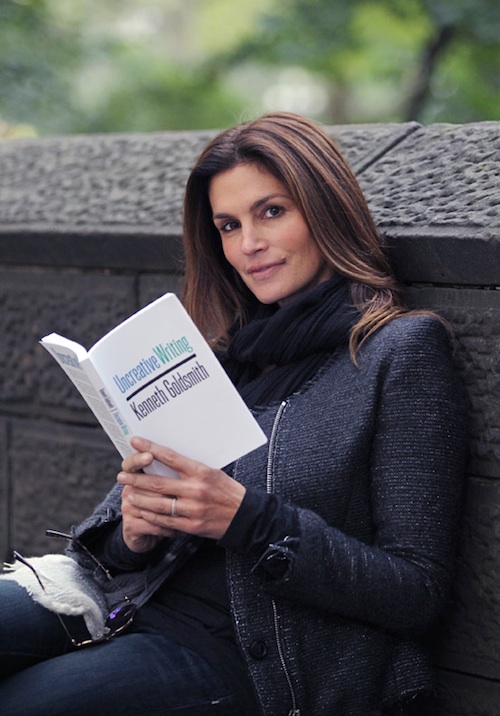
110311goldsteincrawford01LSIt seems there are no new ideas left in the world; only new arrangements of things.

I once saw this written on the wall of a gallery, but according to the poet Kenneth Goldsmith, I don’t need to admit so much, let alone put the thing in quotes.

According to Goldsmith, and a host of other forward-thinking literary figures–both writers and philosophers alike–nobody owns these words. Not the person who said them, not the wall, not the gallery, and not me using them here, now. Perhaps this could be a benefit of writing about pro-plagiaristic tendencies. That I–like Jonathan Lethem, in his own pro-plagiarism Harpers essay, “The Ecstasy of Influence: A Plagiarism”–might just cull some thoughts and phrases from the public domain and patchwork them together here. But, then: Lethem was brilliant with his curation of stolen words, using them to talk about stolen words to talk about stolen words, ad infinitum, matryoshka-style, et al. I am far less ambitious with what I want to say, which is that I am not so much bothered by literary pro-plagiarism–this has, and continues to seem as poor or good a term as any–as a kind of writing. It is, however, its own insistence of itself as a new vision for all writing that I find disconcerting.

I first learned of flarf–or the creation of poetry using Google search results–and other pro-plagiaristic practices in Goldsmith’s 2011 article, “It’s Not Plagiarism. In the Digital Age, It’s ‘Repurposing.’” At the time, these ideas weren’t “new ideas.” Goldsmith knew this; I did not. I had never heard of such a thing as “Uncreative Writing,” which was the official name of the course he had been teaching at the University of Pennsylvania for a few years by then. “In [Uncreative Writing],” he explained, “students are penalized for showing any shred of originality and creativity…they are rewarded for plagiarism, identity theft, repurposing papers, patchwriting, sampling, plundering and stealing.”

I understood, or at least assumed, there was value to the novelty of this practice. Goldsmith himself convinced me of so much when he went on to say: “The act of choosing and reframing tells us as much about ourselves as a story about our mother’s cancer operation.” There is something to be said about the curatorial aspects of writing and of any creative practice, especially as more and more text becomes available to us via new technologies. To be fair, we steal whether we know it or not, and it’s important to acknowledge, as Goldsmith does, that most other creative industries–fine art, photography, etc.–have long since honored experimentation in both originality and authorship. It does seem that the literary community is overdue for the kinds of questions that people like Goldsmith and Lethem are attempting to ask.

And yet:

It does also seem that they, these flarfers, may already have their answers, with or without the input of the rest of the literary world.

Goldsmith goes on to assert that any notion we may still have of the tortured writer–biting her nails, smoking angrily at her desk and then at her window and then at the desk again (my image, not his)–is now outdated. He writes, “an updated notion of genius would have to center around one’s mastery of information and its dissemination.” Suddenly, literary pro-plagiarism seems like that vegan friend who wants to tell you exactly where that hot dog came from, right before you take a bite. It no longer seems that flarf is posing the question for us to wonder at, like “hey team, what if there are no new ideas left?” But rather, it seems to be declaring, and loudly, “HEY, LOOK OVER HERE, THIS IS A NEW IDEA! AND IT IS THE ONLY ONE LEFT!”  Those of us attempting the impossible but nonetheless worthy task of writing to eternity are suddenly naive to do so and irrelevant. Unfortunately, I can see it both ways: our understanding of originality may perhaps be outdated, but there is still room to be a writer in the same world where flarf lives. I would even prefer to say that there is still room for flarf to exist in a world where everyone else just keeps on writing like they always have, unfazed.

It is not out of disrespect for curiosity or provocation that I pass these “new” ideas without signaling, it is simply that, quite in line with the ideas themselves, I don’t think they are new. And maybe I see a hole in the fact that if these movements believed in their own philosophies than they would be challenged to call their practices “an updated notion of genius.” And I use the word “challenged,” as they have “updated”: to cover my bases. Truly, if I look deep enough into the ideology that there are no new ideas, the very concept of ideology quickly dissolves into a soup in which everything is everything is everything, an ugly adulteration of Lethem’s essay, which I do not include in my criticism, which was the beginning, the middle, and the end of pro-plagiarism for me. Beyond his essay, these movements seem to call out ideas that have always existed and been relevant to writing, and then attempt to harness them as a means to change the face of the medium. I guess my question is why? Followed by a wait, what?  Movement for the sake of movement is just motion, and we already have enough of that to contend with in this universe.

But, I want to go back to the words I mentioned earlier, those I saw on the gallery wall. They were from the photographer, Henri-Cartier Bresson, and I admit now that they were incomplete as I presented them. “There are only new arrangements of things,” Bresson said, but then went on to say, “Everything is new, every minute is new.” And I much prefer this vision of rearrangement to that of the flarfers: a vision in which no thing is outdated, and every recycled thought is somehow still unique and original, even in the lifespan of every fleeting minute.


By Maggie Mull
an Editorial Assistant for Black Clock and an MFA Writing candidate at CalArts

Jonathan Lethem Experiences “They Live”

They LiveI didn’t watch John Carpenter’s They Live. I’m not a buff by any standard. Intentionally, even as I anticipated the book’s arrival, I declined the free opportunity to see  this film. But I have read Jonathan Lethem’s They Live. My interest stemmed from my Lethem fandom and a single description printed in size 18 serif font atop the front cover of this book: it reads, “A Novel Approach to Cinema.” My curiosity was snagged wondering at the narrative innovations Lethem could offer in a book of criticism. Other descriptions are similar, if not quite as stimulating. About their new Deep Focus series, of which this work is the first of two so far, Soft Skull Press promises it will present, “…long form criticism that’s relentlessly provocative and entertaining.” And in “Note to Approach I,” set as a preface, Lethem himself describes the piece matter-of-factly, writing “This is the first monograph on They Live.”

Above all, this book represents Lethem’s repeated viewings of They Live articulated through stream-of-consciousness probes on anything from the implied homosexuality of the characters, Los Angeles as its-unnamed-self, RayBan Wayfarers (or, as Lethem points out as the likely case in this movie, their drugstore rip-offs), to diving into racial, Marxist, and generic motifs. The quick introduction, a poetic and prophetic day-after reaction—entitled “What You’ll Recall of the Dream in the Morning”—renders the experience of this book as it does the movie more aptly than any review ever could.

A street preacher’s warning and a pirate television broadcast.
The demolition by riot policemen, helicopters, and bulldozers of an open-air homeless-persons’ compound in a vast vacant lot.
A brazen assault on a ghetto church.
A hero, a wrestler garbed as a construction worker.
A pair of sunglasses that reveals yuppies as alien ghouls.
A chilly, enigmatic beauty, her intentions toward our hero unknown.
The black guy and the white guy. They begin in distrust, but soon learn they’ve got enemies in common. From that point they’ll cover each other’s backs.
Machine-gun fire in a television studio.
A surprise with tits.

But, above all, two sequences…

That is to say, this is Lethem’s experience and this will be your experience too.

Lethem’s writing is, as usual, amazingly pleasurable. Free-associative though rarely tangential, it constantly compels forward movement by refreshing readers on what feels most like every peculiarity of the movie. “RayBan Waferers … had been established as a specifically eighties movie icon…” Or: “At the height of the colorization crisis, a rumor spread that Ted Turner intended to colorize the Kansas sequences in The Wizard of Oz…” Yet all these observations are tightly situated  in the narrative of They Live itself.  That is, the book literally follows the movie’s established discourse. Once the premises are settled, we start at “0:00” and move toward the movie’s conclusion at “1:30:21,” and to help check the two mediums when need be, run time is often cued—“(2:18)” or “(1:02:05).” Also, though this is a work of criticism, Lethem often presents the movie’s shots and sequences as fictional scenes. “Garbed in default blue-collar duds and wearing a back-pack, Nada picks his way out of the distance, across the tracks, toward us … our hero strolls into the story’s frame through the civilization’s back doors, unnoticed, an entrance simultaneously suggesting modesty of means, self-reliant competency, wraithlike anonymity, and (at least to begin) neutrality…” The overall effect is that of a novel stealing the film’s diegetic. That is to say, a novel whose narrator is embedded within the movie itself. (Not many other books give background music).

This was my reason for picking up the book: I’d imagined a work truly adapted from film, appropriating not only the plot but any trope of action and science-fiction movies or even film code.  I’d imagined a perspective not unlike that in Robbe-Grillet’s Jealousy, an ultimately distant view that treats the characters with seemingly complete objectivity, but made “fun” by the popcorn content. Why not, at a minimum, leave open the narrative hooks or even help produce rather than squelch them even before they come up? Here’s an example: in the section titled “Villainous Vehicles (22:40),” Lethem writes of helicopters, “Nada will later be killed by a sniper shot from one.” Is this your friend ruining the end of the story or is this Lethem purposely deflating the narrative so as to direct your full attention to his own “reading” of the film? Ultimately, as B-movies go, They Live is, in the best Roger Corman tradition, a film of ideas. Had I watched it, I would have understood this in my anticipation. Thus arises the need to expand, explain, and explicate. Another note that Lethem provides on helicopters is this: “So, in They Live’s ironclad us-versus-them scheme, the director’s affiliation with his persecuting machines points to a subliminal ambivalence, or even complicity.” Ultimately, this book becomes one of ideas that exist on so many slippery levels that… it, in many ways, re-enacts its own version of these events and becomes the movie as hoped for, as previewed or advertised, as promised.

For this reader the total effect is that of an awed (odd) epic of an 1980s America that could only be retold precisely this way. It drew me in entirely—I set the book down only once to wrap myself in more blankets as my heater recently died—so by the end, I was completely rewarded, just as any reader is upon discovering an new manner in which fiction momentarily demystifies our world.  “Put on the @*#!ing glasses.”

by Justus Caudell
an Editorial Assistant for Black Clock and an MFA Writing candidate at CalArts

Jonathan Lethem Goes West

To his fans, Jonathan Lethem is one who always pushes into new avenues of form and genre, of kidnapping kangaroos and scouring the Zendo for a killer, and he is certainly synonymous with New York. With novels like Motherless Brooklyn and The Fortress of Solitude that have so deeply imbibed into their pages the grit of New York City, it is impossible to separate the two. Chronic City, Lethem’s latest novel, returns to New York once more, but this spring he is set to do the unthinkable. Brooklyn will be sure to bemoan turning Lethemless in 2011 when he trades in New York for Los Angeles as the Roy E. Disney Professor in Creative Writing at Pomona College.

BLACK CLOCK: You have had a long relationship with Black Clock, dating back to the first issue. What was your initial draw to the magazine and what has kept you coming back?

JONATHAN LETHEM: So simple: I’m a fan of Steve Erickson’s, going back to before I’d published fiction myself, and well before I had the luck of becoming his friend as well. Only “fan” puts it too gently: Steve’s accumulating shelf is of the great flares burning out there, lighting up the landscape, and when I heard from him that he wanted me involved in his magazine, I couldn’t imagine saying no. That it turned out to be a really singular and strange and effective publishing adventure wasn’t any kind of surprise. It’s made a great home for some work that might not have fit anywhere else, and a couple of the pieces that were effectively ‘commissioned’ for Black Clock are among my favorite of my recent short works.

Last year you did a series of readings in which you read the entirety of your newest novel, Chronic City, over eight days in New York City. A pretty astonishing task, one that makes my vocal chords ache in sympathy. How did it work out? Is it something you would like to do again?

It was a great one-of-a-kind experience, and I’d never do it again. I made the decision based on several terrific misunderstandings with myself and the actual length of the book.

On your website (http://www.jonathanlethem.com) you have a project running called Promiscuous Stories, where you welcome other artists to lift your stories and lyrics. Art influences art like nothing else can, and I believe it to be a vital part of the creative process. How did you come to the decision to “let go” of some of your work? What sort of response have you gotten?

Well, of course there’s been all variety of results by now, as was pretty much inevitable given the shotgun-blast/messages-in-bottles nature of the internet, and the project itself: good art, bad art, interesting attempts, unfinished works of great intrigue and promise, a few altered careers and opinions. Also, needless to say, loads of people have ignored the whole thing outright, as they were always also welcome to do. A theater troupe in Chicago actually renamed themselves The Plagiarists based on the thing. And there’s a very exciting “anthology film” in the works. But the important thing to say about the kind of letting go that I did on the site is that it isn’t actually an original or particularly unusual gesture. In fact, writers (and other artists) are constantly giving other artists (often filmmakers) “free options” on things all the time, without making a big deal of it. And, conversely, artists of all kinds (including writers) are taking the resources and inspiration and even the plot details they need for their own work from the work of others, without even asking, let alone seeking a formal permission–also without making a big deal of it. What my project consists of is framing these activities so they become visible. Making a big–or at least a medium–deal of it, in order to make a political point that these aren’t shameful or incidental or wayward transmissions, but in fact something to celebrate as central to art practice per se.

You have a strong opinion on “plagiarism;” can you speak a little about that?

I use the word provocatively, trying to nudge people into seeing how few of the “borrowings” they’ve been invited to become incensed about really are worth the name. Palming someone else’s efforts off as your own, covertly and lazily–even this isn’t much of a moral disaster. And most people witch-hunted as plagiarists are doing something much more honest, interesting, worthwhile, and inspiring than that.

Which writers and artists have influenced your work?

Too many to mention. A new one every day. A few go right to the bone of my work: Kafka, Hitchcock, Lewis Carroll.

It seems that everyone I speak to about Lionel in Motherless Brooklyn finds something they identify with in his ticcing. I have caught myself doing Lionel-like tics in my day-to-day life. Did you recognize ticcing as a universal act, something that many could potentially relate to? What inspired this decision on his character?

I’m always looking for metaphors that can serve as a net to catch every meaning that wanders past. Tourette’s, while I was writing that book, became a lens for contemplating zones of myself, areas of human culture, streets of Brooklyn, and aspects of human voicing I was fascinated with trying to bring to the page: insults, jokes, self-revelation in the form Freudian slips, etc. Lionel’s condition certainly also became a kind of weird verbal machine, too, for producing ticcishness in myself and others. He goes on making that impression, a decade later–I guess I got lucky.

Rumor is that Edward Norton is set to adapt, direct and star in Motherless Brooklyn. (An absolutely brilliant choice, I think.) What has been your experience with the adaptation so far? Are there any plans for future adaptations for the big screen or otherwise?

I mostly stay away from the work–or non-work–that goes on when my books enter the film adaptation process. It usually isn’t something I can be particularly helpful with. And the frustrations that go with that work get under my skin very easily. So, I don’t know where the Motherless Brooklyn project stands, or if it stands at all. It might be on its knees. Or taking a nap. Some other books have new dance partners just now: Fortress of Solitude, As She Climbed Across the Table, Gun with Occasional Music and Girl in Landscape. It all sounds very exciting, and it arouses all sorts of silly feelings in the author, but what we’re really contemplating consists of someone else’s–several someones–improbable and mostly excruciating art-attempts. I wish them all well.

Music comes up often in your work. You Don’t Love Me Yet surrounds a band of struggling musicians. In The Fortress of Solitude, life is very nearly dictated by music. You also had the enviable chance to interview Mister Bob Dylan himself. How does music serve your writing?

I use music as an emotional touchstone for my writing (and not only for my writing). I listen to it constantly. At the very least it keeps me still for my work, which is no small thing. At its frequent best it reminds me of who I am and why I bother. I can only hope that a handful of readers are drawn into a projected relationship to one or another of my books anywhere near as rich as my projected relationship with, say, Mister Bob Dylan. It’s actually creepy to talk about these things, but they’re what we all wish for.

The writing of liner notes takes place in both The Fortress of Solitude and Chronic City. Is it your secret ambition to be a writer of such notes?

Either that or a philatelist.

Crossing genres is something you often do, moving through genres from work to work and many times merging them in a single work. In some stores your books can be found in general fiction, others mystery or science fiction. What do you think of genre boundaries? Is genre something that you dwell on during the writing process? Is there an area you would like to explore more deeply?

I started out quite naively excited about the idea of “genres,” but by now it seems more like a matter for critics than for writers–and mostly, alas, a matter for critics to mishandle. It’s at least a very confusing term to bring into descriptions of what it is I (consciously) set out to do in my work. I draw tremendous energy from all sorts of what I like to call ‘vernacular culture’–comics, animation, pulp crime and science fiction writing, rock and roll, etc.–and always will, but the sorts of novels I like to read, and write, have always been all over the high-low map, as well as drifting in and out of the publishing categories that most people are talking about when they use the word “genre.” For me, I see genres where others don’t, and vice versa. The “academic satire” (I wrote one in As She Climbed Across the Table) is a form as precise as a sonnet–now, there’s a genre. Whereas what gets jumbled up in the publishing category of SF–dystopias both evocative and pedantic, vicarious power fantasies, grindingly earnest advocacy for space exploration, etc.–doesn’t make any literary-critical sense as a “genre” — it’s more like a tradition, or an “area” (or, prestige-wise, a backwater, which is a wearisome matter to combat, but also to pretend to ignore). So, what do I think of boundaries? Useless. Descriptions, that’s what I like–fresh descriptions more than tired or received ones. But descriptions come after the fact.

It’s no secret that New York is your home. Many of your novels take place in the City, picking up different cliques to center each. Often, the City is much more than a setting, becoming a fully rounded character. As someone who has yet to have the chance to visit the City, can you describe what about New York has served as a muse for you?

Just as we write this, Claremont California is about to be my home. Which may be my best excuse, if there’s any excuse, for dodging your question. I’ve spent so many fictional pages trying to evoke–not encompass–the contradictory and ambivalent force of my ongoing reaction to that place, and to my being “from” that place, that it doesn’t feel good to me to try to come up with some reductive paraphrase. I did so too many times in the past. But you should visit.

Your latest work, Chronic City returns to New York. Can you speak about it and its eclectic cast?

I wanted to make an absurd snapshot of Manhattan in the middle of the “aughts,” and then blow it up and explore it meticulously, lavishly–my first joke about the book was that I wanted to write the book Gogol would have if he’d been commissioned to novelize Saul Steinberg’s famous New Yorker cover (the one showing the Upper West Side in the foreground, the midwest and China in the background). The disparity between the grim depth of the historical facts surrounding the way we lived between 9/11 and the economic meltdown, and the amnesiac cartoon thinness of how many of us actually lived in those years. Which sounds very punitive, doesn’t it? But as for the eclectic cast, I loved and love them all. I feel very forgiving towards even the worst of them.

For those aspiring writers, can you discuss your experience with publishing and your journey as a writer so far?

Oh, I’ve been absurdly lucky in my journey, which puts me in no position to help anyone else with theirs. Except I’d say how important it is, from the permanently and in many ways rightly defiant and embattled stance of an artist in a capitalist system, to remember that now, more than ever, the people you’ll meet in publishing are doing what they’re doing out of sheer love. If they were into exploitation, they’d find another career.

What is up next for you?

I’m publishing a tiny book about John Carpenter’s They Live in the Fall. Just barely in time to accredit myself as a “Los Angeles writer,” I hope.

by Rachel Kolb
an MFA Writing candidate at CalArts

BC V X

With both the occasion of our fifth anniversary and the publication of our tenth issue imminent, Black Clock has asked some of its most frequent (and prominent) contributors to describe their experience as readers of the magazine. The responses we collected are as singular, idiosyncratic and even a little mysterious as the contents of any given issue.

“Black Clock measures the temper of the turning world, ” a journal of ideas, provocations and cultural leaps, with some of the best writing anywhere.” – Don DeLillo

“There’s never before been a literary journal with exactly the power and elegance, even the force of enigma, of Black Clock.  Each issue arrives in the reader’s hands as an artifact throbbing with potential and strangeness, new names and old names in wild conjunctions and brave forays, a journal to drive the collectors of the future into acquisitive frenzies.” – Jonathan Lethem

“Black Clock is one of the literary magazines I can’t wait to see when it arrives in the mail, and the thing I read that night before all else.” – Susan Straight

“Black Clock provides a much needed fix of experimental fiction and adventurous writing.  If you’re getting the itch for some literary stimulation, cut down on the lattes and invest in a subscription.” – Carlos Ruiz Zafón

“One of the contemporary literary magazines with real vision — and they are in short supply.” – Rick Moody

Black Clock is published semi-annually by the California Institute of the Arts (CalArts) MFA Writing Program.

Black Clock 9 Now Available

Featuring political allegory, subversive satire and secret presidential histories by Jonathan Lethem, Lynne Tillman, Brian Evenson, Jeff VanderMeer, Ben Ehrenreich, Stanley Crawford, Seth Greenland and Janet Sarbanes, among others, including Rick Moody’s log of the Republican primary race earlier this year, an email debate between Michael Ventura and Black Clock editor Steve Erickson on Hillary Clinton and Barack Obama, and a mysterious, unsigned missive written at the end of the world by Marilyn Monroe’s former bodyguard.

For more information about purchasing a copy, visit the Black Clock website.
