
Singular, idiosyncratic and a little mysterious, Black Clock is one of America's leading literary journals.

Posts Tagged ‘Interviews’—

Living Well: Alisa Stein and the Healing Power of Art

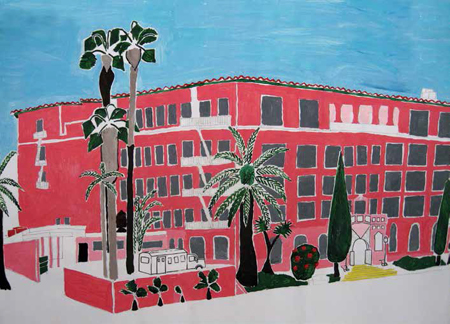
A portrait of Harbor View House by resident artist Ray Rodriguez

A portrait of Harbor View House by resident artist Ray Rodriguez

Among the first in the United States to champion the validity of outsider art were Janos Marton and Bolek Greczynki, two expat scholars out of Columbia University’s School of Visual Arts in the 1970s. Largely influenced by the idealistic, humanist approaches of artists and writers like Jean Dubuffet and André Breton, Marton and Greczynki later founded the first-ever art studio on the grounds of Creedmoor Psychiatric Hospital in Queens. This art studio, christened The Living Museum, sought to showcase the work of Creedmoor’s many untrained yet visionary patients, and was dedicated to the purposes of beauty and healing above all else.

 
Fifteen years ago, psychologist Dr. Israel Rubenstein flew out from Southern California to visit Creedmoor, and was so impressed by the hospital’s art studio that he decided to open a similar space at Harbor View House, an adult residential psychiatric facility in San Pedro. For the past four years, Alisa Stein has served as Art Director of The Living Museum Art Center at Harbor View House, a former racquetball court turned studio and gallery space for the Harbor View House residents—as well as anyone else who’d like to spend a morning chatting with the artists and viewing their work over a hot cup of fresh (free!) coffee, which is exactly how I first met Alisa Stein, as part of a class trip to the studio in one of Mady Schutzman’s graduate writing workshops at California Institute of the Arts. A few weeks later, I returned to the studio to talk one-on-one with Alisa about her work managing the atypical art space. The two of us discussed the psychological benefits of art-making, the realities of mental illness, and more.

ADRIANA WIDDOES: Who are the residents of Harbor View House and how do they get here?

ALISA STEIN: Everyone here has been diagnosed with a mental illness. In addition, they usually have drug and alcohol addictions, so prior to getting here most of them have lived on the streets—either on skid row or park benches. They usually have had some kind of altercation with the law or some other issue and end up at a psychiatric hospital in that way. Then from there they’re referred to living here at Harbor View House. But the number one reason for being here is mental illness. Most of our residents have schizophrenia or bipolar disorder.

AW: What do you think drives the residents of Harbor View House to create art?

AS: I think what drives them is that most of these people have never been accepted by society for whatever reason—whether that’s because of their mental illness or their addiction problems. Coming in here and being able to create gives them a sense of self worth that they can do something. They can make something that they can get recognized by. And that recognition is not just from a gallery or a museum. It’s also from me and other people who are working or living here. Because most of them have never been told that they were good at anything. They haven’t had a lot of success in their lives, so something as small as creating a tissue paper poinsettia can give them such a sense of self worth.

AW:
I agree that creating gives people a sense of purpose, and that’s not something special to people who suffer from mental illness either.

AS: It’s for everyone. We all want to feel creative. We all want to be able to do. People without a mental illness can get that feeling through many different avenues. But for people with mental illness it is so critical because they really lack so much support. Most of their families have just been tired by their illnesses and their addictions and the chaos that they cause, so they just sort of left them to be. So maybe creating tissue paper poinsettias doesn’t give them everything they need, but it’s still something. If they didn’t have that and had nothing instead, it would be even more traumatic.

AW: What are some of the obstacles for the artists that you work with here?

AS: One pretty common obstacle is that they are all on psychotropic drugs and some of them are heavily medicated. Just trying to function through a day when you’re taking 400mg of Lithium and 300mg of something else is difficult. It affects your sleeping and your eating. A lot of them are also trying to stay sober and unfortunately the neighborhood has a lot of drugs that are available. People have to fight off their demons just to not go outside and use. That is an obstacle. Some of the residents’ personalities here can be very volatile and sometimes the environment can be very unsafe, and they’ve got to deal with that. They might have a roommate who has stolen something or done something else bad. This is their home, but it can be a very difficult atmosphere.

AW: How do you experience the relationship between the Living Museum Art Center and the rest of the building, which is perhaps more clinically oriented?

AS: I think the art is such a blessing to this building. People come in and it’s like the oasis here. It has life, color and beauty. The building is otherwise pretty traditional in the sense that the walls are all white and it can feel very institutional. We try to hang art throughout the building and give it some life. The fact that the art wasn’t just done by some artist in downtown L.A. and is actually the art that has been created here gives it so much more meaning. When outsiders come to visit this place, they’re not expecting to see what they see in here, and it feels good to know that things are still going on here. Residents aren’t just milling around smoking cigarettes or lying in bed all day. They are actually producing something that gives the building life.

AW: Are you ever concerned that visitors might be coming to view the patients and not the art?

AS: I’ve never had that feeling. The artists actually really like it when they have visitors. They don’t feel that it’s an observation of them. I think they almost feel privileged that people are interested enough to come see what’s produced here and how this program works. It makes them feel good.

AW: Do you consider yourself an artist (trained or otherwise)?

AS: Not trained, not untrained. I am not an artist. I would say I’m a creative person, but the only F I got in school my whole entire life was when I got an F in art in 7th grade. My teacher at the time told me that I was the most uncreative person that she had ever met! I tell that story all the time. It really stuck with me, but lo and behold— I’m Art Director of a mental health facility creating projects. I think I’m artistic in the sense that I understand the elements of art, but I always tell my artists here that if they ask for help painting a portrait, I can’t.

AW: Do you think being untrained helps your dynamic with the artists working at LMAC?

AS: I do. I think their perception of me is as a leader and as someone who is able to explain and define things. I always tell them how talented they are—and they really are—and I think it’s a good balance. They have taught me a lot about art and drawing and painting. I feel they are not intimidated by me because 99% of the time I can’t out paint them and I can’t create something that looks lovelier than they can. It makes it a more comfortable atmosphere.

AW: How necessary do you feel art programs like LMAC are?

AS: Oh, they are so necessary. They are vital, and not just to provide an extracurricular activity; it has been proven that art-making enhances cognitive skills. There is just no downside to creating. It enhances people’s wellbeing tremendously. I see it first hand. I see the change in the artists’ expression. It just gives them a purpose to create something. That’s not something that anything else in their life offers them.

AW: Do you ever feel frustrated? Do you ever feel like what the art studio can provide the residents here is not enough?

AS: Of course. I feel frustrated when I’ve been working with an artist for 6 months and they’re really coming along and I can see some hope in their eyes and then I don’t see them for a month and I find out that they’ve started smoking crack again and are living on the streets. Then when they end up back at Harbor View they’re all beat up and we have to start from square one again. I get frustrated when I feel like all the work that an artist and I have been doing is lost in an instant. It’s hard to understand mental illness. It’s so different for everyone. Even the same diagnosis of schizophrenia can manifest so differently in each person— and it can be very frustrating. It’s frustrating when a 55-year-old woman doesn’t understand that she is making a poinsettia even though I’ve explained to her that a poinsettia’s leaves are red 15 times. That’s tough. But that woman did do something in the end. It’s all good—and she felt good about it.

AW: Is any of the art for sale?

AS: Yes, we do sell the art. 50% of the proceeds goes to the artist and 50% goes to buying supplies for the studio. Anyone who’s interested in purchasing something can view the art by contacting me and setting up an appointment. We don’t necessarily use the gallery for art sales or exhibits. It’s mostly just to showcase the larger pieces of art that artists have created here. We’ve tried in the past to open the gallery up to the outside, but because of its location on the third floor of the facility it’s difficult to get passersby up here. 95% of our sales happen in outside art galleries. We’ve exhibited in L.A. City Hall, Torrance Art Museum, Angels Gate Cultural Center—all various types of galleries.

The Living Museum Art Center is located at 921 S. Beacon Street in San Pedro, CA. To contact Alisa Stein, make a donation or become a volunteer, please visit the LMAC website.


By Adriana Widdoes

an Associate Editor for Black Clock and an MFA Writing candidate at CalArts
Regrets, He Has a Few: Bruce Bauman on Anxiety, History + Fiction

Often funny, occasionally heartbreaking and always revelatory, Bruce Bauman puts deep character-driven narratives through their proverbial paces, playing with conventions of form, genre and conceptions of history. His writing, which runs the literary and journalistic gamut, has appeared in the L.A. Times, Salon, BOMB, Bookforum, numerous anthologies, and literary magazines, and has garnered Bauman the City of Los Angeles Award in Literature, the UNESCO/Aschberg Bursary in Literature, and grants from the Durfee Foundation and the Jewish Communal Fund, among others. The author of the novel And The Word Was–the story of physician Neil Downs, an expatriate New Yorker who travels to India following the dramatic death of his only son–is currently at work on his new book Broken Sleep, which will be published by Other Press. Bauman is also an adjunct professor in the CalArts MFA Writing Program and the Senior Editor of our very own Black Clock.

BLACK CLOCK: Much of your work seems to comment on history and time; individuals’ dynamic relationships with both their own pasts, others’ perceptions and the official record. I’m curious about what draws you to and informs your treatment of these complex subjects.

BRUCE BAUMAN: First, thanks for your compliments and your very thoughtful questions. They made me aware again why interviews are good for my ego but hard on my brain, which leads me to your question. My sentiment is the inverse of Piaf’s “I regret nothing”–I regret everything. I don’t think I’ve gone one day in my life without regretting something I’ve said or done. (I’m already wondering if I will regret this answer.) So, for that reason, and by extension, my characters are always haunted by their actions and their pasts.

I started writing a diary as a teenager. Aside from tedious whining about my failures with girls and in sports, I chronicled my nightmares/dreams. It was also a rant of teenaged angst and anger. Lennon’s song, “Gimme Some Truth”–pretty ironic coming from such a notorious myth-maker–that primal scream against all the bullshit really resonated with me and millions of others. I thought I could find truth. Now, I’m not even sure how to define truth. I don’t believe in any objective truth. There is always more mystery. Questions left unanswered.

Still, fiction became my road to truth. How to wade through our perceptions or deceptions is my challenge. All successful relationships are complicated in their own way. Often, they are based on unstated negotiations, compromises and social contracts. When these negotiations break down or our mythological selves are exposed, the relationships become uniquely unsuccessful and crisis hits. That’s a starting point for much if not all of my fiction. There’s a line in my novel-in-progress, Broken Sleep, that might be relevant here: One person’s version of history is another person’s version of an incomplete truth.

In Word, Sarah and Neil each tell the other a “lie” that they think will protect the other from major pain–which turns out to be a horrible course to take. Yet there are also secrets that each still holds that work to salvage their relationship and sanity. Castor’s death forces Neil to deal with his fractured relationship to god. The resolution he comes to surprised me and was not what I had in mind when I started the book. The characters took over. When the characters take over, in my experience that makes for the best fiction.

I’m obsessed with American History. Each country has its own version of history. I tried to address selective and reshaped historical memory in my character Levi Furstenblum’s Chambers of Commerce where the Holocaust is not a myth as much as reinterpreted such that Hitler wins the Nobel Peace Prize.

In Broken Sleep, each of the four narrators is living under at least one major false assumption about their past. All revelations are intertwined and their lives metamorphose as the story is propelled forward. There’s a line in the book which sums this up: “The past, present and future are fixed and ever recurring, inseparable and singular, ever-changing and never-changing, and always, always at once, dead and alive.”

And The Word Was is quite diverse stylistically. You have Neil’s first person narrative, which perhaps resembles a diary/travelogue, Levi’s writings, which range from the sci-fi/historiography of Chambers of Commerce, to Mystical Mistakes and his Unpublished Works which take the form of philosophical essays, plus a number of Biblical and Vedic stories and personal anecdotes related by various other characters. The pieces fit together beautifully, but at the same time they all have a great deal of vitality of their own. How did the novel develop as such and why this way?

Word developed over many years of false starts and trials and many, many errors. I had the idea of using multiple child sacrifice myths as the philosophical underpinning for the novel. Chambers of Commerce was originally a short story. When it hit me to combine the two–and Wham!–everything coalesced and the character of Levi Furstenblum came alive and his presence in the Neil story and as narrator in his own right and the book finally worked. The Mystical Mistakes and Unpublished Works sections were based on notes I’d been keeping for years. There is much in my work that is thought out and premeditated and there is a great deal more that comes from the well of my unconscious and I am thankful for that.

I’ve often said that Levi is much smarter than me; and I mean it.

I started writing Broken Sleep in the ’90s. It wasn’t right. I stopped until I felt ready to try again. Now I feel good about it. I have super-supportive editors at Other Press. Again, there’s a mix of genres: realism, speculative fiction, diary and for lack of a better phrase, traditional third-person.

There are many theories behind the book, but the bottom line is that the characters have to be compelling. Hate them or love them, I want the reader to be driven to turn the page. The phrase “page turner” has an unfairly pejorative connotation. I try to incorporate linguistic experiments, symbolism, subplots and challenges to the reader but it all has to be building to a climax/revelation. The term “literary fiction” doesn’t have to imply boring or “too difficult.” That’s anti-intelligence and anti-intellectual bullshit.

Who and what inspires you? Do you see yourself as responding to, modifying, or working within or against certain literary, social, or philosophical traditions in particular?

My influences cover a vast spectrum–from The Bible and Jack Kirby to the Marx Brothers and Fitzgerald to all sorts of music and art and that is featured prominently in Broken Sleep.

But if there’s one book that changed my life, it’s Kafka’s The Trial. I was 14 when I first read it. Not that I was that precocious–mostly I was reading sports books or trying to get my hands on a Playboy. I grew up in a working class part of Flushing, Queens. At that age I imagined myself one of the tough guys in The Wild One or like The Who because they were so violent and seemed so cool with the chaos. It was one highly delusional self-image. Riding a motorcycle has always scared the shit out of me.

I was kind of having a nervous breakdown. I’d gotten accepted to Stuyvesant and in an act of teenaged obstinacy, refused to go. The first semester of tenth grade, I mostly just sat in my room like a zombie. My parents made, what in retrospect I see was a major sacrifice, and took out loans for me to go to a private school in Manhattan. I’m not sure why I agreed. Some sense of self-preservation. It meant hours every fucking day on the subway so I read or fantasized– my great escape. I was reading about the Stones and Altamont and Alan Passaro, the Hell’s Angel who stabbed the guy who was going to shoot Jagger, and he mentioned his life was like The Trial. So, I bought it. I was 100% clueless as to who is this guy Kafka. The book was so bleak, so dark and so funny– that in some upside down way it gave me hope. I don’t claim I understood it then as I do now after so many readings (and with the insight of Maurice Blanchot and Erich Heller). Later I read Kakfa’s diaries, which I still carry around like my bible, and the last line he wrote is my mantra– “More than consolation is: You too have weapons.”

And The Word Was is a conscious homage/finger flip to the generation of Jewish writers like Roth, Bellow, Malamud, Potok. You can see that in the opening lines.

Primo Levi was also an influence.

Finally, my wife, Suzan Woodruff, a brilliant painter, inspires me. She really does become one with her paintings—and watching her work just knocks me out.

This concept of all successful relationships being based on often unspoken negotiations and social contract strikes me as being part of the essence of fiction. For example, writers and readers communicate closely, and even though their dialogue is silent and amorphous, they and the text change since a reader’s articulation of his response is a transformative act in itself. It seems to me that as creative non-fiction becomes increasingly popular (and it is, right?) and readers learn (or have the ability to learn, or think they are learning) more about the personal lives of the authors they read, that the relationship between authors, their work and readers is changing profoundly. I’m curious about how you feel about this, especially given the nightmarish tabloid saga in And The Word Was.

The reader and characters have to form a symbiotic relationship. If they don’t, the relationship is over by page 50, if not sooner.

I hope my feelings about the intrusiveness are clear from Word. The rise of creative nonfiction and “new media” encourages the idea that fiction is just disguised autobiography (my life is not that interesting), and has introduced a complicated writer-reader relationship with few boundaries. Even doing interviews gives me pause–not enough that I won’t do them. There’s a reason I’m not on Facebook–yet.

Your short piece, “Day Break – City Lights” seems to exemplify your interest in intertextuality and form–specifically film, whereas “The Necklace” integrates music and Kandinsky. Do you typically approach your stories from these more abstract, evocative sources, or begin with more concrete ideas and adorn them this way later?

I have no consistent plan. I started “Day Break” in ’98 when we were moving to L.A., a town where Peter Pan-like attitudes on time and youth are prevalent, and as a reaction to the blather about the fractured structure of Pulp Fiction. I wanted to write a story out of chronological order in the way films are shot out of chronological order and was also about movies. It also had roots in Heinrich Boll’s story “Murke’s Collected Silences.”

“The Necklace,” which is also a nod to de Maupassant, was inspired by an interview I saw with a Viet Nam vet about wearing “necklaces.” I’m a huge fan of Kandinsky and the way he created personal myths and symbolism, so the imagery from his apocalyptic paintings seeped into me.

You mention allowing the characters in And The Word Was to take over; I’m curious how you approach facilitating this. Do you feel that successful relationships between you and your characters require this kind of ambiguity?

I don’t have a systematic approach. I write and write and write. If the characters take over the story starts to tell itself and I keep going. If not, it gets tossed into the “I wish I were a tennis pro” bin with scores of others. And then, onto the next story.

_
by Seth Blake
an Editorial Assistant for Black Clock and an MFA Writing candidate at CalArts

photography by Justin Kalman

John Haskell On, Below + Above the Surface

John Haskell is the author of the novels American Purgatorio and Out of My Skin, as well as a collection of short stories entitled I Am Not Jackson Pollock.  His writing has appeared in magazines such as Bomb and The Believer, and he is a currently teaching writing and literature at Columbia University.

BLACK CLOCK: So you’re quite the rambling man – living in San Diego, Chicago, Los Angeles, and New York City.  Has travel or living in such disparate environments changed the way you approach your writing?

JOHN HASKELL: Travel broadens the mind.  Or, if it doesn’t, at least you see different places, and if you open your eyes, a different place can be a different world and seeing a different world does influence my work.  Writing fiction is about creating worlds and yes, someone can write about one world and make that world real and believable and fantastic, but for me, seeing and being in “disparate” places has changed the way I see my own world, in that I see my reality as comprised of many worlds, some below the surface, some above the surface, some right on the surface, but still different, still amazing, still full of those things a rambling man can take in and live with.

In both American Purgatorio and Out of My Skin, the main characters seem to be interested in the malleability of reality – what is perceived or believed to be the truth, is in fact the truth.  Was there any particular source, experience, or idea that you were inspired by which helped form the unique inner logic of these characters?:

All the sources and experiences and inspirations of mine (and my characters) get thrown into a blender and mixed up so completely that I can’t say where they come from, or even if they come from anywhere.  Logic comes from life, and the experiences and thoughts and forms of that life and too complicated to be so clear about.  Life is confusing if you try to make too much sense of it, and although I sometimes get confused, I try to react differently.

What really interests me about your characters is that they seem to have a public life which they present to everyone and a very different private life inside their heads.  They have elaborate facades, which I guess we all do, or a layering of their personality that is visible to the reader.  Even in I Am Not Jackson Pollock, the famous people that you write about already have a public persona or story that most of us are already aware of but in that particular collection we are suddenly privy to their fictionalized private life — which is voyeuristic and above all, very intriguing.

What excites you about creating characters like this?  Or what excited you about particular real people such as Jackson Pollock, Janet Leigh, and others whom you have breathed new life into?

You talk about the private life that is inside the heads of the characters and the public life that these characters present to the world but for me it doesn’t seem like that.  Not exactly.  Maybe there’s the aware world and the unaware world, and I’m trying to get to the unaware world and shine some light on it.  I agree that we all live with a certain amount of façade, and certainly in the Pollock stories, because the characters are usually famous, there is that dichotomy – we know the history of the people and the movies they made, and I was trying to get below that, but not to show a private side so much as to show the same side, or maybe the underside that everyone has.  What excites me about that – it’s not excitement, although I like that you said that – but more like what interested me were the real people I wrote about, and I picked them for a variety of reasons: I saw the film in which Topsy was electrocuted, my aunt was a John Keats scholar, people used to tell me I looked like Tony Perkins, I saw a great painting about Paris, the Greek, and I like haikus and Basho is a fabulous haiku poet.  When I try to write a story that doesn’t get to something I find interesting – I’m bored.  All those people/characters got under my skin, or I let them burrow into my brain, and then by looking closely, I could begin to see that private side, or more accurately the real-life interior that meant something to me.

Some of the stories in I Am Not Jackson Pollock were originally monologues.  Do you often keep performance in mind when writing?  Do you think anything is gained or lost when these stories are silently read on the page?

I don’t think about performance, but I think about the sound of the voice.  I hear the writing, and in fact, often read what I’ve written out loud.  All writing is a kind of performance, but a performance for the reader, to read the text in a way that will mean the most to that reader.  And yes, something is lost when the stories are read silently, but that’s up to the reader.  Maybe something is gained, in terms of thoughtfulness, or stillness, or contemplation. I like the “out loud” aspect, but it’s certainly not the only way to go.

Could you explain a little about your Psycho website?  What was the concept behind it?

Many, many years ago, I thought that the internet, that new invention filled with hypertext ideas and optimistic notions, could be a way to use and possibly transform writing.  The website hasn’t changed since those optimistic and amateurish days.

You had thought the internet could transform writing — how did it not?  What was the effect that was achieved (or non-effect)?

I was entranced by the idea of a new way of writing, a new way of thinking about stories.  When the internet happened, and that included hypertext ideas, there was a kind of anything-is-possible feeling.  So I put together that website from scratch by cutting and pasting other websites and finding pictures.  I don’t think it “works,” but reading is old-fashioned, and although Kindles may take over, it’s still reading.  Having said that, who knows what reading and writing will be like in fifty years?

Movies are brought up a lot in your writing.  How do you see other mediums, like film, interacting with literature?  Or even multi-media interacting (the combination of movies, internet, literature)?

I see movies as an extension of life.  If I walk down a street and someone stops to talk with me, or I see someone bend down and pick up a guitar pick or someone in a movie refuses to light someone’s cigarette, it’s all part of the same canvas that I can use to transform what I experience into art, or at least into writing.  True, life is what gives a person the experience, but that’s not wholly accurate because anything gives someone an experience.  Maybe you have to, say, have been in love, to be affected by a love story, so they go hand-in-hand.  Movies and literature (and the internet and games and dance and theater and puppet shows) walk hand-in-hand.  Because we make literature doesn’t mean that’s the only place to look for inspiration.

by Ashley Tomeck
an MFA candidate at CalArts with an unearthly penchant for snow and a writer of short fiction that often incorporates elements of the fantastic and bizarre

BIRKENSNAKE: THE MUTANT LEFT-BEHIND COUSIN YOU ALWAYS WANTED

Birkensnake is precisely what you want in your lifeboat: good to read, fun to touch. This strange little fiction collection, edited by Brian Conn and Joanna Ruocco, operates somewhere between a literary adventure and art object. Although each issue is offered as a free download on-line, nothing compares to the physical object. Custom designed by artist Sarah McDermott aka Chemlawn, Birkensnake is one of the swankest journals out there.

Last Fall I asked Brian, Joanna, and Sarah to chat with me about Birkensnake. The interview is divided into two parts. Part one features a discussion with editors Brian and Joanna about the journal itself. In part two, Sarah discusses her design process.

THE MASTERMINDS: BRIAN AND JOANNA

BLACK CLOCK: Why did you set out to create Birkensnake? Did you look to other literary magazines for guidance or inspiration?

BRIAN CONN: In fact we started it to get out of coursework. We needed to take a class (we were in the MFA program at Brown) but didn’t want to take a class class, so we thought maybe we’d make up some kind of independent study together, but we couldn’t think of anything we wanted to read, so we thought maybe they will let us do something fun but also totally literary, such as publish a magazine. So we asked them and they let us. We keep doing it because neither of us is willing to be the first to suggest we stop.

We did look at various magazines we happened to have on our shelves. Also consulted with some people at Brown who publish things. Not for inspiration exactly, but just to answer very basic questions about how magazines are supposed to look.

The “look” of Birkensnake is almost as integral to the magazine as the writing. What motivated you to hand-make each issue?

BC: The basic decision was that it is all right to spend a lot of time but not all right to spend a lot of money. Of course we do end up spending a lot of money on acrylic ink, so that isn’t really a reason. But with screen printing you have the thrill of working in a friend’s basement studio day after day after day and late into the night listening to the same three tapes over and over again and wondering whether you will get a repetitive motion injury. Actually nobody knows why we screen print the covers. With laser printing you just put down some money and then all the covers come out of a machine and you, like, glue them or something.

Birkensnake is offered online for free or for $4.00. In a world driven by financial profit, Birkensnake is clearly not interested in “making money.” How important is accessibility and the idea of community to you as an editor and writer?

BC: The most important thing is finding the people who will love the magazine. Maybe that is the same as accessibility or community. Each copy seems like a personal object to us, because we made it by hand, and so we want it to find a good home. It hurts us to send out review copies (we do it anyway) knowing that they’ll end up on some weird shelf in some weird basement, mold for two years, and then get thrown away unread when the reviewer moves to Australia. It hurt just to type that. I sewed that thing! We assume that there are not many people out there who will love it the way it needs to be loved and so we need to make it easy for those people.

Also we both have self esteem problems and do not believe that anything we make could be worth more than four dollars.

Has running a literary magazine impacted your writing? Has your experience as a writer influenced how you operate and edit Birkensnake?

JOANNA RUOCCO: Reading submissions requires more attention than reading the normal stuff we read, like Anabasis and M.F.K. Fisher recipes, because we want to open ourselves up to each piece, to give each piece the chance to dazzle us and change us. In that way, editing Birkensnake requires an energetic commitment, like joining a dating service, and that impacts our writing, because going on lots of dates means you can’t write as much. But then the dates yield the demented baby Birkensnake, which makes us excited about writing again, and so even though we have little time that is not usurped by Birkensnake, we begin to write again, using a kind of shorthand to capture Birkensnake‘s various squawks and cries, and then making a few narrative bridges between them. This is different than the way we wrote before. We operate and edit Birkensnake with a great deal of enthusiasm, because, as writers, we like supporting other writers, and because, as writers, we feel strangely elated when we read a story that blocks the usual channels for interpreting sense-data, and we want to share the story so other people can feel skewed and excited too.

Birkensnake’s submission guidelines say, “We’d like to see narrative taken apart and then reassembled into something almost, but not quite, what it was before. If the story gets sort of broken in the process, that’s okay with us.” Additionally, the magazine seems to publish a fair amount of speculative and slipstream fiction. To what extent, if at all, does the text inform the design?

JR: We’re interested in non-realist fiction, fiction where weird things happen and fiction where the language and structure unsettle expectations about what constitutes a world, or a person, or a story. As a genre, speculative fiction brings people into confrontation, or coexistence, with new worlds and new species, in order to change the way we think about the limits of our own world, species, or subjectivity. Because of speculative fiction’s concerns, many writers who are drawn to that genre are also drawn to writing styles that trouble the rules, or boundaries, of the genre, and we tend to like stylistically troublesome narrative probes. So we publish some writing that could be considered speculative, slipstream, or even straight-up science fiction. We don’t believe in policing the borders between literary and genre fiction, and we’re particularly drawn to texts that skip around in undecidable and potentially dangerous zones between categories.

Where would you like the magazine to head in the future?

JR: Birkensnake is not for everyone, but we want it to remain accessible to everyone (cheap). It’s the mutant, left-behind cousin of the glossy magazine and the mass-market paperback, and we want it to keep mutating. We want Birkensnake to incorporate different kinds of writers and writings and we want to let its form shift depending on both to the content of each issue and the particular resources we have on hand when we enter into production. We scavenge materials to make the physical object, and as editors, we have the mentality of gleaners, always looking for the stories that drop beneath the sights of contemporary literary and genre publishers, or that look slightly too misshapen or rotten to be picked. We hope people find out about Birkensnake and read it, and that people send us their stories, so that in the future Birkensnake can be as weirdly glorious as it is already, with a slightly wider dissemination. We are not ambitious. We want messy, awesome fiction bound together with Frankenstein stitches to be an option if you’re in that kind of mood.

THE VISIONARY: CHEMLAWN

How did you become acquainted with Birkensnake?

CHEMLAWN: Joanna is a friend of mine from college and she asked me to do the cover. We lived together for several years and found increasingly that our creative visions were complimentary. Birkensnake was our first real collaboration with a legit distributed product. I didn’t know Brian but I quickly knew we’d work well together too.

Issue 1 not only features the cover design but also, on the inside flaps, an “Index for Radiological Diagnoses.” Issue 2 is both beautiful to look at and fun to touch. Where did you get the idea for each design? Can you tell us a little about the basic construction for each issue? How many different designs, if any, were created before the final design was completed?

CL: Both Birkensnakes were easy to design because the writing in them is so visually rich. The designs are somewhat literal collages of images present in the text. Birkensnake One has the beefhead from Sam Roberts story and Birkensnake Two is a mash of different things- Blake Butler’s hive, Caren Gusoff’s semiconductors and capacitors, Matthew Pendleton’s cone, etc. Both issues were made under a lot of time pressure, especially the second issue, in which I traveled to Providence from Alabama, with 5 days for both the designing and printing. So we didn’t really have a lot of time for fiddling around- on both issues we used the first design I came up with. The construction is collaborative. I came up with the general structures (I study Book Arts- the first is a simple double pamphlet with wraparound covers, and the second is a long stitch style) but both Joanna and Brian have a good intuition for how materials work and a willingness to get into new things and figure them out, so we all worked on it together.

Providence has this awesome place where you can get left over industrial materials for 10 cents a pound, so we went there and found the radiology folders. They were too good to pass up so we decided to use them not knowing how they would react to the ink or fold or tear or wear over time. For the second issue Brian got very excited about branding or burning elements of the design, and then he found the flocked paper (at the above place). He and Joanna did a couple of test burns and mailed them to me so I could think about it, but we still really had no idea how the burning would interact with the ink until we took the printed covers to the park and blow torched them.

Birkensnake’s submission guidelines say: “We’d like to see narrative taken apart and then reassembled into something almost, but not quite, what it was before. If the story gets sort of broken in the process, that’s okay with us.” Additionally, the magazine seems to publish a fair amount of speculative and slipstream fiction. To what extent, if at all, does the text inform the design?

CL: As mentioned above, the text totally informs the design, at least the cover art. I think the stories really hold together as a unit. I interpret the above submission guideline to mean, in effect if not purpose, and from my non-writer’s standpoint, “almost normal, but kind of f***ed,” so I think the covers follow that- they are pretty obviously representational but hopefully have their own odd logic to them. For the structure, we knew we wanted to keep it simple. We didn’t have a ton of time to devote to binding, and we wanted to be able to sell them for very cheap. We wanted to make a visually and tactilely interesting object that is also accessible.

Brian Conn finished his MFA in the Literary Arts program at Brown University in 2008. His first novel, The Fixed Stars, came out from FC2 in Spring 2010. He teaches writing at the University of Rhode Island and co-edits Birkensnake with Joanna Ruocco.

Joanna Ruocco lives in Providence, RI, where she coedits Birkensnake, a fiction journal. She has published stories in Marginalia, Quick Fiction, Tarpaulin Sky, No Colony, Webconjunctions, Caketrain, and elsewhere. Her short story collection, Man’s Companions, is forthcoming from Tarpaulin Sky Press. The Mothering Coven is her first novel.

Sarah aka Chemlawn McDermott lives in Tuscaloosa, Alabama where she makes books and prints as The Kidney Press. She is finishing her MFA thesis- a book arts edition of Joanna Ruocco’s Compendium of Domestic Incidents, which is being simultaneously published as a chapbook by Noemi Press. She is interested in collaboration, especially between experimental writing and the book arts.

by Elizabeth Hall
who was born in Louisana and raised in Georgia by two back-to-the-landers who got bored;
her website is fireflyoffice.org/coquetry

Claire Phillips is a Cyborg (Maybe)

Claire Phillips and I sip our morning cappuccinos at the ever-busy, ever-trendy Intelligentsia Café. I squint swollen-eyed over cappuccino steam and tell Claire how early 11 am feels to me. She laughs with the confidence of a woman who’s been wide-awake for hours. Her red lipstick is perfectly placed and her sleek, waved black hair does not frizz beneath the light February breeze. I suspect that she is the type who can stay up late, wake up early, and still look lively; possibly she is not human. Maybe she is a cyborg.

I’ve wanted to interview Claire since I first took her Science Fiction writing class at CalArts. Her syllabus offered a wide array of sci-fi names I’d seen, as well as many names I hadn’t. Claire opened the door to galaxies of fantastic worlds that any budding fantastical writer should have the opportunity to experience.

Now that I’ve sampled her brilliant reading list, I have the mastermind here in my presence, flocked by glancing hipsters who vacantly browse the web on their laptops. I wonder if they feel the telepathic vibrations of a genius among their ranks.

BLACK CLOCK: Are there any projects you’re currently working on? Are they science fiction related?

CLAIRE PHILLIPS: I’m finishing a novel called The Story of Dora that will appear in conjunction with the photographs of the Dutch artist Monica Nouwens. I’d call it a satire with science fiction tinges. I don’t think of myself as a straight science fiction writer because it’s not a mainstream work. It’s about a cyborg who predicts the stock market with her orgasms, and I based this on [international investment firm] D. E. Shaw’s stock market prediction machine from the ‘90’s.

I wrote the text on my own and Nouwens’ photographs interact with the text. It’s very much an artists’ book. We decided to collaborate because both my writing and her photography centered on Los Angeles. The Netherlands Architecture Institute picked it up and [the] publishing grants are still in the works.

Are you working on any science fiction related shorts?

I’m working on a couple of short pieces. I became very interested in some of the themes from the course I’m teaching at CalArts. One piece I’m writing is vampire-themed, another is sci-fi based, an homage to and mad rendering of James Tiptree*, you could say.

*James Tiptree, Jr. being one of the pseudonyms employed by author Alice Bradley Sheldon, who published speculative fiction via this male persona for nearly two decades. (eds.)

What initially sparked your interest in works of science fiction and “slipstream” fiction? Who inspires you?

My dad is a scientist, so I would read everything he had in his closet, namely Vonnegut and Asimov, all books he collected at airports in the ‘70’s. At age 16 I was sucked up into this sort of technocratic hysteria, the belief that you could predict the future with psychohistory and then save mankind, sort of messianic and elitist. I was really interested in Isaac Asimov’s The Foundation Trilogy. Maybe that’s something I needed to do, save the world, learn everything there was to know. Later on I became much more cynical, of course.

The Foundation Trilogy is actually related to The Story of Dora. Lots of physicists have entered Wall Street; they took their science and put it into predicting the market. If one scientist can own that, what does it mean for everyone else? Who would you want to give that power of prediction to, if it were possible? In the interview I read with one of the computer scientist’s working on the stock market black box, I sensed he knew it wasn’t morally right, but rationalized it, using Asimov’s “psychohistory”, which I found interesting and disturbing. It took me ten years to find my way into that story. Dora the cyborg is born of an interest in what is happening for physicists today, and my concern and interest is in how capitalist markets are run, and of course, the female orgasm. That dovetailed into teaching science fiction and slipstream.

On that note, how do you define “slipstream” fiction?

Well it’s not technically a sub-genre. Bruce Sterling coined the phrase to define what was happening in 1989 within the science fiction genre. Sci-fi is now moving into the mainstream, so in magazines there is still hard sci-fi, but the fantasy elements are taking center stage. I don’t know if that term will be very dated two years from now. People are trying to sell their anthologies and books, which I understand, it’s hard to sell books, but I think that students are interested in the tropes of the horror genre, fantasy.

I think everyone likes to write science fiction now. There is no such thing as sci-fi. We are no longer Future Shocked like in the ‘70’s when there was surprise over how quickly things were changing. Now people anticipate fast, technological change. If we start terraforming, then there will be nothing we haven’t done. Maybe we’ll get back to [Russell Hoban’s] Riddley Walker eventually, back to where it’s post-apocalyptic, to the Stone Age and nature and reinventing the wheel. I think sci-fi is an important vehicle for our study in history in America of genius inventors, rags-to-riches tales, part of the American fabric that will always be interesting to study. I think that we’ve moved out of seeing scientists in the same god-fearing way, and they are not the giants in charge of the culture’s focus or progress. It’s more diluted than that and I’m still trying to figure out why. Maybe technology has been more democratized.

Your novella Black Market Babies is a staggering piece of work. It tweaks the reader’s sense of reality in sly, artful ways, so that when one finishes the novella, she realizes she’s been on a tumultuous journey. Who is your ideal reader?

That book was written at a very different time for me and I no longer have the same goals as a writer. An improvisational work. I began as a poet. That is more a part of that work than what I write now. What I write now is more dialogue- and plot-driven. I would never put the reader through such hair-raising turns ever again. I don’t think I could do it, so, Black Market Babies would have a very different reader than I want, maybe. My ideal reader would be all readers. If it’s a good book, it has that potential to be read by everyone. Not my father, though [laughs].

Tell me more about your publisher for Black Market Babies, 11th Hour Press. Do they have a history of publishing works that dance around the science fiction genre?

They’re really a group of people who decided they would support me. Artist and illustrator Jonathon Rosen designed the book and did the cover illustration. I was living in the Bay Area at that time, which is a great area for small presses. Small Press Traffic helped. Ron Turner, who runs Last Gasp [Books], he discovered R. Crumb. Ron Turner publishes transgressive stuff, cartoons, low-brow art. I called him up and said, “I have this book and I really wanted to be included on the table at Virgin Books”. He said, why don’t you come with me to the Chicago Book Expo and I’ll give you a badge, so I went to the big book expo and we did business there. By the end of that weekend he bought 250 of my books off the bat, which was exciting, because most distributors don’t pay upfront. I got a lot of distributors and then it went from there. He was really instrumental.

Which literary journals, in your opinion, are most receptive to works of fantastical fiction?

I don’t write short fiction very much, and it’s all so experimental, so I don’t usually submit to these magazines. But I’d say Lady Churchill’s Rosebud Wristlet, McSweeney’s, Asimov’s Science Fiction Magazine, The Magazine of Fantasy & Science Fiction, and Strange Horizons.

Do you like cats?

As much as Cordwainer Smith, maybe more.

Claire Phillips teaches writing and science fiction at the Southern California Institute for Architecture (SCI-Arc) and CalArts. She is a recipient of the American Academy of Poets Award. A podcast of her recent fiction can be found on the Writer’s Block at KQED.org.

by Courtney Johnson
a writer and an Associate Editor of Black Clock

photography by Monica Nouwens

Chris Ziegler’s business card is bigger than yours

Chris Ziegler is the former music editor at the Orange County Weekly and staff writer at now defunct legendary, Punk Planet. His freelance work has appeared in Paper Magazine, Arthur and Spin, among others. He is one of two co-founders of Los Angeles music paper the LA Record, a free alternative weekly that is distributed on street corners. Along with the brand’s website and other cross-promotional events, the Record tries to promote local Los Angeles music. We recently spoke with Ziegler (via phone) about the internet’s continued impact on the future of literary publishing, and some ideas to stay afloat.

BLACK CLOCK: Do you think what’s happened in the music industry this past decade because of the internet will happen to the literary, publishing industry?

CHRIS ZIEGLER: What’s happened to music is going to come to publishing. People are getting freaked out about e-books and a similar thing is happening with comic books but it’s not as mainstream yet. What’s happening is a total reconstruction of the entire industry and the information is incidental. To retool something so that it can reproduce to make a profit.

How has the LA Record dealt with these challenges?

We planned for it. The whole point is to reinforce and promote the LA music community and we don’t rely solely on the physical format to do that, we can do it through the site, we can do it with the publication and through events. We just need the physical product in the beginning to establish ourselves, basically what we wanted to be to people, so they would know what we are about. We do the physical publication but it’s marketing for the brand, the national newspapers produce the brand to sell the physical product. The LA Record produces the magazine to promote the brand. We also do parties, put out music, it doesn’t necessarily have to be in print, it’s a format that fit[s]. It’s a giant business card.

Do you see any way of salvaging these industries?

I don’t think there is any way to save them the way they are now. There is no way a literary journal is going to turn a profit, maybe if you add DVD’s like Oxford American did. The only way you could do that is to make a physical artifact. I know that sounds like a contradiction but make an artifact that is completely unique that can’t be replicated on the internet. Since everything you can put in a magazine can be replicated online, you have to be super creative and smart at marketing. Point being you can’t just put a bunch of pictures and words on the internet. It needs to be unique.

Do you think reading physical books and magazines will become an artifact of the past?

It’s kind of already an artifact. It’s not like a 150 years when there was a King James Bible in every house. I think Dos Passos said that, don’t quote me.

As soon as there is an effective e-book reader it will kill books. Last night I literally tried to read a Kobo Abe book on my laptop for free but the site format was total crap so I opted not to. Its just physically hard to do, music isn’t so difficult. So as soon as they find some easy replacement that works, they will.

by Nikki Darling
who writes fiction and non-fiction, and graduated from CalArts in May 2010 with an MFA in Critical Studies

Herman Melville Tells All!

“Old age is always wakeful;” Herman Melville once said, “as if, the longer linked with life, the less man has to do with aught that looks like death.” And indeed, for a man of his age, Melville keeps to a surprisingly energetic routine. When I managed to catch up with him in Venice last week, he was enjoying a hearty lunch off the boardwalk between his daily muscle-beach workout and his weekly Thai massage (“it is a way I have of driving off the spleen and regulating the circulation,” he explained, passing me a card). Nevertheless, he was gracious in accommodating a young writer all too thrilled to have landed an interview with one of America’s greatest (if not, of late, most prolific) writers.

Dressed in his customary black overcoat and bilious beard, he stands out against the distinctly bo-ho crowd at the shabby-chic, side-street oyster bar, Essex where he is a fixture and cantankerous local favorite. He hails me from his customary seat at the end of the polished-steel counter, and before I manage to sit down he has already ordered me two kinds of chowder—the house specialty. Melville has apparently already polished off a large bowl, but another soon arrives, and he bends over it happily, his face reddening slightly from the steam. “Chowder for breakfast, chowder for dinner, and chowder for supper, till you begin to look for fishbones coming through your clothes,” he intones—apparently a private joke with the waiter, who smiles either in appreciation or indulgence.

A New Englander by extraction and temperament, Melville seems to have made himself at home in Southern California—even becoming so much a local as to decry the changing face of the beach towns.

“But look!” he exclaims, gesturing to a group of sarong-and-flip-flop-clad young women strutting out of the Starbuck’s next door and pastthe restaurant’s front window. “Here come more crowds, pacing straight for the water, and seemingly bound for a dive. Strange! Nothing will content them but the extremest limit of the land; loitering under the shady lee of yonder warehouses will not suffice. No. They must get as nigh the water as they possibly can without falling in. And there they stand—miles of them—leagues. Inlanders all, they come from lanes and alleys, streets and avenues—north, east, south, and west. Yet here they all unite.”

All bitterness is expelled, however, by a mention of the legendary New England winter, which Melville, for all his tough-as-nails old-sailor’s demeanor, seems not to much miss.

“Such dreary streets!” he laughs, remembering Massachusetts. “Blocks of blackness, not houses, on either hand, and here and there a candle, like a candle moving about in a tomb.”

Melville is attacking his chowder with obvious gusto, but between spoonfuls , the conversation turns to the writing life—and to the illustrious author’s ongoing dry-period. Since the 1860’s— and on the heels of the critical lambasting that met the release of Pierre—Melville’s publishing has slowed to a trickle. Indeed, excepting the unauthorized, 1924 publication of Billy Budd, the great author has given his public not a word since before the turn of the last century. Guessing that Melville might be sensitive about his lack of new works, I try to introduce the subject carefully, expressing my appreciation of his 1891 collection Timoleon and wondering aloud if there might be others like it in the works.

“It is impossible to talk or to write without apparently throwing oneself helplessly open,” he says, growing suddenly pensive and scraping his spoon against the last scraps of clam adhering to his bowl. dismissive“I abandon the glory and distinction of such offices to those who like them. For my part, I abominate all honorable respectable toils, trials, and tribulations of every kind whatsoever.”

Sensing that I may inadvertently have touched upon a sore subject, I assure Melville that even if he never writes another word, his legacy is ensured. That, he assures me, is not a thing he thinks much about.

“I am, as I am; whether hideous, or handsome, depends upon who is made judge.”

And all too soon, our time together is up. Melville is polite in excusing himself—if you find a good masseuse in this town, it’s inadvisable to keep her waiting. But seeing me gathering my things with half a bowl of clam chowder still cooling in front of me, Melville all but orders me to stay until my plate is clean.

“If you can get nothing better out of the world,” he says, by way of parting advice, “get a good dinner out of it, at least.”

by Emily Kiernan
a native of the decaying Pennsylvania steel town from the Billy Joel song, who writes about islands, vaudeville, implacable but unjustified feelings of abandonment, the West, and places that aren’t the way she remembered them
