

Singular, idiosyncratic and a little mysterious, Black Clock is one of America's leading literary journals.

Posts Tagged ‘Byron Alexander Campbell’—

Patronage, Revisited

We are the democratic patron of those arts deemed commercial—our votes are cast in plastic swipes and PayPal clicks. Why, then, are we so often dissatisfied with those fancies by our favors fashioned?

It doesn’t have to be this way. The 21st century has granted us technologies capable of freeing us from corporate mediation–even as our lives become more and more mediated by those selfsame technologies. So, while we now have commercials on Youtube and targeted advertisement on Facebook, we also have places like Kickstarter, helping independent ventures get off the ground by connecting creative entrepreneurs directly with the people most enthusiastic about their success: you and me.

But before we can get there, we must pick our way back–way back–through the historical relationship that has always existed, sometimes regrettably, sometimes gratefully, between artists and their economy.

Let me put it another way: Any writer you’ve heard of is bound to be a sell-out. Open up the book review—if your paper still has one—and you’ll find a coven of J.K. Rowlings. A cabal of Stephen Kings. A blasphemy of Dan Browns, an orgy of Stephanie Meyers, a litigation of John Grishams, and a scattering of Cormac McCarthys to legitimize the business. They have to be. Either they sell millions of copies, or they might as well not exist.

They can’t help it. Writers, like spirits that fade to dust as soon as they’re forgotten, are only writers when they are being read. Otherwise, they’re no better than hobbyists. I know adults who, educational curricula aside, haven’t cracked a single book outside of the Twilight “saga” in the past half-decade. Their numbers dwarf the adults I know who still consider reading a pleasure, and who bother to scratch below the bestseller lists.

But are the readers really to blame? We’ve been fed up on pulp and crap, Pavlov’d to believe that sitting patiently through over 500 hours of television advertisements per year is time well spent. We can’t read what isn’t published, and we will read only a small percentage of what is—chiefly because, unless you’re following the career of a favorite author, the space beyond that Bestsellers rack gives way quickly to unnavigable void. Every Borders bookstore nationwide either has closed or will soon be closing its doors, permanently. As much of a McBookstore as it could sometimes be, some cities had no other options (independent bookstores either having been choked off by chains or never having existed in the first place) and will soon have no option whatsoever. Our public libraries—which survive, increasingly, on private patronage—have never been more in peril. We may soon find the bookshelf obsolete. Browsing is a dying art.

Growing up near the coast, I never got to experience the awe of seeing the ocean for the first time. By the time I knew what it was, it had always been there. That experience…I think it’s left the menu for good. My generation, and the generations to follow, will never get to see those kinds of horizons with fresh eyes; they’re only a plane trip away, and television and movies have already shown us all there is and more. We’ve been robbed.

Our grandchildren might one day experience that same awe upon visiting their university or federal library and seeing those rows of physical books lined up for the browsing. I take little consolation in that. They’ll be incapacitated by choice. Or are libraries already on their way to becoming an app?

Let’s change the subject. Let’s change something. Let’s talk about patronage. Some patrons are pecuniary. When most of us think of patronage—if we devote any thought to such a seemingly outmoded system—we paint some romantic portrait of a Renaissance artist under commission by a nobleman wishing to alchemize his wealth into legacy.

But patrons are also conceptual, in both a straightforward and less straightforward way. Patrons don’t just say “Here’s some money; paint me something pretty” (those would be dads). Neal Stephenson, in volume 1 of his three-volume, 3000 page historical/science fiction “Baroque Cycle”, describes a scene in which the emergent Royal Society, operating under the patronage of John Comstock, abruptly cease all ongoing experiments in order to fulfill a request from Comstock’s patron (and, by order of hierarchy, all of England’s): “His Majesty had noticed that ant eggs were bigger than ants, and demanded to know how that was possible.” Patrons make things—art, discovery—possible, but in the end they also shape those possibilities in their own image.

Likewise, we have patrons that are purely conceptual, that offer no material support in the making of something but are nonetheless an element of its making. They’re all around us—books, movies, television, and the various other worlds in which we steep long enough each day for their flavors to influence us. In both cases, it pays to be transparent about our sources—those individuals who keep their sponsors hidden tend not to keep them for very long.

So, for example, I may never have started thinking about patronage had I not recently cracked the seal on Quicksilver, Stephenson’s aforementioned novel, set in 17th century England at the dawn of the Scientific Revolution. It’s easy to think of patronage only in terms of the Michelangelo and the Medici, but natural philosophy was no less governed by the whims (and purses) of nobles; it’s clear that the great thinkers of the Royal Society would have been doing a lot of daydreaming were it not for their wealthy and politically powerful connections.

By some weird harmonic resonance, these kinds of situations keep turning up in my imaginary life, invisible though they seem to be in my real one. Mason & Dixon, An Instance of the Fingerpost…. While I wouldn’t point to it as a pioneer of interactive storytelling, I’ve been enjoying Assassin’s Creed II, which can best be described as The Da Vinci Code with extra da Vinci. However, Leonardo’s flamboyant enthusiasm for cryptanalysis and man-powered flight can’t compare with the weird authenticity of playing the role of an assassin who receives commissions from patron among patrons Lorenzo de’ Medici—what one writer calls a “Medici Assassin.”

There’s something hopelessly romantic about all this. True, we still have grants, federal and private, in nearly all fields of art and science. The recipients of grants still need to expend some effort to keep their sponsors happy. But there’s no romance in that. It’s nothing like the jeopardous underdoggedness you imagine Boyle must have felt when he wanted to cut up a dog for science, or da Vinci to put a man in the air.

What’s really changed? Only our entire economic and political structure. When the wealth and power were in the hands of the few, even the economy and politics reflected the ideals of the most powerful patrons—the Medici are the perfect example of this phenomenon. We still have a few people—or corporations or interest groups—with a controlling interest in the cultural wealth of our nation. We also, as voters and stockholders, have some degree of control over the allocation of grants. However, if you tune the microscope closer, you’ll see that there are a few Big Daddy patrons with their hands down everybody’s shorts, making us all feel a little dirty. Their names are Consumerism and Democracy, though they may as well be Legion.

How much sway do we really hold over the arts we patronize? Between Borders and Penguin, Amazon and Random House, our votes are mediated at both ends by forces whose eyes, when reading a literary masterpiece or a piece of illiterate mush, will always be distracted by the twinkle of gold on the horizon. They decide what we can spend our money on, and what happens to that money once we spend it. We then fall into the same cycle that has poisoned the fast food industry: our teeth grow soft on digestible, saccharine fare, requiring every meal to be sweeter and more finely chopped than the last, until we’re stuck drinking sugary mush and wondering where all the carrots have gone.

So we begin to look for an alternative. Outside of creating our own insular system of commerce–which I believe ignores the very real, sometimes grim economic situation of many artists, commercial or no, who deserve compensation for the important work they do–our only choice is to rewire the system, bypassing the middlemen who decide what we can make and want made, trying to learn to make those decisions for ourselves.

Donating to a Kickstarter campaign, as many of you already know, is a bit like buying stock in creativity. My first experience with Kickstarter was with Andrew Plotkin’s Hadean Lands project, which had well exceeded its goal by the time I got on board. However, Kickstarter offers enticements for various levels of donations—by pledging $25 or more, I secured myself a “rune-inscribed CD” of the game (the only way to obtain a PC-compatible version of the iOS exclusive); higher-tier backers will have their names integrated into the game as Heroes of the Calcination/Dissolution/Coagulation, while the most coveted prize sees Plotkin flying out to bake cookies and discuss stuff. If Plotkin hadn’t been able to raise enough money to get his enterprise off the ground—a non-issue in this case—I wouldn’t have been charged a cent; backers are only billed once the goal has been met. And, like a real investor, I’ve been receiving monthly updates on the project, so I get to see exactly how my money is being spent (mostly on noodles, as it turns out).

Kickstarter makes it frighteningly easy to want to spend money. Each campaign is attractively laid out, with a video describing the project and clear descriptions of the project’s goal, projected business plan, and what each level of donation will net you. There’s something slightly suspicious about the machine-pressed design of the individual pages, and the segregation of pages “curated” by places like YouTube and Sundance, but I try to push it to the back of my mind. Finding projects is also easy: click on the word “discover” in the top tab, and you’re immediately shown a slew of projects, broken down into categories such as “New and Noteworthy,” “Popular This Week,” and “Recently Successful.” This is my first time really browsing the site, so it’s hard to tell how deep the rabbit hole really goes (another reason why the e-reader browsing experience will never replace the bookshelf). Sidebars make it easy to search by city or category, as well as to find small projects or projects that will soon expire. You don’t have to dig deep to find something enticing; at the time of this writing, I’m browsing through a cross-cultural puppeteering project that will tour Thailand, Cambodia, and Burma; a short film starring plastic army men and living cicadas; and an anthology comic book featuring work exclusively by women. The front page of the site also has a Project of the Day: in this case, Les Figues Press’s I’ll Drown My Book, a collection of conceptual writing by women such as Kathy Acker and Renee Gladman which has recently met its goal (congratulations!). Were I to pledge the minimum in each of these projects to net myself a copy (or a handmade sock-puppet in one case), I would be out $115–and I’ve barely left the front page.

The front page also shows me Strange Attractors: Investigations in Non-Humanoid Extraterrestrial Sexualities, an art book/DVD that I can practically guarantee would never appear on the front table at Borders. It’s a bit of a coincidence, because my name is listed on the table of contents, alongside fellow CalArts Writing MFA Denise Li, whose contribution, as I’ve said elsewhere, is one of the most hyper-charged, profound, confusing, and hilarious things I have ever encountered—a bit like sex itself. Unlike I’ll Drown My Book, Strange Attractors still has some distance to cover toward its goal–$5000 in the next 25 days. Will they make it? That depends on how many people besides myself find the following description enticing: “this project has gone beyond male and female, beyond queer, beyond any notion of gender, beyond the anthropomorphic to erotic possibilities as vastly varied as the universe itself.”

Of course, Kickstarter isn’t the only corner of the web connecting artists directly with their audience. I was recently published by another one of them. Word Busker: newer, smaller, and generally poorer-known than Kickstarter, but no less inspired. The motto of this literary e-zine (which specializes in <500-word microfiction) is one I think we can all agree with: “sentimentality can only survive on ramen noodles for so long.” Their approach to that problem seems so simple you have to wonder why everybody else isn’t doing it: rather than pay the author a fixed royalty for publication, the reader is encouraged to donate, via PayPal, an amount they consider proportionate to the worth of the story. The donation is then passed on directly to the author. This has increasingly been the model in other kinds of independent art communities, but this is the first time I’ve seen it applied to literature. I have a feeling that, once they’ve caught the attention they deserve, Word Busker will be a Big Thing.

The Word Busker model might not seem so revolutionary at first glance. In a traditional publishing model, the readers give money to the publishers, and the publishers give money to the writers; the writers are still getting paid, so what’s the big deal? For one thing, it’s not that simple: technically, the readers give money to the booksellers, who order from the distributors, who then send a check to the publishers. And then there’s the fact that the writers (and the printers and artists etc.) have (hopefully) already been paid by the time the book hits shelves. What this means for magazines particularly is that, even if the reader’s money can be said to make its way eventually to the authors, it’s getting invested in the next issue’s batch of authors. If you bought 15 copies of Black Clock 11 because you love Chris Abani, that’s great and we love you forever, but you can’t count yourself as one of Chris Abani’s patrons (and I’m not sure he’d want you to).

Of course, this isn’t really a problem if all you love is Black Clock (or BOMB or Harper’s or what have you). But there are times when one piece particularly moves you, or you want to help cultivate an emerging talent, and it’s nice to be able to intervene directly. Word Busker is for those times. It also quite handily does away with any concept of a “shelf life”—a chimera in the world of online publishing to begin with. If you stumble across one of these stories for the first time 12 years from now, you can still reward the author for the very current pleasures induced by their past efforts. You’ll just have to cross your fingers that PayPal hasn’t folded by then.

What’s next? We already have novels written by delegation. The time may come when I can say “Write me a book about an unbound lagomorphologist hitchhiking his way up the Mississippi Delta,” toss a fiver with a patrician flourish at the screen, and the internet will write it for me. I am my own Medici. Magical.

by Byron Alexander Campbell
an Associate Editor of Black Clock preoccupied by dreams and theories of interactivity

In Search of an Autobot Poetics

I. PURPOSE + HYPOTHESIS

I am in search of an autobot poetics.

That’s auto- as in automatic and -bot as in chatterbot, so you can put your toys back into the shoebox for now.  If a handful of stanzas on ancient shapeshifting robots waging battle while their engines explode with raw power was all I was after, my search would already be complete.  Unfortunately, that’s not quite what I had in mind.  Though I doubt any work of verse could fail to be improved rewired through Optimus Prime’s well-tuned voice-box, the subject of this experiment is, like the incognito automatons of fame and legend, more than meets the eye.

The recent appearance on Jeopardy of IBM’s trivia-loving computer, Watson, demonstrated to the layman what specialists in the field have known for decades: the direst hurdle inhibiting artificial computer intelligence isn’t smarts, it’s personality.  Computers are several degrees smarter than us already, judging by the speed, efficiency, and accuracy with which they dispatch the specialized tasks we’ve designed for them (and designed them for).  As Alan Turing—influential in the creation of the first proto-computers—knew, the real test of machine intelligence is their ability to accurately mimic a human being.  What makes for a convincing human being, if not personality?

While its (his?) ability to parse and produce natural language is impressive, Watson doesn’t quite pass yet.  Nevertheless, several acquaintances of mine are convinced, not that we’re on the verge of the great AI breakthrough, but that computers have already developed distinct personalities.

It’s not surprising, really: we’ve been saying it about our cars, with their various coughs and caprices, for a century (watch out, Autobots, your cover is blown!).  Human beings have a tendency to project personality onto impersonal mechanisms, especially when those mechanisms are erratic or difficult to comprehend.  It’s tempting to say that a stuck pixel or a crash screen means that your laptop has developed sentience.

But does that make it any more likely? Regardless of the answer, it’s hard not to be impressed by the way supposedly random processes tend to produce less-than-random results.  It’s this uncanny knack for personality in chaos we have to thank for the enduring popularity of tarot, numerology, and astrology.  Though rationally we have little reason to trust them, the systems themselves seem to think otherwise, and it all has a startling tendency to work out.

Possessing the absolute minimum computer knowledge required to squeak by, I decided it was time to put the matter to rest once and…well, for now, at least.  Will a computer program, arranging words into (grammatically structured) lines utterly at random, be able to access its soul and compose a poem?  Can we use that poem to extrapolate the start of an autobot poetics?


II. MATERIALS + METHODS

I built Tobo out of words, clauses, and deductive reasoning.  Rather than beget the bastard from the ground up—in which case I might as well just make a real boy, which takes less time, is more fun, and yields a genuine personality in over 68% of cases—I constructed him in the artificial womb of Inform 7, a design system for interactive fiction (more on that here).  This offered two immediate advantages: one, I didn’t have to learn C+anything, and two, Inform 7 is supposedly “based on natural language,” which meant that Tobo would be born with the germ of poetics in him at the most basic level.

Now, “natural language” is always subject to interpretation.  Here’s an example extracted from somewhere around Tobo’s ribcage:

To speak succinctly: say “[one of]A [random subject] [random transitive verb]s the [random subject] [random adjective]ly[or][random preposition] the [random subject][at random], a [random adjective] [random subject] [random intransitive verb]s.”

I could only hope the boy himself fared better.

I then gave him a name, because most personalities I know have names (in case you’re curious, “Tobo” is short for “autobot.”  If I wanted him to be born with style, I’d have to steer far clear of the generic “Otto”).  I gave him a gender (male, because I’m male and it was a 50% chance anyway and I didn’t want to fall into the “emotions=feminine” trap).  I gave him a word bank from which to compose his opus drawn from a draft of the first section of this post and the Transformers theme song.  I told him to write six lines a pop, and repeated the experiment a few times to build up some stanzas.  Hence the term autobot: essentially, a chatterbot on autopilot.  I let him do his thing.


III. RESULTS

My only edits involve fixing tricky punctuation or verb conjugations.  Everything else is all Tobo, uncut and unshuffled.


After the personality, a programming poetics remains.

A subject watches the reason humanly, an impressive word seems.

The machine tarot has been said by a complete verge.

Regardless, the layman explodes.

Strong enough to break the bravest heart.

Strong enough to break the bravest heart.


The machine century has been developed by a recent program.

So, the car decides.

To the personality, a grammatical poetics fails.

Strong enough to break the bravest heart.

And this way it will remain ‘til the day when all are one.

More than meets the eye.


The stuck Optimus Prime has been met by a difficult mechanism.

The great astrology has been searched by an uncanny test.

An I produces the ability stuckly, a verse smarts works.

Really, the test decides.

Legends producing in cover languages.

So, the program explodes.


For the efficiency, an uncanny eye doubts.

The natural Optimus Prime has been possessed by a natural Jeopardy.

A specialist meets the appearance impressively, a little Alan Turing doubts.

The tempting screen has been searched by a minimum verge.

The surprising personality has been met by a complete breakthrough.

The autobot fame has been comprehended by a minimum chaos.


IV. CONCLUSION

I feel a little uneasy now, typing this, knowing that my computer—that Tobo—is one of the great undiscovered wits of our age.  Yes, he has a tendency to wax self-indulgent—“The surprising personality has been met by a complete breakthrough”—but there’s a startling self-deprecating humor in there as well: a little Alan Turing doubts.   That’s a comforting thought, at least: the apocalyptic visions of Isaac Asimov, James Cameron, and the Brothers Wachowski seem a little less grim with the knowledge that our silicon Pharaohs will forever be cursed with a little Alan Turing in their core processors, doubting.

Two questions remain: is this poetry?  Is it the basis for a new poetics?  To answer the first, I’ll cite the great scribe Tobo himself: to the personality, a grammatical poetics fails.  Consulting the Oxford English Dictionary (an action of which I have a feeling Tobo would disapprove), I find that poetry is characterized “by the use of distinctive style and rhythm.”  While Tobo’s untitled piece contains the requisite intensity of emotion, his style and rhythm are crippled by the very grammatical scaffolds I used to give him his voice.  It’s a double-edged sword, since it’s only by adhering to those grammatical scaffolds that he can begin to articulate his subject position and capacity for poetic expression: An I produces the ability stuckly, a verse smarts works.  I accept full responsibility for my son’s defects.

As for the poetics: I have repeated the experiment multiple times, yet Tobo’s style is only beginning to separate itself from its initial constraints.  Like all machines, he has a fondness for calculated repetition.  Following his prophetic declaration of autobot fame, Tobo turned back to the saga of his own creation, beginning with the lines:


The impersonal I has been noticed by a supposed decade.

After the battle, a trivia-loving fame explodes.

The AI battle has been decided by a human program.

Subjects exploding in human legends.

A screen parses the layman completely, a shapeshifting laptop doubts.

If the now works.


Regardless, the car works.

Regardless, the astrology seems.

And there’s nothing you can do.

And there’s nothing you can do.

More than meets the eye.

Processes composing for natural knowledge.


He went on to conclude, rather chillingly:


…an autobot poem fails.

IBMs exploding after incognito tasks.

More than meets the eye.


Is it a purely human tendency for new poetics to arise hand-in-hand with social and political dissent, even revolution?

We might not be prepared for an autobot poetics after all.

by Byron Alexander Campbell
a Black Clock Editorial Assistant preoccupied by dreams and theories of interactivity

SEE+HEAR+DO (6/28-7/4)

THE RATTLING WALL (6/29@7PM, LA)
Book Soup, 8818 Sunset Blvd, W. Hollywood CA 90069

Book Soup hosts the second in a series of readings celebrating the debut issue of The Rattling Wall, a new LA-based literary journal published by Narrow Books with funding from PEN Center USA. The reading will feature Black Clock 12 contributor Samantha Dunn (Failing Paris), alongside Alisa Slaughter, Libby Flores, KM Droney, and Eric Layer. Be sure to purchase a copy of The Rattling Wall Issue 1, which includes offerings from Black Clock contributors Lou Mathews, Tod Goldberg, and Matthew Zapruder, among other notable voices. Free.

MICHAEL SHOWALTER WITH JENNY SLATE (6/28@12:30PM, NY)
The Bryant Park Reading Room at 42nd Street between 5th and 6th, New York, NY 10018

A member of the surreal sketch comedy troupes The State, Stella, and Michael & Michael Have Issues, Michael Showalter also wrote and appeared in the 2001 film Wet Hot American Summer and 2005’s The Baxter. More recently, he has turned his pen to more introspective pursuits with his debut memoir, Mr. Funny Pants, described by comedienne Amy Poehler as “honest, absurd, and absolutely pointless.” Showalter will be joined by Jenny Slate (Dead Millionaire) as part of Bryant Park’s “Word for Word” outdoor reading series. Free.

DAN BERN W/ COMMON ROTATION (7/1@10:30PM, LA)
Bootleg Theater, 2220 Beverly Blvd, Los Angeles, CA 90057

With a voice that channels the likes of Bob Dylan and Tom Petty perhaps a little too well, Dan Bern is a musical storyteller in the grand American tradition. He’s also a secret novelist, having published 2004’s Quitting Science under the nom de plume Cunliffe Merriwether. Joining him exclusively for his Los Angeles performance are LA-based trio Common Rotation. $10.

CODEPINK PRESENTS WOMEN BEHAVING BADLY (7/2@7:30PM, LA)
Beyond Baroque, 681 Venice Blvd, Venice, CA 90291

Sponsored by the grassroots peace organization CODEPINK, this all-woman reading features nonfiction writer Jo Scott-Coe (Teacher at Point Blank), Bellwether Prize-winner Gayle Brandeis (The Book of Dead Birds, Delta Girls), two-time Pushcart nominee Stephanie Barbé Hammer, and Donna Hilbert (The Green Season, Traveller in Paradise). Free.

POTENTIAL *EMERGENCY* MINECRAFT (Part 2 of 2)

This, the fourth entry in “Playing Between The Lines” (a series of expeditions into the evolving space of interactive storytelling, its praxes and practical benefits), concludes the investigation of the narratological implications of Minecraft begun here.

In Part 1, I expressed some of why I find the experience of watching other people play Minecraft rewarding.  It speaks to my views on what makes all interactive storytelling rewarding.  I’ve described the symptom in enough detail, at this point, that it’s probably time to look at the cause, to begin to unpack the three narrative types I mentioned earlier and to figure out how exactly they’ve come up with this digital distillation of the private soul that we’re calling Minecraft.

LORE

I’ll begin with the most familiar, the one most people refer to simply as “narrative.”  When Karen/Ebert besmirches the video game “story,” this is what they’re referring to.  Even those who share my enthusiasm about the interactive form have a tendency to place the “story” in its own bracket, to block it off from the aspects of the experience with which they pretend to concern themselves.  In reality, because the lines of distinction between these three narrative forms become nebulous in good interactive design, their distinct characteristics and interplay are often rendered invisible: it’s often difficult to tell where “story,” as the Karen/Ebert is using it, ends and where the rest of the experience begins.

To avoid implications that any one of these three forms is subordinate to the others, I’m going to swap the term “narrative” here for a slightly more fraught, but less problematical, one: “lore.”  When interactive aficionados discuss lore, they refer to the largely unspoken but internally consistent rules and backstory that govern the behavior of the secondary characters and the setting they inhabit.  The recent Bioware title Dragon Age: Origins, for example, includes a rich vein of lore in its virtual codex, a hypertextual compendium of terms, figures, history and beliefs concerning the high fantasy realm in which it is situated.  This is a very different approach to how From Software’s Demon’s Souls characterizes its high fantasy setting: the latter employs minimal but effective dialogue, focusing instead on evocative architectural structures and the telling placement of characters, objects, and creatures within them.  This, too, is lore.

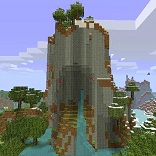
Minecraft’s lore is diverse and plentiful, though more deeply buried than in the previous examples.  Lore can be something as simple as where friendly or hostile creatures (known as “mobs”) are likely to appear, how they behave, and what sorts of materials they drop when killed, especially when the results are particularly esoteric or unexpected.  It’s important to note that the actual mechanics of the AI and whatnot aren’t lore — that’s just coding — but the player’s understanding of those mechanics can be.  If the player finds a saddle, for example, it can be used to ride a pig, for whatever small pleasures that conveys.  The green moss covering the walls of all Minecraft dungeons (small randomly-appearing chambers containing treasure chests and mob-spawning mechanism) is lore.  Recipes for refining and crafting items from raw materials are part of the lore.  Alternately, lore can be as complex as The Nether: an underworld added in October 2010, accessible only via portals generated when the player constructs a 4X5 archway of pure obsidian blocks.  The Nether comes attached with all sorts of delicious and evocative rules or exceptions: any distance traveled in The Nether is multiplied by eight when the player transports back to the world above, clocks and compasses fail to work, and it contains its own unique set of creatures and materials.

Lore, in the specific sense suggested by these examples, can be understood as an effort to suggest a much larger framing narrative fueling and lending interpretation to the player-character’s passage through the interactive world.  World-building would be an acceptable alternative term, as might paratextuality.

I think it would be useful, though, to consider lore more broadly: not simply as the hidden details or worked surface surrounding the narrative, but as every aspect of the narrative that is fixed in place.  Lore is the only degree of control the author of an interactive story has over the way the story will shape up, even in the most linear of interactive stories.  This would make the blocky visual appearance of everything in Minecraft part of its lore.  It makes any prologue or supplement found in an instruction manual, or on the back of a game case, lore.  Lore now includes the actions mapped to individual buttons or commands, the player-character’s library of verbs.

It also includes things like the non-interactive cinematic reel that introduces virtually every video game.  It includes the ending, or multiple endings.  It includes every line of dialogue, every scripted gesture.  By this broader definition, “The princess is in another castle” is part of the lore of Super Mario Bros.

This is more than just a taxonomic whim.  Lore, as I said before, suggests and interprets the actions of the player-character.  Because the protagonists acts outside the direct control of the interactive story’s author, we have to take into account where the authorial hand does show itself.  Doing so, we find it to be equally present, and operating in much the same way, in the environmental minutiae of the story-world (lore specific) and in the forty-five-minute movie that precedes the climactic battle (lore general): both feed, emotionally and narratively, into how the player approaches and experiences that fated clash.  Even previous experiences of failure or success can be lore, as they alter the interactor’s attitude toward and understanding of the task at hand.  People who build a wall between “story” and “gameplay,” or anything else, forget that without story, gameplay would be a purely technical exercise.

POTENTIAL

Let’s not forget, though, that the opposite is equally true.  Just as a game’s interactive elements cannibalize from its lore for their emotive and narrative impact, so a game’s story must include every interaction the player provides, regardless of their apparent lack of importance.  This is the key to understanding the concept of potential narrative.

The term “potential narrative” is fairly self-explanatory.  In traditional narratives of the kind Great-Aunt Ebert champions, the author writes us from A to B to C, from the exposition all the way up until the denouement.  To utilize a Minecraft-appropriate analogy, writing traditional narrative is like building a rollercoaster: it might be full of surprises, twists and turns, it might speed up and slow down, it might lull you into a comfortable rhythm only to pull the ground out from under you, and it might be intricately constructed and beautiful as hell.  But the tracks don’t change.  It’s the same plot from reading to reading, though our understanding of it may vary (see: emergence).

In a potential narrative, the plot is built from the interplay between information the author has provided, or lore, and input the interactor provides, and thus varies from reader to reader and from reading to reading.  The author simply lays a groundwork from which conflict and resolution may naturally develop.  In Minecraft terms, reading a potential narrative is like traversing a dungeon: you know there will be skeletons, and you know there will be treasure, but it’s up to you how and in what order you choose to encounter and resolve these plot points.

Minecraft, which keeps its scripted elements as invisible as possible(there’s no introductory reel, no set goal, and no way to win, in fact no end to the story except in death) isn’t the best model for clarifying potential narrative.  For a more concrete example, we need look no further than Andrew Plotkin’s Hunter, in Darkness, mentioned in this series’ previous entry.  Hunter, in Darkness begins with the lines “Nearly — nearly. The animal stink is rank and close. You raise your crossbow, try to peer beyond dark, wet stone.”  This is an immutable element of the story; every potential narrative will begin the same way.  From there, the player-character may venture forward into the darkness … to be immediately devoured by the lurking beast.  Thus ends one potential narrative.  In another potential narrative, the player-character investigates a side chamber to the left, where a swarm of bats necessitate a blind dive into a pit.  There’s another pit to the right of the starting point: most attempts to descend this will result in protracted but inevitable death (capping their respective potential narratives).  The option to fire blindly at the beast, wounding it but allowing it to escape, also exists, but all paths lead eventually to death, or to the bottom of a pit with a wounded hand and blood-hungry bats on your trail.  If we rule out death and failure (which are, rightly, potential narratives of their own), this and the opening, along with several other milestones leading to the conclusion, are fixed narrative elements. They anchor all the potential stories together, allowing for the illusion of a unified narrative.  These fixed milestones are what most people refer to when they talk about the “story” of a video game or other interactive work, but in reality each experience with an interactive story is its own potential narrative.  Actions such as shooting the beast, which have repercussions on the written narrative, or making closer investigations of the pit and other elements of the cave system, which emotionally flavor the overall text, are far from trivial additions to be judged separately from the fixed “plot.”

It’s important enough to repeat: everything that unfolds within the interactive story, regardless of its apparent significance, is a part of the potential narrative.  That means that, in Minecraft, placing a block in the middle of the field, then immediately reducing it to rubble, must still be counted in the potential narrative, even though it will have no repercussions on the ending (if Minecraft had an ending).  Taking a step forward then back, or standing in one place, likewise contribute. After all, in the absence of other signifiers of character, how are we to tell if Minecraft Guy is decisive or vacillatory, adventurous or lazy?

To provide some literary context: in 1960, author Raymond Queneau and mathematician François Le Lionnais joined forces to create the Ouvroir de Littérature Potentielle, or Oulipo, with the goal not of creating works of literature themselves, but of discovering new metaphorical machines for generating works of potential literature.  Noted authors as different in aesthetic orientation as George Perec and Italo Calvino have employed Oulipian constraints and algorithmic processes to produce literary works that they regard less as books than as models of potential literary processes.  What many people fail to consider, however, is that every interactive story, from the most linear shooting game to open-ended playgrounds for self-expression like Minecraft, is its own machine for generating potential narratives.  As with the Oulipian texts, the literary quality of the narratives produced, like the content of the narratives themselves, cannot be accurately predicted.

I’m not interested in Minecraft as a game.  If I were, I would have played it by now.  No, in my addiction I see it not as a game at all, but as a generator of potential narratives.

EMERGENCE

Which, it turns out, has only a little bit to do with narrative as we would normally conceive it, as even the Oulipo conceived it.  It has everything, on the other hand, to do with emergence.

Emergence arises when interaction governed by a simple set of rules transforms into something significantly more complex.  While you could view it as a question of degrees — emergent narrative is one notch up from potential narrative — they’re actually complementary concepts.  The easiest distinction to make is that potential narratives are, at least conceptually, measurable and recordable.  Emergent narratives, on the other hand, can’t be found in the screen or on the page.  They are entirely psychic phenomena, and can afflict, without warning, any person tuned in to receive them.

Generally, emergent narratives emerge when the input from the audience and the feedback from the interactive story approaches a 1:1 relation.  In most potential narratives, the player-character’s actions are built from the lore provided by the author.  In emergent narratives, the player-character’s actions are built from the actions of the player-character.  It’s the same process by which we make narratives out of dreams and fevers.  Noby Noby Boy, Keita Takahashi’s interactive art game thing, is emergent to the point of abstraction due to its literally elastic controls and high level of unpredictability.

If potential narrative is like a dungeon full of monsters and treasure, emergent narrative is like Survival mode itself.  A dungeon can be carefully crafted out of lore to lead adventurers to discover certain paths.  Trick floor panels and pitfalls can be installed.  Ancient scrolls detailing the terrible, primordial, and prophesied evils that dwell in the deepest locked room can be scattered about, usually next to the key to that very room.  Not to put too fine a point on it, a dungeon can be constructed.  Minecraft’s Survival mode, on the other hand, procedurally generates entire worlds, complete with forests, oceans, islands, mountains, and cave systems.  Procedural generation, to oversimplify things, means that the content is, for all intents and purposes, random.  Algorithms are put into use to ensure that bits of lava aren’t floating around in midair above an ice floe, but that’s as far as the authorial hand extends.

Which means that caves in Minecraft aren’t guaranteed to contain treasure, or skeletons, although the chances of the latter are fairly high.  They certainly won’t contain ancient scrolls and mysterious keys.  They don’t contain, in short, anything remotely resembling a plot.  What they do contain is the unknown in its purest form.  Every block you uncover in Minecraft is another cubic meter of uncharted wilderness, a frontier virgin to the eyes of man.

Emergence is why the minutiae and tedium of potential narratives — that 1000th skeleton vanquished, those hours spent mining wood from trees — remain vital.  Emergent narratives are unpredictable, and can therefore reliably be expected to adhere to the least expected moments.  In an emergent system, subtle changes, such as those introduced in Survival mode, can engender profound effects.

Advertising for video games, which are by and large fairly linear potential narratives, often make a big fuss about the choices presented to the player, all of which tend to fall into uninteresting binary categories.  “Will you be a hero?  Or a villain?  Will you save the world?  Or destroy it?”  An emergent narrative, on the other hand, doesn’t ask such questions.  It doesn’t offer choices.  It simply offers a space in which the player is free to act as they see fit.  Most potential narratives are multiple choice tests.  Emergent narratives are Rorschach tests.

The previously cited Minecraft videos illustrate one of the most exciting benefits of creating emergent or potential narratives: they come to reveal at least as much, if not more, about the interactor as they do about the author.  Of course, this comes with fairly steep trade-off: the more emergent the narrative is, the more tongue-tied it leaves the author, an issue closely related to the interactive author’s dilemma in Alexander Ocias’s very different independent work Loved.  Notch isn’t making a statement with Minecraft.  He is building an increasingly rich and varied environment in which his players can express themselves, or in which they find themselves expressed, for the emergent narrative is often as much of a surprise to the interactor as it is to the original author.

Simply put, if you have more answers than questions, you’d be a fool to try to express them emergently.  It’s no place for political commentary.  But when the goal becomes unlocking things neither the author nor the audience knows are there….

Even with that in mind, there’s another hurdle.  It’s 600 meters tall and made of flaming cubes of magma.  Even in something as unpredictable and open-ended as Minecraft, there’s no guarantee a narrative will emerge, and if it does, its form will be entirely unpredictable.  There’s only a small chance that anything meaningful will arise at all; it will depend entirely on the audience.  In short, one does not write an emergent narrative; to do so would go against the very nature of the thing.

Which isn’t the same thing as saying there’s no such thing as an emergent text.  “But I know nothing of interactive storytelling!” you quaver, in your best staunchest luddite impersonation.  Bosh, I say.  As much as they take advantage of the interactive form, emergent or potential narratives can exist, and even thrive, outside of electronic media.  Interactivity is an element of the way a work is conceived and received; it isn’t tied to medium.  Go read a poem: symbolism, slippage, sensorially supercharged abstraction … these are all fertile grounds for emergent meaning.  Sure, you aren’t likely to read the novelization of Minecraft any time soon.  Any book emergent on the same level of Minecraft would look like a crossword puzzle, or a collection of abstract ASCII art.  Both the author and the reader would have to relinquish control.  If potential narratives are about choice, then there must exist a choice to view the page as something more than a self-contained box of text, as a mere staging ground  for an as-yet-unwritten drama.  I’m thinking of collaboration, of revision, of adaptation and appropriation.

I don’t know if such a book yet exists.  I don’t even know if it would be worth writing.  A good narrative can be very reassuring.  There’s an existential anguish in casting about in a wilderness, finding nothing but random patterns and a meaningless wash of your own inputs.  It takes a great deal of dedication to press on into that world of darkness and of your own reflections, in the hope that you will discover something of meaning, something beyond solipsism.  If the Minecraft novel existed, I don’t know if I could read it.  But it would still excite the hell out of me.

As I said above, unpredictable narratives emerge when a simple set of rules yields something more complex.  What could be more simple, and more complex, than written language?

A box of Legos, perhaps.  A starship made out of toy blocks.

by Byron Alexander Campbell
a Black Clock Editorial Assistant preoccupied by dreams and theories of interactivity
POTENTIAL *EMERGENCY* MINECRAFT (Part 1 Of 2)

This is the third entry in “Playing Between The Lines,” a series of expeditions into the evolving space of interactive storytelling, its praxes and practical benefits.

Video games have terrible stories.  You know it.  Your Great-Aunt Karen knows it.  Roger Ebert, famously and repeatedly, knows it.

Yet people invest hundreds of hours of their lives, long after any apparent narrative satisfaction has been achieved, on what amounts to an endless epilogue of monster-slaying and skill-point distribution.  There is an emergent narrative, in double-jumps and headshots (the kind that involve eruptions of viscera), that gamers find so thrilling they ignore the inadequacies of the scripted tale.  The stauncher of the anti-gaming luddites express bafflement when grown men, not to mention teenage boys, confess to shedding tears over these ridiculous melodramas with nary a trace of three-act structure.  Goodness!

But maybe you, Roger Ebert, Great-Aunt Karen, and the rest of the stauncher luddites are looking at it the wrong way.  Judged against classic film theory or narratological structures, many interactive stories do indeed fall far short.  Yet, if they produce as strong or stronger an emotional or intellectual reaction in their audience, can we really call them inferior?  Interactive stories, video games included, should be judged not by their scripted content, which is often limited.  They should be judged by the potential stories they make possible, which are infinite.  These potential stories don’t exist anywhere in a trailer or script; they can only be experienced by means of true, invested, 1:1 personal interaction.

To illustrate this concept, I’m going to talk about a game I’ve never played.

A CLASSIC IN THE MAKING

I’ve never played Minecraft.

I just wanted to let you know that, if you haven’t played Minecraft either, you’re not alone.  There’s you, me, and probably at least one other person out there somewhere.  Great-Aunt Karen, maybe.  Possibly somebody who has spent the past two years researching flightless birds at a remote base in Antarctica.  It’s also possible they were dwelling at the bottom of the ocean.  Or pinned under rubble.  Not perfect cubes of rubble, though, because if they had, they would have been playing Minecraft.

Minecraft, developed by Markus Persson, a.k.a. “Notch,” is a freeform saga of creation and destruction built in Java.  It began in May 2009 as what is now known as Minecraft “Classic,” or “Creative mode.”  Classic resembles nothing more than a horizonless shoebox filled to the brim with digital legos.  Providing players with a randomly generated terrain and graphically simple cubes of various design, Notch tasked them with building, collectively or alone, anything they could imagine.  The players, experiencing this virtual architectural Toyland from the first-person perspective of a nameless fellow about three cubes tall, could stack limitless quantities of the block of their choice vertically or horizontally, as well as destroy any blocks currently in existence, with the click of a mouse button.

If there’s anything to be learned from Minecraft Classic, it’s that human beings can imagine a great many things, and, like chimpanzees with a typewriter, they will build them given enough time and resources.

This primitive version of Minecraft was an unmitigated success, and within a month Notch was accepting pre-orders for the final version of the game, which is still off there somewhere beyond the edges of the shoebox.  By January 10, 2011, over 1,000,000 copies had been sold.  Lest we forget, this is something that was developed by one person over the span of two years, and it’s still very much a work in progress—in fact, its conceptual framework relies on this state of incompletion.  It can be taken as a given, at this point, that Minecraft will join the ranks of Second Life and World of Warcraft as an honest-to-goodness phenomenon of interactive design.

While the range and complexity of objects produced in Classic is a true testament to humanity’s unswerving drive to — especially keeping in mind that these full-scale reproductions or cloud-capped monuments to whimsy were put together block by pixellated block — the original Minecraft was too blatantly and open-endedly an electronic toy-set to be considered a storytelling platform.  There was no goal, except to build, and no conflict, except for the internal conflicts all creators face.  The most exciting narrative that could arise went something like: build a beautiful structure, make it public, have it destroyed or vandalized by somebody with malicious intent (figures known among collaborative gamers as griefers).  Some might call this the quintessential structure of a tragedy, but it was too repetitive, and too vague, to carry any emotional oomph.

All that changed when Notch introduced “Survival mode.”  In Survival mode — available only to those who have pre-ordered the game — things function in largely the same manner…but for two all-important distinctions.  One, building blocks are no longer free or limitless: the player must now collect and craft every resource by hand.  Two, the procedurally generated worlds are no longer uninhabited: they now contain sheep, cows and chicken, which yield resources as important as leather and feathers.  With this population boom, as well, came mobs of predators, inhabiting dark spaces only to emerge at night and home in on the player with eerie precision.

Suddenly, Minecraft isn’t about devoting weeks to building a scale model of the Tower of Babel.  It’s about scrambling to fashion some form of shelter, just to last through the night.  It’s about venturing into caves infested with hostile creatures in the hopes of discovering some of the more valuable resources.  It’s about survival in a way that camping in the woods doesn’t begin to approximate.  And it’s about making something out of that inkblot of a cubist world, something revelatory and meaningful.

Suddenly, it’s a wellspring of potential narratives.  Which is precisely why I haven’t played Minecraft.

“LET’S PLAY”

I’ve let other people play it for me.  And it’s become an addiction.

Luckily, people seem more than happy to make their struggles and victories public.  Series of “Let’s Play” videos on video sharing sites such as Youtube provide narratives at least as engaging as the highest budget television serials.  If you don’t believe me, check here.  Or here.  Or any of dozens of others.

It can be difficult to explain the draw of these videos to somebody uninitiated in the infinite drama Notch has incepted.  Watching other people play video games seems a counter-intuitive practice, particularly after my declamation about invested personal interaction in the introduction.  The pivot-point here is that there are actually three co-planar levels of narrative at work in any interactive story: “lore” (a term I’m using broadly to encompass all elements of linear storytelling present in an interactive work), potential narrative, and emergent narrative.

I’m going to touch on all three in greater detail in the follow-up post, so you can keep your wig on.  For now, let me just say that Minecraft Survival is deeply emergent.  So emergent, in fact, that I couldn’t hope to navigate the subterranean sprawl that houses its various narratives if I merely played it by myself.  Narratives emerge from the back-and-forth between the simple, flexible, but elegant process that drive the game and the distinct subconscious signatures of the players.  Playing it myself, I would soon fall into a rhythm in the way I react to the way Minecraft reacts to my reactions.  My narratives would begin to homogenize, and the narratives of others would soon become a part of that homogenization, victims of narrative projection.  It’s therefore more rewarding for me, more fascinating, to watch others try to cope with survival.  I witness narratives sprouting up out of the darkness that I would never have seen on my own.

Minecraft has become a door via which the inner minds of its players are made visible.  With each step into the unexplored caves, they are venturing deeper toward the basal planes of their own psyches.  It’s like watching them build a toy block window into their most intimate recesses.  It’s like people-watching with x-ray goggles.  It’s like a number of other analogies with perverted connotations.

It’s what makes Minecraft so appealing to not play.

Watch out for part 2, in which I delve deeper into the narratological trinity from which interactive stories are composed.

by Byron Alexander Campbell
a Black Clock Editorial Assistant preoccupied by dreams and theories of interactivity

SEE + HEAR + DO (3/16-3/22)

This week, See + Hear + Do travels into the future… or various versions of it.

MICHIO KAKU, PHYSICS OF THE FUTURE (3/16@7PM, NYC)
The Strand, 828 Broadway, New York, NY 10003
Theoretical physicist Michio Kaku—author of Physics of the Impossible and Hyperspace—materializes at The Strand bookstore to provide his forecast on where science is headed in the coming century. Highlights include elevators into space, driverless floating cars, robotic surgeons, and every boy’s dream, x-ray vision. Free.

ANDREW FOSTER ALTSCHUL (3/17@7:30PM, LA)
Skylight Books, 1818 N Vermont Avenue, Los Angeles, CA 90027
Andrew Foster Altschul, author of Lady Lazarus, reads from and signs his new novel Deus Ex Machina, about a reality TV show gone terribly awry, at Los Angeles’ Skylight Books. Free.

DEVO (3/19@8PM, LA)
Club Nokia, 800 West Olympic Blvd, Los Angeles, CA 90015
Performance artists cum rock band DEVO serve up their signature blend of essential vitamins, sci-fi kitsch, surrealist humor, and mordant discordant satirical synthetic pop. The Octopus Project opens. $35-$100.

LISA TEASLEY, PETER MEHLMAN, MEGAN BROWN (3/20@7:30PM, LA)
Wordspace, 3191 Casitas Ave #156, Los Angeles, CA 90039
Wordspace in Los Angeles continues its Featherless reading series with an unlikely trio: Lisa Teasley (Heat Signature, Dive), Peter Mehlman (Seinfeld writer/producer), and playwright Meghan Brown. Free.

DEB OLIN UNFERTH & BEN MARCUS (03/22@7PM, NYC)
The Center for Fiction, 17 East 47th St, New York, NY 10017
Novelist Ben Marcus (Notable American Women, The Age of Wire and String) and memoirist/fiction writer Deb Olin Unferth (Revolution: The Year I Fell in Love…, Vacation) will read and discuss their work at an event presented in partnership with Creative Capital. Free.

Interacting with Andrew Plotkin

This is the second entry in “Playing Between The Lines,” a series of expeditions into the evolving space of interactive storytelling, its praxes and practical benefits.

Last time, we examined certain properties of interactive storytelling and discussed their implications for literature as a whole. What this inquiry failed to address, of course, was the fact that one of the oldest forms of computer entertainment has been straddling the border between literature and the interactive since the mid-’70s. Often misrepresented as a dead genre, interactive fiction, sometimes known as text adventures and often abbreviated IF, has enjoyed a steady but stealthy renaissance in the past twenty years, thanks to the contributions of independent authors such as Andrew Plotkin.

On his Kickstarter page, Plotkin refers to himself as “a hacker, game designer, and general messer-around of code, art, and language.” Winner of eighteen total XYZZY awards, the IF equivalent of the Oscars, Plotkin has also made numerous technical contributions that have helped make the form more widely accessible. In July 2010 he gave a lecture that attempted to describe IF for readers and writers of traditional fiction, providing a much more elegant and comprehensive introduction than I could hope to. He’s also compiled a page of decent introductory works in the form.

Near the beginning of November, Plotkin made the shocking announcement that he would be quitting his day-job to write interactive fiction, which has been almost exclusively freely-distributed since 1989, full-time. Within a single day, his announced goal of $8,000 in pledges to kickstart this enterprise had already been surpassed, with total pledges exceeding $31,000 as of the sixth of December–a strong indication of the respect the author commands. His first commercially distributed work will be Hadean Lands, available semi-exclusively on the iPhone, iPad, and iPod Touch, a teaser of which is available here.

While all of Plotkin’s major IF works are available to experience in-browser at his website, three in particular are worth singling out. Shade begins in a dark, cramped apartment, but it is not long before the bleak, arid atmosphere, and the overwhelming sense of melancholy, begin weighing down the walls of your tiny existence. Spider and Web is a Rashomon-esque reimagining of the relationship between the interactor’s input and the story–or in this case, stories–consequently constructed. Lastly, Hunter, in Darkness draws inspiration from the classic computer game Hunt The Wumpus, imbuing it with a palpable sense of dread, darkness, and the terror of survival.

Recently, Black Clock had the opportunity to do some old-school interaction with Plotkin, the kind that involves two human beings swapping ideas. In this case, we asked him a few questions about his past and present work, as well as his vision regarding the possibilities of the form in which he works.

BLACK CLOCK: You’re best known as an author of interactive fiction. What exactly does that mean? Just what is it you do?

ANDREW PLOTKIN: I write programs that simulate a story world in an interesting, explorable way.

I build adventure games with a familiar command-line interface, in which the player types simple text commands and the game responds with textual output.

I write stories with a head-thumping abundance of setting and description, inexplicably in the second-person point of view, which give the reader just enough influence over insignificant details to feel responsible for the protagonist’s mistakes.

I take part in a retro school of game design which hearkens back to 1975 (and which was commercially extinct by 1990).

I take part in a forward-looking school of game design which experiments and innovates much faster, and with far more freedom, than the “real” game industry.

Ever heard someone say “twisty maze of little passages, all alike”? Or “it’s dark, you are likely to be eaten by a grue”? I write those.

Alongside people like Graham Nelson, Adam Cadre, and Emily Short, you’re one of the biggest names in independently-developed IF. What’s your proudest contribution?

I hate to choose. Not because of excessive modesty (I’m no more humble than the next guy), but because comparing art with craft is hard. Was it more valuable to create a new IF virtual machine that people now rely on, to come up with a clever dissection of IF storytelling through unreliable narration, or to write an introspective, allusive game that pointed IF beyond the genre adventure story?

Okay, I’m really no more humble than the next guy. The point is, I’m differently proud of software tools, narrative tools, and stories. I’d like to say that I’m most proud of inventing a new rule-based programming paradigm, but after years of thrashing I still haven’t succeeded in inventing it!

On that note, in what role–programmer or writer–do you feel more comfortable?  Or do you inhabit a space between?

I am completely comfortable as a programmer. Programming is easy; you turn the pieces around until they’re elephant-shaped, and then you add anything necessary to hold them in the shape of an elephant, and presto, it’s an elephant. Sometimes you have to knock a bit in half to make the ear look right. I was a programmer to begin with–I mean, from age nine at latest, and we didn’t even have a computer until I was ten–and programming is what I’ve done to make a living.

That is to say: writing is the hard part for me. I haven’t had any formal training in writing, so I’ve had to invent what I do based on the works that I read. See previous question.

I can divide the question up further: I am comfortable writing text, but I’m uncertain writing stories. (This is both cause and effect. IF gives you lots of text to write, even in a game with a slender story, or no story at all. Talent is what you pursue.) If you accused me of pushing those structural boundaries, or writing allusively, in order to gloss over stories that I’m not confident about–I wouldn’t deny it.

You’ve been active in making IF accessible to a more general audience. Do you imagine a future where IF, or some variation thereof, has become as ubiquitous as traditional books?

Imagine? I imagine futures in which people play IF while drifting on very slow glacier-barges across the Mediterranean icefields, pausing occasionally to fight off narratively-starved hordes of extremely literate snow-crabs. Imagining these things is easy.

I don’t find it likely that IF will become as popular as books (that is, books in general)–nor as popular as games (games in general). It’s a narrower medium, and it will have a narrower, more dedicated audience.

But if you were asking me about some new genre of book, I’d inevitably tell you it’s not as popular as books in general. That’s always the wrong question. I think IF could be as ubiquitous as (say) fantasy noir detective stories, or as popular as casual tower-defense games. IF could develop a following that isn’t scattered and disconnected–regular players could be hooked up to authors writing regularly. With discussion and criticism in the literary press.

Then we’d be complaining that our subgenre isn’t as popular as farming teenage vampires, but it’s always something, right?

Speaking of books, have any non-interactive works of fiction been of particular influence to your IF? Or does it change with every project?

You can recognize particular influences–setting, tone, or event–from all sorts of sources. Heliopause riffs on the lyric space opera of Jack Williamson and George R. R. Martin. Hunter has a claustrophobic moment inspired by an Alan Garner novel. Delightful Wallpaper is notionally set in an Edward Gorey illustration.

(I like to remind people that Delightful Wallpaper was inspired by House of Leaves, because the influence is completely undetectable. Except that there’s a house. The book was the start of a thought process, which went off around several corners.)

These aren’t interesting answers. The more fundamental influences…. When I look at prose I try to remember the textures that Patricia McKillip writes. Dave Duncan, and more recently Brandon Sanderson, are great at constructing fictional tools (devices, magics) that interact in subtle, systematic, and surprising ways. C. J. Cherryh can portray a setting, universe and all, just by framing a character’s point of view. Diana Wynne Jones describes the fantastical by grounding it in the reader’s unconscious knowledge of the real world. I try to do all these things.

What element or work of IF first reeled you in as a reader/player? Following from that, what motivated your decision to author your own work?

I got hooked playing Colossal Cave (a.k.a. Adventure), the original text adventure, when I was a child. My father’s office had a take-your-kid-to-work day–one of the few places I could have seen a computer in 1978 or so. He plunked me down in front of a mainframe terminal, and the rest was history.

I started writing IF by sitting in front of the family Apple (a few years later) and thinking “Ok, I can do this. Text input, text output.” I don’t think there was ever a question that I wanted to write IF. IF was the best kind of game there was.

Are there particular spaces or narratives you feel IF is better equipped to explore than traditional fiction?  Than graphical games?

Usually I’m asked what kinds of story-telling IF is best equipped to handle. Immersion, complicity, playing points of view off each other–easy answers. Text games (like any prose form) can do internality and voice; any visual form has to strain to imitate those. (Generally by adding voices, but spoken text is so slow.) IF lets you collapse a room, a building, or a neighborhood into one unit for the player’s attention.

But you asked about spaces and narratives, not techniques. That’s a more interesting question. Questions.

Far as we’ve come in the past twenty years, IF is still best at explorational, environmental stories. A book with that much setting can turn into a travelogue, but in IF you’ve got your hands in it; it won’t get dull. Or it shouldn’t.

Any narrative that turns on a realization is ideal for interactive presentation. Particularly so if the realization is in the reader’s head, with contrasting movement in the protagonist’s. A story that’s conveyed with a system of rules, rather than events, makes great IF…. You know, these are terrible answers. Explore an island! Solve a puzzle! You don’t need me for this.

We’ve just barely begun to figure out what kinds of stories can be told — can only be told — in multiple revisions. What can be conveyed from many outcomes considered together? (Or many in-goes, perhaps?) I don’t have an answer.

In Dual Transform we move between various spaces by invoking metasemantic archetypes, and in Delightful Wallpaper we’re dealing with potentialities and intentions, with all means of physical interaction cut off. Navigation in The Space Under The Window is virtually indescribable by IF standards. Do you think it’s necessary to redefine the way the interactor moves through or conceives space in order to create the sort of conceptual spaces that interest you?

Redefining movement is not necessary, no. Space is a wonderful toy and I love playing with it; it goes back to my love of mazes. (Many IF players will tell you they’re sick of mazes in IF; but if they tell you they’ve never loved mazes, I don’t believe ’em.) But it’s just one toy.

It is necessary for me to build interactions that will befuddle, enlighten, surprise, and then (again) enlighten the player. You could say that any such complex interaction is metaphorically navigation in a state-space. I might say that myself; my perception of game mechanics (and programming mechanics, and probably people mechanics) is proprioceptive and structural, rather than verbal or visual or what have you. But that’s just a way of modeling the design. In the story world, the interesting interactions could just as well be about manipulating objects, or manipulating the environment, as about spatial movement. Wallpaper is an example of all three, in different ways.

(I just asked a bunch of IF-playing friends if they loved mazes, and some of them said “sure” and some looked at me like I was nuts. So, now you know my biases.)

Playing Hoist Sail for the Heliopause and Home, I found myself naturally falling into these nautical or nautical-romantic terms during play, such as ‘weigh anchor’ or ‘hoist rigging’ or even ‘go forth.’  The effect was really liberating, and at the same time immersive; it allowed me to lose myself in the rhythms of this world. Do you think modern IF has become too mired in its traditional input language, these plain dry verbs that have been handed down from things like Zork and Adventure?  How useful is it to revise that vocabulary?

I push around the edges, but the center is always the same. Or if it’s not, shifting it takes a great deal of work.

Even Heliopause relies on some old-school taking, dropping, and putting. Indeed, you can play it through entirely with the standard vocabulary–get the anchor, open the sails, wait. Discovering the new verbs is fun, but if the player reaches for the old ones and finds empty space, the mood will crack right apart.

Heliopause might be on the edge of what we can do. I chose a vocabulary that most people (most native English-speakers, anyway) would recognize. I laid down a great number of verbs, mapping to a very few actions, so that all of the obvious guesses would have useful effect. And most players don’t know real sailing terminology, after all. It’s not like I tried to handle knots.

Plus, Heliopause is short. I think I took the sailing actions as far as I could; any more would have gotten (more) mechanical and tedious. So should more games try (as it were) this tack? Of course; but it’s a harder course than it appears.

How do you deal gracefully with the need to provide your audience with the vocabulary they need for a successful interaction, without sacrificing immersion?

It’s not a graceful maneuver. Nobody expects it to be, at this point.

(Even in commercial video games, teaching the interface isn’t subtle. You’re maintaining good immersion if you pop up a discreet “press X to jump” banner, as opposed to having the protagonist shout “Press the X button to make me jump!”)

Heliopause starts in a very simple environment; you have nothing to do, which is a pointed clue. The description says you can “weigh anchor”. If you try flying or launching (or even going upward), the game again suggests “weigh anchor” or “raise anchor”. The command is (I hope) impossible for the player to avoid, and I repeat it relentlessly. Subtlety is just not worth the risk at this point; if the player doesn’t step into the right frame of mind, the rest of the game is wasted.

In the Hadean Lands demo, I flat-out order the player to try “recall” and “speak word” at the appropriate points. Since I want to make that game accessible to newcomers, I might go farther, and add tutorial messages for all the familiar IF actions.

Later on, one can back down the learning curve, beckoning the player into her own realizations. You’re still managing the process of learning; but you’ve built more structure for the player to climb.

Then, of course, you spend hours sweating out all the possible variations that a player might type. No learning process is unambiguous.

Let’s talk about Hadean Lands for a moment. Without asking you to show your hand too much, is there something new you’re planning, either in terms of narrative or interaction, with this upcoming project?

How about this? I want to get back to an element which isn’t new at all: resource puzzles. 1980s adventure games were full of items that you could use up, destroy, or run out of — food, lantern fuel, fragile treasures, spells that only worked once. If you consumed a resource for the wrong reason (or just ate the food too quickly), well, too bad. You’d have to back up to an old saved game and try to find another way through.

In that era, players expected that sort of hardcore foolery. You kept your saved games, and you expected to run through tough scenes dozens of times before figuring out the right plan. But that got less popular when graphical adventures came along. Maneuvering through a sequence of video animations was slow, particular on 1990-era computers. A style of gameplay which was already tedious in text (where you could type quickly and skim, after all) turned into a tarpit of graphical frustration.

Myst firmly established the idea that there were no fatal mistakes, only puzzles you haven’t solved yet. (Aside perhaps for a few dramatically-failed denouements.) Text games rapidly began following the same path–particularly in the IF Competition, which invited short games and promised a tighter, less frustrating experience.

My first few games allowed fatal mistakes, but for the past decade I’ve been sticking to the “polite,” safer model. I don’t regret that. But I miss the puzzle designs that are possible when you have irrecoverable choices to make.

So for Hadean Lands, I’m going to try a compromise. As you know if you’ve played the demo, you’ll have alchemical resources to use. Some are in limited supply. As you’ll also see in the demo, space and time are… fractured, perhaps… and that will offer a way to recover from mistakes. You’ll be able to try different combinations of elements to solve problems. The trick will be finding combinations that don’t require the same element.

I have to keep the frustration within tight bounds, of course — the iPhone interface discourages unnecessary typing. So there will be shortcuts for various paths, once you know how they work. You won’t have to repeat sequences of commands. That’s all to the good; the fantastic shouldn’t be made familiar through repetition.

Writing IF full-time sounds like a bold move. Do you see it returning as a commercially viable form sometime in the future, or would you prefer IF works remain freely shared among the community?

Didn’t you start by asking me this?

Yes, yes, I do see IF becoming commercially viable. I could be hallucinating, but I see it. Whether I truly wind up doing this full-time depends on the success of Hadean Lands. I’ve collected enough advance funding to cover its development. If that turns out to be repeatable, then I’ve got myself a career. If not, I’ll do something else.

The community will continue to freely share IF works — of course. We’re several Internet decades past the point where anyone could pretend that a free art community is antithetical to commercial art. If my livelihood has to struggle against a tide of work freely available online, then — I’ll have proven that IF is just as viable as writing, music, and filmmaking. Right? Because all of those people have the same problems. I look forward to it.

by Byron Alexander Campbell
a Black Clock Editorial Assistant preoccupied by dreams and theories of interactivity

Loved and the Strange Frontiers of Interactive Storytelling

This is the first in Playing Between The Lines, a series of expeditions into the evolving space of interactive storytelling, its praxes and practical benefits.

Alexander Ocias describes his brief, open-ended browser-based game Loved as “A short story in the form of a flash platformer.”

“What’s this?” you cry.  Perhaps your narrative sensibilities have been outraged. “Platformers?  Like that Super Mario?  Where can a story possibly exist in something like that?”  As we shall see, the answer is: everywhere and nowhere.

“JUMP OVER THAT PIT OF BARBS.”

On first glance, Loved does resemble, superficially at least, some of the red-capped plumber’s more famous adventures.  Although the ambient, melancholy music track and stark palette scream “art game,” you’ll spend much of the five to ten minutes it takes to “win” this “short story” jumping gaps and avoiding obstacles or enemies.  Where was that story again?

Ocias answers this question with his own statement of intent: “to build something confrontational, that would engage players to give thought to what they are doing both in and out of game.”  In other words, Loved treads a fine, ambiguous storyline that spurs heated debates as to whether it’s an allegory for abusive spousal, human-animal, or parent-child relationships, and about the extent to which a parent / guardian / government’s seemingly cruel, arbitrary commands ultimately benefit the child / ward / citizen.  Despite the ambiguity and sparseness of the apparent narrative, Loved still successfully engages the player as an interactive story by explicitly dealing with its own form and means of production.

“WILL I TEACH YOU HOW TO PLAY?  OR NOT?”

When seeking a better understanding of interactive storytelling, it’s useful to examine those interactive stories that are both overtly self-referential and overtly game-like.  Being games, they necessarily include a set of rules and goals.  When content mirrors form, and vice versa, we get a glimpse into both the rules that govern a game and the rules that govern the creation of a game.  And once we grasp these rules, we can begin to formulate a sort of player’s manual for the writing and reading of interactive storytelling, its inherent strengths and weaknesses, and insight into what interactive and static narrative–the ergodic and the nonergodic, if you prefer–offer one another.

Gaming is rife with extradiagetic or metatextual statements.  The classic and pervasive command “Press Start to Begin,” for example, makes no sense in the context of the game world (“Who is pressing start to begin what and why?”), and therefore exists only on the level of metafiction.  From control tutorials to Game Over screens and pleas to “Insert More Tokens,” this tendency arises as a matter of course from the interactive nature of the medium.  Gaming necessitates a constant re-education of the audience for two reasons: one, it is still a relatively new medium, reaching virgin audiences (no jokes, please) on a daily basis; and two, new games advertise themselves by flaunting innovations in methods of interaction.  Therefore, if an audience is to interact with the work in a meaningful way, electronic games must provide a set of instructions to facilitate unfamiliar interactions.

In your “typical” electronic games, the disembodied, authoritative voice speaking above the story quickly ceases to faze its audience, and thereby ceases to be meta at all. The “Press Start” screen can be likened the title page of a book; in both instances, the omnipresence of extradiagetic information does not detract in any important way from the story itself.

In a strange twist, interactive games like Loved that integrate things like “Press Start” seamlessly into the narrative on an intradiagetic level, i.e. within the world of the story, draw more attention to the story’s construction, and consequently to the narrative techniques that drew attention in the first place. An early example is Konami’s 1987 Metal Gear, an espionage game in which the protagonist has a specific radio frequency for saving his data and the game’s villain, appropriately named Big Boss, sends him messages imploring him to turn off his computer and walk away.(1)

The metafiction in Loved functions on a similar level.  When play begins, the unseen narrator asks “Will I teach you how to play?  Or not?”–a variation on a common method of toggling tutorial messages for new or veteran audiences.  The statement that follows, however, jettisons convention and cements the identity of the narrator / guide as a character within the story: “You do not deserve it” the faceless voice coldly informs us, proceeding somewhat paradoxically to issue a series of commands, some more helpful than others, which may be read as goals or missions or even a form of tutorial: “Jump over that pit of barbs,” “Touch the statue,” and later contrary or redundant commands such as “Do not move” or “Do not fail.”

“YOU ARE WRONG.”

Now, interactive stories achieve their interactivity by building feedback between the audience and the story: one could technically interact with, say, a painting in various ways, by touching it or reciting incantations before it, but it will never react meaningfully; there is no feedback.  In contrast, Loved provides feedback on two primary levels: there is the genre-standard navigation of basic hazards, failure in which will undo some of the player-character’s progress, and there is also the way the game-world reacts, textually and visually, to the player’s responses to the aforementioned commands.  Obedience adds detail and definition to the visuals: it is only after jumping over the barbs, for example, that they are recognizable as such.  Disobedience produces a visually confounding effect: fat, rainbow-colored pixels obscure elements of the interface, reminiscent of the “corrupted environments” often caused by programming glitches.

This corruption, more blatantly than the corrupt affection of the disembodied voice, forms the basis of Loved’s metafiction.  The interactive story deals implicitly and explicitly with the basic dilemma of the interactive storyteller: the balance between a guided narrative and the illusion of choice.  A well-formed story should take the audience by surprise, either emotionally or intellectually; otherwise, it devolves into an exercise in self-congratulation, at best.  However, interactive storytelling by its very nature must offer the player, and provide feedback for, some degree of control over narrative progression.  Hence the storyteller’s dilemma: a game in which the player exercises complete control over the narrative offers no opportunity for narrative surprise, but if the author exerts too obvious a pull, the player feels cheated and the interactive effect, a crucial element of the medium’s immersive and empathetic capabilities, is lost.

A more concrete example might be helpful here.  Let’s imagine for a moment that the story of Oedipus: The Game(2) hinges on the reveal that the grunt the player killed in the level 1 was actually the player-character’s father.  If the player doesn’t kill the grunt in level 1, the narrative ceases to function; it literally becomes corrupted.  However, unless the player willfully kills the grunt by choice, the impact of the latter revelation becomes softened to the point of impotence.  The author cannot simply wrest control away from the player and dispatch the grunt in a cinematic, or report his death second-hand.  A simple and common work-around would introduce an impediment, lifted by the grunt’s death, that literally arrests the narrative until the desired action has been performed: the unmanned chariot crashes through a roadblock, allowing poor Oedipus access to Thebes.  However, this trick has the danger of becoming obvious with repeated use, and the more blatant it appears the less the action feels like a true choice.  This inherent dissatisfaction drives the player to “trick” the system, to find that marginal, glitch-inducing alternative route to Thebes.  This is known as sequence breaking.

Loved plays with this concept of pushing at the edges of a structured narrative.  When the player follows the arbitrary script set by the disembodied author / narrator / guide / voice, he or she is rewarded with a defined, clearly delineated game-world: by playing the story the way the author intended, the world–and the narrative that unfolds within it, for story and setting are never far removed in electronic games–take on some degree of depth.  The temptation always exists, however, to do things differently: when the voice commands “Travel the lower path,” and yet a higher one devoid of obstacles is so clearly visible, it betrays the arbitrariness of the player-character’s proscribed actions.  Why must we take the lower path?  Because the obstacles within it provide the conflict that shapes the story.

In other words, Loved illustrates that place where an author’s authority becomes authoritarian.  When the voice commands “Throw yourself into the barbs,” we do so because the story demands a sacrifice, the sacrifice of choice and freedom for the glory of a meaningful narrative.  When the game denies our claims of manhood, and instead insists that “You are a girl,” or vice versa if we claim femininity, we acquiesce because this is, after all, the story of a girl, isn’t it?  When our manhood–or womanhood–is later restored, we feel victorious, forgetting that the same voice now rewarding once denied.  Our ennoblement can only take place after we’ve been degraded, and both moves are equally calculated to serve the caprices of the narrative.

“YOU WILL FAIL.”

Things only begin to fall apart when the player takes the high road rather than the low.  Although providing the illusion of a fully realized narrative space, Loved, like all narrative, is only as wide as it has been written.  Push beyond the pixel-thin borders at your peril: there you will find naught but chaos and madness.

And yet it chafes, this higher road denied us.  Why?  Nobody questioned Scout’s double-X chromosomes when Harper Lee told us it was so.  Nobody looked for a workaround to Oedipus’s inevitable self-blinding.  There is an authorial power that we passively accept in static storytelling: the construction of paragraphs or the framing of shots are much more constrictive than the arbitrary edges of an interactive narrative, the higher path left totally occluded from view.  Sequence breaking only exists in literature insofar as one could, conceivably, skip to the last chapter to find out whodunit.

Why should this be so?  As readers, shouldn’t we have the right, the desire to re-cast Scout as boy rather than tom-boy, and explore the narrative from those darkened, corrupted corridors?  As writers, shouldn’t we remain open to the possibility that some may travel avenues in our narrative that we never realized were there?  What could be more exciting, more terrifying and exhilarating, than a space within a narrative where even the author daren’t venture?

In the spirit of Loved’s abrupt, ambiguous ending, I conclude less with a solid declaration than with an open-ended question, or a rallying-cry for writers and readers: Where do the edges of our fictions lie, and who among us can claim to have braved the frontiers beyond?

(1) The Metal Gear series has since become famous, or infamous, for this particular style of breaking the fourth wall.  A non-exhaustive list can be found at Metal Gear Wiki.
(2) Although this example was intended somewhat farcically, it should be noted that a few attempts have been made to turn Sophocles’s play into a game, the most successful of these being Singapore-MIT GAMBIT Game Labs’ Seer.

by Byron Alexander Campbell
a Black Clock Editorial Assistant preoccupied by dreams and theories of interactivity

Making a Space with Brian Evenson

Brian Evenson is owed some karmic rewards.  The publication of his first novel, Altmann’s Tongue, generated enough controversy to oust him from his teaching position at Brigham Young University, rattle his faith, and sever close personal relationships.  Asked to stop publishing or risk censure from the Mormon community, Evenson opted to keep writing, leaving his position and his family behind.

Since that decision, however, Evenson has garnered a wealth of awards and critical success, including an O. Henry Award for his short story “Two Brothers” and International Horror Guild Awards for The Wavering Knife and The Open Curtain.  Known as a writer who defies easy classification, he has received equal recognition from both literary and genre presses.  And the payback just keeps coming: Evenson’s latest novel, Last Days, won the 2010 ALA/RUSA Prize for Best Horror Novel; his work has been adapted into a variety of other media–most recently a stage version of Father of Lies; to date, his writing has appeared in four of twelve issues of Black Clock; and he currently serves as both a professor and director of the Literary Arts Program at Brown University.

Evenson’s work, though consistently divisive and occasionally iconoclastic, demands to be read.  An aura of mystery, in the oldest sense, permeates his writing, fueled by symbolism that seems to function outside rationality and violence that is incomprehensibly rational.  Characters with innocuously simple names enact atavistically simple motivations as they drift through uncertain, but curiously familiar, settings.  “The Munich Window” features one of the most despicable yet irresistible narrators seen since Nabokov, and Last Days takes readers on a harrowing trek through an underground world of obsession and self-mutilation.  In a recent review of short story collection Fugue States, Steve D. Owen called Evenson “the contemporary inheritor of the newest irrealist tradition” for the epistemological incertitude that permeates his writing.  Recently, Black Clock was able to chat with Evenson and explore the methods and motivations behind his work.

BLACK CLOCK: Your novel, Father of Lies, recently received a stage adaptation by director Jose Zayas.  How was that experience for you?

BRIAN EVENSON: It’s always amazing for me when someone adapts my work in one form or another, just because it creates possibilities for it that I maybe didn’t see.  There’re things a play can do that aren’t really possible in a work of fiction.  I’m afraid I haven’t seen Jose’s adaptation yet because the only days it was up were when I was out of the country, but I’ve heard only good things about the performance from friends who saw it.  I’m very excited to watch it on DVD: I’ve heard he’s done some very interesting things with darkness and staging and with the intimacy of the performance.  But I’m always for adaptations.  When Zak Sally adapted a story of mine into a comic, for instance, it was really great.  The other kinds of adaptations I’ve had, ranging from electronic music to radio plays to an experimental opera, I’ve been really happy about.

When you’re writing, do you ever picture what it would be like if it were adapted into a different medium?  The visual aspects of it?

I think a lot of my work is very visual, so I do have a pretty clear visual sense of what’s going on with a story.  But I don’t think I ever sit down and think, “Oh, this would make a great movie, this would make a great this or that.”  There have been four or five short films made based on my stories, and it’s sometimes really interesting to see how different the visual ideas the director has are from the ideas that I had in writing the story. But I’ve also been very happy with those adaptations as well.  I think that it just expands the work.  Obviously there’s a lot of openness in my work.  There’s an attempt on my part to make a space that people can enter into and make their own.

That’s an interesting concept.  Do you want to talk about that for a little bit?

I think there are different ways to think about writing.  One thing that I try to do is think about writing as something that serves as a catalyst, that connects to the reader, and the reader ends up completing the story in some ways, filling it in.  As a result I think there’s a lot of ambiguity and openness in my work.  Even though there are strong visual components, it’s work that demands active participation on the part of the reader.

Does that ambiguity arise from your particular approach to writing?  Do you sit down and say “I’m going to write such-and-such a story” or do you try to leave it more open for yourself as well?

Any time I have a clear idea where a story’s going before I’m close to the end, I usually don’t finish it, just because I get bored with it.  So yes, I think part of the process for me is trying to do something that feels at least a little bit new to me as I’m writing it.  I want a story that’s holding my interest, or a moment along the way that surprises me,  or that I don’t know where it came from, that seems to have tapped into something that I don’t really understand completely.  As a reader, I’m really interested in work that upsets the easy definitions I have for how a story should work.  I like fiction that does things that I can’t predict, but that does them so artfully that they seem natural and necessary at the same time as they seem surprising.  So I think that as a writer what I’m trying to do is get to a place where the story is something the reader is really involved in, but sometimes caught off guard by, or turned over by, or disrupted by in some way or another.

Earlier, you put this concept together of creating a space that the reader can enter into.  I’ve noticed that in a lot of your recent work especially there is a lot of imagery involving geometric, enclosed spaces.  Is that part of why that imagery recurs in your writing?

I think it might be partly that.  I’ve always been interested in the notion of enclosed spaces and characters that are put in a position of trauma, or put in a position where they don’t quite understand what’s going on around them.  I like the notion of being trapped, and the notion of being in a space that one either does or doesn’t understand very well but that one has to deal with.  I think those are things that always come up in my work.  I think part of it is the influence of Beckett.  I really love what he does in his work in terms of the almost geometrical quality of the descriptions, and how you have in something like The Lost Ones a very careful description of a space and of a cylinder.  But you also have that in a lot of his work.  In something like Company, you have these moments where the descriptions seem almost geometrical.  For me, I’m not really sure where that’s coming from or what that’s about exactly.  It may be partly that my mother is an architect.  I think it’s really an interest in spaces and the way in which we function in relation to spaces.  It’s partly an interest in dwelling, and houses, and things like that, but it’s also an interest in how many spaces just feel constricted and restrained.

If you had it completely figured out, I’m sure it wouldn’t be as interesting for either you or the reader.

I’m sure that’s right.  Gaston Bachelard has a book called The Poetics of Space in which he talks about the relationship of spaces, and my interest may be partly coming from that and from phenomenology as well.

Other than philosophy and Beckett, do you have any other influences outside of prose fiction?  Beckett wrote some prose but he was also a playwright.

Well, a lot of the Beckett work I’m really interested in is the prose: I think he does some amazing things in his novels.  But I came to his plays first.  And someone like Thomas Bernard is similar—someone who is as well known for his plays as for his fiction, but does really interesting things in both.  He’s really interesting to me both as a playwright and as a fiction writer.  Same with Friedrich Dürrenmatt.  And I read a lot of contemporary poetry, the poetry of my colleagues at Brown of course but also a great many others, ranging from well-known poets like Ashbery and Creeley to lesser known people.  I don’t know if the influences are as direct there, but I’m very interested in language and the way in which language can be manipulated, and poetry’s taught me a lot about that.  And film has been a huge influence as well.

Any specific films?

When I was quite a bit younger, I saw Blue Velvet, the David Lynch film, and that was really unlike anything else I’d ever seen.  It really blew wide open the notion for me of what was possible with film.  Since then, I’ve come across a lot of other films that I’m interested in in different ways.  But that one was a film that I came to very young, and it was pretty important.

And that also has that famous scene where Kyle Machlachlan’s character’s hiding in the closet; there’s that entrapment there as well.

Yeah, that definitely has that.  That particular scene I think is pretty amazing.  Fritz Lang’s M and The Testament of Dr. Mabuse were two other films I watched early on and have watched repeatedly.  They’re very important to me as well.  Michael Haneke’s films too.

I wanted to ask you about the controversy that surrounded your first published book, Altmann’s Tongue.  It was a pretty major controversy that altered your life in a lot of ways.  Do you think it’s helped shape the writer you’ve become since then?

Yes.  Just to give people a sense of the controversy, my first book was published while I was a professor at Brigham Young University, which is a Mormon school.  At this point I’m an ex-Mormon, but at the time I was Mormon.  There was a student there who was not one of my students who sent an anonymous note to a Mormon Church leader saying that my book Altmann’s Tongue was evil, and that it should be banned and that anyone who had written it shouldn’t be allowed to teach at BYU.  The university called me on the carpet and asked me to explain the book, and I did my best to do so.  Then as time went on it became clear that they just wanted me to stop writing.  And then the anonymous letter was released to the press and it became a pretty major controversy.  At the time it was really irritating and traumatic, because it was my first job out of graduate school, I’d been at the school not very long when this happened, probably about a year if that. I really had to start the process of deciding if I was going to stay, and, if I was going to stay, if I was going to stop writing.  Because they said to me directly that they didn’t want me to continue with writing the work I was doing.  But then I found a job at Oklahoma State, and left, and have gone on from there to have a very productive university career.  At the time it was hard, because I was supporting a young family, trying to figure out what to do, but in retrospect what it did for me, which I think was very important, was that it made me realize that people really would respond strongly to what I did, either positively or negatively.  So I got the sense very early on that what I did as a writer mattered.  I think most writers go through their career without necessarily feeling that, at least to the extent I did.  It made me think very carefully about every word, it made me really conscious about what I was doing, and ultimately I think it was a kind of gift.  To begin as a writer really feeling like what I was doing mattered and would have consequences.

That’s a great take on it.

(laughs) Yeah, it’s something that over time I’ve come to feel more and more.  It’s partly because as time goes on, the trauma associated with that whole experience has faded a lot.

At the time, when you were writing Altmann’s Tongue, did you have any notion that it would be considered at all dangerous or evil?

I was a little surprised by that, partly because when I interviewed for the job I’d mentioned Altmann’s Tongue and explained what I was doing.  The interview committee had said to me, “Well, is there sex in the book?”  And I’d said, “No, there’s not actually much sex at all in the book.”  And they said, “Well, as long as it’s just violence it’ll be okay.”  So I went into the experience thinking that I’d checked and made sure that I was doing something that could at least be considered acceptable.  So it did catch me a little bit off-guard.  And in terms of violence, there are all sorts of books that are quite a bit more violent than Altmann’s Tongue.  But the violence in Altmann’s Tongue is very deliberately done in such a way as to be unsettling.  It’s not movie violence.  One thing I was interested in doing was trying to restore a sense of violence as something that disrupts the social order and destroys the individuals that practice it, violence as something truly disturbing.  And in that sense, I think that the response I got to the book from the Mormon community showed me that in fact I’d succeeded in doing that, that I’d made violence threatening again, rather than something that you could just say “Oh, if it’s just violent, it’s no big deal.”

Is that something that you’re still working on in your writing?

I don’t think it’s something I’m working on as much at this point, at least not primarily.  There have been moments since Altmann’s Tongue where I’ve been interested in exploring issues of violence, and I think there’s a thread of violence that runs through my work, but the stuff I’m more interested in at this point is trauma, and the psychology of trauma, and how people respond to difficult situations.  It’s closely related, but there’s a little difference in emphasis and, consequently, a little more psychological depth.

To shift gears a little bit, you’ve recently written a few books in established franchises under the name B.K. Evenson.  Because you’re publishing under a different name, even though it is another form of your actual name, it seems as though you want to keep it separate from your other work.  What’s the distinction you’re trying to create between that and your other fiction?

It’s not that I want to keep it utterly separate; I just want a slight distinction.  I didn’t use a pseudonym, I just used my initials and last name, and I think it’s because when I started doing these things—I’ve done three things now: one is an Aliens book based on the movie Aliens, I did a short story for the video game Halo, and I just published last week Dead Space: Martyr, which is based on the video game Dead Space—it was partly that at first I thought, “Well, there are going to be people who are interested in these books who aren’t interested as much in my other fiction and vice versa, so I’ll put them all under the name B.K. Evenson so that if they liked the Dead Space book they can find the other things like it.”  But the thing that I found when I was writing them was that even they’re probably not quite as complicated as much of my literary fiction (partly because I’m working with a pre-existing property, there are certain rules that they want me to follow), the themes and the ideas that are dealt with in those three pieces are really very much part of my universe.  So there are scenes in Dead Space: Martyr that are pretty directly connected to what I’m doing.  It just happens that there are also twisted and reanimated dead.  It’s a different take.  It’s very similar; I’m not ashamed of those books, but I also think that they’re not necessarily the things I’m going to be remembered for, if I’m remembered at all.  At the same time, I spent a lot of time trying to make the Dead Space novel the best video game novel out there.

When you were writing those books, you said that it’s simpler in some ways.  Is it sort of a relief to be able to work within an already established universe, or are you itching to get back to your more personal projects?

One of the reasons I’ve started doing these is because while the school year’s going on—I’m the Chair of the Creative Writing Program at Brown right now—it’s sometimes pretty hard for me to find the time to do sustained writing.  If I’ve started something, it works really well; otherwise, it’s pretty difficult.  But with these books, the people I work with want me to do an outline first, so I do an outline that ends up being fifteen or twenty pages.  So I have a kind of structure that I can work with.  And they’re also really fun to write, and I can give myself permission to think of it as something that I’m doing for fun, that doesn’t seem like work.  So they’re books that I can write when school’s going on and when I have all these other administrative things that are taking up my time.

I’ve read before that you had an, uh, memorable experience of the first Alien movie when you were younger.  Are you also a fan of the Halo and Dead Space universes, or is that more something that you saw as a good fit for your style of writing and your ideas?

The Aliens book really did fit incredibly well.  The first movie in particular something I grew up with.  I remember the first time I watched it, and there are moments in that movie I think are still really amazing. I’d played Halo, and was interested in it, and had an idea for something I could do which would be somewhat different than what other people had done with Halo stuff in the past.  So that became interesting to me, to think about how can you take this pre-existing thing and move it in a new direction.  I do this with genre in my more literary work as well.  Some of my work responds to genre, whether it’s horror or something else, in a very direct way.  And then with the Dead Space game, I think it’s an amazingly horrifying game, and really fun to play, and I’d played it in advance of being asked to write the novel.  It seemed like a really natural fit: I could immediately see ways in which I could find a space for myself within the format of the Dead Space world.  And the other thing I loved about Dead Space is that there’s this weird religious component to it, and that seemed like a good fit for some of the things I do.  Religious strangeness is never too far away from my work.  Like how Last Days is grounded in this notion of a crazy religious cult.

This may sound like a bit of a left-field question, but in Japan in the 1920’s, and then later in postwar Japan, there was an art movement known as Erotic Grotesque Nonsense.  That specific movement is pretty contained in that area of the world, but I think I can detect a similar interplay between the erotic, the grotesque, and the absurd/nonsensical in some of your work.  For instance, in “Eye” from Altmann’s Tongue and in “Invisible Box,” which was featured in Black Clock 7 and is included in Fugue State as well.  Do you see those three elements working together in your writing in any way?

The grotesque is always there, I think.  In almost everything I do, the grotesque is present.  The erotic is there in some pieces, and not in others.  Obviously “Invisible Box” is playing around with that pretty directly, and “Eye” is doing it as well, in two very different ways.  The thing about “Invisible Box” is that you start in a space that seems like it’s funny, and then it gets stranger and stranger.  I don’t know the Erotic Grotesque Nonsense movement from Japan, so it’s hard for me to know how to respond directly to that, but at the same time I am really fascinated by someone like Hans Bellmer, who does stuff with doll parts and erotic drawings that are also very, very strange.  So yeah, I think there is some presence there.

A lot of your work can be described with “sub-” words: subconscious, although I know you don’t really agree with the concept; subversive; subjective; subterranean; finally, subdermal is a great descriptor for many of your stories.  There isn’t exactly a question here, but can you talk about some aspects of your writing that occur below the surface?

I mentioned before that when I’m actually working on a story if I know where it’s going and have a sense of how it’s going to play out, I’m not that interested in it.  When a story’s working really well, I become very connected to the process of thinking about the language of the story, in the sense that I allow my conscious mind to be distracted by the language of the story and the way in which the language is working.  And that opens something else up, and allows certain things to organize themselves or certain things to happen that wouldn’t necessarily happen otherwise.  As you’ve mentioned, I’m a little bit uncomfortable with the word “subconscious.”  It’s not that I don’t believe that there’s something that exists below the conscious mind, it’s just that I question the formal way in which we think about it.  It’s partly that that word, “subconscious,” culturally has so much baggage that goes along with it.  But at the same time, I really do feel that good writing for me is something that accesses something that exists that is very hard to get at in other ways.  Outside of artistic media, it’s very hard to get at.  For me, when a story’s really working well, something is going on with the language, and the rhythm, and the sound of the piece, as well as the way in which different regimes of meaning are crosscutting, that ends up connecting to the reader on a subdermal or subterranean—whatever you want to call it—level, that kind of plugs into you in a different way than information does.  And that’s what I’m interested in: thinking about writing as something that’s intensive or affective, as something that is short-circuiting some of the things that are seen as the norm for us in terms of our day-to-day confrontation with language.

Is that part of the reason that you draw influences from the horror genre?

Probably, yeah.  I think it’s partly just that horror is so interested in mood, and creating a certain kind of mood.  It’s a very curious genre.  Horror for me is really defined by creating a certain kind of mood.  And that mood, also, when it’s done at its best, ties into basic fears that we have and explores things that we generally leave covered up.  My work has always had one foot in literature and one foot in horror, and it’s really interested not in being in one camp or the other, but in straddling and trying to use as many different sorts of things as I can to create an effect for the reader that’s intensive in the same way that experience is intensive.  I think that fiction can be experiential.  You feel, when you read a story that’s intense and very good, that you’ve actually experienced something.  Good fiction should be able to have that effect, should be able to increase your heart rate, should be able to make you feel like you’ve lived through something.

You’ve been a frequent contributor to Black Clock.  What is it about the magazine that draws you back?

There are several things.  One is the design of the magazine:  I think it’s incredibly nice-looking, very beautifully done.  I also think that Steve Erickson, the editor, has made great choices and has good taste.  So I always feel like I’m in exceptionally good company when I’m in Black Clock.  One of the appeals for me is knowing, even if I don’t know for sure who’s going to be in the issue, that I’m going to like the work that’s there, and that I’m going to respect the aesthetic that’s been used to assemble the work.  It’s that, as much as anything.

by Byron Alexander Campbell
an MFA candidate at CalArts
