
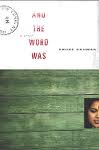
 After twenty-one hours of traveling, four different countries, three different planes, and three hundred and fifty pages, a litany kept repeating itself in my mind: my life, my time, my hope, my god, my faith, my love, my glory.
With his 2006 debut novel And The Word Was, Bruce Bauman has given us the gift of an honorable character and an honest man; a man who isn’t afraid to love. Neil Downs is an ER doctor from Queens who runs away from New York City after the tragic death of his son. He ends up in New Delhi, where a myriad of factors come together and blow up in front of the reader, ranging from the political to the philosophical to the hypocrisy that exists in our everyday lives.
Neil tracks down his favourite writer, Holocaust survivor Levi Furstenblum, whose writings are interspersed throughout the novel and are the catalysts to certain events. What was fascinating to me was Neil finding himself in the writings of Levi while Levi’s writing reflected what Neil is not. Levi might have lost his god, his family, and his faith in humanity, but Neil did not. Yes, Neil lost his son, his god, and even his wife for a while, but he was always on the path toward repairing this. Perhaps my favourite parts of the novel are the instances when Neil kneels down to help an injured young woman, and to place rocks on specific graves, as if he is brought to his knees from all the guilt, the tormented ghosts of his past, and his regrets.
(And perhaps my choice of Edith Piaf’s “Non, Je Ne Regrette Rien” wasn’t a random yearning that has been haunting me ever since I read Bauman’s first sentence.)
Curiously enough, “epistasis is the biological term, which science best defines as that nothing is simple and everything depends on everything else” (Bauman 230). The etymology of “epistasis” comes from the Greek word “epi,” meaning “upon,” and “stasis,” which means “stopping;” therefore “a stopping” or “stoppage.” While Neil is in this constant game of “stop and go” (something that Levi knows all too much about), they both need each other and everything that exists in the universe in order to survive.
In essence, this sums up Bauman’s novel beautifully (even if the science that has been carefully penned into this novel is sometimes out of my reach but hey! That is the beauty of fiction). When you lose a person you love, you lose a part of yourself. When you lose your god, your faith is shaken and you start to shatter into small fragments. Most of the time, those two are interrelated and I’m not quite sure which way the causal relationship works.
It is the tug of war that goes on in our entire universe. It is the debate of god and science, of love and loss, of death and life. It is the alienation that Neil feels wherever he may be, mentally or physically. It is his wish to go deaf—for silence in a world that is anything but silent. It is the desperation for something more and the unwillingness to accept that perhaps seeing is believing. It is the bonding of people who are suffering and how they heal each other by searching for the truth together, consequently bringing each other to salvation.
I can’t stop thinking about the struggle that Holika, an intriguing upper-class Indian woman who had a brief affair with Neil, faced with the social norms that exist in India. I can’t help but think about Abraham and Isaac. About Rilke and “The minds of murderers are easily comprehended.” About the similarities between India and America. Between Israel and Palestine. All the corruption and death, but all of the underlying humanity that is surely found between them. Between, between, between . . .
Ultimately, the greatest tragedy is not Levi Furstenblum losing his family or his god. It is not Neil Downs losing his son in a savage hate crime. It is not the unfairness that plagues India, America, or the world. The tragedy, fundamentally, lies with Sarah Roberts—Neil’s wife who is lamentably silent throughout the first part of the novel—who has her own heavy cross to carry. A cross that is so heartbreaking and so intense, that not even words could contain her pain as most of her journey was off the page. She was alone. And when Neil hears the anguished words of what really happened, our stomachs are in our throats, too.
Because while every single one of the broken characters in the book lose faith in a god that lives out of reach, Sarah loses faith in the man she loves. She lost faith in herself. But as much faith as was stolen from her, she did not lose faith in humanity. Humanity—which Levi (spells ‘Evil,’ spells ‘Live’) Furstenblum only saw the most vicious, the most atrocious, the most horrible aspects. Humanity—which never cared about the agony that was found in the victims of the 20th century, a counterpart to the hatred that was felt by their torturers.
And The Word Was is a novel that teaches the reader that hope is often found in the strangest, dampest, and darkest of places. It tells the story of hope always dying last. While I willingly run to the city that Neil Downs has tried to leave behind, I realise that hope is time, and my time will last as long as I want.
By Eleni Demetriou
an Associate Editor for Black Clock and a graduate of the MFA Writing program at CalArts.


