Singular, idiosyncratic and a little mysterious, Black Clock is one of America's leading literary journals.

Posts Tagged ‘Black Clock’—

Black Clock 16 Launch at The Last Bookstore

moody1Last Sunday, writers and readers alike convened at downtown L.A.’s The Last Bookstore to celebrate the much-anticipated release of Black Clock 16. Located in an old bank building fit with tall columns, dim lighting and an arched ceiling, the cathedral-like Last Bookstore hosts a massive collection of new and used books and vinyl records (many for as cheap as $1!) that requires seriously superhuman strength not to peruse for hours on end. What’s more, with such artful installations as its eerie flying typewriter sculpture and a walk-through tunnel made of books, The Last Bookstore offered Black Clock the perfect setting in which to launch its dystopic Issue No. 16. As KCRW’s Michael Silverblatt put it to the crowd on Sunday: “This is an entire issue of how we’re falling apart. Here at The Last Bookstore we can come together and not fall apart.”

Seats filled quickly and stragglers settled for standing room only as Black Clock Editor Steve Erickson took the stage to present the night’s readers. Up first was Claire Phillips (author of Black Market Babies and a previous contributor to Black Clock 15) reading the entirety of her short yet impactful story “Tubular,” a science fiction piece set in a disturbingly familiar, near-future Los Angeles which has succumbed to mass societal collapse after the 2010 B.P. oil spill. Attendees on Sunday listened intently as Phillips’ characters navigated their strange, new landscape with necessary wit and numbness, even in the face of 10-foot “land-faring mutant worms.”

Next was The Contortionist’s Handbook and Dermaphoria author Craig Clevenger, who read an excerpt from his short story “Chicken Wire” while clad in a pair of snakeskin cowboy boots. Also set in and around Los Angeles, “Chicken Wire” tells the ominously humorous story of Jimmy Wynn, a failed metal band guitarist turned cab driver who spends most of his time in the Mojave desert begging his rough-and-tumble customers to pay their fares. Fans should look out for Six Finger Films’ “Smoke & Mirrors,” a short written by Clevenger and based on a chapter of his current novel-in-progress, scheduled for release later this year.

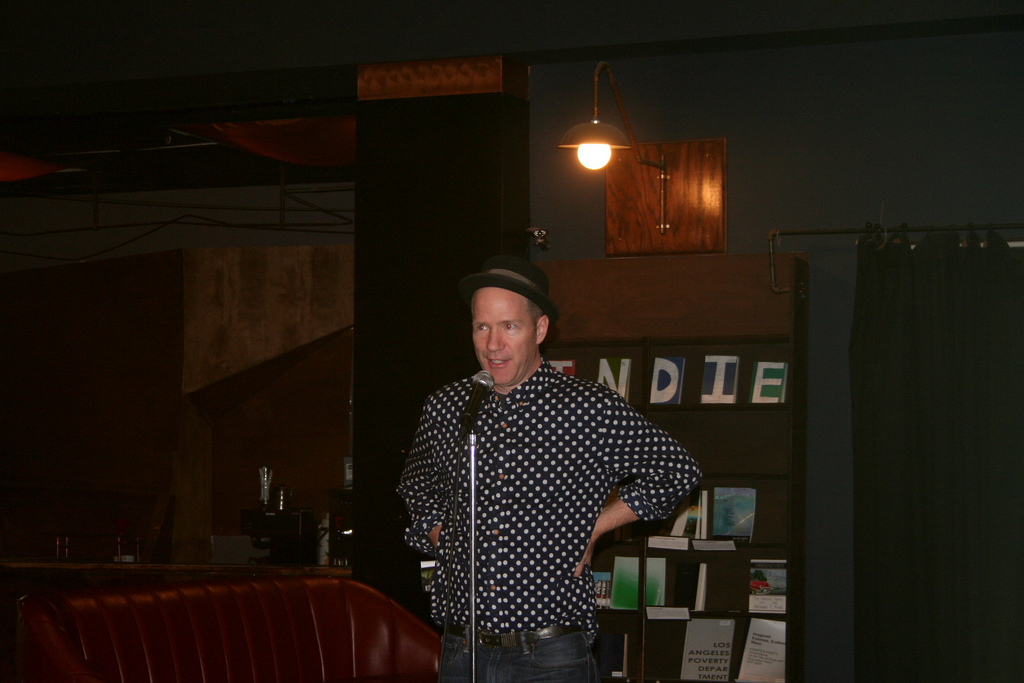
Last in the line-up was Rick Moody, author of The Ice Storm and most recently, On Celestial Music: And Other Adventures in Listening. Before reading, Moody took a moment to affectionately warn the audience, “If you happen to be of the Red State persuasion, you might want to go get coffee now.” This turned out to be good advice in the end: Moody read from his latest piece of nonfiction, entitled “Election Diary 2012” and chock full of unforgettable, fiery opinions regarding our country’s most recent presidential election race. Last Sunday’s listeners were especially tickled by his November 25, 2011 entry, in which Moody engages in a lengthy imagining of Newt Gingrich wearing diapers.

As the event came to a close, attendees mingled with the night’s readers and Black Clock staff in the relaxed atmosphere of The Last Bookstore’s main floor before slowly filtering out onto the twilit streets of downtown L.A. It was a night that proved truly surreal. Just like the issue it celebrated.


By Adriana Widdoes
an Editorial Assistant for Black Clock and an MFA Writing candidate at CalArts
SEE + HEAR + DO (5/3-5/10)

STEVE ERICKSON AT THE JAPAN SOCIETY IN NYC: SEEING STORIES: FICTION, MANGA & GRAPHIC NOVELS (5/03@76:30PM, NY)
East 47th St, New York, NY 10017
American and Japanese artists have been inspiring each other for decades. Tonight, authors Hideo Furukawa and Steve Erickson share their strong apocalyptic imaginations, and Roland Kelts, half-Japanese author of Japanamerica, will discuss the mutual influences in narrative visual art. Followed by a reception. Buy tickets online or call the Japan Society Box Office at (212) 715-1258, Mon– Fri 11AM–6PM, weekends 11AM–5PM. $12/$8 Japan Society members, seniors & students.

LARRY FLYNT + DAVID EISENBACH (5/04@ 7PM, LA)
Book Soup, 8818 Sunset Blvd, West Hollywood, CA 90069
The authors will discuss and sign their book One Nation Under Sex. Free.

CHICAGO DURUTTI SKOOL: WORKSHOP WITH THE NEXT OBJECTIVISTS (5/05@7PM, CHICAGO)
The Mess Hall, 6932 North Glenwood Ave, Chicago, IL 60626
A free, open-to-the-public poetry workshop dedicated to the study & reproduction of the outsidereal. Free.

THE POETRY OF GLOBAL CITIZENS (5/06@7:30PM)
Beyond Baroque, 681 Venice Blvd, Venice, CA 90291
Celebrate the launch of new works by Iranian-American poet and artist KATAYOON ZANDVAKILI in our upstairs Project Room. Readings to follow. Admission $7, students/ seniors/children $5, Free for members.

FREE COMIC BOOK DAY (5/07@ALL DAY)
Various Locations
Free Comic Book Day is a single day–the first Saturday in May each year–when participating comic book shops across North America and around the world give away comic books absolutely Free to anyone who comes into their stores.

MOTHER’S DAY FESTIVAL ON OLVERA STREET (5/8@ 10AM, LA)
Olvera Street, El Pueblo de Los Angeles Historic Site, Main St & Cesar E Chavez Ave, Los Angeles, CA 90012
Food, fun and celebration of moms. Free.

AN EVENING WITH LEONARD NIMOY (5/09@6PM, BOSTON)
Metcalf Hall, Boston University,  775 Commonwealth Ave, Boston, MA 02116
The pop-icon and Boston native discusses his life and multi-faceted career. $25 admission, Free to members of the Friends of the Libraries and the BU Community.

Between 11 and 1: Zero Hour in the BLACK CLOCK archives

It has been nearly six years since Black Clock 1 rolled off the presses (presses in Iceland, in fact.) Since then, ten more issues have been published, and the magazine has steadily established itself as a unique forum for experiments in the written word from many of the eminent voices in literature today.

But what is the essence of Black Clock? Is there a consistency across time: a unified vision that persists? Certainly one of the distinctive features of the magazine remains its visual impact as an object of art in and of itself, not merely a sort of textual delivery system. A quick comparison shows that this has not changed even though Black Clock has had three separate art directors: Gail Swanlund, Ophelia Chong, and, currently, Chris Morabito.

From Black Clock 1’s goal, in Steve Erickson’s words, to “bring together a group consisting of some of your favorite and most admired writers, and then have each one write whatever he or she wished” to Black Clock 11’s “tour of that which cannot be recovered,” the premise of each issue has remained maddeningly approximate and yet fully coherent as one makes his or her way through each issue’s content. This becomes all the more surprising in light of Erickson’s decision to open up submissions to new, unsolicited material. Black Clock allows its readers to wander blindly through its pages without hand-holding or explicit context, both visually and thematically, and this seems to be the crux of its aura of mystery.

Black Clock 1 and 11 share two contributors: Rebecca Goldstein and Joanna Scott. Their bios have both bulked up significantly in the intervening years. One general difference that stands out is a vague sense of the ballooning of secondary content between 1 and 11. The staff has grown from ten to twenty eight though this seems mainly due to an increased academic symbiosis between the magazine and its publisher, CalArts. The magazine now sells ad space, has outside benefactors, and devotes several pages to “shout-outs” to those that make its production possible: all signs of a healthy magazine in an era where the written word seems to be on life support as an economically viable means of distribution.

One darkly ironic piece of evidence of this is the variance in respective cover prices – because in the end, we live in a bottom line era. $12 US in March of 2004, and only $13 US as of December 2009. Less than inflation! A tribute to the benevolence of Black Clock to its readership? Evidence of good business practices and a tightly run ship? Sure that’s a part of it. Ah, but what about these numbers: $16 dollars Canadian in 2004. $14 Canadian in 2009. Ouch! Art as a gauge of the economic landscape.

And as grim a picture as these and circulation numbers paint for the small press in the United States, it’s worth noting that maybe the most frequent comment Black Clock fans make to staff at readings and through correspondence is that they think of the it as more than a mere magazine, but as a sort of trans-genre aesthetic object. Something savable, collectable, and treasured. Whatever future awaits the printed word, it seems safe to say that Black Clock 1, 11, and – with a bit of luck – 111 will continue to bear witness to their literary time and place as artifacts, but never fossils.

by Mark Skipton
a graduate of the MFA Writing and Integrated Media Programs at the California Institute of Arts and an Associate Editor for Black Clock

Honors For Steve Erickson

Black Clock editor Steve Erickson is one of seven writers to receive an Academy Award in Literature from The American Academy Of Arts And Letters. Additionally, Steve has been named a finalist for an American Society Of Magazine Editors National Magazine Award in Criticism.

In 1941 The American Academy Of Arts And Letters established awards to encourage creative work in the American arts. Now $7500 each, Academy Awards are given annually to artists, writers, composers, and architects. The Awards in Literature are given in recognition of “exceptional accomplishment in any genre.” Past recipients of this honor include David Mamet, William S. Burroughs, David Markson, Rikki Ducornet, Lorrie Moore, and Black Clock contributors William T. Vollmann and Don DeLillo.

The awards will be presented in New York in May at the Academy’s annual Ceremonial. The Academy’s 250 members nominate candidates, and a rotating committee of writers selects winners. This year’s committee members were Philip Levine, Romulus Linney, Rosanna Warren, and Joy Williams.

Co-sponsored by the American Society Of Magazine Editors and the Columbia University Graduate School In Journalism, the National Magazine Award is generally recognized to be the highest (or Pulitzer-like) honor accorded to writers in the magazine industry. Steve has been nominated for three reviews which originally appeared in the Los Angeles Magazine:

“The Next Frontier” [essay on the revived science fiction television serial Battlestar Galactica] (January 2009)

“War Games” [essay on Kathryn Bigelow’s The Hurt Locker and Armando Iannucci’s In The Loop] (July 2009)

“No Ordinary Fad” [essay on the enduring popularity of The Beatles in the digital age] (September 2009)

Past recipients of the Award in Criticism include James Wood, Adam Gopnik, James Wolcott, Anthony Lane, and Black Clock contributor Tom Carson. Winners of the “Ellie” (named for the the Alexander Calder stabile “Elephant” awarded each winner) will be feted at a gala to be held at Alice Tully Hall in New York on April 22nd.

For a complete listing of this year’s nominee’s, please visit the Magazine Publishers Of America‘s website.

Congratulations Steve.