
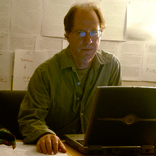
 Often funny, occasionally heartbreaking and always revelatory, Bruce Bauman puts deep character-driven narratives through their proverbial paces, playing with conventions of form, genre and conceptions of history. His writing, which runs the literary and journalistic gamut, has appeared in the L.A. Times, Salon, BOMB, Bookforum, numerous anthologies, and literary magazines, and has garnered Bauman the City of Los Angeles Award in Literature, the UNESCO/Aschberg Bursary in Literature, and grants from the Durfee Foundation and the Jewish Communal Fund, among others. The author of the novel And The Word Was–the story of physician Neil Downs, an expatriate New Yorker who travels to India following the dramatic death of his only son–is currently at work on his new book Broken Sleep, which will be published by Other Press. Bauman is also an adjunct professor in the CalArts MFA Writing Program and the Senior Editor of our very own Black Clock.
BLACK CLOCK: Much of your work seems to comment on history and time; individuals’ dynamic relationships with both their own pasts, others’ perceptions and the official record. I’m curious about what draws you to and informs your treatment of these complex subjects.
BRUCE BAUMAN: First, thanks for your compliments and your very thoughtful questions. They made me aware again why interviews are good for my ego but hard on my brain, which leads me to your question. My sentiment is the inverse of Piaf’s “I regret nothing”–I regret everything. I don’t think I’ve gone one day in my life without regretting something I’ve said or done. (I’m already wondering if I will regret this answer.) So, for that reason, and by extension, my characters are always haunted by their actions and their pasts.
I started writing a diary as a teenager. Aside from tedious whining about my failures with girls and in sports, I chronicled my nightmares/dreams. It was also a rant of teenaged angst and anger. Lennon’s song, “Gimme Some Truth”–pretty ironic coming from such a notorious myth-maker–that primal scream against all the bullshit really resonated with me and millions of others. I thought I could find truth. Now, I’m not even sure how to define truth. I don’t believe in any objective truth. There is always more mystery. Questions left unanswered.
Still, fiction became my road to truth. How to wade through our perceptions or deceptions is my challenge. All successful relationships are complicated in their own way. Often, they are based on unstated negotiations, compromises and social contracts. When these negotiations break down or our mythological selves are exposed, the relationships become uniquely unsuccessful and crisis hits. That’s a starting point for much if not all of my fiction. There’s a line in my novel-in-progress, Broken Sleep, that might be relevant here: One person’s version of history is another person’s version of an incomplete truth.
In Word, Sarah and Neil each tell the other a “lie” that they think will protect the other from major pain–which turns out to be a horrible course to take. Yet there are also secrets that each still holds that work to salvage their relationship and sanity. Castor’s death forces Neil to deal with his fractured relationship to god. The resolution he comes to surprised me and was not what I had in mind when I started the book. The characters took over. When the characters take over, in my experience that makes for the best fiction.
I’m obsessed with American History. Each country has its own version of history. I tried to address selective and reshaped historical memory in my character Levi Furstenblum’s Chambers of Commerce where the Holocaust is not a myth as much as reinterpreted such that Hitler wins the Nobel Peace Prize.
In Broken Sleep, each of the four narrators is living under at least one major false assumption about their past. All revelations are intertwined and their lives metamorphose as the story is propelled forward. There’s a line in the book which sums this up: “The past, present and future are fixed and ever recurring, inseparable and singular, ever-changing and never-changing, and always, always at once, dead and alive.”
And The Word Was is quite diverse stylistically. You have Neil’s first person narrative, which perhaps resembles a diary/travelogue, Levi’s writings, which range from the sci-fi/historiography of Chambers of Commerce, to Mystical Mistakes and his Unpublished Works which take the form of philosophical essays, plus a number of Biblical and Vedic stories and personal anecdotes related by various other characters. The pieces fit together beautifully, but at the same time they all have a great deal of vitality of their own. How did the novel develop as such and why this way?
Word developed over many years of false starts and trials and many, many errors. I had the idea of using multiple child sacrifice myths as the philosophical underpinning for the novel. Chambers of Commerce was originally a short story. When it hit me to combine the two–and Wham!–everything coalesced and the character of Levi Furstenblum came alive and his presence in the Neil story and as narrator in his own right and the book finally worked. The Mystical Mistakes and Unpublished Works sections were based on notes I’d been keeping for years. There is much in my work that is thought out and premeditated and there is a great deal more that comes from the well of my unconscious and I am thankful for that.
I’ve often said that Levi is much smarter than me; and I mean it.
I started writing Broken Sleep in the ’90s. It wasn’t right. I stopped until I felt ready to try again. Now I feel good about it. I have super-supportive editors at Other Press. Again, there’s a mix of genres: realism, speculative fiction, diary and for lack of a better phrase, traditional third-person.
There are many theories behind the book, but the bottom line is that the characters have to be compelling. Hate them or love them, I want the reader to be driven to turn the page. The phrase “page turner” has an unfairly pejorative connotation. I try to incorporate linguistic experiments, symbolism, subplots and challenges to the reader but it all has to be building to a climax/revelation. The term “literary fiction” doesn’t have to imply boring or “too difficult.” That’s anti-intelligence and anti-intellectual bullshit.
Who and what inspires you? Do you see yourself as responding to, modifying, or working within or against certain literary, social, or philosophical traditions in particular?
My influences cover a vast spectrum–from The Bible and Jack Kirby to the Marx Brothers and Fitzgerald to all sorts of music and art and that is featured prominently in Broken Sleep.
But if there’s one book that changed my life, it’s Kafka’s The Trial. I was 14 when I first read it. Not that I was that precocious–mostly I was reading sports books or trying to get my hands on a Playboy. I grew up in a working class part of Flushing, Queens. At that age I imagined myself one of the tough guys in The Wild One or like The Who because they were so violent and seemed so cool with the chaos. It was one highly delusional self-image. Riding a motorcycle has always scared the shit out of me.
I was kind of having a nervous breakdown. I’d gotten accepted to Stuyvesant and in an act of teenaged obstinacy, refused to go. The first semester of tenth grade, I mostly just sat in my room like a zombie. My parents made, what in retrospect I see was a major sacrifice, and took out loans for me to go to a private school in Manhattan. I’m not sure why I agreed. Some sense of self-preservation. It meant hours every fucking day on the subway so I read or fantasized– my great escape. I was reading about the Stones and Altamont and Alan Passaro, the Hell’s Angel who stabbed the guy who was going to shoot Jagger, and he mentioned his life was like The Trial. So, I bought it. I was 100% clueless as to who is this guy Kafka. The book was so bleak, so dark and so funny– that in some upside down way it gave me hope. I don’t claim I understood it then as I do now after so many readings (and with the insight of Maurice Blanchot and Erich Heller). Later I read Kakfa’s diaries, which I still carry around like my bible, and the last line he wrote is my mantra– “More than consolation is: You too have weapons.”
And The Word Was is a conscious homage/finger flip to the generation of Jewish writers like Roth, Bellow, Malamud, Potok. You can see that in the opening lines.
Primo Levi was also an influence.
Finally, my wife, Suzan Woodruff, a brilliant painter, inspires me. She really does become one with her paintings—and watching her work just knocks me out.
This concept of all successful relationships being based on often unspoken negotiations and social contract strikes me as being part of the essence of fiction. For example, writers and readers communicate closely, and even though their dialogue is silent and amorphous, they and the text change since a reader’s articulation of his response is a transformative act in itself. It seems to me that as creative non-fiction becomes increasingly popular (and it is, right?) and readers learn (or have the ability to learn, or think they are learning) more about the personal lives of the authors they read, that the relationship between authors, their work and readers is changing profoundly. I’m curious about how you feel about this, especially given the nightmarish tabloid saga in And The Word Was.
The reader and characters have to form a symbiotic relationship. If they don’t, the relationship is over by page 50, if not sooner.
I hope my feelings about the intrusiveness are clear from Word. The rise of creative nonfiction and “new media” encourages the idea that fiction is just disguised autobiography (my life is not that interesting), and has introduced a complicated writer-reader relationship with few boundaries. Even doing interviews gives me pause–not enough that I won’t do them. There’s a reason I’m not on Facebook–yet.
Your short piece, “Day Break – City Lights” seems to exemplify your interest in intertextuality and form–specifically film, whereas “The Necklace” integrates music and Kandinsky. Do you typically approach your stories from these more abstract, evocative sources, or begin with more concrete ideas and adorn them this way later?
I have no consistent plan. I started “Day Break” in ’98 when we were moving to L.A., a town where Peter Pan-like attitudes on time and youth are prevalent, and as a reaction to the blather about the fractured structure of Pulp Fiction. I wanted to write a story out of chronological order in the way films are shot out of chronological order and was also about movies. It also had roots in Heinrich Boll’s story “Murke’s Collected Silences.”
“The Necklace,” which is also a nod to de Maupassant, was inspired by an interview I saw with a Viet Nam vet about wearing “necklaces.” I’m a huge fan of Kandinsky and the way he created personal myths and symbolism, so the imagery from his apocalyptic paintings seeped into me.
You mention allowing the characters in And The Word Was to take over; I’m curious how you approach facilitating this. Do you feel that successful relationships between you and your characters require this kind of ambiguity?
I don’t have a systematic approach. I write and write and write. If the characters take over the story starts to tell itself and I keep going. If not, it gets tossed into the “I wish I were a tennis pro” bin with scores of others. And then, onto the next story.
_
by Seth Blake
an Editorial Assistant for Black Clock and an MFA Writing candidate at CalArts
photography by Justin Kalman
