
Singular, idiosyncratic and a little mysterious, Black Clock is one of America's leading literary journals.

Posts Tagged ‘Black Clock 15’—

Black Clock’s Own “Drifting Clarifier”: The Anthony Miller Interview, Part Two

The first part of this interview with Anthony Miller, Black Clock’s Editor-at-Large, appeared on this blog way back in September 2012. The promised sequel to the interview was starting to look as apocryphal as one of the movies Miller wrote about in Black Clock 15. In the second part of the interview, we continued our conversation about his “Alternative Film History,” as well as his larger role in the shaping of Black Clock.

BLACK CLOCK: What does it mean to be Editor-at-Large of Black Clock?

ANTHONY MILLER: I’m still not entirely sure. After being a contributor who sat in on more than a few editorial meetings, Steve christened me “Editor-at-Large” starting with issue 7.  In that issue, I had the privilege of working with Samuel R. Delany on his story “In the Valley of the Nest of Spiders,” which eventually became his 600-plus-page novel Through the Valley of the Nest of Spiders. Since then, I’ve been a roving resource, soundboard, and consultant, engaged in some combination of brainstorming, contributing, and editing. My responsibilities have differed with every issue. Brian Eno once described himself as a “drifting clarifier.” That’s how I fancy myself as an editor-at-large. It’s also one of those masthead monikers that confer instant gravitas upon you.

BLACK CLOCK: What is your process for writing the essay-like capsules for Black Clock?

ANTHONY MILLER: The capsules are actually the easiest and most fun things to write. They’re so small; I try not to take them too seriously or to overwork them.  (I do not always succeed.)  I think of them as barroom riffs. It’s as if you’re drinking with your friends and discussing the most influential first novels or weirdest cult movies or your favorite music or restaurant critics, tossing out just the right arresting detail or amusing insight, trying to make your case in a very narrow conversational window.

BLACK CLOCK: What was the process like writing those capsules with Steve Erickson for the “Noir” issue (Black Clock 10)?

ANTHONY MILLER: Steve thought our Noir issue ought to have a kind of primer that would run throughout the issue. I was flattered when he asked me to collaborate with him in compiling a list and writing capsules. We began by exchanging a series of lists about books, movies, music, and images that were swirling in our heads as we grappled with the question “What is noir?” At first it was intimidating because Steve was one of the people who first got me reading writers like Charles Willeford, which led to my discovery of The Burnt Orange Heresy (#32 on our list). There are about a dozen entries where we combined forces so that we could both weigh in on a particular “noirtifact.” We disagreed about some entries but we found that we each ranked The Long Goodbye and Double Indemnity exactly the same (#2 and #1, respectively).

BLACK CLOCK: Reading your alternative film timeline from issue 15, I kept feeling like I was watching a time-travel movie, as if a slight alteration to Cary Grant’s career in 1940 somehow offset Val Kilmer’s life some fifty years later. Did you write the timeline chronologically?

ANTHONY MILLER: I love the idea that Cary Grant’s portrayal of Hamlet in Hitchcock’s film is the butterfly that flaps its wings and causes the storm of Val Kilmer’s demise. I’m overjoyed to hear it felt like time travel. I love time-travel movies and universe (or multiverse)-jumping narratives like those on Fringe and in Matt Fraction’s comic book Casanova. I also relish Alan Moore’s exquisitely researched historical distortions in his League of Extraordinary Gentlemen: Century trilogy. As I’m discussing comic books, I should add that the very first alternate histories I encountered were in the pages of a Marvel comic book called What If.

As I mentioned before, I did not proceed chronologically. I had a bunch of ideas already in my mind but I also sat around riffing with my friends and they came up with ideas I could never have imagined. Some of their ideas set my mind spinning in altogether different and fascinating directions. Two influences outside my circle of movie-going friends were Patton Oswalt’s program of imaginary double-bills in his 2007 tribute post to the late Sherman Torgan, the proprietor and double-feature programmer at the New Beverly Cinema, “I Will Program A Month In Heaven For You, Sherman Torgan” and Sean Hartter’s fantastic and fantastical movie posters. I was thrilled when Sean agreed to share his magnificently divergent visions of the movies with us. His cover for Black Clock 15 is an absolutely ideal representation of the issue.

BLACK CLOCK: Is there a single entry in the timeline that feels most important? One that had the biggest impact on the rest of the timeline?

ANTHONY MILLER:

For Establishing a Divergent World…:

Buckaroo Banzai Against the World Crime League, the second successful film in the Buckaroo Banzai series.

For Charting A New Direction Not Only In Movies But Also In Music…:

Nicolas Roeg’s A Clockwork Orange, starring Mick Jagger as Alex, with the rest of the Rolling Stones as his fellow “droogs.”

For Imagining What Would Never Be…:

Chris Farley’s Oscar-winning role as “Fatty” Arbuckle.

BLACK CLOCK: Which is the better adaptation of a postmodern novel and why: Cassavetes’ version of The Crying of Lot 49 or Wes Anderson’s Pale Fire?

ANTHONY MILLER: Of course, Frederic Jameson examines Cassavetes’ Lot 49 in his analysis of Pynchon in his totemic Postmodernism, or, The Cultural Logic of Late Capitalism. Ray Carney says when Cassavetes discovered Pynchon’s book—which he felt had some affinities with his Shadows—he thought of the young girl he had worked with on Paul Mazursky’s Tempest. That was how Molly Ringwald came to be cast as Oedipa. As for the film version of that diamantine Nabokov book Mary McCarthy called “a creature of perfect beauty, symmetry, strangeness, originality, and moral truth,” I recommend Wes Anderson’s essay in the Norton Critical Edition of Pale Fire and that magnificently erudite and weird collection Pale Fire ReasZembled.

I should probably say The Crying of Lot 49 because you Don’t Ever Antagonize The Horn.

BLACK CLOCK: Since your interests and taste plays such a big part in your work, I’d like to ask for just a list of the various things you like, but in lieu of that, What are your favorite books? What has affected or influenced your writing the most?

ANTHONY MILLER: Some books I love: Gravity’s Rainbow, The Marriage of Heaven & Hell, Labyrinths, Pale Fire, The Phantom Tollbooth.

A number of other things of which I am fond: Thelonious Sphere Monk, Charles Mingus, Anthony Braxton, Van Morrison, David Bowie, Robert Wyatt, the Mekons, Ken Nordine, Gil Scott-Heron, Robyn Hitchcock, PJ Harvey, The Handsome Family, The Firesign Theatre, Marc Maron, Joseph Cornell boxes, Rosamond Purcell photographs, poems by Yeats, Eliot, Berryman, and Paul Muldoon, Flann O’Brien and Italo Calvino on living inside stories, Alberto Manguel on readers and libraries, comic books by Grant Morrison, cultural musings by Luc Sante, bewildering and bewitching ephemera from Ben Schott and John Hodgman, plays by Wallace Shawn, films with Tilda Swinton, Bookworm, Dangerous Minds, HiLobrow, BLDGBLOG, The Venture Bros., Utopia (the Channel 4 series), arcane words, obscure museums, strong coffee, reading aloud to women, annotations, aphorisms, epigraphs, digressions, lists, trivia, the year 1973, the Reino de Redonda prize, a properly pulled pint of Guinness, well-aged whiskey, midnight movie screenings, Scrabble, cats, psychogeography, pogonotrophy, mythology (ancient and modern), curiosity, passion, originality, affection.

I love the maximalist novel, the concept album, the epic movie. I adore artists who attempt to encompass entire worlds in their work, who are unapologetically inclusive and ultra-referential, who work on everything-but-the-kitchen-sink canvases. Some of these artists—Pynchon, Bowie, Kubrick—have also affected me by being as emblematically enigmatic as any of their works of art.

BLACK CLOCK: What is the one “secret” book or movie that you think should get more attention?

ANTHONY MILLER: There are so many books that deserve more attention. Anything by Anna Kavan, Russell Hoban, Alasdair Gray, Alexander Theroux, Bruce Olds, Siri Hustvedt, and fellow Black Clock 15 contributor Geoffrey O’Brien. I have always believed J.G. Ballard’s writing tells us more about the time in which we live than Jonathan Franzen’s. Victoria Nelson’s The Secret Life of Puppets and Gothicka should both be read by anyone who is at all curious about the role of the supernatural in the 20th and 21st Centuries. Another recent book which impressed me with its scope and obsessiveness was Dave Tomkins’s absolutely alluring history of the vocoder, How to Wreck a Nice Beach. Not long ago, I recommended Wanderer by the actor Sterling Hayden to an adventuresome friend of mine, an autobiography of a flinty yet thoughtful Hollywood nomad that makes a bracing antidote to an age when people don’t seem to have to have accomplished very much before penning a memoir.

A truly secret film is David Blair’s Wax or the Discovery of Television Among the Bees, a bizarre amalgamation of apiology, military history, and conspiracy theory, which I read and heard about before I tracked it down on video. It can also be watched on the Internet. You’ll never get the bees out of your head again.

BLACK CLOCK: How does Los Angeles fit into your writing? How has it influenced your writing?

ANTHONY MILLER: I was born and raised in Chicago and lived for a few years in Dublin. Both of those cities have had as much impact on me and on my imagination as Los Angeles has. Some days, after more than a decade, I’m still not sure I live here. I think L.A. is simultaneously the most exhilarating and confounding place I’ve ever lived, but my writing isn’t rooted in any of its well-worn literary tropes: fame, noir, self-invention, oblivion, apocalypse, decay, the shimmer of fool’s gold. I have learned about this city from the work of Reyner Banham, Mike Davis, Thom Andersen, and Steve Erickson, among others, but I’ve learned just as much from driving around and getting incredibly lost.

BLACK CLOCK: If you were to write an entry for “Black Clock” in an encyclopedia of literary journals, what would that entry say?

ANTHONY MILLER: Established in 2004, this journal of the mercurial and the magnificent, of the evanescent and the intransigent, of the profound and the profane, remains known for its sinuous wordplay and scintillating design, its dedication to its stable of brilliant and wildly successful contributors, and its complete absence of page numbers in its Table of Contents.


By Sam Freilich
an Associate Editor for Black Clock and an MFA Writing candidate at CalArts
The Anthony Miller Interview: Part One


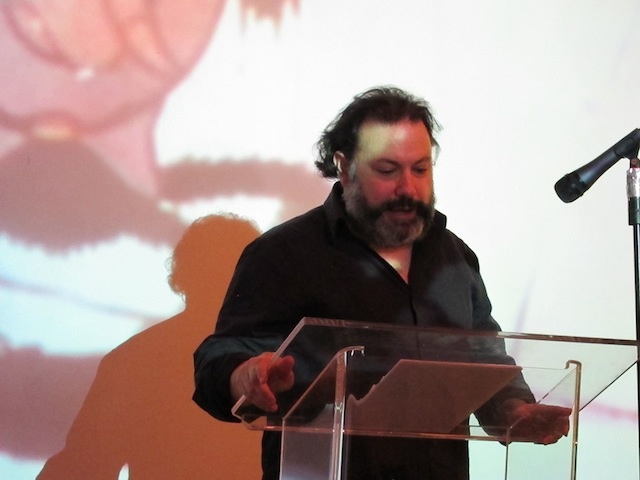
Black Clock Editor-at-Large Anthony Miller is participating in Literary Death Match tonight, September 6th. If I were a betting man, and if there existed a sports book that released odds on semi-competitive literary events, my money would be on Miller. His contribution to the most recent issue of Black Clock, “A History of the Cinema 1920-2014,” is the sort of writing meant to pulverize the LDM competition. Each entry in the alternative timeline packs a sharp, nearly deadpan punch, like a Steven Wright one-liner. They are paraprosdokians that bend the dry rhetoric of most film histories into fantastically absurd contortions. Ronald Reagan stars in The Maltese Falcon; Alejandro Jodorowsky directs the megahit Dune; and John Cassavetes adapts Pynchon. As Miller explains below, in the first part of our two-part interview (part two can be found here), his timeline is “a love letter to timelines and the kinds of stories timelines tell.”

Besides Black Clock, he has written for Bookforum, LA Weekly, Los Angeles CityBeat, and Poets & Writers, and is currently at work on a novel and “a book about encyclopedic novels and secret histories.” The back of issue 15 enigmatically identifies him as its “conceptual progenitor.” In all of his Black Clock work, Miller uses short, mostly nonfictional essays to tell stories as strange and expansive as any novel. His pieces are punch-drunk valentines, heart-shaped capsules dedicated to preserving and celebrating obscure, beloved cultural flotsam and jetsam, both high and low. Safire’s Political Dictionary; David Foster Wallace’s tennis writing; Chris Farley’s Oscar-winning turn as Fatty Arbuckle (Black Clock issues 9, 12, and 15 respectively). What do these things all have in common? There’s an obvious through-line connecting everything Miller has written. But those connections aren’t really identifiable; they’re more intuitive or synaptic, like a game of black magic or Justice Potter Stewart’s definition of pornography. You can’t necessarily define it, but you just know an Anthony Miller subject – whether it’s an encyclopedia of political history, postmodern sports analysis, or an impossible pop-cultural moment – when you see it. You will see it when he reads tonight at Busby’s East.

As much as it’s a love letter to movies, the piece also feels like a send-up of the way people have written about movies, especially with its stern, wrought title, “A History of the Cinema: 1920-2014.” Why start at 1920, with Caligari, and end at 2014, with Nicole Holofcener’s post-feminist remake of The Maltese Falcon?

I appreciate that you read it as a love letter to cinema. It’s also a love letter to timelines and the kinds of stories timelines tell, whether it’s in the appendix of a book or on a museum wall. As for the title, it was the only thing I could have called it. The dates were simply where I began and ended in this particular version. Among the many film books on my shelf is A Concise History of the Cinema, Volume 1, edited by Peter Cowie (The Tantivy Press, 1971), which I consulted a few times during the writing of my chronology.

I considered creating not just an alternate timeline of the movies but an alternate timeline of science, one in which film stocks and cinema projection were invented in 1850. The resulting Mathew Brady, Alexander Gardner and Timothy O’Sullivan films of the Civil War were so gruesome that they forever altered our consciousness about war and violence. Then I realized that was absurdly Pollyannaish and the whole concept of an entirely other universe was too complex and multifaceted for a mere timeline. Maybe I’ll do it in a novel—and throw in some vampires. That’s the ticket to writing a bestseller these days, isn’t it?

Finally, not that I was thinking about this at the time, but Caligari is an expressionist movie about a mad somnambulist. What better way to usher us into a kind of cinematic dreamworld?

I feel like one of the pleasures of reading your piece is how it speculates on the idea of this secret, disappearing history becoming the dominant one–if Louise Brooks had become the biggest star of the thirties, if Uncle Boonmee became a Disneyland ride, etc. (It also feels in a way like this great, big inside joke.) How and why did you choose each of these events?

The real challenge was just how many directions I could have gone, just how many tentacles this beast had. I wanted to be authoritative, but eventually realized that would be a trap. My choices were definitely not random but they were, ultimately, utterly subjective. That’s the beauty of speculative histories: Everybody’s world would look completely different. Steve [Erickson, Black Clock Editor-in-Chief] really wanted me to make Idris Elba the star of Tarantino’s James Bond movie, and I refused. No disrespect to Stringer Bell—The Wire is one of the great TV shows—but even though he might have been 007 in Steve’s crypto-cinematic consciousness, this was my timeline and I didn’t envision it that way.

If the timeline can be read, as you say, as a “great, big inside joke,” it’s one that’s made up of little jokes, or at least knowing nods in certain directions. In my universe, it’s Manny Farber, not Pauline Kael, who picks up the first National Book Award for film criticism. (Kael becomes an actress in Altman’s Nashville and other seminal films of the 1970s.) Books such as The Dolly Dolly Spy, A Confederacy of Dunces, and Flicker have their moment on the big screen. I found places for obscure filmmakers like Joycelin Shrager, whom I borrowed from an entrancing Thomas M. Disch short story I read in a collection called Hollywood Unreel.

Steve wanted the timeline to serve as the introduction, the portal, the wormhole to this issue. It’s like Zack Snyder’s alternative-history credit sequence for Watchmen (unquestionably the best thing about that misbegotten film) where we see moments in twentieth-century history transformed by the presence of superheroes. The Louise Brooks entry was one of my first. Her decision to play the lead alongside James Cagney in The Public Enemy was one of the scenarios described to potential Black Clock 15 contributors to give them a sense of the issue we were imagining. It seemed like an easy way to alter an entire decade with one actress.

The Uncle Boonmee entry—one of the very last entries to find its way into the timeline—originated because I figured Apichatpong “Joe” Weerasethakul shares a certain fanciful sensibility with Walt Disney. There’s a jungle setting, a talking catfish, a princess, and a monkey ghost—think of it as “The Wonderful World of Weerasethakul.” Wouldn’t you be far more curious to climb aboard an Uncle Boonmee ride than a Transformers ride?

All the entries feel like pieces in a giant, intricate puzzle; each date contingent on the next. What was the process of getting those pieces to fit together?

It demanded a basic curatorial sensibility that is demanded of all writers: not too many films from any one genre, not too many films from any particular decade. I edited for rhythm, sequencing short and long listings. With only a few exceptions, each director was assigned a single film. You wanted a more profound answer than that, didn’t you? Really, it was a practical problem—a jigsaw puzzle, like you said.

Initially, the timeline was MUCH longer. (I would like to find a home for the more extended timeline, one that would cast out beyond the cinema.) I tested a number of entries out on my very patient friends; the ones that got the best reactions, I kept. One reader later described the timeline as “fantasy football for film nerds.” It was great fun to contemplate how an invented film or a recasting of an existing one could alter the course of cinema, whether it was a minor shift or a seismic realignment. After a conversation with Bruce [Bauman, Black Clock Senior Editor] about recasting The Wizard of Oz, we decided it would be funny if Bill “Bojangles” Robinson played the Scarecrow to Shirley Temple’s Dorothy. In 1980, this would then convince Michael Jackson, who felt he hadn’t done enough in The Wiz to eradicate Robinson’s minstrelsy, to accept a role as a gay man in A Chorus Line. (His potential participation in A Chorus Line is mentioned in John Jeremiah Sullivan’s phenomenal essay “Michael” in Pulphead.) I also deliberately preserved a few real films within my timeline.

At first, I created entries as they came to me, with little regard for chronology. I had a number of different tracks running at once: The Movies That Might Have Been, The Sequels That Never Were, Movies From Novels and Movies, Movies About Richard Francis Burton (who makes an appearance in my essay in Black Clock 4). I worked in some entries based on some of the other stories in the issue including (with the author’s extremely kind permission) Geoff Nicholson’s truly brilliant inspiration of casting Buster Keaton to star in Andy Warhol’s Read. I had an inkling of what Mark Z. Danielewski was doing with “Clip 4” and incorporated and embellished details about the mysterious filmmaker Darc as I saw fit. On the flipside, a number of the films from my timeline make scattered appearances in “Clip 4.”

Which of these movies would you have most liked to have seen actually happen?

So many of them: Sergei Eisenstein’s Unterwelt, Orson Welles’s Heart of Darkness, Maya Deren’s Spellbound, Jean-Luc Godard’s Ubik, John Boorman’s The Third Policeman, Jacques Rivette’s Life A User’s Manual, the Wachowskis’s Invisibles trilogy, Terrence Malick’s Zoolander prequel Hansel. I shouldn’t forget Shaft in Space or any of the Matt Helm movies with Elvis Presley.

Of the ones that actually had the tiniest foothold in our reality, I have to go with Jodorowsky’s Dune. For one thing, you wouldn’t have to get high to enjoy it. I say this as an enormous David Lynch fan who back in 1984 saw a midnight preview of Dune where we received a double-sided glossary of “Dune Terminology.” (I still have it.) Lynch would have given us Ronnie Rocket instead. I think Jodorowsky would have made the ultimate psychedelic epic. His Dune would have been a work of genius or a crime against cinema. Either way, it would have been unforgettable.

By Sam Freilich
an Editorial Assistant for Black Clock and an MFA Writing candidate at CalArts

Black Clock 15 OST

Black Clock contributor Howard Hampton (issues 4 and 15) has compiled a soundtrack for the sweeping epic (during which no one will be seated!) that is our latest issue. Fire up your Maxwellian demon or tune into your imagination and viddy what scenes may come.

Black Clock 15
The soundtrack album that never was!

Compiled by Howard Hampton*


1. “Waiting for My Man,” The Yardbirds [from the film Kaleidoscope]

2. “Hankuri,” Mad Man Jaga [from the film A Clockwork Orange]

3. “America (She Can’t Say No),” Throwing Muses [from the film The Crying of Lot 49]

4. “Indifference,” Robert Plant [from the film The Monkey Wrench Gang]

5. “The Shadow World,” Sun Ra [from the film Elvis vs. Cthulhu]

6. “Stranger in My Home Town,” Elvis Presley [from the film Elvis vs. Cthulhu]

7. “Katrina,” James Blood Ulmer [from the film Katrina, Academy Award winner Best Picture, Song, and Director, Charles Burnett, 2009]

8. “Mother,” Lou Reed [from the film Baz Luhrmann’s Intolerance]

9. “Who Killed Marilyn?” The Misfits [from the film Hollywood Babylon]

10. “Stagger Lee,” Joan Baez [from the film Shaft in Space]

11. “Darktown Strutter’s Ball” / ”I’ve Got a Feeling,” Maria McKee [from the film A Confederacy of Dunces]

12. “A Cottage for Sale,” James Brown [from the film The Honeymoon Killers]

13. “War with My Soul,” Raven [from the film Ronnie Rocket]

14. “A Minute and Two Seconds,” John Cage [from the film Uncanny X-Men]

15. “See No Evil,” Wild Flag [from the film Angel Archer]

16. “Dead Flowers,” Ronnie Lane’s Slim Chance [from the film Maximum Dogbreath]

17. “Going Down the Road Feeling Bad,” The Carolina Chocolate Drops [from the film The Life of the Party]

18. “Pale Blue Eyes,” Laurie Anderson with Lou Reed [from the film The Lovely Bones]

19. “Tea for Two,” The Comedian Harmonists [from the film Kill Bill vol. 1]

20. “Face Place,” The Slits [from the film Who Killed Bambi]

21. “Let’s Submerge,” X-Ray Spex [from the film The Invisibles: Entropy in the UK]

22. “Year One,” X [from the film Footloose]

23. “I’m a Robot,” Miles Davis [from the film Tron]

*Almost all songs are from concert bootlegs or out-of-print albums that can be found on the internet by anyone with a modicum of ingenuity, a search engine, and a bit-torrent client.
