Singular, idiosyncratic and a little mysterious, Black Clock is one of America's leading literary journals.

Blog—

Black Clock 16 Launch at The Last Bookstore

moody1Last Sunday, writers and readers alike convened at downtown L.A.’s The Last Bookstore to celebrate the much-anticipated release of Black Clock 16. Located in an old bank building fit with tall columns, dim lighting and an arched ceiling, the cathedral-like Last Bookstore hosts a massive collection of new and used books and vinyl records (many for as cheap as $1!) that requires seriously superhuman strength not to peruse for hours on end. What’s more, with such artful installations as its eerie flying typewriter sculpture and a walk-through tunnel made of books, The Last Bookstore offered Black Clock the perfect setting in which to launch its dystopic Issue No. 16. As KCRW’s Michael Silverblatt put it to the crowd on Sunday: “This is an entire issue of how we’re falling apart. Here at The Last Bookstore we can come together and not fall apart.”

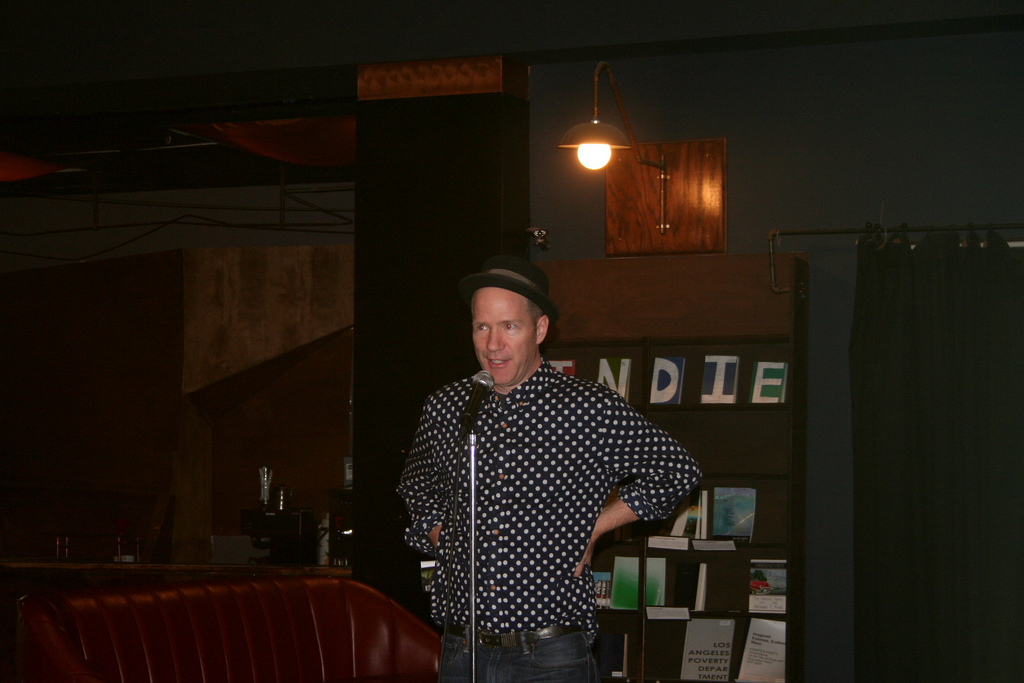
Seats filled quickly and stragglers settled for standing room only as Black Clock Editor Steve Erickson took the stage to present the night’s readers. Up first was Claire Phillips (author of Black Market Babies and a previous contributor to Black Clock 15) reading the entirety of her short yet impactful story “Tubular,” a science fiction piece set in a disturbingly familiar, near-future Los Angeles which has succumbed to mass societal collapse after the 2010 B.P. oil spill. Attendees on Sunday listened intently as Phillips’ characters navigated their strange, new landscape with necessary wit and numbness, even in the face of 10-foot “land-faring mutant worms.”

Next was The Contortionist’s Handbook and Dermaphoria author Craig Clevenger, who read an excerpt from his short story “Chicken Wire” while clad in a pair of snakeskin cowboy boots. Also set in and around Los Angeles, “Chicken Wire” tells the ominously humorous story of Jimmy Wynn, a failed metal band guitarist turned cab driver who spends most of his time in the Mojave desert begging his rough-and-tumble customers to pay their fares. Fans should look out for Six Finger Films’ “Smoke & Mirrors,” a short written by Clevenger and based on a chapter of his current novel-in-progress, scheduled for release later this year.

Last in the line-up was Rick Moody, author of The Ice Storm and most recently, On Celestial Music: And Other Adventures in Listening. Before reading, Moody took a moment to affectionately warn the audience, “If you happen to be of the Red State persuasion, you might want to go get coffee now.” This turned out to be good advice in the end: Moody read from his latest piece of nonfiction, entitled “Election Diary 2012” and chock full of unforgettable, fiery opinions regarding our country’s most recent presidential election race. Last Sunday’s listeners were especially tickled by his November 25, 2011 entry, in which Moody engages in a lengthy imagining of Newt Gingrich wearing diapers.

As the event came to a close, attendees mingled with the night’s readers and Black Clock staff in the relaxed atmosphere of The Last Bookstore’s main floor before slowly filtering out onto the twilit streets of downtown L.A. It was a night that proved truly surreal. Just like the issue it celebrated.


By Adriana Widdoes
an Editorial Assistant for Black Clock and an MFA Writing candidate at CalArts

Music and the Chaos That Binds Us: A Look at Music and Reading with Henry Bean

IMG_0070Back in November, Black Clock Associate Editor Patrick Benjamin started a train of thought on the union of music and reading. I found his insight into this experience quite astounding, as I had never given it even a bit of thought before. This is because when I read I block out the rest of reality, so listening to music isn’t important to me as a reader. I’m sure if I could remember them, there have been times when the feeling of the music in the room mingled with the reading world I was in, but it’s not something I seek out, and I especially avoid listening to anything I know the lyrics to because I’ll just end up singing – leaving the book unceremoniously abandoned on my lap. More often then not, the world of the book is all I can hear, and all I care to hear.

But, maybe the truth is that I’m just not listening to the right music. So, I turned to one of our Black Clock 16 contributors, Henry Bean, to see what his thoughts were on this matter. Mr. Bean’s story in the newest issue of Black Clock, “A Hole in the Sky,” follows Tyrell, a man with strong ties to music, as he struggles through the special chaos of a certain moment in his life. Without giving anything away, I think between my associate and Mr. Bean I’ve been inspired to give the combination of music and reading an actual chance.

***

Henry Bean: “In Ingmar Bergman’s final film, Saraband, there’s a scene in which a angry old man, played by Erland Josephson, sits in his study, leaning forward in concentration, eyes closed, brow furrowed, listening with all his might to a recording of a Bruckner symphony.  His son enters the room; the man stops the music, begins to tell his son (who is 60) what, in fact, he thinks of him, a bitter, scathing denunciation that is one of the most terrible encounters between a parent and child ever depicted in film or literature, after which the son leaves, shattered, and the man picks up the symphony where he left off, burying himself in it with the same intensity as before.

This, I imagine, is how music ought to be listened to, as if it contained the secrets of the universe, and not a note is to be missed.  Unfortunately, I can’t do that, except on drugs, which I don’t take anymore.  To listen now, I need something else (driving, cooking, cleaning the house) to siphon off nervous energy so the rest of me can focus on the music.  Reading is not a good something else; it’s too complicated and demanding.  Usually, when I try to read and listen, I end up either turning off the music so I can follow the words, or getting so absorbed in the writing I don’t hear the music. 

But every now and then, for five minutes or half an hour, it works perfectly; the music and reading abet each other, each somehow clearing the way for the other kind of perception.  When this happens, it’s almost invariably one of two kinds of music that does the trick. 

The first is Bach, particularly Glenn Gould’s two recordings of The Goldberg Variations (1955 & 1980) which are both such mysterious blends of mathematics and “feeling” that either they don’t interfere with the decoding of printed words and the understanding of sentences, or they even facilitate that process.  It is as if the Bach expresses a truth, a universal constant, in the presence of which everything becomes logical.  The world makes sense.  This calms the mind and lets it focus on the words and their meaning because a deeper, foundational meaning is being attended to.

 The other kind of music that sometimes has this effect is a larger category, 20th Century classical. Not all of it works.  Stravinsky doesn’t; it’s too dramatic, it fights the words.  But Schoenberg, Stockhausen, Shostakovitch and especially Charles Ives sometimes do, though they are, in a way, as chaotic as the Bach is orderly.  I’m not sure how this happens, but the modern music’s abstraction, the scarcity of melody or conventional harmony, the atonality, the wavering between structure and chaos, somehow “support” or enable reading just as the Bach does, but from the opposite direction. 

 Ives is the 20th Century composer I know best, particularly his 2nd Symphony, in two different recordings by Bernstein, and maybe one of the reasons it works is that I know it so well.  Reading “to it’ is like sitting with a book in a familiar landscape; there are “events” in this landscape (especially the grave restatement of the main theme late in the symphony) that inevitably distract me, but they do so in a way that is predictable, and thus comforting.  And, when they’re past, I go back to the reading refreshed, restored.  Even if I’ve only ‘been away’ for half a second, it lets me see the text with new eyes. 

 Of course, Gould’s Bach is also very familiar, so maybe that’s the key as much as the music itself.  Music we know well does what we expect; that reassures us and leaves us free to fall through the hole of our reading into another reality, confident that the one we left behind is being attended to by the music.”


Following this wonderful continuation of our thoughts about the intertwining of music and reading, I wanted to dig further into the possible implications of music in “A Hole in The Sky.” So, I asked a few prying questions, to which Mr. Bean graciously replied with an honesty I’m sure Tyrell would appreciate.

Black Clock: I would venture a guess that the main character in your story shares a similar opinion about music. Would you say that?

Henry Bean: I imagine that Tyrell’s opinions about music are very different from mine. For one thing, he knows music much better than I do. As he observes in the story, he would “live inside it” if he could. The problem is, he can’t. I have no idea what kind of music he likes or listens to, but I suspect that a lot of it would be people I’ve never heard of. He might find the composers I mentioned (Ives, Stockhausen, Schoenberg, etc) formally interesting, but my guess is they’re too cerebral for him (though I could be wrong about that). He wants an expression of feeling that’s more direct, raw, deep, shattering; as I say in the story, he’s a romantic, and we share that. But, unlike me, he would have no trouble listening to music while he reads or writes (if he wrote) because music to him is the deepest reality. I agree with that, but I can’t feel it the way he does.

Black Clock: Does your character’s affinity for music play a role in the way he sees the world, and inevitably, in his fate?

Henry Bean: Music is the purist of the arts, and Tyrell is nothing if not a purist. It’s purism (an insistence on what should be in the face of what is) that gets him into trouble and that won’t let go even as it threatens to destroy him. It’s not so much that his affinity for music leads him to this fate as that it reveals the purist impulse that also produces the fate. They’re parallel not causative.

Black Clock: I’ve started incorporating certain music into the background while I write, though it only works about fifty-percent of the time. Did you listen to music while writing “A Hole in the Sky”? If yes, what?

Henry Bean: No. I can sometimes listen a little while writing a screenplay, but never with prose. It’s too hard; there’s no concentration left over for anything else.

Black Clock: As a fun question, any suggestions for what you might listen to while reading “A Hole in the Sky”?

Henry Bean: Frankly, I want the reader’s full attention on my story, not divided and shared with someone else’s music. However, if I had to pick one piece it would be Ives’s The Holidays Symphony. All the little musical fragments in that work, the patriotic tunes, traditional ditties, Stephen Foster, etc, help set the very American landscape where the story occurs. (The importance of which I never thought of until you asked this question.) And Ives is always working on the boundary between order and chaos; this is very much where Tyrell wants to be and must be and who he is; and I guess we share that, too.

 ***

I think being on this boundary is something we can all sympathize with, even if the experience is different – especially if the experience is different – because in that space which only one person can truly know, lies a very good story.

Inspired? Intrigued? Perhaps you, like me, are staring at your record collection with a heavy tome in one hand, ready to bite into a new musically charged reading experience. I hope so, and I hope that if you’re interested, you’ll check out Henry Bean’s story “A Hole in the Sky” in the newly released Black Clock 16, and join us for the issue’s launch on Sunday February 17th (4pm at The Last Bookstore, Downtown LA).


By Jessica Marie Felleman
an Associate Editor for Black Clock and an MFA Writing candidate at CalArts.


Black Clock’s Own “Drifting Clarifier”: The Anthony Miller Interview, Part Two

The first part of this interview with Anthony Miller, Black Clock’s Editor-at-Large, appeared on this blog way back in September 2012. The promised sequel to the interview was starting to look as apocryphal as one of the movies Miller wrote about in Black Clock 15. In the second part of the interview, we continued our conversation about his “Alternative Film History,” as well as his larger role in the shaping of Black Clock.

BLACK CLOCK: What does it mean to be Editor-at-Large of Black Clock?

ANTHONY MILLER: I’m still not entirely sure. After being a contributor who sat in on more than a few editorial meetings, Steve christened me “Editor-at-Large” starting with issue 7.  In that issue, I had the privilege of working with Samuel R. Delany on his story “In the Valley of the Nest of Spiders,” which eventually became his 600-plus-page novel Through the Valley of the Nest of Spiders. Since then, I’ve been a roving resource, soundboard, and consultant, engaged in some combination of brainstorming, contributing, and editing. My responsibilities have differed with every issue. Brian Eno once described himself as a “drifting clarifier.” That’s how I fancy myself as an editor-at-large. It’s also one of those masthead monikers that confer instant gravitas upon you.

BLACK CLOCK: What is your process for writing the essay-like capsules for Black Clock?

ANTHONY MILLER: The capsules are actually the easiest and most fun things to write. They’re so small; I try not to take them too seriously or to overwork them.  (I do not always succeed.)  I think of them as barroom riffs. It’s as if you’re drinking with your friends and discussing the most influential first novels or weirdest cult movies or your favorite music or restaurant critics, tossing out just the right arresting detail or amusing insight, trying to make your case in a very narrow conversational window.

BLACK CLOCK: What was the process like writing those capsules with Steve Erickson for the “Noir” issue (Black Clock 10)?

ANTHONY MILLER: Steve thought our Noir issue ought to have a kind of primer that would run throughout the issue. I was flattered when he asked me to collaborate with him in compiling a list and writing capsules. We began by exchanging a series of lists about books, movies, music, and images that were swirling in our heads as we grappled with the question “What is noir?” At first it was intimidating because Steve was one of the people who first got me reading writers like Charles Willeford, which led to my discovery of The Burnt Orange Heresy (#32 on our list). There are about a dozen entries where we combined forces so that we could both weigh in on a particular “noirtifact.” We disagreed about some entries but we found that we each ranked The Long Goodbye and Double Indemnity exactly the same (#2 and #1, respectively).

BLACK CLOCK: Reading your alternative film timeline from issue 15, I kept feeling like I was watching a time-travel movie, as if a slight alteration to Cary Grant’s career in 1940 somehow offset Val Kilmer’s life some fifty years later. Did you write the timeline chronologically?

ANTHONY MILLER: I love the idea that Cary Grant’s portrayal of Hamlet in Hitchcock’s film is the butterfly that flaps its wings and causes the storm of Val Kilmer’s demise. I’m overjoyed to hear it felt like time travel. I love time-travel movies and universe (or multiverse)-jumping narratives like those on Fringe and in Matt Fraction’s comic book Casanova. I also relish Alan Moore’s exquisitely researched historical distortions in his League of Extraordinary Gentlemen: Century trilogy. As I’m discussing comic books, I should add that the very first alternate histories I encountered were in the pages of a Marvel comic book called What If.

As I mentioned before, I did not proceed chronologically. I had a bunch of ideas already in my mind but I also sat around riffing with my friends and they came up with ideas I could never have imagined. Some of their ideas set my mind spinning in altogether different and fascinating directions. Two influences outside my circle of movie-going friends were Patton Oswalt’s program of imaginary double-bills in his 2007 tribute post to the late Sherman Torgan, the proprietor and double-feature programmer at the New Beverly Cinema, “I Will Program A Month In Heaven For You, Sherman Torgan” and Sean Hartter’s fantastic and fantastical movie posters. I was thrilled when Sean agreed to share his magnificently divergent visions of the movies with us. His cover for Black Clock 15 is an absolutely ideal representation of the issue.

BLACK CLOCK: Is there a single entry in the timeline that feels most important? One that had the biggest impact on the rest of the timeline?

ANTHONY MILLER:

For Establishing a Divergent World…:

Buckaroo Banzai Against the World Crime League, the second successful film in the Buckaroo Banzai series.

For Charting A New Direction Not Only In Movies But Also In Music…:

Nicolas Roeg’s A Clockwork Orange, starring Mick Jagger as Alex, with the rest of the Rolling Stones as his fellow “droogs.”

For Imagining What Would Never Be…:

Chris Farley’s Oscar-winning role as “Fatty” Arbuckle.

BLACK CLOCK: Which is the better adaptation of a postmodern novel and why: Cassavetes’ version of The Crying of Lot 49 or Wes Anderson’s Pale Fire?

ANTHONY MILLER: Of course, Frederic Jameson examines Cassavetes’ Lot 49 in his analysis of Pynchon in his totemic Postmodernism, or, The Cultural Logic of Late Capitalism. Ray Carney says when Cassavetes discovered Pynchon’s book—which he felt had some affinities with his Shadows—he thought of the young girl he had worked with on Paul Mazursky’s Tempest. That was how Molly Ringwald came to be cast as Oedipa. As for the film version of that diamantine Nabokov book Mary McCarthy called “a creature of perfect beauty, symmetry, strangeness, originality, and moral truth,” I recommend Wes Anderson’s essay in the Norton Critical Edition of Pale Fire and that magnificently erudite and weird collection Pale Fire ReasZembled.

I should probably say The Crying of Lot 49 because you Don’t Ever Antagonize The Horn.

BLACK CLOCK: Since your interests and taste plays such a big part in your work, I’d like to ask for just a list of the various things you like, but in lieu of that, What are your favorite books? What has affected or influenced your writing the most?

ANTHONY MILLER: Some books I love: Gravity’s Rainbow, The Marriage of Heaven & Hell, Labyrinths, Pale Fire, The Phantom Tollbooth.

A number of other things of which I am fond: Thelonious Sphere Monk, Charles Mingus, Anthony Braxton, Van Morrison, David Bowie, Robert Wyatt, the Mekons, Ken Nordine, Gil Scott-Heron, Robyn Hitchcock, PJ Harvey, The Handsome Family, The Firesign Theatre, Marc Maron, Joseph Cornell boxes, Rosamond Purcell photographs, poems by Yeats, Eliot, Berryman, and Paul Muldoon, Flann O’Brien and Italo Calvino on living inside stories, Alberto Manguel on readers and libraries, comic books by Grant Morrison, cultural musings by Luc Sante, bewildering and bewitching ephemera from Ben Schott and John Hodgman, plays by Wallace Shawn, films with Tilda Swinton, Bookworm, Dangerous Minds, HiLobrow, BLDGBLOG, The Venture Bros., Utopia (the Channel 4 series), arcane words, obscure museums, strong coffee, reading aloud to women, annotations, aphorisms, epigraphs, digressions, lists, trivia, the year 1973, the Reino de Redonda prize, a properly pulled pint of Guinness, well-aged whiskey, midnight movie screenings, Scrabble, cats, psychogeography, pogonotrophy, mythology (ancient and modern), curiosity, passion, originality, affection.

I love the maximalist novel, the concept album, the epic movie. I adore artists who attempt to encompass entire worlds in their work, who are unapologetically inclusive and ultra-referential, who work on everything-but-the-kitchen-sink canvases. Some of these artists—Pynchon, Bowie, Kubrick—have also affected me by being as emblematically enigmatic as any of their works of art.

BLACK CLOCK: What is the one “secret” book or movie that you think should get more attention?

ANTHONY MILLER: There are so many books that deserve more attention. Anything by Anna Kavan, Russell Hoban, Alasdair Gray, Alexander Theroux, Bruce Olds, Siri Hustvedt, and fellow Black Clock 15 contributor Geoffrey O’Brien. I have always believed J.G. Ballard’s writing tells us more about the time in which we live than Jonathan Franzen’s. Victoria Nelson’s The Secret Life of Puppets and Gothicka should both be read by anyone who is at all curious about the role of the supernatural in the 20th and 21st Centuries. Another recent book which impressed me with its scope and obsessiveness was Dave Tomkins’s absolutely alluring history of the vocoder, How to Wreck a Nice Beach. Not long ago, I recommended Wanderer by the actor Sterling Hayden to an adventuresome friend of mine, an autobiography of a flinty yet thoughtful Hollywood nomad that makes a bracing antidote to an age when people don’t seem to have to have accomplished very much before penning a memoir.

A truly secret film is David Blair’s Wax or the Discovery of Television Among the Bees, a bizarre amalgamation of apiology, military history, and conspiracy theory, which I read and heard about before I tracked it down on video. It can also be watched on the Internet. You’ll never get the bees out of your head again.

BLACK CLOCK: How does Los Angeles fit into your writing? How has it influenced your writing?

ANTHONY MILLER: I was born and raised in Chicago and lived for a few years in Dublin. Both of those cities have had as much impact on me and on my imagination as Los Angeles has. Some days, after more than a decade, I’m still not sure I live here. I think L.A. is simultaneously the most exhilarating and confounding place I’ve ever lived, but my writing isn’t rooted in any of its well-worn literary tropes: fame, noir, self-invention, oblivion, apocalypse, decay, the shimmer of fool’s gold. I have learned about this city from the work of Reyner Banham, Mike Davis, Thom Andersen, and Steve Erickson, among others, but I’ve learned just as much from driving around and getting incredibly lost.

BLACK CLOCK: If you were to write an entry for “Black Clock” in an encyclopedia of literary journals, what would that entry say?

ANTHONY MILLER: Established in 2004, this journal of the mercurial and the magnificent, of the evanescent and the intransigent, of the profound and the profane, remains known for its sinuous wordplay and scintillating design, its dedication to its stable of brilliant and wildly successful contributors, and its complete absence of page numbers in its Table of Contents.


By Sam Freilich
an Associate Editor for Black Clock and an MFA Writing candidate at CalArts

A Bumpkin’s Metropolis: Trop Founder Tom Dibblee on Why Fiction Matters

A few weeks back I met up with Tom Dibblee, editor for the relatively new online publication Trop. He was kind enough to sit down at a posh little place in Glendale, Capri Jimmie Maddin’s Lounge, have a few drinks, and answer some questions.  

Patrick: So you got this Trop thing. How did this come together?

Tom: (laughs) It’s funny. I’m hesitating here because I’ve told this story so many times that I have this easily accessible, streamlined, one paragraph answer. And that answer is: Roger Sollenberger, Stephan McCormick and I were all living in Milledgeville, Georgia, a small college town about a hundred miles southeast of Atlanta. There it is: We were living there and we became friends. (laughs) We were the only people in town who were older than twenty-two, not local, and especially who were writers.

Patrick: So who were the other people in Milledgeville?

Tom: College students, locals. But actually Milledgeville is a really vibrant little town.

Patrick: Why do you think that is?

Tom: I think that rural culture there is intact. Rural culture there doesn’t feel like it’s dying.

Patrick: Much like Southern California’s might…?

Tom: I’m actually thinking more of the rural Midwest and rural Northeast. Rural parts of those places feel beleaguered to me, but the rural South went through its beleaguered phase like a century and a half ago. They got it down and the place is still intact so it feels, even, on the up and up. It’s an optimistic rural place. Like the worst is over. So yeah, it’s vibrant. It’s 18,000 people and it is rural, but because of Georgia College it had a handful of bars and restaurants.

The Trop was Metropolis Café, a Greek restaurant owned by an Indian guy named Deepak. He was at the time twenty-six. But before I met Roger and Stephan I knew maybe a few baristas, a couple of farmers, and then I started going to Metropolis because it’d just opened and Deepak was around my age and not from Georgia. We were fish out of water together. So I spent about six months hanging out there every night, just shootin’ the breeze with Deepak and the rest of the staff.

Then, one day Roger showed up. I was sitting at the bar at Metropolis. This was during the World Cup and I’m drinking beer and it’s 1:30PM, it’s 110 degrees out and there’s this guy sitting next to me and we start talking and he goes, “Where’re you from?” and I say, “San Francisco,” and he says, “Aw, yeah, I know a few people out in San Francisco.” And I’m thinking, “What the fuck?!?” I was holding myself back from pounding my fist on the bar. I’m thinking, “No one here knows anyone from San Francisco! Who the hell are you!?” So we talk for a while and the game ends at, whatever, 3PM and we make a date to meet up later. And by later I mean, like, 5:30PM that same day. (laughs) So I walked home, took a shower and kinda sat on the couch for a little bit and then walked back and Roger came back a few minutes later. It turned out we were both working on novels, and both sort of feeling marooned. At this point it’s the dead of summer in Milledgeville. The college has cleared out, there’s no one around. You see the same six people every day at Metropolis. So I was extremely glad to meet Roger. And then, sometime after that Metropolis installed a stage and we decided to start putting on shows.

Patrick: So Trop started as a performance collective.

Tom: Yeah. Our first show was an awards show. This would have been February of 2011. It was right around the Academy Awards and we put on a show where we gave ourselves absurd awards, just as an excuse to deliver absurd acceptance speeches.

Patrick: That would be the writing aspect?

Tom: Yes. Roger won “Most Culturally Sensitive Man.” He came up with his entourage and delivered this long speech about being a culturally sensitive man. But Stephan McCormick won for “Most Haggard Bastard Alive” and wrote a twenty-minute speech about the origins of haggardness in the French Revolution. We all said to him that if he delivered this twenty-minute speech it might kill the entire show, so he tore through it as fast as he could and scattered pages around him dramatically, and it wound up being an epic performance. It went over very well.

Patrick: It’s interesting that that was the first of Trop, but Trop is still doing that in a way, where you have this, not a new kind of non-fiction but maybe a skewed kind of non-fiction. This sort of “It could happen but it hasn’t happened.”

Tom: Fake non-fiction is one way to put it. It’s funny, especially now that we’ve started to take submissions, looking at what a short story is and what the fiction in The Weather section is, there’s a sensibility to that fiction. I think that… (pauses) Y’know, I don’t know how to describe it.

Maybe it’s that, when we started scheming, we all were going to have columns, and that’s all the site was going to be. It was just going to be a bunch of columns and these were essentially our silos for creative writing. Some were going to be pure fiction and some pure non-fiction. Mine was classic in-between and a couple others were in-between too. So we, rather than trying to categorize these columns, decided not to worry about it and call it quasi-fiction. These columns are not planned out. You have to figure things out on the fly. It’s like you’re improvising a novel in front of people, on stage. So for me as a writer, I needed the versatility to go in and out of both fiction and non-fiction. And Roger definitely did this too. At first he’s writing about a grocery store, then he catches a plotline and sees it out. He’s talking about this guy who lived near the grocery store and it became a short story. But I think embracing quasi-fiction was about giving us the versatility to let our columns be what they were going to be.

Patrick: If you want content weekly that sounds like a much more comfortable place to be.

Tom: For me that’s exactly how it was. At first I was writing one column post every two weeks and my life wasn’t eventful enough to supply a column with real information, so I would use really minor events and just fly off the chain to make them worthwhile. It wound up being about driving to Nevada, and once I discovered the Nevada thing, I didn’t want that discovery to end, so I made it about driving towards an eternally receding Nevada.

Patrick: Is that a way of filling in the gaps of where life could have been exciting?

Tom: It’s just a lot easier if you’re trying to draw on your own life in a recurring way, and frequently, you then need to be able to turn a story about walking into a dude’s kitchen into something. If you are confined to non-fiction that’s going to be hard.

Patrick: And boring.

Tom: And boring. Writing like this has become the case I make for fiction. When I’m talking to people and they’re telling me “Oh, I’m working on this and that, I don’t know if it should be creative non-fiction or not.” Well, to me, it’s about giving yourself the wider range of possibility that fiction makes available, so that you can make a story about walking into a dude’s kitchen worthwhile.

Patrick: Allowing yourself to be tangential. Even if that tangent is one where the thing never happened.

Tom: Yeah.

Patrick: Trop has a number of serialized novels going now. You have your own most recent one, Nightmares of Hell.

Tom: I have a couple of fake books going. The first one is My Bad Man Memoir, which is an idea that came up when we were doing our Trop retreat.

Patrick: What was that about?

Tom: Evan Allgood, Roger Sollenberger, Will Torrey and I spent a couple weeks in a house in Chincoteague, Virginia and wrote a lot and worked on the website. Will is from San Antonio and he has what became known as a “bumpkin voice,” which is a voice he uses not all the time but a lot. So we’re spending two and a half weeks straight in a little house with the same people writing a lot. And drinking a lot. And not doing much of anything else but those two things. And we slipped into one of those funny vortexes you only get in when you spend a lot of time with the same people in a confined space. And the soundtrack to that vortex was Will’s “bumpkin voice.” (laughs)

The way I would describe it is Will being incredulous at the modern world. Not knowing, for example, what “mocha” is and trying to order a “mo-cha” at Starbucks. Being really intent upon getting his free drink at the mini-golf place. Being certain that every drink he ordered came size large. In any case, the bad man memoir that I started to write was originally his idea. It was his “bad boy meth memoir” that he would recite into his voice-recorder. And I was the number one fan. We all asked him if he would actually write it. He talked about making it a Twitter feed at one point. We all really wanted him to do something with the bad boy memoir. He didn’t want to, though, so finally asked him if I could do it myself. I changed it so it seemed like my idea though, the “bad man memoir” instead of the “bad boy memoir.”

So I’ve got two excerpts from My Bad Man Memoir and more coming. But then I started getting into the idea of writing fake books, which is just fun. It just adds to the absurdity of it. If you’re just writing a four-hundred-word short story, that’s one thing. But if it’s four-hundred words, and it’s about something way, way less than walking into a dude’s kitchen, and the presumption is that it’s part of a one-hundred-thousand-word book, you’re giving yourself a lot more ammo to play with. So I started creating other fake books. I have My Bad Man Memoir, Nightmares of Hell, The Head and Neck Consultation Suite: A Bad Health Memoir, and then I also have Deleted Sex Scenes, which is a compilation of sex scenes that didn’t make it into any of those other memoirs. Both Sex Scenes and Head and Neck are forthcoming.

Patrick: One of the things that I think is really interesting about these fake books that if you were to write them enough how would they not become books? Wouldn’t they stop being fake at a point?

Tom: That’s a good question. Nightmares of Hell I could see myself going on with for a while. I’m not sure I could hold the attention of the reader (laughs) much beyond six or seven four-hundred-word excerpts. Fake books might have a shorter shelf life than real books.

Patrick: Speaking of keeping readers’ attention, being an online publication now, has that been difficult? You guys didn’t start that long ago.

Tom: Well yeah I’d say the whole project has been a challenge. Right now the main challenge is, at first we were all writing everything ourselves. We identified as a collective. But then, to keep the site growing, and to enable ourselves to have lives outside Trop, we had to expand, and find other writers, and open up a bit. So what I’m doing is looking around. Evan Allgood tends to approach people he’s seen at readings in Atlanta, but I look on Twitter. When I find something I like by someone who seems like a good fit, I reach out.

Patrick: Has that been successful?

Tom: We just started doing this two weeks ago, and we’ve gotten a few new people that way, and I think we’ll find more. I think that’s my new strategy. To canvas the other online literary magazines out there in search of people who would be a good match. I like that better than submissions because we do have such a specific sensibility and aesthetic, the sort-of fake non-fiction thing and kind of a we-don’t-do-that-much-pure-humor-writing-but-there’s-a-lot-of-humor-anyway thing

Patrick: I’ve noticed there’s humor all over the site.

Tom: There’s a good amount of it. I think part of that is from being performative. Part of it is just being who we are and who we’ve chosen to be friends with.

Patrick: If someone wanted to submit to Trop how would they do that?

Tom: Just reach out. There’s a general email address on the page and we accept submissions for The Weather. That’s [email protected].

Patrick: Trop’s reviews and interviews include people like Jesse Ball, Ben Marcus, and there are a few others from that camp. Do you guys have a focus for your criticism?

Tom: We just brought on a new reviews editor, so this could change. But before, most people who were writing reviews for us were writing more than one or are were going to write more than one for Trop. We were generally doing everything in-house, so we wound up reviewing people that we were individually interested in reading and thinking about. Though we did at one time have a mission statement for our criticism that we would review younger American writers. People who we saw occupying the tier that we were all trying to get to.

Patrick: What’s that tier?

Tom: Many of us are working on first novels. So we wanted to review the people who had a novel or two out. People who were where we wanted to be. Speaking for myself with my criticism, I just wanted to know the terrain. But that actually wound up being complicated because reviewing debuts of literary fiction is a more sensitive task than reviewing, say, Jonathan Franzen. You can say whatever the hell you want about Jonathan Franzen.

Patrick: There’s already a body of criticism.

Tom: Right. But if you’re writing about someone who just got his first book out you have to be more tactful. And so, if you’re reviewing a lot of debuts and second efforts you wind up with too much positive criticism. It started to feel like we weren’t really flexing our critical muscles. I know for me, after a few debuts, I was like, “I’m not doing this again.” Because I want to be able to write within an expanded frame and not have to be delicate.

Patrick: Do you feel like you’ve been too sweet? Too precious to debut novelists?

Tom: I believe what I write in my reviews. But if I were reviewing someone’s third or fourth book they would be different reviews, more like talking to a friend than to an elder.

Patrick: Which is interesting coming from someone who is involved in a really new publication. This is a new publication talking about new literature from new writers. It sounds like infants grabbing at infants.

Tom: You’re waking up in the morning and working on what you hope will become your first novel and you’re struggling and you want to pull your hair out and then you sit down to write your review of a first novel. (laughs) If you have any kind of self-awareness, you’ve gotta–

Patrick: Because it’s not just about being kind to the other writer. It’s also about being kind to yourself.

Tom: It’s respecting the effort. With someone with their fifth or sixth book out you’re still respecting the effort but you know they’re all right. And for you, the would-be debut novelist, a fifth or sixth novel is distant enough that there’s no sense that you’re secretly talking about yourself. If you’re an aspiring first-time novelist writing about Jonathan Franzen, there are just too many leaps involved. But if you’re sitting there talking a debut (puts on voice) “In first novels this this and this,” you’re immediately talking about yourself.

Patrick: Speaking of which. You have all these fake novels and tons of reviews and all this other stuff up but you do have a book you’re working on.

Tom: All of us do. This is another reason I think for the fake non-fiction, for the humor, and for the performative aspect. The original group of us that started with our columns, we all had novels going or short story collections we were working on. We all wanted to do this but we didn’t want our columns, our writing for Trop, to replace our books. We wanted it to be what at the time we naively called “low-pressure, complementary” writing. And it became… (laughs) It’s not low-pressure. We’re trying to make it good but let it maintain a more playful feeling.

I think for me doing a playful “fake book” is a way of compartmentalizing. I have a very specific Trop style that keeps my writing separate from what I do in the novel. I think that part of that is making sure my Trop writing doesn’t take away from my novel. Another part of that is that my novel is happening in private while my Trop writing is happening in public. From the time I finish a Trop piece to the time it goes live is a matter of days. It’s immediately public. It feels like there’s an audience sitting right there. I’m conscious in my Trop writing that I’m writing to that audience and writing in such a way where with my novel I know I have as much time as I want to sit with it by myself and make it right.

Patrick: One of my favorite columns is “Charlatans of Pop.” Where’s this Hesiod James? Where does he come from?

Tom: Hesiod James comes from his own universe. He’s from Virginia. I think he’s twenty-nine or so and as far as I know he’s been a professional musician for coming up on a decade. But he’s a sideman. Meaning he’s a bassist who plays for country stars that you’ve heard of and he rotates around. He was playing for one guy this year then I saw him a year ago play for another guy out here in Lancaster. But Hesiod James is interesting because he’s an autodidact. Can you tell that from the column?

Patrick: Sure.

Tom: Yeah. He is an at-the-top-of-his-game country bassist. And he’s also a front man for his own band too. Hellens. Hopefully they do well. I’ve listened to their music. It’s really good. But think about the normal course of events for a literary twenty-something who’s writing a book. Think about the normal kind of trajectory, you know when you’re a teenager you read Catcher In The Rye and Hermann Hesse then when you’re in college you maybe discover, I dunno, like, Pynchon and maybe Roland Barthes or something like that. And then maybe you have a David Foster Wallace phase and then you maybe decide you need to read a lot of “the great books” and then you want to read the contemporary fiction so you know what’s going on. Hesiod James, being an autodidact, is not like that. He has his own trajectory. He’s really reading the classic texts. Like Plato’s Dialogues is just the beginning. He’s referring to stuff that I don’t think anyone else on Trop could possibly pick up on. He’s dropping names of minor characters from minor tragedies that are barely even referred to on Wikipedia. (laughs)

Patrick: But also sometimes comparing those characters to The Beatles or The Beatles’ manager.

Tom: That’s him. He reads that shit while waiting to do sound-checks.

Patrick: What should we be reading right now?

Tom: I like The Yellow Birds by Kevin Powers. It’s about Iraq. Powers is an Iraq vet. It’s such a good case for fiction. If you think of my case for fiction being that you can tell a story about walking through a guy’s door into his kitchen, and if you have fiction at your disposal you can possibly make that story good, Kevin Powers has a heightened case for fiction. He makes Iraq real through fiction. What happens is gruesome. It is extremely gruesome, heart wrenching, and sad. But the beauty of the book is that it makes the gruesomeness of the war, and what happens to the protagonist, through the way Powers sets up the plot so that you care so much about the character… he makes it real. What happens to the protagonist is something that you probably read about in the paper. But Powers makes all the shit about Iraq in the newspapers register. Just by tying it all to a plot. Having that gruesomeness happen to a character that you’re emotionally wrapped up in.

Patrick: And not to get too precious about this but that sounds like an argument for fiction is that you can take those things people would gloss over–

Tom: I think that’s exactly it. I think that’s exactly what Kevin Powers does. The Yellow Birds brought Iraq home for me. It’s what lodged the war in my consciousness as much as it could for someone who wasn’t there and has met a couple of people who have been but really is very much removed. That was a book that lodged Iraq in my consciousness.

Patrick: So fiction can matter.

Tom: I think Kevin Powers’s The Yellow Birds is a case in point for why fiction matters.

Patrick: As you know, Black Clock is a Los Angeles based publication, of course we have contributors from all over the place, but you’re here in Los Angeles. You have a number of Trop folk out in the world. Is there anything about Trop that is about Los Angeles?

Tom: The fact that we’re spread out is a reflection on Milledgeville more than anything. Milledgeville is the kind of place where if you’re in your mid- to late-twenties and you’re working on a novel you might want to hole up there for some time, to get a lot of writing done. But you might not want to live there forever. It’s good for a little while, but the people who pass through Milledgeville tend to disperse. And really half the point of the site, for me, was to be able to keep on working with friends I don’t live near anymore. We all dispersed, but we get to keep on collaborating.

As for LA, it’s been easier to start something here than elsewhere just because of how warmly received we were. The literary community in LA, my experience has been that when I meet a literary person, whether that’s someone who’s got a couple books out or someone who’s trying to get their first going, they’re just glad to meet another literary person. You’ve got the resources of a huge city, but the literary subsection is small enough that everyone’s welcoming and glad to meet you right off the bat. I barely realized Trop was real until I mentioned it to people and I was really encouraged and heartened by how the literary community here, just upon catching wind of a new online literary magazine from someone they’ve never heard of, just how happy they were that that was happening. That it existed. That something literary was coming out of LA. And it put pressure on me though. Like, people were happy to hear about Trop, and I’m thinking, “We better make this thing good!”


By Patrick Benjamin
an Associate Editor for Black Clock and an MFA Writing candidate at CalArts

Crank Up the Volume: Carola Dibbell Discusses Two of Our Favorite Things

Carola_DibbellSome of fiction writer Carola Dibbell’s earliest work includes short stories in The Paris Review and The New Yorker. However, for those of us who cherish a smooth beat equally as expertly navigated syntax, Dibbell’s name might be most recognizable for the music writing that she published for years in The Village Voice, including essays reviewing several New York super-acts in their prime, such as Blondie, Run DMC, Lou Reed and Patti Smith. Now, in her latest piece of short fiction “Rini’s Child” (published in Black Clock 16, on shelves in February 2013), Dibbell has created the narrator Inez, whose unforgettable voice and unique dialect guides readers through a catastrophic near-future riddled with infertility, distrust and pandemic. Recently, Dibbell let us pick her brain about “Rini’s Child,” the subject of music and books and how these two favorite interests of ours might (or might not) influence each other.

BLACK CLOCK: You wrote rock criticism on and off for thirty years and have spoken before about the leakage between fiction and music writing. Can you explain what you mean by that? What role has music played in your fiction?

CAROLA DIBBELL:
In the early seventies, I was surprised and impressed by the rock writing in Dave Marsh’s and Lester Bangs’ Creem, and a little later in the Village Voice music section, edited by Robert Christgau, my husband. In this fledgling and disreputable form, you could be vulgar, personal, amateurish and formally ambitious all at once and actually be read. It gave me a chance to do things with the voice and tone and disorder I was already exploring in fiction that was not actually read. It took longer for me to bring those rock critic elements into my fiction except, I suppose, that writing about pop led me to contemplate genre fiction. Then, in the late nineties, when my fiction was going nowhere, I made a conscious decision to let the rock critic write the fiction, sort of, and the fiction changed a lot. Music itself is a different question, which I will get to later.

BLACK CLOCK: Do you think that music critics approach writing much differently than other writers?

CAROLA DIBBELL: I suppose I’ve read jazz or rock reviews that evoke rather than analyze their subject in a way book or film criticism is less likely to, but I wouldn’t want to generalize. It’s also true that describing a sound is a special kind of challenge. And reviewers of beat-driven music sometimes need to deal with the critical question of whether the piece under discussion makes you want to get up and move, which might not come up so much in other kinds of critical disciplines. Though it could.

BLACK CLOCK: In your latest story, “Rini’s Child,” the narrator, Inez, has a unique speech pattern. What particular genre of music, if any, did Inez’s speech develop from, and how has that music been specifically emulated within the story’s prose? Did you plan this in advance, or did it happen naturally while you were writing?

CAROLA DIBBELL:
I invented Inez for the novel “Rini’s Child” is adapted from, The Only Ones. I wanted a character who would work interestingly inside the premise, which is, briefly, reproductive experimentation in a dystopic setting, with the narrator a “donor” who ends up an unplanned mother. As a writer, I was getting sick of my arty bohemian protagonists, and as a parent dealing with onslaughts of standardized tests, I was also pondering intelligence. Inez’s voice is mainly about her as a character—apparently ignorant, possibly damaged, but extremely observant for all she expresses herself so awkwardly. I spent years loving punk, where stiffness was often a positive thing, so perhaps that influenced my vision of her stiffness and jerky rhythms, but my distaste for literary smoothness goes way back, and I am always messing with rhythms and rhythmic logic. While I was getting into the voice, one hip hop line kept rolling around my head: “My mind is playin tricks on me,” from the Geto Boys. Not sure it gets across written out, but spoken it has an almost but not quite conversational beat I wished I could incorporate into Inez’s flow. Don’t think I ever did, though. There was really a lot of trial and error while I figured out what I was doing, especially with the grammatical quirks.

When I was extracting “Rini’s Child” from a chapter in the novel, I did think about how songs work, especially the kind where the volume cranks way up in the last verse. But that build is also a convention in some science fiction stories—and, just to be clear, I thought more about Bruce Sterling and Ursula Le Guin than any kind of music as I conceived this project. Sometimes it’s more about the vision and ideas than the sound. Theodore Dreiser’s masterful gaffes and epic outsiderness. Doris Lessing’s courage. I actually think about her all the time.

BLACK CLOCK:
Did any other genres of music influence the way you construct your narratives? Any specific artists or groups that you’ve spent a lot of time listening to over the years?

CAROLA DIBBELL: There was a point in my life when I thought my literary voice was related to what female groups like the McGarrigles or the Roches were doing. These days, as my writing voice gets odder, I feel more affinities with Brazilian Tom Zé’s wavery, scratchy vocals, or possibly the Velvets’ offkeys and bluntness, but that’s pretty subjective if not totally out to lunch, and I’d be surprised if anyone even knew what I meant by it. I often like projects that use or simulate ambient sound, like Los Lobos’ work with Tchad Blake, or Cornershop, and I sometimes try to bring that feeling or flavor into my writing. I’m currently smitten with the great unknown Cincinnati band Wussy, who have almost nothing in common with what I do, except maybe low-rent settings.

BLACK CLOCK:
How about the other way around: has any literature affected the way you listen to music?

CAROLA DIBBELL:
There is a lot of chicken and egg in the influence question—and we haven’t even talked about cartoons and movies—but it’s possible my love of Dickens affected my taste for cockney punks.

BLACK CLOCK: When the word “prose” is used to describe fiction writing it might generally be assumed that the language is not particularly metrical, lyrical, or musical. However, your writing is obviously very sound conscious. Should we call it something other than “prose”?

CAROLA DIBBELL:
I think almost all prose has some music in it. I tend to prefer less obviously musical prose—Defoe over Fielding, Hammett over Chandler. Lists, facts. Detective procedurals. With some exceptions, if it’s not verse and has a plot, I call it fiction, and I hope that’s what I wrote in “Rini’s Child.” But I’m glad if readers notice and care about the rhythms, which I put so much work into. On the other hand, if they didn’t notice and liked the story for some other reason, I’m glad, too.

BLACK CLOCK: Do you actively listen to music while writing?

CAROLA DIBBELL: I never listen to music while writing and rarely while reading. In my daily life, though, it’s on pretty much all the time.

BLACK CLOCK: Are there any specific songs, artists, or albums that you think produce the same mood as the story’s language?

CAROLA DIBBELL:
There are certainly artists who make sounds that remind me of some of what I try to do. MIA using young aboriginal voices on Kala. Cornershop—say, Handcream for a Generation, and Los Lobos spinoff Latin Playboys as well as their Colossal Head. Pere Ubu’s dissonant and jerky Dub Housing. In spirit, the scuzz and scrappiness of Maureen Tucker’s solo work is on some kind of wavelength, and “Babydog,” from the Raincoats’ Looking in the Shadows, is a great song about infertility. But look. Why not just give Wussy’s Funeral Dress II a listen? What’s to lose?

BLACK CLOCK:
What are you working on now and where can we look for your writing in the future?

CAROLA DIBBELL: My agent is currently shopping The Only Ones. I’m feeling around a few new ideas but not sure what I’ll do next. It could be something quite different.


Carola Dibbell lives in the East Village with her husband, the critic Robert Christgau, and their daughter, Nina.


By Adriana Widdoes
an Editorial Assistant for Black Clock and an MFA Writing candidate at CalArts
Further Moore: A Birthday Tribute to a Comic-Book Magus

On his way home from a long day of teaching high-school English in North Hollywood, he decided to stop at the comic-book store. He picked up a comic called Snakes & Ladders, Eddie Campbell’s illustrated adaptation of a spoken-word performance by Alan Moore. (Later, he discovered there was a Snakes & Ladders CD.) Moore had presented his intricate and delirious historical-cosmological monologue in London’s Red Lion Square on April 10. April 10 was his birthday. He took it as an omen and purchased the comic book. Snakes & Ladders may have been obscure, but the name Alan Moore certainly wasn’t. Along with Neil Gaiman and Grant Morrison, he was one of the triumvirate of comic-book visionaries whose writing had been vital to his late teens and twenties.

An occultist and anarchist with an abiding distrust of the heroic and a grim predilection for the dystopian, Moore had penned a number of illustrious comic books. In Saga of the Swamp Thing, he endowed the eponymous palustrine creature with an all-too-human soul. Watchmen demolished the mythology of the superhero and introduced one of his most unforgettable characters with one of the most sublime of all comic-book monikers, Rorschach, named after that blurry psychoanalytic blot out of which you dredge images residing within your unconscious. With V For Vendetta, Moore resurrected the spirit of Guy Fawkes, the man who attempted to blow up Parliament (“Remember, remember the fifth of November”) and later provided a “face” for “Anonymous” hackers and the protesters of Occupy. Moore’s portrait of The Joker as a dark trickster in The Killing Joke preceded Heath Ledger and Christopher Nolan’s by two decades. From Hell surveyed the psychogeographic terrain haunted by Jack the Ripper. The League of Extraordinary Gentlemen recruited its adventurers from Moore’s voracious excavation of the vast trophy room of Victorian literature. A whole host of hermetic sources were brought to bear in the 32-issue Tarot inspired-feminist-Kabbalistic-apocalyptic-who-knows-what-else odyssey Promethea. Then there was Lost Girls, concerning the erotic escapades of Wendy from Peter Pan, Alice from Adventures in Wonderland and Through the Looking-Glass, and Dorothy from The Wizard of Oz when they meet up in an Austrian hotel on the eve of the First World War. Moore had thought deeply and profoundly about heroes, stories, cities, politics, history, theology, pornography, and, beneath it all, humanity. Nothing human was alien to him.

This comic-book magus was ungovernably ambitious, beguilingly learned, relentlessly immersive, extravagantly, even exasperatingly referential and, impossible to ignore, fantastically, formidably unshorn. With his wizardly beard, Moore had the look of a man who couldn’t wait to be an eccentric old geezer or nutter. But wasn’t the entire history of England bestrewn with brilliant nutters? Who was the one who proclaimed: “I must Create a System, or be enslav’d by another Man’s/I will not Reason & Compare: my business is to Create”? It was that 18th-century graphic novelist William Blake.

He found that he shared with Moore admiration for and fascinations with many of the same authors and nutters—David Lindsay, H.P. Lovecraft, Mervyn Peake, Thomas Pynchon, Iain Sinclair. He was impressed by how Moore explored the idea that superheroes and villains were forged out of trauma even as he acknowledged that the resulting transformations from these wounds were ludicrously unlikely. “People I’m sure have had their parents killed in front of their eyes,” Moore said in an interview. “I think that would probably lead to a life in analysis and probably all sorts of personal problems. It probably won’t lead to you becoming a bat-themed vigilante.” Moore underwent his own esoteric transformation, became a different sort of conjurer with words when, on his fortieth birthday, Moore declared himself a magician. He claimed to be worshipping a forgotten Roman snake god answering to the name Glycon. Among his many projects he was said to be at work on a grimoire, his own manual of magic.

The day after poring over Snakes & Ladders and casting his mind back through all the worlds Moore had introduced to him over the years, the class he taught—on Samuel Taylor Coleridge’s “Kubla Khan,” as it happened—would take a number of peculiar turns. He opened his class with what he thought would be received as a liberatory proclamation (or was it actually an incantation?):

“TODAY, YOU ARE NO LONGER HIGH-SCHOOL STUDENTS. YOU ARE ROMANTIC POETS, FEARLESS EXPLORERS AND CARTOGRAPHERS OF THE IMAGINATION.”

A few students seemed to smile or nod their heads in approval. Many tittered, rolled their eyes, or gaped openly, embarrassed for the nutter who had now materialized before them at the front of their classroom. How swiftly do some opposing systems of the world collide!

So remember, remember the 18th of November. Happy 59th birthday, Alan Moore.

Read at 826LA, November 18, 2012
 

By Anthony Miller
an Editor-at-Large of Black Clock

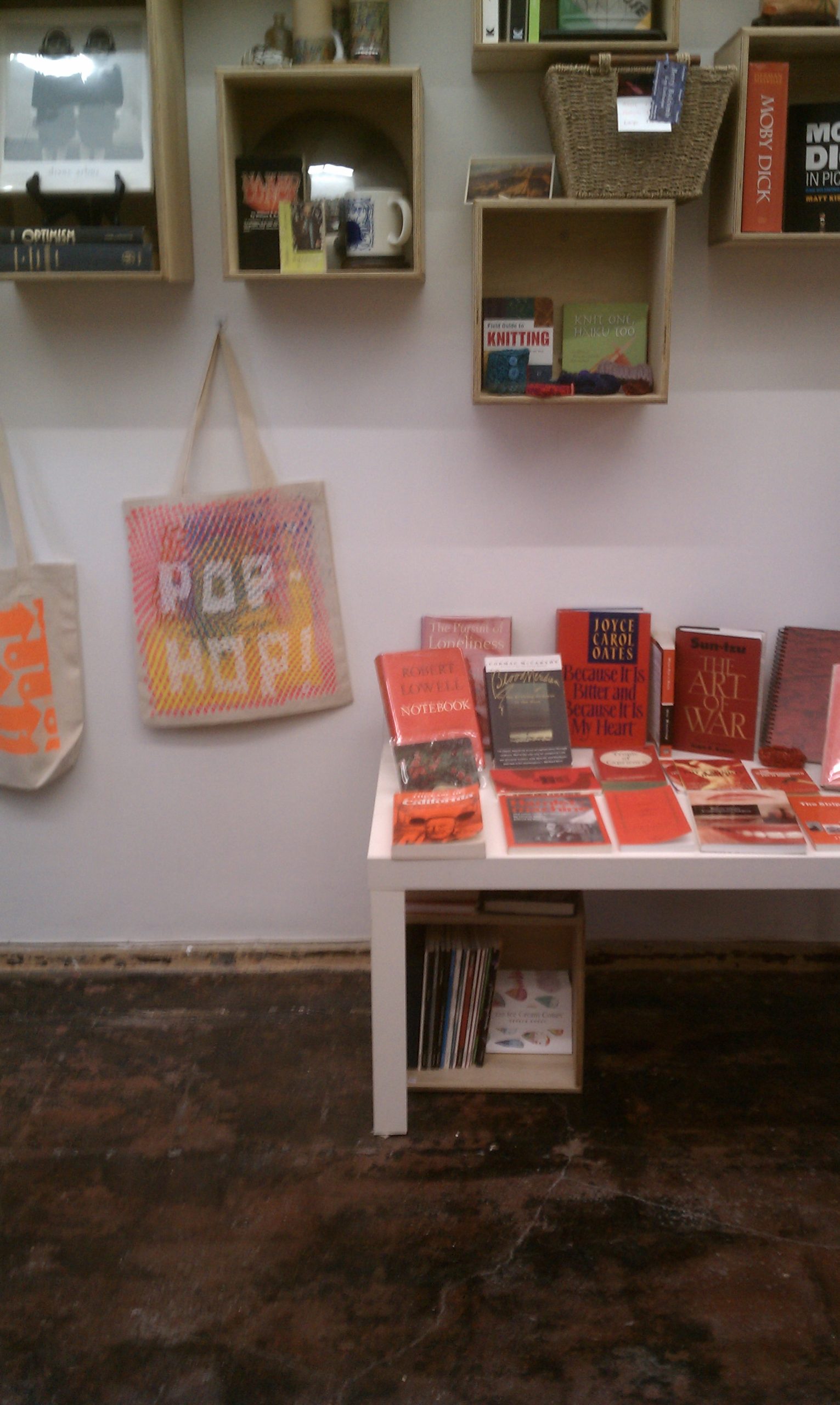
Pop-Hop: The evolution of the bookstore at its finest

As a writer and a reader there’s something I can’t/won’t/refuse to shake, and that’s a good bookstore. With the threat of e-books taking over as the popular form of publication, I tremble with rage at the thought that we might lose my favorite kind of business.

When I first moved to Los Angeles in 2008 I found it incredibly difficult to locate a good bookstore. I went so far as to follow half complete directions to a used bookstore somewhere between Malibu and some hills only to find it had been dissolved years before. Do you know that disappointment? Does it permeate your city too? I blame the Internet, I think it goes out of its way to forget bookstores still exist. I’m sure it’s intentional, and I hope someone more versed in conspiracy theory is already on this, because I don’t really have the time.

However, in spite of the Internet’s selective memory, I’ve managed to locate bookstores here and there throughout the last four years. From The Last Bookstore downtown to Iliad Bookshop in North Hollywood, the book business is hanging in there. Then there are the special places that are doing more than hanging in there, that are making their own distinct presence known by building a community, and one of those places is Pop-Hop Books & Print, “[a] bookshop, print studio & salon in the Highland Park neighborhood of Los Angeles”.

If you haven’t been to Pop-Hop yet, well shame on you, but really, you should make the trip. Recently opened in May 2012 by friends Robey Clark and Sarah Balcomb, Pop-Hop is what I dream my home library will look like someday. Sturdy shelves installed by friends line the right side of this narrow, long, and high ceilinged space. The shop gives off an air of clean and clear purpose. The white walls contrast with what might look like items from your grandmother’s attic. At first glance, to the non-bookish eye, the books and items gracing these shelves don’t seem all that special – mostly used, with a handful of newer books, and scattered lost objects. But these shelves are weighed down by something very specific. Love. Sarah loves books, you can see it in the way she has carefully chosen, organized, and alphabetized her shop, and in the little color coordinated display that lingers by the register. First editions pop up every other grab. Lovingly read books creak open to show you their unique stories and odd photos. You’ll find cookbooks, children’s stories both old and new, psychology and social science books, fiction, non-fiction, local handmade books, and maybe even something as unusual as an instruction book on the best ways to kiss a woman: titled The Art of Kissing (copyright 1936, reprinted in 1988).

This last example is why I have a particular affinity for Pop-Hop. I’m a person who will pick up old communist manifestos and books from the 1900s on how to learn Esperanto, and at Pop-Hop, Sarah displays this same affinity for the odd and rare little book. If you’re looking for a surprising read, or a gift for the book loving person in your life, Pop-Hop is the place to go.

You should also swing by if you’re looking for that yard sale item that’s escaped you, or fun handmade art by local artists. Scattered around the shelves, bits of scrap art mingle with very precious French mugs, and it’s not at all unusual to see very small screen-printing screens acting as bookends. Another aspect to the Pop-Hop shop is its screen-printing studio run by Robey. The walls are hung with bags, t-shirts, and baby clothes that were all screen-printed in house. They run weekend workshops where you can learn to screen print, or make a handmade book. Also on weekends they host story times for kids as well as readings and music performances open to the public, and participate in the NELA bi-weekly art walk. Basically their feet aren’t just wet, they’re soaked from all the activities they’ve both started and become involved with in only the first year of their existence. They’ve created an inviting open space where everyone is welcome, and they’re flourishing.

I appreciate what Pop-Hop does, that they’re helping to keep the printed book circulating and doing it with verve. Their unique and constant interaction with their neighborhood is creating a community, and a community with an appreciation for books and art. A community with this kind of appreciation isn’t going to let a place like Pop-Hop slip away in the oncoming storm of electronic books. Pop-Hop is a lesson in the adaptability of the bookstore, and it’s a lesson I hope other aspiring bookstore owners can pick up, make their own, and run with.


By Jessica Marie Felleman
an Associate Editor for Black Clock and an MFA Writing candidate at CalArts.

Monster Mashup: The Union of Books and Music

At the risk of flogging a dead horse I haven’t ridden, I’ll relay some recent news. Beyond how bad or boring (or potentially great) Fifty Shades of Grey is, inside one will find myriad references to classical composers. Or so I’ve heard. Also, I’ve read that EMI Classics, in an obviously gluttonous but altogether wise move, is releasing a reading soundtrack. Something to enjoy sonically while you relish E L James’s Twilight fan-fiction adapted book. This all got me thinking, what music do we listen to while we read?  What do we hear when reading? Does it make any difference?

When I asked my sister what she listens to while reading she responded, “I listen to the Wicked soundtrack while I’m reading Wicked. And you should listen to classical music while you’re doing the Sunday crossword puzzle because you need to listen to smarty-pants stuff for that.”

She’s a voracious e-reader. She tore through the Dragon Tattoo series in a week of lunch breaks. The Hunger Games series she finished in a weekend. All this reading in silence.

Despite her jokes, she admitted she listened to nothing while reading. I was and am baffled. Silence is nosy and distracting. But on it went. Many friends, to my surprise, read in that non-place with nothing to keep pace, no friends but the characters. Many said they didn’t read. Only some were joking.

I’m sure there are plenty of studies about children engaging their latent genius via Beethoven or something. Whatever . . . All I know is there’s no way we’re going to make it as readers in this alleged silence–full of city sounds, buses and freeway traffic, garbage collectors and arguing neighbors. And if you happen to live in the country, don’t count yourself out. What of the crickets, the wind, the mental lists of things not yet accomplished, the fears that will probably soon be realized? No. Silence is not an option.

This morning I tried pairing the instrumental tracks from Trojan’s Reggae Chill-Out box set to William H. Gass’s In the Heart of the Heart of the Country. No dice. But also, no surprise. I bounced around: Erik Satie is too somber somehow, Yann Tiersen too lively. J Dilla, just silly. So, back to the Trojan collection. And it worked, they clicked: I read. Time and/or patience are sometimes all you need.

Forcing the union canwork. Sometimes a larger contrast can be best. Perhaps too appropriately I’d been listening to Ennio Morricone’s score to Once Upon a Time in the West while hobbling through Cormac McCarthy’s Blood Meridian. Only when I needed to define ocotillo or pyracanthra or any of the other hundreds of terms and words I’d never before encountered did I notice how funny it was, sitting pajama-clad in the sun, looking up what an ignis fatuus was while that haunting harmonica clashed with the manicured lawn, the mother persuading her children into her SUV, the city-allocated outsized bins of recycling, yard waste, trash. Loud city things that almost made me give up what I thought would be the perfect mixture of music and story.

I got through it, but the whole scene, day after day, felt silly. Like I was standing in the yard ready to draw a pistol on a passing Acura. So let’s mix it up, I thought. Henry Miller’s Sexus is the first of his books that has in it no French. How vaguely funny then that I’d chose Julie Doiron’s Desormais, tonally, a terribly sad album. Seeing as how I can comprehend but a handful of French words and phrases, and Doiron’s vocals, all in French on Desormais save one English track I omitted, the typically intrusive human voice is no bother. I’ve also found this to be true with much bossa nova and more occasionally tropicalia. The mood of Desormais isn’t the mood of Sexus. It took hours of listening to Doiron’s 2001 release while reading Miller’s 1962 novel for them to wed in a way that wasn’t catching me up. And when they finally did they were inseparable. Moments away from their partner were grueling, pointless. The paranormally calm sixth track from Doiron’s album does nothing for me now.  It’s become inextricably fused with Miller’s description of the Bronx.  I’m listening to it presently.  As the especially staccato guitar intro plays I see nothing but Miller borrowing money from this or that person . . . and a man across the street whacking weeds with his weed-whacker.

This amalgamated, rhetorical relationship has both its benefits and its disadvantages. For instance, I doubt I’ll again be able to consider anything but Raskolnikov wishing his family would leave him the hell alone each time I hear “My Angel Rocks Back And Forth” from Four Tet’s 2003 album Rounds. At the same time, when I want to hear his multi-layered complaints for solitude, that’s the song I put on.  I imagine the synesthetes have something to say about all this.

Pairings I have proven to work:

  • William Gibson’s Burning Chrome and Nathan Johnson’s score to Brick
  • Kelly Link’s Stranger Things Happen and Dirty Three’s Cinder
  • Anne-Marie Kinney’s Radio Iris and Kazumasa Hashimoto’s score to Tokyo Sonata.


Some records do double duty. Cliff Martinez’s score for Drive pulled me through the cold worlds of J.G Ballard’s Crash as well as Don DeLillo’s Cosmoplis, the latter tempered with shuffled Throbbing Gristle and Whitehouse albums, but only after a few drinks. Finally, as fun or funny as you think it might be to read Poe and listen to “Monster Mash” on repeat, it isn’t. It’s stupid and you feel stupid doing it.

To read a version of this discussion in practice, from the horses’ mouths if you will, I highly suggest checking out David Gutowski’s Largehearted Boy. There you’ll find, as is stated on the site: “Book Notes, which has authors create a mixtape relating to their latest book; Note Books, where musicians I admire explore their literary side; Soundtracked, where directors and composers discuss their film’s soundtrack; and The Largehearted Boy Cross-Cultural Media Exchange Program, where authors interview musicians (and vice-versa).”

Perhaps the most relevant of these features is “Book Notes,” with participants that include Ben Ehrenreich, Ben Lerner, Blake Butler, Aimee Bender, Eileen Myles, Jeff VanderMeer, Grace Krilanovich, Rosanne Cash, Sam Lipsyte, Matthew Specktor, Brian Evenson, Amelia Gray, Veronica Gonzalez, Bret Easton Ellis, Dana Spiotta, the list goes on.

Almost everyone I’ve mentioned this concern to says, in one way or another, I should shut up and try to get some work done. Well, to them I say: yes I will. I’m sorry to have wasted your time . . .

. . . but when in doubt always put on Chopin’s Nocturnes.


By Patrick Benjamin
an Associate Editor for Black Clock and an MFA Writing candidate at CalArts.

Green Apple Books: Independent Bookstores Just Won’t Quit

The first time I walked into Green Apple Books in San Francisco, I remember thinking, “Oh yeah. This is definitely a nice bookstore.”

My tepid response was put on hold once I realized I was in the annex to the bookstore which holds merely a drop of Green Apple’s ocean of a collection. Once I entered the main building a few doors down, I was speechless–my eyes darting back and forth as I tried my best to take it in all at once.

Green Apple Books is a bibliophile’s utopia–stacked wall-to-wall with books of every genre, every size, new and used, from leather bound to hardback to paperback, and not a Starbucks counter in sight. And an even bigger surprise: the employees are knowledgeable and will go out of their way to help you. I was floored when I asked for a specific title and the attractive man with the beard, flannel shirt, and tattoos led me to a section that to me had no clear sorting system and, with the greatest of ease, plucked the one copy of my book from a seemingly impenetrable wall of words.

This is what a bookstore is supposed to be. Sure, they have sizable sections for other things like music and DVDs, but at Green Apple, the appetizers, main entrees, and desserts are the books themselves. The smell of old books on wooden shelves fills your nose as you walk over creaky floorboards. A visitor feels transported away from the vibrant activity of Clement Street and the modern world into another dimension where books are still printed on paper, the word “kindle” only refers to fire, and people love the feel of rifling through pages and having tiny gusts of wind hit their faces.

The bookstore itself is a veritable labyrinth–this is fitting, as this neighborhood bookstore has been open for 45 years. What started off in 1967 as a store of 750 square feet has grown to ten times its size according to the store’s website. The evolution of the bookstore is made evident by the fact that they provide a map for those visitors who have lost their way while perusing through fiction and have somehow found themselves in the adorably titled “Granny Smith Room” which houses books on linguistics, philosophy, and anthropology.

Within the main building they have a second floor as well as a large children’s book area, all in addition to the annex housed a couple of doors down. Continuing with the apple theme, they have a “Red Delicious Room” with books on subjects like Eastern religion and birds. On the stairways are books grouped by deliciously quirky themes like “Deep Dogs,” which has titles like The Art of Racing in the Rain, “This is What Happens When You Don’t Eat Your Vegetables” with books like Tokyo Vice, and my personal favorite “Sexy Time” with such books as She Comes First.

To say that there’s something for everyone here would be trite. But entirely true. Max Segal, a San Francisco native, tells me, “When I first came to Green Apple as a kid, I thought it was a produce market. It wasn’t until later that I realized they do actually produce something–just something entirely different than I thought.”

Green Apple Books is so much more than just a store that sells books–to describe it as such would be too impersonal. And Green Apple is anything but impersonal. It is a neighborhood landmark, a longstanding independent bookstore that survived the most recent recession, a well of knowledge and entertainment, and a source of community pride.

You can lose yourself for hours in its book-lined aisles–just make sure you bring your good credit card. Because leaving empty-handed just ain’t gonna happen.


By Bel Poblador
an Associate Editor for Black Clock and an MFA Writing candidate at CalArts. She is a Los Angeles native, a lover of San Francisco, and an advocate of all things dog-related

Tick Tock: I Wrote This For You

It was the only time I had taken a Metro-North train from Grand Central up to New Rochelle alone. It was the 4th of August 2012 (a Saturday night), and that’s when it all began.

My days in New York City were winding down fast and I was trying to comprehend how my summer had just flown by. Interning at BOMB magazine in Brooklyn for three months, as well as celebrating my 24th birthday on the Upper West Side on a rainy July day, was not something I had planned. But I’d be quite the disappointment of a Fitzgerald-worshipping, aspiring young writer if I didn’t spend at least some time being inspired in New York. Plus, Bruce, my short story instructor-slash-senior editor, is a firm believer in being young, and crazy, and just living in New York (or Paris) in your 20s.

I just never thought I’d end up falling in love with New York City.

The temperature on the train was ridiculously low, and I vaguely remember wishing I was back in Los Angeles where I could just get in my car and have complete control over the temperature instead of cursing at myself for not bringing a hoodie or a cardigan or something, when I realised I was staring at a man’s hands holding a couple of magazines. In hindsight, I must have come off as a stalker, but honestly, he was holding Black Clock #13. Our mixtape.

The only natural next step in my process of thought was to imagine Black Clock and BOMB dancing together a very elegant waltz on a pink cloud. The male lead being Black Clock in this scenario, and maybe I was onto something with BOMB magazine—being the artist’s voice since 1981—a graceful female artist that is oozing the sex appeal of Jessica Rabbit—while Black Clock is ‘singular, idiosyncratic, and a little mysterious’ since 2004 (perhaps channelling Humphrey Bogart). In true star-crossed lovers fashion, BOMB and Black Clock find themselves in each other; small, fractured pieces of their souls found in the pulse of their printed words. (New York City’s love affair with Los Angeles beautifully overcoming the distance between them).

Surely BOMB is Catherine, Maria, Padmé, Princess Diana to Black Clock’s Heathcliff, Tony, Anakin, Dodi Fayed, the difference lying in the swanlike grace of the quiet exchange that can be found in both magazines’ contributors lists. Steve Erickson, Bruce Bauman, Lynne Tillman, Jonathan Lethem, Rick Moody, Don DeLillo . . .

There is no tragic ending in this metaphor. There are, instead, stolen kisses at reading events (perhaps most notably at the McNally Jackson reading in March 2012 for Black Clock #15, where Lynne Tillman read from her piece “Two Serious Ladies: The Film” as Black Clock staff listened through the bookshelves); a quick exchange of glances via blog posts on upcoming events; even passing notes as contributors press light pecks between issues. (Or perhaps their love affair—soundtrack by Hans Zimmer—is sidetracking me.) My point being, if Black Clock had a delectable soulmate, it would be BOMB. (2,972 miles apart if we take the I-80 East from CalArts to Brooklyn.)

With the continuing trend of bookstores declining in the USA—a further 2% decrease from 30,4000 in 2011 to 29,795 in 2012—and the American Bookstores Association having 1,900 member stores (500 member stores fewer than in 2002), with eReaders on the rise, and fanfiction writers becoming  overnight sensations, my heart reverberates between two decades. Here I am, in the land where u’s have no place being next to o’s, and my favourite love story is written between the pages of two magazines that live on the two coasts. Their feelings are echoed and reflected in Editor’s Choices, in the breaths of line breaks and italics, and interviews. Where the short stories and poems that can be found in Black Clock share the same intimacy and give off the aura of BOMB’s First Proof. Where Artist on Artist interviews shine with contributors from the West Coast magazine.

Ultimately, Betsy Sussler and Steve Erickson have been transforming, pushing, and re-writing artistic and literary boundaries since 1981 and 2004, respectively, both providing readers with works of art.

So to the guy who was on that Metro-North train that night—thank you. Thank you for reminding me that a little love for the written word can go a long way.

I got off at Pelham.
 

By Eleni Demetriou
an Associate Editor for Black Clock and an MFA Writing candidate at CalArts