
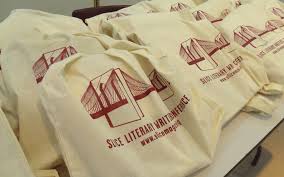
 What’s interesting about the literary scene in New York—that one distinctive thing that is so very different from the literary scene in Los Angeles—is that it will always haunt you no matter where you are. Maybe it’s the city itself, or maybe it’s the kind of people it attracts, but if you’ve ever had the (mis)fortune of living within Gotham’s walls, you can understand how you cannot escape anything on this island.
Another thing about the literary scene in New York is the curious case of Williamsburg aka Hipsterville. It seems that writers flock to New York City and settle down in Williamsburg, far, far away from Manhattan.
And far, far away from me.
Which is how, on September 7th 2013 at 8:30AM, I found myself making the forty-minute journey from the Upper West Side to Brooklyn. (One stop on the downtown 1 to 96th street, and change to the 2 (or 3) until Borough Hall.) As a Slice Magazine intern, I was making my way to the writers’ conference we were hosting. I was in charge of setting up and making sure everyone who was attending knew where they were going and what they were doing.
I listened to Tom Waits as I held Eugenides’ Middlesex throughout the entire ride, all the while giving myself a little pep talk, which largely consisted of mantras not to make a fool of myself. (Needless to say as an awkward writer, this did not go as planned as I had a little run-in with literary agent Renée Zuckerbrot and editor Calvert Morgan. But more on that later.)
I wasn’t used to literary New Yorkers; what I knew was readings at the Downtown Los Angeles Library, at Stories café in Echo Park, at Griffith Park under brilliant sunshine. I knew forty-minute-commutes in the privacy of my car, I knew palm trees and warmth. But here I was, on a mildly dreary September day in the Empire State, and all I could think of was something I had read the previous summer while interning in Brooklyn that went something like: ‘I kept on wishing I was back in Los Angeles wishing I was back in New York wishing I was back in Los Angeles.’ I wished it then, and I kind of wished it now.
Forty minutes later, I arrived at St. Francis College where the Slice Literary Writers’ Conference was taking place. Slice Magazine is the beautiful creation of Maria Gagliano and Celia Johnson. They have provided the world with a wonderful literary magazine—a magazine that has received positive reviews from the community (see Junot Diaz, for example). It “aims to bridge the gap between emerging and established authors by offering a space where both are published side by side.” They were launching their thirteenth issue after the conference at the PowerHouse Arena in Dumbo, Brooklyn.
But let’s back up a bit to the conference. The lineup consisted of extraordinary people. Agents, editors, writers, interns. Panel after panel, workshop after workshop—from 10AM to 5PM—the building swelled with all the knowledge that was being oozed out and sucked in. Having said that, it was interesting to see how business-like most of the people were. And perhaps that is something that, sometimes, writers forget. Because, after all, the publishing aspect of writing—that ugly side, the side that is not really a side in our minds but the top of a mountain we’ll get to after years of climbing and sweating and writing—is a business. It’s supply and demand, it’s marketing, it’s profit-making.
The most extraordinary example of this business, however, was when I started pointing several aspiring writers to room 3204. (Or perhaps 3042. Maybe it wasn’t even a four-digit number, but 3 was in there.) In any case, Room X was on the third floor, and in that room sat four literary agents. Four business-minded, word-loving, book-adoring individuals with an impressive list of clients. That is where I made a fool of myself in front of Renée Zuckerbrot of Zuckerbrot Literary Agency as I showed her the way to the room for the afternoon. I was so nervous and careful not to say anything stupid, I didn’t say anything at all. In the silence that surrounded us, I was very aware of the noise our footsteps made and the chatter of people around us. I scratched my mind for something to say, something witty, but all I did was keep quiet and convinced myself that Ms. Zuckerbrot probably thought I was physically inept at social conventions such as talking.
These hungry writers with completed manuscripts had 15 minutes—that’s right, fifteen; one five—to sell it. Instead of an impersonal email with a pitch that barely gets 2 minutes of attention, these people had one quarter of an hour of face-to-face time with literary moguls. I can’t say how many of those writers actually got the ‘okay’ to send them the manuscript as I was busy making sure editors and publishers knew where their panels and workshops were, but it is a true testament to Slice that it has given the literary community such a rare opportunity.
It was such an opportunity that found me talking to Calvert Morgan—Executive Editor of Harper and Editorial Director at Harper Perennial—as we walked down the corridor towards his panel. It wasn’t a moment of enlightenment, nor was it an ‘aha’ moment, but it was the sort of advice that is given to you that just sits with you for a while and warms you up as time passes. It was a simple, “there is never such a thing as just a crew member,” in reply to me saying “I’m just a crew member.” And maybe I still feel like I made a fool of myself in front of him, but at least I got a few words from Mr. Morgan that will probably haunt me for the rest of my life.
By Eleni Demetriou
A Greek-Cypriot fiction writer who fell in love with New York City after living in Los Angeles for two years.
