
Photo by Deirdre Brinlee
Brace yourself, for the book I am about to discuss may be beneath Black Clock’s usual literary standards. Though Poppy Z. Brite’s 1992 novel Lost Souls may not be as high as the penciled brows of its many gothic readers, I feel that it deserves a bit of critical attention, even if only as a vehicle to sort out my own tenuous attraction to it.
I must begin by saying that I don’t get to do a lot of “frivolous” reading. One of my most influential professors in college, Dr. Rachel Crawford, put forth the motto: “read promiscuously.” While purposefully embracing its sexual connotations, she meant it in its most literal sense, to read indiscriminately, to absorb all that is available. Though I wished to follow this approach, I felt unable to abide. Not because I was so excessively busy or because I devoted my attention to only the most acclaimed classics, but because, simply and tragically, I am just a slow reader. You might say that’s not a bad thing, that it means I savor the words and let them flourish into images rather than merely speeding through information. And to a certain extent, this is true. But I am actually clinically slow, diagnosed with a processing disability that has me reading about three times slower than “normal.” (Note, the quotes around “normal” are important. Normal is relative, and I do not mean to imply that you, the reader, must be normal simply because you are not me.) So, when I decide on a book to read, it is a serious commitment. I made this commitment to the debatably deserving novel at the behest of my boyfriend, who had read it in the mid-’90s, in the throes of his ultra-goth youth. While Lost Souls may not hold a place in the pantheon of critically lauded literature, Poppy Z. Brite does hold a role as something of a modern gothic cult figure. And thus seemed worthy enough of my attention.
It is hard to discuss New Orleans vampire fiction (which is exactly what Lost Souls is) without mention of Anne Rice, and with her Interview with the Vampire series having been published almost two decades before Lost Souls, it might be easy to snidely assume that Brite was merely riding Rice’s velvet coattails. However, New Orleans vampire lore predates both authors by, oh, a couple centuries, and both authors claim this unique city as home. So while it may be fair to say that Rice blazed a pulpy trail, I am of the belief that there is little thieving going on here.
Brite’s story anchors itself in modern (well, ’90s goth) subculture, teenage longings, and the search for identity–insofar as it can be found by hedonistic whim. The first half of the novel consists of vignette-style chapters featuring clusters of characters scattered across the American south, until they all converge in New Orleans to begin a decadent downward spiral. At the center of this spiral is a boy named Nothing, who embodies the most basic of misfit teenage fantasies: unable to relate to his family or even his alternative and sexually explorative friends, he finds out that he is not only adopted, but perhaps something other than human. His quest to uncover his true identity begins–as seems realistic for an aimless yet musically obsessed teenager–when he leaves his hometown in search of an obscure band to whom he feels a connection, called Lost Souls?. On his hitchhiking course toward the band members, he is intercepted by three captivating creatures who lure him eagerly into their dingy yet intoxicating van. These vagabond vampires spend their days carousing in their van, drinking blood and booze and eating substanceless sweets. The head of the triumvirate is petite, androgynous, and deliciously charismatic Zillah, flanked by his flunkies Twig and Molochai, who are really more like interchangeable props than actual characters. If there are any outside comparisons to be made, I would say that Brite’s creation would resemble an X-rated The Lost Boys (1987) with a Bowie and Bauhaus soundtrack.
Lost Souls is not plot-heavy by any stretch of anything, and with many tangents of sex and violence, sometimes reads as if it comes with its own built-in fan fiction. However, I do not think these are necessarily failures on the author’s part. Whether intentional or not, this near-plotlessness reflects the necessary aimlessness that stems from the combination of a lost teenager and thoroughly un-obligated immortals. When their myriad wanderings culminate in an unsurprising bloodbath, there is little catharsis despite Oedipal allusions. Amorality reigns from start to finish.
Every vampire tale contains slightly different mythology, and the Lost Souls vampires are rather unique. Unlike most characters of their kind, these vampires are a race of their own, rather than the result of some kind of supernatural blood-born pathogen. Humans cannot be turned, but they can be impregnated. However, when a vampire baby is born, it is of a gory process that inevitably kills the mother, whether she is human or vampire. Evolutionarily speaking, this could account for the extreme lack of women in the novel; The only two noteworthy human women never meet, and die of the aforementioned cause. The one female vampire exists only in a second hand flashback, and suffers the same fate. Though Lost Souls utterly fails the Bechdel Test, I’m not as wary of this as I could be. Perhaps it’s because all of the men are fucking each other via graphic and surprisingly elegant prose.
Perhaps author and text should be kept separate for text’s integrity, but I feel that isn’t the case here (debatable integrity of the text aside). In recent years, Brite has made a transition not only in writing, but in identity. Poppy Z. Brite is now Billy Martin, and uses masculine pronouns. Writing this article has posed an interesting case of what I am going to refer to as genderqueer timetravel. Initially, I wondered if it would seem disrespectful to refer to him as “her” and even as “Poppy Z. Brite,” especially since he has always been infamous for identifying as a gay man in a woman’s body–which for many years was only taken at camp value. Brite/Martin has always clearly had an investment in the fluidity of gender and sexuality, which is evidenced by the writing on his personal website, though the bio has not been updated since 2004. I expect that this fluidity (A.K.A. “genderqueer timetravel”) in my own writing of this piece, as opposed to retrospective pronoun alteration, would feel appropriate and not dismissive. The big red letters on the cover of the novel read Poppy Z. Brite, which essentially brands the novel as a product of one point in its author’s life.
Upon the publication of Lost Souls in 1992, Brite was only 24 years old. This was her first full-length novel, and already it had gained the endorsement of Stephen King. Coincidentally, I happened to be the same age upon reading it. Despite the arbitrary connection that this evoked, I couldn’t help but wish I were younger. Out of curiosity about its reception by the public, I began reading book reviews on Amazon and Goodreads.com and was surprised to find an overwhelming consensus: when read by teenagers, the book was breathtaking, engrossing, titillating. But most of these reviews are by adults reflecting upon this, many who say they have been tempted to reread the book in recent years, but have decided against it, for fear of ruining the memory. Or rather, not so much out of a fear that it might be, but a knowledge that it will be, ruined. Interestingly, this is precisely how I feel about Anne Rice, having read her novels at fourteen. I even remember underlining sentences that I would like to emulate in my own writing–though as a now allegedly-adult writer, I do not write fiction. But I could easily see a text like Brite’s coming out of someone of comparable age in my own MFA writing program, though it would be a marked (and perhaps easier to market) difference from the poetic non-fiction weirdness that myself and many of my colleagues spend our time on. Must it be bad that a work by such a young person might be better suited for even younger people? I think not, especially because this shift in audience is not due to a lack of sincere and innovative prose, but rather because of a certain kind of escape fantasy suffused with shock value.
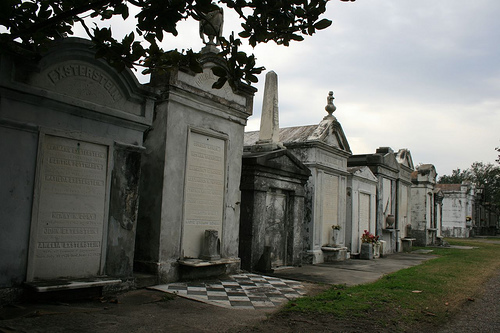
My own relationship to the book consists of a strange combination of defense, dismissal, and affinity. I must admit that the latter may be more circumstantial than anything to do with artistic integrity. When I started the book, I had just returned from my first ever trip to New Orleans, after two of my friends moved there. Reading the book at this opportune time allowed for a kind of mental re-tourism, rather than blindly following a literary tour of a mythic city so often associated with vampires and a living-legendary level of public drunkenness. And it is not that Brite is not competent enough to lead this tour; having been there just adds a seemingly necessary visceral element to a text that capitalizes on the visceral. If you are a normal human who absorbs bestsellers at the rate of a couple of weeks a pop, I say, hey, why not give Lost Souls a shot. But having lingered with Poppy, Nothing, Zillah, friends, and foes for a couple of months, I am not exaggerating to say that I feel I have made a terrible new group of friends–the pretty kind that you are drawn to at a club, but have little else going for them. Truth be told, I have no regrets.
By Vesta Seltzer
an Editorial Assistant for Black Clock and an MFA Writing candidate at CalArts
